Be Angry and Sin Not—Yeah, But How?

Image

What I saw in my kitchen this morning made me instantly angry, and I most certainly would have sinned, again, if I had not been meditating for the past two days on the Apostle Paul’s instructions to “Be angry and sin not” (Eph. 4:26).

The puppies tore up my rug, again, the one I had just fixed with duct tape (don’t laugh); and their water and food dish was empty, again, showing that my husband had shirked his duties for these puppies he wanted, again.

As I sat stewing at my dining room table, contemplating what to do with this welling anger (magnified greatly by past-due pregnancy hormones), I stroked my Bible. This was supposed to be my morning devotion time, but I was tempted to wake my husband and yell at him: “See what they did? You clean it up. See their empty food and water dishes? You fill them.”

I was also ravenously hungry by this point, and getting angry, yet again, that Buc has never in nine months of pregnancy made it a priority to get up and eat breakfast with me on the weekends. He always has to shower first and look at his news, which seems extremely selfish when I’m about to pass out. Because he won’t rearrange his routine, we miss eating breakfast together—because often I just can’t wait.

Anyway, this morning I had a decision to make. Was I going to pause and pray, or just react? Because I’d been mulling over Ephesians 4 for the last two days, I heard these words in my mind: “Be angry and sin not.” “Forgive others as Jesus forgave you.” “Speak only words that will encourage others, not tear down.” I also remembered an anecdote I’d just read about how Abraham Lincoln once advised a general to deal with his anger at a colleague. To summarize, Lincoln told his general:

Write a letter to that man in all honesty, in all nastiness, to express your feelings.

But…

When you are done with the letter, DO NOT send it. Reread it to yourself, then burn it. Now, write a new letter.

While my first impulse was not to pause and pray, or to write a letter, I asked Jesus for strength to overcome my instincts, my unreasoning hunger, and my prego hormones. And then I popped in a toaster strudel to tide my appetite, and pulled out a clean sheet of paper.

“To my husband,” I began. “I am very angry at you right now…” From there I quickly filled up the front and back. I could have gone on, but interestingly, part of my letter ended up detailing my own faults. Trying to see things from Buc’s perspective, I found myself writing things like, “I know you would tell I am too easy on the puppies, letting them get away with ruining my stuff, and how will I discipline a child if I can’t even handle dogs? Maybe you’re right; I just wish you could appreciate how damn hard this is for me. I’m not good at discipline.”

I paused for a moment, considering how small this morning’s events really were in comparison to life’s bigger mysteries—such as my son’s impending birth—realizing how sad it would be to ruin a morning just for the chewed up rug and empty water dish. And then, remembering what I’ve learned about fruits and roots, I wrote: “Maybe a root of this anger is that I feel unappreciated and disrespected. I feel you don’t understand how hard certain things are for me [like disciplining the dogs] or how important other things are [like breakfast on demand]. I just wish you would try to see things from my perspective and not brush off these things that are a big deal to me.”

By the end of two pages, I felt less volatile, but I still didn’t trust myself to speak in love. Remembering a tip from Dr. Laura’s The Proper Care and Feeding of Marriage, I pulled out a second clean sheet of paper. (The basic premise of Dr. Laura’s book is to kill your spouse with kindness—actively love him or her so much through words and deeds that he or she can’t help but respond in kind.)

ImageNow, I listed all the GOOD things about my hubby I could think of. Blinded as I was by my anger, I needed to remember that my husband wasn’t intentionally annoying me; and I knew that compared with all his good traits, this little issue would fade.

After I wrote for that one page (why is it so much easier to write bad than good?), I cracked open my Bible and reread Ephesians 4 in The Message version (yesterday I read the NIV), and then I went on to Ephesians 5 for good measure. Very funny, God. Chapter 5 is the one about wives submitting to their husbands. In my reading, which took no more than ten minutes, I was reminded of these key ideas:

1. Because I have been reborn, I can rely on Jesus’ blood and breath flowing through me, and Jesus’ love for my husband. I don’t have to rely on my own strength anymore.

2. Also because I have been reborn, God wants me to be mature, not childish anymore (Eph. 4:14-16; 21-24). How mature is it (I had to ask myself) to make a fuss over a torn rug and an empty water dish, or my empty stomach?

3. “Go ahead and be angry. You do well to be angry—but don’t use your anger as fuel for revenge. And don’t stay angry. Don’t go to bed angry. Don’t give the Devil that kind of foothold in your life” (Eph. 4:26-27).

4. “Make a clean break with all cutting, backbiting, profane talk. Be gentle with one another, sensitive. Forgive one another [husbands included] as quickly and as thoroughly as God in Christ forgave you” (Eph. 4:31-32). What a tall order this was! But compared to Christ, who forgave those who tortured and murdered him, what did I have to complain about?

5. “Figure out what will please Christ and then do it!” (Eph. 5:10). I was pretty sure it wouldn’t please Christ for me to explode at my husband or skip my morning devotional. I was also starting to feel that it would please Christ for me to, once and for all, admit that these frustrations with our puppies are largely due to me not preventing bad behavior I could, actually prevent. I figured it would please Christ for me to finally just deal with the problem so it wouldn’t waste any more of my time or energy. I resolved to submit to my husband’s good counsel (Eph. 5:21-28) and start being more assertive with the dogs, and not let them sleep in the main areas of the house anymore (we have a laundry room that will do as well) so as to avoid these unpleasant morning surprises.

When Buc sauntered into the kitchen, eyes widening at the fluff strewn all across the tile (I hadn’t had energy to clean it yet), I was just finishing my three-part anti-anger plan, and I had no desire to yell at him anymore. I also didn’t feel much like talking (which is sometimes the best recourse when you can’t say anything nice), so I left the list of good traits on the table and threw the nasty letter (ripped to pieces) in the trash. I went to take a shower, after which I started scrubbing the bathroom tile. Better to give myself lots of distance from the temptation to sin. After awhile, Buc approached me, and he lit up my day with three statements:

1. “Do you want to eat breakfast together?” (Yes, I did.)

2. “I found that list you wrote about me, and I know you’re mad at me, because you don’t write those good things when you’re not. But I appreciate the list, and I love you. And I cleaned up the dogs’ mess.” (I was gratified that he’d found the loving list, and he knew without me telling him that I was angry. I was also reproved by the fact that he thinks I don’t write good things about him unless I’m angry—something for me to work on.)

3. “I’m going to get cracking on organizing my closet and my gun supplies” (something I’ve wanted him to do for the last few weeks). “I appreciate you honey, and how you keep me organized.” (This made me feel especially good, because it told me he has noticed the extra efforts I’ve been putting in to get ready for our baby. I was also softened to see that Dr. Laura’s advice was working: I had chosen to be kind to him, and he chose to be kind back.)

Readers, this may seem a long post to recount a silly could-have-been spat this morning, but don’t take lightly how important these small moments of life really are. I believe our lives are made up of these small moments, these small choices (to yell or to pray, to speak kindly or to criticize) and they are the stuff our characters are made of in the end. One “silly” spat can ruin a whole day, just as the choice to submit to God in something as simple as pausing to pray (or to read, or to write a “fake” letter) can set off a full day’s worth of kind words and deeds.

I wrote this post for myself, to remind myself how important it is not to skip my daily time with God, but I hope I have reminded you of the same thing. Even born-again Christians need to be recalibrated on a daily basis.


My Ugly, Messy Rebirth Story: Conclusion

After giving my life to God, I was always on the lookout for tools to share my faith. I didn’t feel I was particularly good at this part of the Christian life, and I thought it was because I hadn’t yet found the right method. Enter Paul Coneff and The Hidden Half of the Gospel.

Paul  conducted a week of prayer at my church in the spring of 2012, and after just the first night, I knew his message was special: I sensed it might even be the missing link in my life and ministry, this “hidden half” of Jesus’ story. So, what was it? And how, if I’d been in church almost my entire life, had I missed it?

Lindsey HH Cover MasterThe Hidden Half of the Gospel

Paul began his presentation with a question: “What did Jesus do more of while on this earth: Teaching or healing?”

Healing was the obvious answer. Then Paul asked, “Why have we [churches and Christians] reversed Jesus’ model of ministry? Why do we do more teaching than healing, when he did more healing than teaching?”

He continued, “Now let’s say that I am sitting in my office and I am studying for a sermon. Some church member comes in and says, ‘I have been struggling with guilt and shame from an abortion.’ Is it easier to turn to that messiness and brokenness of her life, or is it easier to do a Bible study on the character of God? Give her some scriptures on forgiveness and say, ‘You know God has forgiven you,’ pray with her a thirty-second prayer, and walk away. Which is easier?”

His point? Many churches, and Christians, don’t know how to handle messy problems like this one (other common examples being pornography addiction, abuse, eating disorders, infidelity, and cutting ), so we don’t–meaning we don’t offer the help so many people need. He went on to prove his point with a concept he calls the “cycle of sin-and-forgiveness.” Many Christians come into the church and get forgiveness for their sins, only to fall back into their patterns of sin. Then they ask for forgiveness, but continue to sin, again and again and again. (In my own experience of praying with women, I’ve also seen a pattern of wallowing in guilt over past sins that the person is no longer committing.) Paul continued. “Why is it that so many Christians who have accepted the ‘good news’ of Christ still are not free?”

family-fighting
Photo Credit: Peacefulparenting.com

I was riveted. Exactly! I said to myself, remembering how my parents had been wooed into the church with lots of good information and had gotten baptized, only to leave our family scattered and scarred by an affair and divorce (see parts 1, 2, and 3).

For the first time, I saw my problems standing stark naked in church, and I was desperate to know: How can the church address these issues?

The Hidden Half of the Gospel is how Paul addressed them. This is a message I would come to know well when Paul later asked me to cowrite his book of the same title.

Two Pillars

There are two pillars to The Hidden Half:

lies
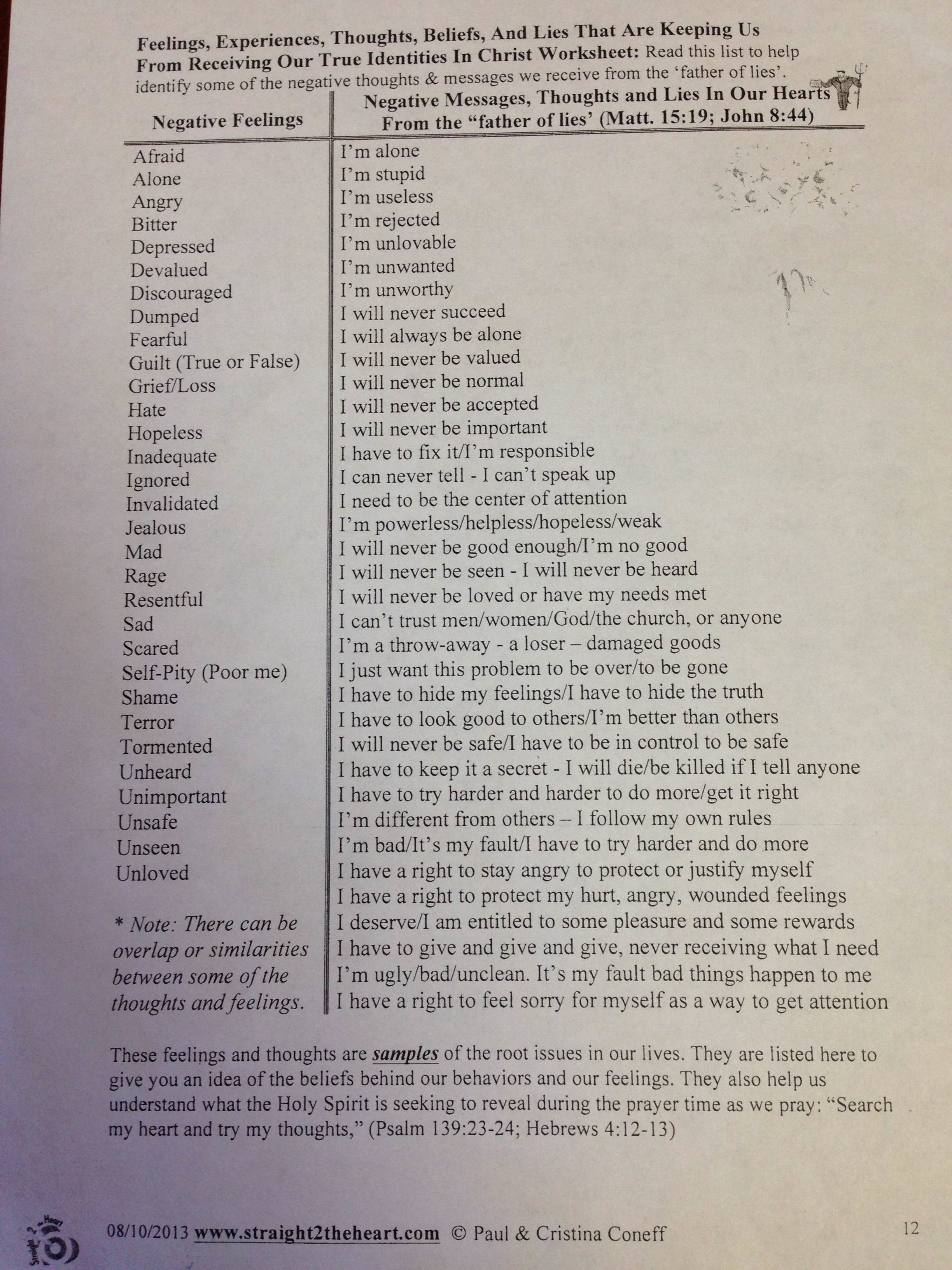
Here is a worksheet that can help you identify the lies Satan may be planting in your mind. I was able to recognize which lies applied to me because they were “thoughts” that ran through my head on a regular basis.

1. The root of our sin and suffering is Satan, the father of lies (John 8:44). This concept of roots is huge in Paul’s ministry. As Paul explained, all our negative behaviors and patterns are merely fruits of deep-seeded roots, or lies, planted by Satan. We cannot fix the fruits unless we first attack the roots. Thus, healing begins by identifying the Satanic lies driving our behavior. Once we know the roots, or the lies, we can take those to Jesus and let him deal with them, which leads to pillar 2.

2. The root of our healing and freedom is Jesus, our Suffering Messiah (Luke 9:22; Rev. 5:5; Col. 2:15; Isa. 53). The suffering of Jesus is the crux of The Hidden Half of the Gospel, and the key to our healing.

As Paul explained, many churches have overlooked this crucial aspect of Jesus’ gospel, instead choosing to focus on Jesus’ death and resurrection. The death and resurrection take care of forgiveness of sins, but often merely believing in and accepting these concepts doesn’t resolve suffering, or the cycle of sin-and-forgiveness. Putting “suffering” back into the definition of the gospel, as Jesus explained it to his disciples (see Luke 9:22), offers hope to those of us stuck in suffering—depression, abuse, addiction, etc.—because it means Jesus didn’t just nail our sins to the cross, but he also nailed our suffering there, as well. The Bible tells us Jesus “suffered and was tempted in every way” that we are tempted, to offer us help when we suffer and are tempted (Heb. 2:17-18; 4:14-16).

Why Jesus Had to Suffer

Photo from http://trutheran.blogspot.com/2012/10/the-burdens-of-sin-and-suffering.html

“Have you ever thought about why Jesus’ story had to be so gory?” Paul asked the audience.

I really hadn’t.

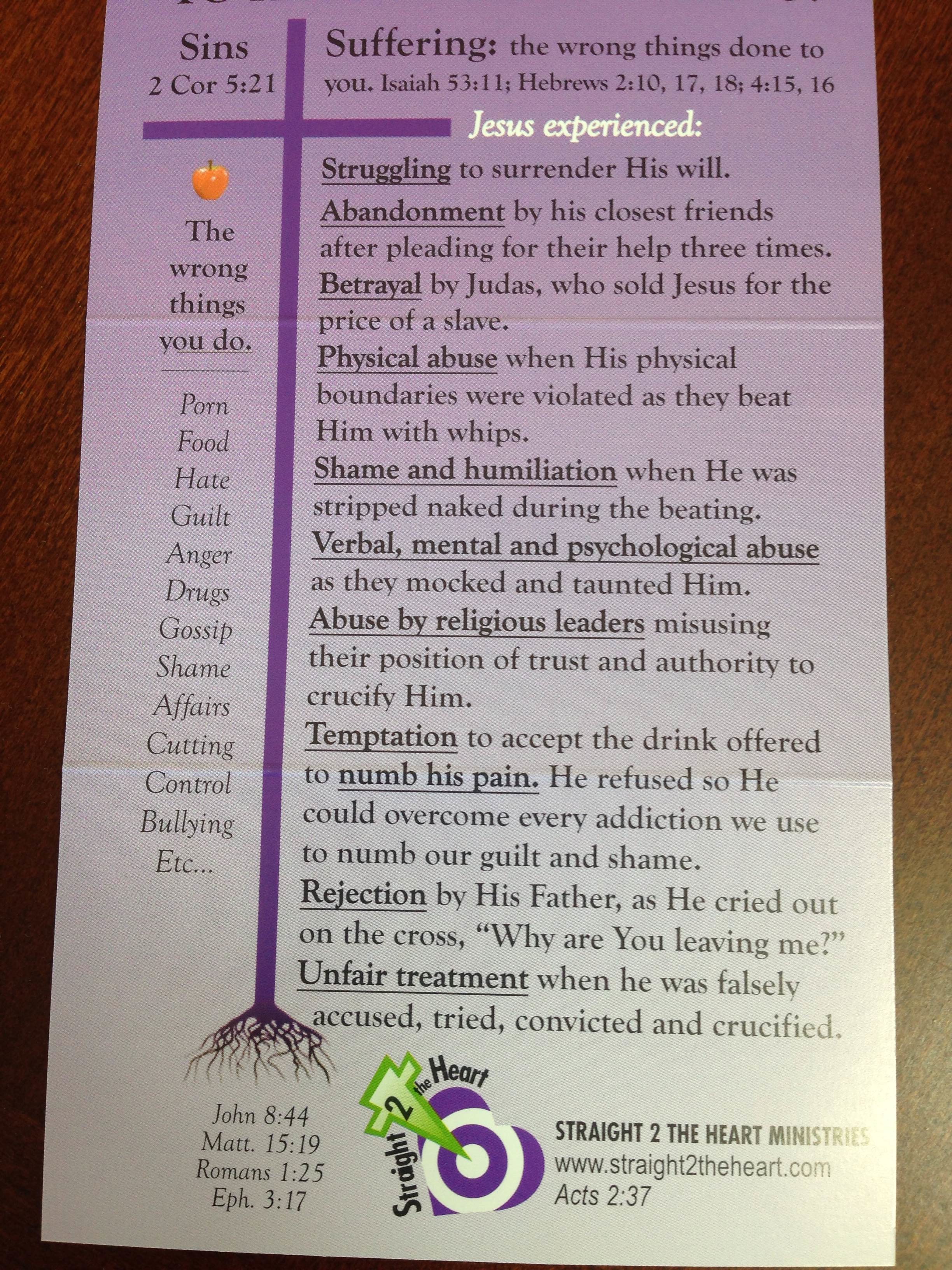
“Well, think about it.” Paul continued. “Jesus was abandoned; betrayed; physically violated; shamed and humiliated; and verbally, mentally, emotionally, and physically abused. Now, do you think He understands the pain that abuse victims feel? Does He understand when a parent abandons a child? Was He ever tempted to numb His pain?

“He suffered all these things and more so He could identify with us. So that he could understand every way we are sinned against, and every form of self-protection we develop in order to numb our pain.

Here is a list of some of the experiences Jesus went through (from the prayer card used during Straight 2 the Heart prayer sessions).

“What’s more, he suffered these temptations  and triumphed over them, which means that when we take time to connect our stories with Jesus, to pray and meditate on what it means that he suffered for us, and became sin for us, we can experience his victory.”

By this time, I was hooked. I wanted this in my life. I wanted a ministry that was relevant to the suffering I’d experienced, and that which I saw all around me.

So I signed on for Paul’s seven-phase, thirteen-week discipleship program. That’s right. A thirteen-week program. This wasn’t any “quick fix.” It was going to be an intense period of praying on a consistent basis, first for myself (to get more healing in my own life before I was expected to pass it on–a requirement of Straight 2 the Heart Ministries) and then for others. I was going to learn at the feet of Jesus (and the seat of Paul Coneff) for an extended period of time, sort of like the first disciples, before I set out to make more disciples.

Discipleship, Small-Group Style

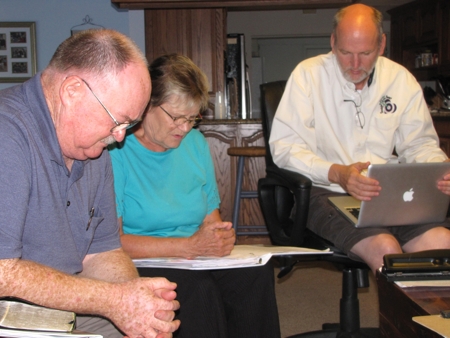
Paul (right) training Mary to lead Charles through prayer.
Paul Coneff (right) training Mary to lead Charles through prayer.

Paul spent the next four months with five of us, discipling us—praying with us, and training us to pray with others. And not quick, clean, thirty-second prayers. These were deep, messy prayer sessions that first asked Jesus to identify our negative roots, and then helped us connect our stories to Jesus’ story. It didn’t end there. We delved deeper, praying, “Lord, what else do you want me to know about these roots in my life? What blessings or barriers are there in these areas?” The prayers were recursive, connecting our stories to Jesus, then having us stop and listen to the Holy Spirit so he could take us one layer deeper into our negative roots. Always, by the end of the prayer sessions, which dredged up long-buried hurts and often tears, Jesus revealed blessings, too. He always brought to mind His promises to combat the negative roots our praying was churning up.

Our training ended, with the goal being that we would start more small groups in our church, beginning with a few men and women, hopefully to grow as disciples multiplied.

My Gateway to New Life at Home, at Work, and in Ministry

My life intersected with Paul Coneff’s message and ministry, Straight 2 the Heart, when I was at a crossroads in my life. I was coming up against the age of thirty, and was finding that pursuing my “chosen” path, graduate school to become a professor, was leaving me feeling empty. Here’s a summary of how God has since rerouted my plans through this life-changing prayer ministry.

Facing Remaining Negative Roots

tree roots
Photo Credit: “Exposed Tree Roots” by Colin Brough

First, Straight 2 the Heart has helped me to be honest about areas in my life that weren’t all healed yet (some of which are still in progress) such as:

  • Anger at the premature loss of my childhood family and, well, my childhood.
  • Resentment at my husband’s happy family (and any happy family).
  • Disillusionment with my church and religion because it “did not help me” in my time of crisis. Straight 2 the Heart helped me to see that my church didn’t help me because it didn’t know how—also, because I didn’t let them know I needed help in the first place. (It also provided the answer for how churches can help, when they have the right tools.)
  • My pattern of trying to control my life in my own strength so it would never get out of control again (or my attempts to never repeat my past depression, suicide attempts, broken family, etc., through over-planning, becoming over-busy, and more).
  • My avoidance of having kids out of the above need to maintain control.

Gaining Deeper Healing 

Second, Straight 2 the Heart has led to more healing for those negative roots in these ways:

  • The decision to let go of the “safe,” but wrong career path of academia.
  • The decision to finally pursue the identity God has for me, which has translated into sharing my story through writing and even teaching. This blog, my memoir-in-progress, and Paul’s and my forthcoming book, The Hidden Half of the Gospel, are all examples of me sharing my story for God’s glory.
  • The decision to have a baby.DSC_7783
  • The decision to be honest with other women, to reach out and accept relationships I had avoided but desperately needed (See my post “Friends in High Places”)
  • I am gaining more appreciation for my church as I look past its flaws (every church has flaws) and see the human beings there. Since deciding to be vulnerable with my own story, I’ve connected with many of these dear people in meaningful ways.  I am getting the authentic “fellowship of believers” experience I missed as a child, when my family was intent on covering up its problems.

Taking the Next Step in Ministry

S2Hlogo
Photo Credit: Cristina Coneff

Third, Straight 2 the Heart has helped me learn how to have a really relevant ministry, or how to help others who are stuck in negative places and patterns like those I’ve suffered. (It is through making Jesus’ gospel relevant to the everyday struggles of life—boldly connecting our messiness to Jesus Christ’s suffering and his full gospel to “heal the brokenhearted and set the captives free.”)

  • My partner in prayer ministry, Amanda, and I, prayed two new young women (now dear friends) through the thirteen-week prayer process, which helped lead them to lots of healing—and baptisms in our church!
  • Amanda and I also trained women at a neighboring church to facilitate the same thirteen-week prayer and discipleship process in their congregation.
  • With the help of Amanda and Mary, our other cohort from our initial 13-week training, I facilitated a third prayer group, consisting of around ten ladies, in my home for several months last fall. This group resulted in amazing healing for many of these women (for marital, parental, and other common problems) as well as facilitating much needed connection between these lovely, but often isolated church ladies.
  • Now I am working on rendering the miracles we saw in these women willing to be honest with one another and with God into the closing scenes for my memoir. I want my story to testify to how one changed life can ripple out to other lives, and still more lives from there. This is what discipleship is all about.

Now, what I’ve left out of my rebirth story (and there’s lots I’ve left out), I am working on telling in my memoir. Why did I call this my “ugly, messy” rebirth story? If you consider a real birth (and I’ve been considering it a lot lately), it’s a messy process. It’s no small thing when a new physical life is created—and the same is true for a new spiritual life. The creation of a life, and the re-creation of a life, are not simple or easy processes. At times they are painful, ugly, and messy—but to get to the birth, or the rebirth, they are necessary. That’s why I have unapologetically included the ugliness and messiness in my story—along with its beauty. Without either, my story would be incomplete.

 Read part 1      Read part 2      Read part 3     Read part 4      Read Part 5    Read Part 6

To read more about The Hidden Half of the Gospel, see the following articles Paul and I wrote on the subject:

“The Fruit and Root of Freedom from Addictions” Part 1

“The Fruit and Root of Freedom from Addictions” Part 2

To schedule Paul to speak at your church or to facilitate a discipleship group, contact him at www.straight2theheart.com.

And if you want to get a copy of our book, The Hidden Half of the Gospel: How His Suffering Can Heal Yours, follow this blog to be notified later this spring when the book is published!

Waiting for Baby, and a Blog Anniversary

Baby Sam's 3D Sonogram from October 31, 2013
Baby Sam’s 3D Sonogram from October 31, 2013

I am interrupting my rebirth series to record these moments: waiting to go into labor and, as WordPress has informed me, my blog’s one-year anniversary.

I haven’t blogged much about my pregnancy. I’ve kind of gone underground in the last month on the whole thing, here and on Facebook. I keep getting text messages asking, “Is he coming yet?” I have some very anxious family members who “can’t wait” until he’s here. In fact, judging by my lack of comment on the topic, they seem even more excited than I am. What gives?

Fear

One thing that has kept me from writing on the topic is fear. Baby Sam is not here yet, and labor and delivery is a risky thing. Not to mention that newborns are pretty fragile. When I used to talk about having kids, as I prefer to do with most things, I focused on cerebral concepts (parenting philosophies), not materialistic details (car seats, breast pumps, umbilical cord care, ec.). Now, with my due date less than a week away, all I can think of is the details—and I feel overwhelmed.

Yes, I’ve read a good deal on pregnancy and newborn care, and I’ve been working every day to ready my house—“nesting,” I think it’s called—but these activities have not really made me feel better. Every day lately I have been faced with the fact that I lack practice and know-how for the material details of life. I feel suddenly estranged from those things that have recently defined me—teaching, writing, leading (various church groups)—and it’s a scary feeling. Rather than burden the blogosphere with my worries, like the Virgin Mary, I decided to ponder these things in my heart. (I wonder if she worried about breaking her baby?)

Respect

Another reason I’ve avoided too much “baby talk” is out of respect for the women I know who are struggling with infertility. It seems unfair that I get to have this experience and they don’t. I feel like it’s even more unfair because I haven’t always wanted children. Some women know their entire lives that they want children, while I spent most of my twenties denying the desire. Shouldn’t the women who’ve always wanted kids be entitled to them, first? On the other hand, is it because my heart was so hard in this area that God decided I needed them (and the other ladies could go without)? (Or another thought: Was I formerly in denial?)

It’s probably not a comfort to the ladies struggling with this issue, but I make sense of their infertility like this: these ladies are already healthy in this area, this natural desire to nurture. I wasn’t. Maybe those hard-hearted of us (and overly cerebral, egg-head-ish types) need children more than the already well-adjusted, family types. I’ve thought about this a lot, and I’ve debated posting that hypothesis, scared I would offend or minimize someone’s pain. I’d be curious to get your thoughts in the comments. I don’t understand God’s ways, except I believe he allows bad things (like infertility) to happen, he doesn’t cause them.

Exhaustion

A final reason for not blogging about baby is that I’m exhausted right now. My body is exhausted from carrying the little dude, and my mind is exhausted trying to wrap itself around how my life is going to change when he comes. With limited energy, it seemed smart to use the little I had to get things ready as much as possible during these last days, materially speaking.

In Conclusion…

The Three of Us
The Three of Us

I know it doesn’t sound like it, but I am very excited for baby Sam to arrive! I recently had my first “good” dream of his birth: he was cute, had a full head of hair, and he looked like my hubby—all things I expect, after seeing our 3D sonogram. I’ve imagined holding him in my arms and I want to cry for happiness. I smile at the thought of the three of us becoming a family. I long to inhale his baby scent and feel his smooth skin. I look forward to slowing down and becoming less mechanical and more of a person. I praise God for blessing me with a baby—and I will strive to be a good steward of what God has given me.

Perhaps the most comforting thought amidst these last-minute hormones and unknowns is the knowledge that Sam isn’t really mine—he is a gift on loan from God—and God is the only one who can sustain him. It’s not up to me to be a perfect mother; I’ll just do my best to follow God’s lead.

On that note, it should be an interesting second year on this blog, full of many firsts and, I’m sure, many mistakes—but always lots of learning and growth. Here’s to one good year behind me, and an exciting year ahead!


My Ugly, Messy Rebirth Story, Part 6

Photo Credit: "Friends Talking" by Lusi
Photo Credit: “Friends Talking” by Lusi

One surefire way to tell you’ve been “reborn” is the desire to share your faith with others. On the other hand, if the idea of “sharing your faith” turns you off or even terrifies you, that’s a good sign you haven’t been reborn. For most of my life, born “Christian” though I was, that was my experience: I didn’t know what to share, and I didn’t know how.

After my “Damascus Road Year” (see part 5), for the first time in my adult life, I had abiding joy and peace, which led to faith. Finally, I had something to share. Now, I just had to figure out how to share it.

In the four years since my conversion, I’ve decided we born-again Christians can share our faith in two ways: implicitly, and explicitly.

Sharing Faith Implicitly

First, we can share our faith implicitly by living out our new identities in Christ. If we’ve truly been reborn, then our daily lives—our habits, our behaviors, our interactions with others—will naturally witness to Jesus Christ, because we will be emulating him. If we are following Jesus, we will not be living like the rest of the world, and people will take notice.

For example, after my conversion, my public high school students started to ask me questions about my faith, even advice about faith-related matters: “Why don’t you drink?” “Why do you go to church on Saturday?” “What do you think about marriage?” “How can I make my boyfriend see that prayer is an important part of the Christian life?” These questions came without me explicitly stating my beliefs—but I didn’t need to, because my behavior showed me to be different from most of the other teachers.

Sharing Faith Explicitly

Second, we can share our faith explicitly in a variety of ways, depending on our personalities. Note: This form of sharing does not come in a “one-size-fits-all” box. Unfortunately, some churches, preachers, and Bible teachers, try to make us feel like witnessing should look the same for everyone, thereby making some of us (i.e., those of us who don’t fit the traditional mold) feel like failures before we’ve even begun.

Two years prior to my conversion, I was the victim of one such discipleship training that was intended to prepare me to give Bible studies at the end of eight weeks. But after eight weeks, I was no more ready to give Bible studies than I’d been at the beginning, for two reasons. One: I hadn’t yet met the Lord personally (though I was active in my church and looked “good” on the outside), and two: the type of ministry wasn’t right for me.

The first fatal flaw of the training was that it didn’t show me how to have a personal experience with Christ before asking me to spread that experience to others. To its credit, the training frontloaded the concept of preparing our hearts for ministry. The speaker said we should deal with our own baggage before we try to minister to others—but she didn’t really explain or model how, exactly, I was supposed to rid myself of that “old man”—AKA my baggage. When I began the training, I was still depressed and self-centered, and it’s pretty hard to testify to Jesus’ redemptive power in that state of mind. Unfortunately, after the first night, it was assumed we were ready to learn how to “share our faith” with others. And that brings me to the second fatal flaw.

Photo Credit: "Hands on West Africa" from imbstudents.org
Photo Credit: “Hands on West Africa” from imbstudents.org

This training only presented one way of how to share my faith, as if that were the only way. I don’t want to unduly pick on my religion, but since it’s the one I know, it gets to be the example. In the Seventh-day Adventist tradition, the ol’ standby for sharing faith is knocking on doors and offering Bible studies. For Adventists, and probably a lot of other Christian religions, Bible studies equate to a series of topical handouts that progress through our beliefs by way of Q and A—with plentiful Bible verses listed to help answer the Q’s.

Let me be clear: I don’t think these studies are bad. I think they definitely have their place, especially for those who are completely new to the Bible. But when it comes to sharing my faith, these studies do not appeal to me. That’s because I did not personally or experientially come to know Jesus through these types of studies, and I find it hard to believe that others could, either (though I’m sure it’s happened).

When it comes to explicitly sharing our faith, we should choose a method we can be passionate about; it’s important that we honor our personalities, choosing and using a method that speaks to us. If you’ve found the Lord and are excited to share him, yet you’re still not sure how to do that explicitly, learn from my experience. Perhaps you just haven’t stumbled upon the right method yet.

Bible Study Bummer

When it came time to start my “explicit” phase of ministry, I knew who I wanted to reach out to—my friends and peers from church—but I didn’t know how. After a lifetime in the Adventist church, the only thing I could think was traditional Bible studies…so that’s basically what I did.

Now, I didn’t start with our prefabricated lesson studies, which usually progress through a series of doctrines. I wanted to focus more on the heart, because I believed that, more than head knowledge, my friends and peers needed a heart experience with the Lord—or what I’d recently found. So, I picked a book about having a heart experience, John Dybdahl’s Hunger: Satisfying the Longing of Your Soul, and made study guides for our meetings. My heart was in the right place, but my approach was wrong.

Photo Credit: "Small Group Bible Study" from manuscriptBiblestudy.com
Photo Credit: “Small Group Bible Study” from manuscriptBiblestudy.com

I had designed the studies similar to my high school handouts, complete with fill-in-the-blank answers. That’s a good way to short circuit good discussion and sometimes independent thought. As for prayer? By now I had somewhat of a vibrant personal prayer life (it involved a lot of writing to God in my journal), but I didn’t know how to facilitate really effective public prayer. So I duplicated the format we used at church: I asked for praises and then prayer requests. We went around the circle, said our praises and prayer requests, and then one person prayed, thanking God for the praises, listing the requests, and asking God to guide the study. It was a fine prayer, but it wasn’t going to result in hearts being transformed.

Despite my ineptitude, our Bible study consistently drew a crowd. I could tell my friends enjoyed coming (was it because I fed them?); and I even made some new, dear friends. I wasn’t running a particularly great study, but God brought blessings out of it (and therein is a lesson). However, after a year and half, I wanted something better. I’d read Trish Ryan’s Christian memoir, He Loves Me, He Love Me Not, and her small group was, as I read it, much more effective than mine. She wrote of things like group intercessory prayer that resulted in many heart conversions. It was then that I began to feel like a failure in ministry—and had my “Unexpected Breakdown” (check out what happened in this post that got me freshly pressed).

After two years of being on fire for the Lord, I burned out. After giving so much to my friends and to the church, I felt bankrupt myself.

Now about to finish a master’s degree and no longer sure I wanted to pursue a doctorate (would spending so much time in grad school be to bypass another calling the Lord had for me?) I needed to find strength again. I also needed (but didn’t know it) more healing for the roots of my former depression.

In the conclusion, learn about the prayer ministry that not only helped me heal, decide to have children, and decide to change career courses, but also taught me how to witness “straight to the heart.” It is the same prayer ministry that laid the groundwork for Writing to my Roots.

 Read part 1      Read part 2      Read part 3     Read part 4      Read Part 5

My Ugly, Messy Rebirth Story, Part 5

Photo Credit: from ubdavid.org

For a long time I waited to have the type of “Damascus Road” conversion that the Apostle Paul had. I wanted a cataclysmic experience to bring me to God, once and for all. Maybe I should have been careful what I wished for!

As I wrote in part 4, I was about to start my second year of teaching when my mom—who already had cancer—was hospitalized for bipolar disorder, and my little brother went into foster care. Because my hands were tied with one-hundred adolescents, one-thousand miles away, I fell to my knees and pleaded for God to do something. And he did.

Oh, but he didn’t change my outward situation–or my mom’s, or my brother’s–at least not at first. First, he changed me—from the inside out.

My Damascus Road Year

I believe that God is always growing those who seek him. While we don’t always sense our growth, sometimes we experience “growth spurts.” That year was my first spiritual growth spurt. With God’s leading, and with a little help from Steven Covey’s The Seven Habits of Highly Effective People, I was forming all kinds of good habits in my life.

By far the most important habit I formed that year was the habit of daily prayer and Bible study.

Photo Credit: "Bible Collage 4" by ba1969
Photo Credit: “Bible Collage 4” by ba1969

Next, I began memorizing Scripture so that, when negative thoughts came, I could re-set my mind on God’s promises. Without even having to think about it, I started pondering Scripture throughout the day and conversing with God. In turn, he responded to me by bringing certain Bible verses to mind that I had memorized.

Again, without my having to work at it, the words that I spoke, in conversation and in prayer, started to change. Rather than counting my losses, I started counting my blessings. My journaling naturally took a more thankful tone, too, as I wrote about how I was experiencing “happy days” like never before.

After allowing God’s words to take root in me for several months, I was generally not depressed anymore. When sad days came, I fought them off by reciting Scripture and reading the Word.

And that is the key to rebirth: we cannot changes ourselves, but God’s “living and active” Word must change us (Heb. 4:12-13). If there is one thing we can do, we can avail ourselves of the Word and prayer.

More Spiritual Fruit

Photo Credit: blog.zap2it.com
Photo Source: blog.zap2it.com

Not only were my devotional habits changing, but so were many other aspects of my life. During this time, I heard a pivotal sermon all about monitoring what we put into our minds and bodies. The speaker, evangelist Leo Schreven, raised tough questions for Christians, such as: Why do we listen to, read, and watch the same kinds of materials that the “world” listens to, reads, and watches?

As Schreven pointed out, so much of mainstream media and entertainment is opposed to Christian principles, such as the many pop, country, or rock songs crooning of infidelity. What about TV shows and movies fraught with violence? He pointed out that there is so much “trash” around us, yet we Christians sift through it as if through a dumpster, always hoping to find something halfway decent—instead of doing the sensible thing and avoiding the trash altogether.

Input, Output: By Beholding, We Become Changed

As a recovering depressive, this point hit me hard. I was beginning to realize that a large part of my depression came down to my thought patterns—and many of my post-adolescent thought patterns were determined by the music I listened to, the books I read, and the things I watched.

Photo Credit: "Man Watching TV" at www.digitaltrends.com
Photo Credit: “Man Watching TV” at http://www.digitaltrends.com

There was a reason I often felt cranky after watching secular movies or reading secular books: They were not uplifting. Even cute, seemingly harmless chick flicks left me desiring a more glamorous life, a more “storybook” marriage, a prettier figure, and a more successful career. In other words, they were leading me to desire almost everything but a relationship with the Lord.

Moreover, I realized with horror that when I listened to music with depressing or even suicidal lyrics (the band Evanescence came immediately to mind), I was cooperating with Satan by meditating on self-destructive thoughts.

Now I was beginning to understand why my older brother had tossed out his entire CD collection after his own rebirth experience. I realized these seemingly “harmless” hobbies are really insidious tools of the devil to speak lies to us.

Photo Credit: Jonah Bayer

So I threw out my CD collection, too—the bad part of it. For a time I stopped reading novels and switched completely to the Bible and self-help books (this was an odd and confusing thing for an English major to do). I also separated myself from certain friends (sadly, self-professed “Christians”) who habitually exposed me to R-rated movies. I knew these changes were all necessary to cleanse and fortify my sinful, depression-prone mind.

The other conviction I felt was a need to reach out to my friends, many of whom called themselves Christians, but who, like me, did not live like it. Why, if we were “Christians,” did we never come together to talk about Christ? The only times we got together, we watched secular movies and did other non-Christ-centered things. I made it a goal to start a young adult Bible study for these beloved friends.

Crisis Resolved

All of these changes were happening in me while Mom was in the mental hospital, my little brother in foster care, and myself tied up with teaching, 1,000 miles away from them. Later that fall, Mom was mentally stable and discharged from the hospital, and by November, she had my little brother back. The remaining unknown was Mom’s cancer.

Meanwhile, I marveled at how God was sustaining me. I believe God carried me on high that year, helping me soar above situations that could have otherwise devastated me.

The One Who Sustains

The truth is, no matter if we think we are sustaining our lives, God is the one who sustains. We couldn’t even breathe without him. We may think we’re the ones moving our lives forward—but we can do nothing of ourselves. The Apostle Paul wrote, “[God] himself gives all men life and breath and everything else,” and “It is God who works in you to will and to act of his good purpose” (Acts 17:25; Phil. 2:13). Jesus Christ, while he lived on this earth in human flesh, even said, “Of myself I can do nothing.”

On the Other Side of Hardship

Photo Credit: "Glass Tears" by Man Ray
Photo Credit: “Glass Tears” by Man Ray

Ever heard this saying?

Sometimes you have to be knocked flat on your back to look up.

I believe that God uses trials to get our attention. I’m not saying he causes bad things to happen, but he uses bad things to make us stop and realize how powerless we are. Without facing trials, we tend to get haughty, thinking we don’t need God. It is when we are knocked flat on our backs that we have to face the truth: we can do nothing without God.

After God has broken us, he can use us: “Before I was afflicted, I went astray. But now I obey your word” (Ps. 119:67). While most of us would never ask for hardships, sometimes they are the best things that can happen to us. The Apostle Paul recognized this. Knowing that “God’s strength is made perfect in weakness,” Paul said, “Therefore I will boast all the more gladly about my weaknesses, so that Christ’s power may rest on me” (2 Cor. 12:9). But what if we don’t have this attitude?

A Mature Faith

Please note: It is not natural to “boast about weaknesses,” or to thank God for hardship. It is only a mature person who can recognize the blessing in trials, and only a mature faith that can observe: “Godly sorrow brings repentance that leads to salvation and leaves no regret, but worldly sorrow brings death” (2 Cor. 7:10).

When hardships come, we will either experience godly sorrow, or worldly sorrow. One type of sorrow sees hardship as an opportunity to lean on God and grow, and the other sees it as a life-ender; that was me in parts 1, 2, and 3.

So what am I to make of those years when I tried to pray but did not feel God’s presence? Looking to James, I think the answer has something to do with developing perseverance. James says, “[T]he testing of your faith develops perseverance. Perseverance must finish its work so that you may be mature and complete, not lacking anything….” (James 1:2-4).

Sometimes we are not ready to receive the things of God. “The carnal [or worldly] mind is hostile to God. It does not submit to God’s law, nor can it do so” (Rom. 8:7). I would substitute the word “immature” for “carnal.” My immature mind was not ready to submit to God—plus, I was in so much pain, I couldn’t concentrate on anything else.

Photo Source: www.cafemom.com
Photo Source: http://www.cafemom.com

Why do some of us have to go through more pain than others to “get it”? I don’t know. I just know that, on the other side of pain, there can be great joy. “Blessed is the man who perseveres under trial, because when he has stood the test, he will receive the crown of life that God has promised to those who love him” (James 1:12).

As the writer of Hebrews said, “No discipline seems pleasant at the time, but painful. Later on, however, it produces a harvest of righteousness and peace for those who have been trained by it” (12:10-12).

This is how we know we have matured spiritually: when we can thank God for our trials.

After we have experienced a rebirth, how do we share our experience with others? Read part 6 to find out what worked (and what didn’t) for me.

Read part 1      Read part 2      Read part 3     Read part 4

My Ugly, Messy Rebirth Story, Part 4

While still in college, like many students, I was forever trying to figure out what career to pursue. But it wasn’t just about figuring out a career: I felt panic at the thought of college ending with nothing waiting for me on the other side. I needed a plan after college, because I still didn’t trust myself with free time. (Having kids was definitely out, because I couldn’t fathom passing along my dysfunction to another generation—much less the responsibility that comes with children.)

Photo Credit: "Reading Outdoors" by Lusi
Photo Credit: “Reading Outdoors” by Lusi

So, during my senior year of college, I spent many mornings at my kitchen table, praying: “God, what do you want of me? Why am I here? Why don’t I feel your peace? When is life going to get better?  And what the hell am I supposed to do when I graduate?”

For all my praying, I didn’t notice any response from God–except for the fact that I got only one job offer: teaching at a rural Texas high school. Feeling insecure and unprepared, I took the job.

Teaching Troubles

Photo Credit: "Young Woman Teacher" at kevinmccullough.townhall.com/blog
Photo Credit: “Young Woman Teacher” at kevinmccullough.townhall.com/blog

Teaching that first year became all about performance. The demands of the job, along with the sassy attitudes of my freshmen, sent me home every day exhausted and on the brink of tears. I lost sleep, I lost weight, and I lost confidence.

I woke early many mornings with knots in my stomach. I remember paging through the Psalms at 4 a.m. looking for comfort, but I never felt comforted. Every day the stress began all over again; I didn’t feel God’s hands guiding. Instead, I only sensed myself fumbling through the dark from August until June.

But somehow, I made it through the first year—and even agreed to come back for a second.

Hindsight and Foresight

During the summer, I couldn’t make much sense of what had gone on the previous year, except that I knew I could not repeat that year again. I resolved to plan ahead as much as I could for year two. There would be no more frantic school nights wondering what to teach the next day; there would be no more “dead” time during class. The students might still act up, but it wouldn’t be for lack of preparedness on my part.

7 habits 2
For more information, visit https://www.stephencovey.com/7habits/7habits.php

In July, my older brother, Kyle, suggested I read The Seven Habits of Highly Effective People, which I did.

A note on my brother: for a few years, I’d been noticing a change in Kyle that had me wanting what he had. When I was twenty-one, I’d first seen it: I’d walked in on him kneeling fervently in prayer—prayer that lasted over thirty minutes—and I’d heard him talk about his new relationship with God. He’d even prayed with me, looked up Bible verses with me, and encouraged me to “give it all to God” so I could find peace. But try as I might, I couldn’t find that dynamic God-relationship he’d found. Maybe I was doing it wrong; maybe I didn’t know how to pray properly. Whatever the case, as I read The Seven Habits, I felt myself come alive: here were concrete steps I could take not only to get my classroom in order, but maybe my life, too.

I began putting the habits to work immediately in my lesson planning: I was being proactive (habit 1) by starting well before the school year began; I was beginning with the end in mind (habit 2) by defining goals I wanted my students to reach by the end of the year. I was so taken with the seven habits, in fact, that I decided to make them my first unit of the school year. I ordered an audio presentation on The Seven Habits of Highly Effective Teens to play for my students, and I made powerpoints to go along with each segment. By August, I had a three-week unit ready to go, and I was excited for the year to begin.

But one week before it did, crisis hit.

Testing Time

I was notified that back in Minnesota my mom had gone off her bipolar meds and my ten-year-old brother, Caleb, had been put in a group home. To make matters worse, Mom had recently been diagnosed with cancer and was not accepting conventional treatment. Now, there was no way she would seek the medical help she needed—for either malady. In the past when I got this kind of news, I typically retreated to a solitary place and cried until I regained composure–sometimes I was incapacitated for days.

This time, I didn’t have that luxury. Now, I was one-thousand miles away from the problem and had one-hundred students to lead and guide. It was no time to collapse—except to collapse to my knees.

Photo Credit: "Young Woman Praying" from blogs.voices.com
Photo Credit: “Young Woman Praying” from blogs.voices.com

Oh Lord! I prayed. I feel so helpless! What is going to happen to Mom? What’s going to happen to Caleb? Is she going to die? Is he going to be left to foster care, or stuck with his drunk dad? God, I am lost right now. I’m so scared!

Lord, I don’t know what any of us are going to do, especially Caleb. Oh please protect Caleb! Please shield him from this somehow—he shouldn’t have to go through this. But I am not there to save him, and I cannot go to him right now. Oh Lord, HELP!

I cried myself to sleep that night, and when I woke intermittently, my stomach souring each time the reality washed over me, I began praying all over again: Help, Lord, please. Just please…help.

An Answered Prayer

Somehow I began my school year on the right foot. The students were responsive to the seven habits, and I fed off their energy. Six times each day for the first three weeks, I listened to the audio presentation about forming effective habits—and the material bore into me. I learned that it takes about three weeks to form a habit, and at the end of our three-week unit, I realized I’d formed a habit of my own: morning prayer and Bible study.

Driven to my knees by my utter helplessness at fixing the family drama, I was praying like never before. I had also started reading my daily Sabbath school lesson—the study guide put out by the Seventh-day Adventist church—and the Bible. Amidst a backdrop of uncertainty, I took comfort in the routine of reading God’s word in the quiet morning hours. I began talking to him during my commute, telling him my fears and concerns like he was my friend. And now, it was as if he’d opened my mind to concentrate on his truth—and he’d opened my heart to feel his presence.

While everything around me swirled in confusion, the peace that passes understanding filled my heart. I was able to stand in front of my students with a smile, knowing God was with me—knowing I didn’t have to know how things would turn out. All I needed to know was that God was in control.

For the first time in my life, I was surrendering everything to God: my fears, my feelings, and my attempts to control my life. My family’s situation had showed me how very powerless I was—and how my survival, Mom’s survival, and Caleb’s survival, depended on a higher power. If any good was to come of this, I knew it would have to be God’s doing.

In part 5, read what happened to my mom, Caleb, and me, as well as what God taught me about persevering through hardship.

My Ugly, Messy Rebirth Story, Part 3

Photo Credit: "Despair" by Lusi
Photo Credit: “Despair” by Lusi

Read Part 1   Read Part 2

After my family broke up and I stopped going to church, I slipped in and out of depression—sometimes of suicidal proportions. I also started looking for love in all the wrong places. This is where those boyfriends I’m not proud of come in. This period escalated to its worst point the fall after my high school graduation, when I found myself unable to cope with the new structures of college–along with the painful breakups that came with those boys–and promptly made a plan to drop out and kill myself.

The Failed Religious Retreat

In a last-ditch effort to stop the self-harming thoughts that were overwhelming me every day, I accepted an invitation from some upper class Christians to attend a non-denominational weekend revival. Willing to try anything at this point, I even did the suggested three-day fast before the retreat.

But instead of uplifting me, the retreat left me more despondent than ever.

Photo Credit: stuffofwonder.com
Photo Credit: “Worship” at stuffofwonder.com

Here I was, sitting suicidal, in a crowd of Christians with upraised hands who were thanking Jesus for all he had done for them. The speakers were claiming some Bible truths about how God sets us free, how he overturns the lies Satan tells us—lies such as I’m no good; God can’t forgive me; my family has always had a history of mental illness, therefore I will suffer mental illness too, etc. But though I identified with many of the “lies,” I could not denounce them in my life, because they had been truths to me for so long. Whereas these people around me seemed to have come out on the other side of their pain and were now thriving, I was still swimming in it, and I didn’t see a way out. Unfortunately, the speakers didn’t provide one, except to say that Jesus had already set me free.

Clearly, they didn’t know my story.

This was a different type of sermon than I’d been used to hearing growing up. It wasn’t all about doctrine or prophecy—the common fodder for sermons in my religion. It swung the other way: Jesus’ saving grace, Jesus’ free gift. All I had to do was “reach out and accept it,” they said.

Yeah, but how?

How could I do that when I had no goals, no plans, no hope—except for the hope of unconsciousness? And how in the world could one evening of singing, crying, and praying, erase a lifetime of negative thoughts, family dysfunction, and impotent church experiences?

formal-letter-writing
Photo Credit: “Formal Letter Writing” at http://www.goodletterwriting.com

As college students all around me raised their voices in a frenzy of praise songs and hallelujahs, I became angrier and angrier, and more hopeless. The day I returned from the retreat was the day I drafted my suicide note.

Facing the Truth

I wrote that although I had always “called myself a Christian,” maybe I didn’t even know the real meaning of the word. For the first time in my life, I confronted God, cursing him for letting things get so bad, if he even existed. Finally I asked questions I had avoided my entire life: Where was Jesus in my pain? Where had he been when Mom left and Dad turned volcanic? When we’d found ourselves playing church, all the while imploding? When I’d spent so many nights writing and crying to no one but my journal? When I’d spent days hiding the truth about my “clean, Christian family”? And later, after my family dissolved, where was Jesus in my despair? For that matter, where had he been when the men I’d trusted with my heart betrayed me?

Photo Credit: "Cross--Christian Symbol" by Xmonau
Photo Credit: “Cross–Christian Symbol” by Xmonau

Being reminded that Jesus had died on the cross for my sins only seemed to mock the pain I felt at having been sinned against. So what? I wondered. What did Jesus’ death offer me now, in the moments of my suffering, when I couldn’t muster a reason or a will to live?

After witnessing once again how disconnected Jesus seemed from my life in the here and now, I knew what I had to do. Without a Savior for my suffering, I had no hope but to end it all.

In my memoir I describe at length what happened the night I tried to end it, how I failed, and the sorry state I found myself in four months later, during my discharge from the second of two mental hospitals. Here’s a paragraph from my memoir to sum up:

Now that my plans [for suicide]  had failed, I felt lost. Four months removed from the making those fervid plans, the numbness I felt was strangely akin to that which I’d felt while making them—only without the accompanying peace. After battling hopelessness for so long, there was a calm that came with knowing it would all end soon. But now, without that assurance that life was going to end, I didn’t know how to feel, or what to do, except to concentrate on the immediate steps in front of me.

This is the period where I moved into my own apartment, began hiding away from everyone except people I couldn’t avoid (like coworkers), and began my nasty habit of bulimia. There were nights I almost tried to end it again—I certainly thought about it enough—but the thought of hurting my family was usually the reason I mustered for staying around. I just figured I’d have to deal with the depression, or numb it, for the rest of my life. I resolved to live with the pain, doing whatever I had to do (overeat, cut, offer up my body if it meant not being lonely, write death wishes in my journal) to distract myself from it.

Turning Point?

During this time I was introduced to a nice Texas boy named Buc, who lived a whopping 1,000 miles away. And this is when I came back to church by default. Not to say God wasn’t leading, but that I didn’t really go back by choice.

A few months before I met Buc, I found myself occasionally back at church because my mom was attending again. Then, when my best friend, Samantha, introduced me to Buc and he was a Seventh-day Adventist Christian, and I moved to Texas within four months and we married within another two months, I naturally followed suit. (My memoir has the rest of the details of my move and marriage—the point here is my faith journey.)

If not for these “coincidences,” I’m not sure I would have returned to church.

Photo Credit: Billy.com

So, I moved to Texas when I was twenty, my husband and I married, and I joined his church. No one there knew about me or my past. Within a few months, they knew about as much of me as my old church in Minnesota had known: that I could play the piano and I seemed to be a high achiever who could write. (At this point, my method of coping with depression became keeping myself so busy I couldn’t think. Hey, I figured it was better than putting a gun to my head.)

These new church members, like my former ones, didn’t know of my persistent depressive/bordering on suicidal thoughts, or my bulimia. Again, plastic smiles became my shield at church. But again, the hypocrisy of it all started to bother me. As a self-professed Christian, I knew something wasn’t quite right. I felt my life should be different from how it was somehow.  So I started doing the only things I knew to do:

I began reading my Bible sometimes, and other religious books. My journal turned into a prayer journal. But oh! When I read back over the prayers! How defeated, how negative! I didn’t realize that true conversion, true Christianity, was not just about directing my words to God (whatever they may be) and logging some Bible time each day. Somehow I’d picked up the idea (at church?) that this was all Christianity was: You have to read some Bible every day, and you have to go to church. You have to take church offices. You really should pray, too, but heck if I knew how. Yes, I was looking for a change in my life, but I’m not sure I was looking for a real spiritual rebirth—an inner re-creation, or makeover—because I just didn’t know this kind of thing was possible.

I was in the church trying my best to be a Christian. But while my fellow church members were telling me what a blessing I was, how glad they were to have me, what a good girl I was—they had no idea how bad I really was on the inside. Of course, it wasn’t the “plotting evil” or “planning sin” kind of bad. Rather, my “badness” was the depressed, forlorn, hopeless, heartsick kind. Mine was not a born-again existence. This was survival mode existence. What would it take for me to finally fall on my knees and give God all my pain and hurt and heartsickness? What would it take for me to finally find that “new life,” or that “rebirth,” the Bible promises? The answer begins in part 4.

Read Part 1   Read Part 2

My Ugly, Messy Rebirth Story, Part 2

Read Part 1

green and red apple
Photo Credit: “Red and Green Apple” by Just4you

What does it mean to be a born-again Christian? To read the New Testament, you’d think it means getting a whole new perspective on life, a new heart, and new behaviors along with it. Galatians chapter 5 gives a nice, quick contrast between the life controlled by the flesh, and the life controlled by the Holy Spirit. The former produces bad fruit like sexual immorality, impure thoughts, idolatry, hostility, quarreling, outbursts of anger, selfish ambition, divisions, and much more. But the latter produces those famous “fruits of the Spirit”: love, joy, peace, patience, kindness, goodness, faithfulness, gentleness, and self-control (see vss. 16-26). To make it more personal, living a Spirit-filled, or “born-again,” life would mean new thoughts for the depressive (formerly me) who keeps repeating, “I just want to die” (Eph. 4:21-24; Col. 3: 1-3).

If an entire household were born-again, I suppose that would mean no more yelling at one another—no more anger and bitterness and malice. Parents would love each other and kids would respect their parents. Sabbath mornings would be joyful, not hate-filled. My parents would have stayed together—and our family would not have ended in an affair, an illegitimate child (or my beloved younger brother), a divorce, and possibly not the two older children (my brother and me) moving far, far away from a home that we came to know as a battleground. In a family that called itself Christian, how could we have gone so wrong?I believe it was because my family was not living a Spirit-filled life: we were not truly “born again.” (To read how Jesus explained rebirth and the Spirit-filled life, see John chapter 3).

Becoming “Adventist”

I know my parents were taught doctrine (a set of biblical beliefs) before joining the Seventh-day Adventist church, but were they taught about how to have a personal relationship with Jesus Christ? Were they taught how important it is to “be renewed in their minds”—and not just by learning information, but by internalizing God’s love for them and Jesus’ suffering and death and resurrection? When they were baptized, were they really taught what it meant to be buried with Christ—to put on love—and to die to self (Rom. 6:3-4)?

While I am tempted to blame the church for not teaching my parents these things—because the fruit in their marriage and in our family points to a “non-born-again” existence—I don’t know the answer to these questions.

Bible
Photo Credit: “Black Bible” by Tacluda

Before I go any further, I should note that my dad grew up Lutheran and my mom, Catholic, so if a church or denomination is to blame for missing the “born-again boat,” several are to blame. I don’t know much about my parents’ formative experiences with church, except that Dad’s didn’t leave any notable impression on him, and Mom’s left her wanting more and better answers. She finally started to read the Bible for herself in college, only to realize that the Catholic church strayed pretty far from its teachings sometimes. (One example would be their changing of the ten commandments—deleting the second one and splitting the tenth into two.)

I know my parents, when they were newly married, came into the Seventh-day Adventist church through a Revelation Seminar, or a series of meetings that teaches esoteric prophecies in Daniel and Revelation, along with other defining doctrines of the Seventh-day Adventist church (the seventh-day Sabbath, the state of the dead, the truth about hell, the health message, etc.). I know my parents latched on to the logical presentation they saw; they couldn’t argue with the Adventists, because these people proved everything they taught straight from the Bible. I know these convincing proofs were enough to get my parents baptized.

kids-in-church
Photo Credit: gritintheoyster.wordpress.com

And then my parents started doing what the Adventists did. They took my brother and me to church on Saturday and restricted what we could do on the Sabbath: no TV, no sports, no shopping or eating out from Friday night sundown to Saturday night sundown. They stopped eating unclean meats, such as pork and seafood, per instructions in Leviticus. And as I grew up, these outward markers, to me, became what it was to be a Seventh-day Adventist Christian—only I didn’t think much about myself being a Christian, or a follower of Christ. I mostly thought of myself as an “Adventist,” because, it came to my attention, being “Adventist” separated me from my peers who were busy eating bacon, playing sports on Sabbath, and attending other fun events that I couldn’t. 

My Fallout from Church

When I was sixteen, after Mom left with my baby brother and Dad and my older brother were angry and I was depressed, I started blatantly breaking the fourth commandment (“Thou shalt keep the Sabbath holy”) by working on Saturdays. Suddenly I didn’t care about breaking the Sabbath, because, well, why should I? I had been attending church all my life, but church hadn’t helped me any. It hadn’t saved my family.

I can’t remember if anyone tried to tell me about what it really meant to be born again: in this case, being renewed in my now-suicidal mind—or finding peace amidst the storm. Perhaps some caring adult tried to tell me, and their words fell on deaf and hurting ears. All I know is I didn’t see the Spirit-filled life, or love and joy and peace, demonstrated at home. And this brings up another crucial point.

Fruit of the Non-Born-Again Family—Plus, the Christian Pretending Game

happy-family-leaving-church
Photo Credit: “Happy Family Leaving Church” by iamachild.wordpress.com –

I remember many kind church members who I think would have intervened had they known what was really going on in my home. But my parents were good at something many other Christians are: They hid our problems from the public eye. After they split up, my parents admitted that they’d always planned to divorce—but they were trying to wait until my brother and I graduated high school. When it hit the fan, not only our fellow church members, but also my brother and I, were flabbergasted that things were really that bad. Mom and Dad had played the game well.

Going back to the born-again discussion—because I think the true root of my family’s demise was that we were not born-again—my parents today admit that they entered marriage unprepared and unconverted in their hearts. I don’t ever remember Mom and Dad modeling for my brother and me daily prayer, except that we prayed before meals and sometimes before bedtime. Family devotions were non-existent. Our lifestyle, filled with sports and fiction and media and rock and country music, was very secular, except for one day a week when we put all that away to “keep the Sabbath.” So we were “Adventists.” But we were not really Christians (not really living like Christ). Which means we were really nothing but posers, because you can’t be a true Seventh-day Adventist without being a Christian, too.

Roots of a Blow-up

Learning doctrine is great, if it is biblical. I believe that Seventh-day Adventist doctrine is biblical. But if doctrine is all you have, in the end you really have nothing, as my family’s story shows. Along with doctrine, you need to have relationship—relationship with God and Jesus that transforms the way you think and live and relate to others every single day of the week. This is what I mean by being born-again.

family-fighting
Photo Credit: Peacefulparenting.com

Before shouting matches occurred in my home, we should have been dropping to our knees as a family. Before my depressive thoughts took root, I should have been planting scripture in my mind.

“We do not wage war with mere human plans or methods. But we use God’s mighty weapons, not merely worldly weapons…with these, we take captive every thought to Christ” (2 Cor. 10:3-5). What if my parents had learned, and I had learned, to take every thought captive to Christ?

Oh, what a much happier story I’d have to tell.

Instead, we went to church angry, put on plastic smiles, and then, when everything blew up, we kept those things out of sight, too. I learned to keep my depression out of sight. Then, when the façade became too farcical for me, I disappeared from church altogether.

The good news is that when your spiritual leaders fail you (possibly because they don’t know what you need, if they even know what they need), God can still get to your heart. He eventually got to mine. Sadly, it’s also true that the sins of the parents reach into the third and fourth generations—so sometimes even as we are coming back to God, it’s a murky, uphill battle. There are consequences to living opposed to God’s laws, and it can take a long time for life to smooth out again (hence my “ugly, messy” rebirth story).

RootsToFruits_1080-1024x576
Photo Credit: “From Roots to Fruits” on faithstudentministries.com

Before I can tell you about the good fruit God eventually produced in me, in part three, I will expand on the lingering effects of growing up in a (church) culture where I thought it was “not okay” to ask for help—as well as the idea that there wasn’t anything inherently life-changing about Jesus, his Word, or prayer.

Read Part 1

My Ugly, Messy Rebirth Story, Part 1

When I was a little girl, going to church on Saturday (because we were Seventh-day Adventist Christians), was a disaster. I was apparently in my feminist phase, and I refused to wear dresses. I used to throw tantrums. Yes, the same woman who is quiet and reserved today—the one whom many dub phlegmatic and calm—was a stomping, screaming terror.

Temper Tantrum
Photo Credit: http://no-maam.blogspot.com/2012/06/woman-most-responsible-teenager-in.html

Why were the worst days on Sabbath? And not just for me, but for my whole family? We all yelled at each other, piled into the car with frowns on our faces, and crinkled brows. We drove to church seething at one another. My parents usually still made me wear a dress…after up to an hour of screaming at me and me screaming back.

Oh my.

Then we got to church and acted happy—I think. Truth is, my memory has left a lot of gaps, especially of the early years, which makes it hard to write a memoir sometimes. So here’s a digression…because this is a messy testimony…

Blanking Out the Past…Because It Hurts

I’ve been writing to my roots (writing this blog and writing my memoir) for about a year, and memories of my childhood are just starting to surface. It was only in the second draft of my memoir, after my editor pushed me to go there, that I delved into my formative years. Why is this?

I think it’s because I needed time to get back there. After my parents’ divorce and my depression, my suicide attempts and my hospitalizations, the present moment—the struggle to just maintain life and just be—became all consuming. I plumb forgot about my past, bad and good.

I used my parents’ divorce and the mess surrounding it to justify my depression and my eating disorder, among other self-sabotaging behaviors. I discounted the fact that—hello—I had depressive tendencies long before my home blew up. And now we go back to the story.

Bad Beginnings

Sad Tears
Photo Credit: “Sad Tears” by Lusi

In writing to my roots, I’ve uncovered the ugly truth that I was always a melancholy child. Facing the fact that the problem has always been inside me—and it didn’t come from any externals (although it was certainly exacerbated by them)—has been hard. It means I can’t totally blame the dysfunction of my early adulthood on my parents or my church or anyone else—except the enemy of my soul.

It’s hit me hard lately that he was attacking me from very early on. I always had the tendencies to stress and despondency and impossible perfection that I still blog about. I remember freaking out about doing my fifth grade Science worksheets “just right.” I remember that my sixth grade Minnesota portfolio had to excel everyone else’s. Every year of elementary, I had to beat out the other kids in the reading program.

At home, I used to rant and rave about how stressed I was, making entire days a living hell for my parents. I learned there was some power in airing all my negative thoughts—“Life sucks,” “I wish I could die”—because they got me some attention. Even when I was shut away in my room, I wallowed for hours, yelling, weeping, complaining. Everyone knew when I was in a bad mood, because it clouded the whole house.

It’s amazing to me that these messages found their way into my brain so early, and that life was sometimes too heavy to handle, even at age ten. (Satan’s that good—I mean, that bad—isn’t he?)

Okay, let me pause again. These admissions are really embarrassing, but I make them in hopes of showing how our negative roots (negative thoughts) must lead to more and more negative fruits (negative behaviors) later in life. In my case, though my outward tantrums stopped around teenage-hood, I found other ways, inward ways, to sulk. The biggest way was keeping a very negative journal from age fourteen until age twenty-five—which, though less visible to the world, still reinforced my poisonous thoughts every bit as much as my childhood tantrums.

Tantrums Change…Temperaments Don’t…or Do They?

melancholy
Photo Credit: “Melancholy” by Lusi

For most of my life, I’ve classed myself as a Christian. However, after I married and entered my adult phase (which events, I think, happened in that order), it always struck me as problematic that I still lived with my negative, “please let me die” thoughts. Was this the kind of fruit a truly “born-again” Christian should be producing?

Writing on the new life in Christ we are promised when we accept Jesus as our Savior, Paul said, “The mind of sinful man is death, but the mind controlled by the Spirit is life and peace” (Rom. 8:6). Romans 8:1-17 is all about living life through the Spirit, in fact, and it’s all about inward renewal, or thoughts. It tells me Jesus conquered “sin in sinful man” so that I could live not according to the sinful nature, but according to the Spirit (vss. 3 and 4).

The true, spirit-filled life doesn’t sound like it includes wanting to die. The “born-again” experience doesn’t seem like it has room for thoughts like, “Life sucks.” When I think back now to my life before rebirth, I see what Paul meant by his statement, “The mind of sinful man is death, but the mind controlled by the Spirit is life and peace.”

Before I accepted Jesus as my Savior on the inside, my mind was centered on death…which tells me that, although I was “in the church,” I wasn’t really “born-again.”

In part 2, I will explore why some Christians are depressed, and why my “Christian” family eventually imploded.

Read Part 2

How Lovely Is Good News

got a letter
Photo Credit: “Got a Letter” by Lusi

It’s a lesson I’ve been hearing and trying to apply for years: Don’t underestimate the power of good words. Today I’m not talking about skillful writing (per se), but uplifting words, written or spoken. I hear this advice as a wife, when my husband entreats me to stop nagging him for his shortcomings. “Positive reinforcement,” he says, “Is what will get me to change.”

I heard this advice at graduate school when learning best practices for teaching writing: “If you only criticize students, you will freeze their writing process. You must encourage what they are doing well so they can gain confidence to keep writing.” And, “Wait until later to correct their grammar and punctuation. If they only see red marks on the page, they will be so scared of screwing up, they won’t take any risks.”

The Bible says, “The soothing tongue is a tree of life, but a perverse tongue crushes the spirit” (Prov. 15:4), and, “Gracious words are a honeycomb, sweet to the soul and healing to the bones (Prov. 16:24).

Putting Wisdom into Practice

I’ve tried to put this advice in practice this semester as a college writing instructor. This doesn’t mean I never comment on what’s bad in an essay, but I give as many compliments, if not more, as criticisms. And I waited until about halfway through the semester to significantly address punctuation or grammar. I’m not sure if it was this approach, or my sequence of assignments, or the natural improvement that comes over time, but by essay four, all my students were writing their best papers yet. I think it has something to do with all of the above, plus the fact that the fourth assignment, modeled on a magazine article submission, was a true story of their choosing written for teens. They seemed to care more about this task, given the topic and the clear audience, and it showed in their writing.

I think older, more experienced writers, can handle criticism without letting it derail them. Same goes for older people in any context, if they are well adjusted adults who have learned to let adversity lead to growth. Still, “How beautiful on the mountains are the feet of those who bring good news, who proclaim peace, who bring good tidings…” (Isa. 52:7). As one who has just received some good news, I am reminded just how life giving good news can be.

My Own Good News

This weekend I received the edit letter on the second (partial) draft of my memoir. I sent Trish 130 new pages thinking, “These suck,” but I sent them anyway, because I had done what she suggested. As I awaited her letter, I expected to read, “You were right; I see why you didn’t put these things in the book originally; they don’t work, they aren’t well written.” I thought she would confirm my self-diagnosis, and I would be stuck at square one, trying to figure out a book structure that’s been problematic from the beginning.

Guess what? I was wrong. Her letter positively glowed. Here are some of the good words she gave me:

  • Fabulous

  • Good stuff

  • I am so, so proud of you for digging deep.

  • It was a vivid, powerful reading experience.

  • I didn’t do much line editing, mostly because I was really caught up in the story.

  • These are great scenes. There are lots of pages where I don’t note anything because the story was carrying me along. That means you’ve done it right.

  • Fantastic job!

  • Overall, you have raised your writing level so much with these new pages. I know this is taking longer than you thought it would. But you will be glad you took this time and wrestled out these scenes. The end result will be a book that you will be really proud of, and will entertain and bless your readers.

  • You’re a fun, talented writer to work with.

The Results of Good News

After the second time I read through the six-page letter, I felt light, like a weight had been lifted. A week ago when I sent in my pages, I felt heavy, lost in my writing process, and unsure what I was going to do after she told me to try again. I resisted working on my memoir for the entire week, figuring it would do no good until I knew what she would say.

Now I am re-energized. Last night around bedtime, I even felt compelled to sit down and outline some new scenes that will finish the book. The outline poured out and suddenly clarified the structure of my book. I saw how the new pages would circle back to and unify this new, as yet unwritten, ending. I realized I could not have conceived of this ending until now, because the events have just happened within the last month.

One lesson for me to learn was, again, God’s timing. Though I tried to set a date on this book project from my very first blog post, I couldn’t, because I didn’t know what all needed to be in the book.

The other lesson was good news. How lovely was this good news to me! Would I have seen the vision for completing my memoir without Trish’s good words? God used her words to revitalize my writing, and now I can’t wait to get back to work!