Duck Dynasty, my “Mommy Coworker,” and other Goings-on in my Crazy, Busy Life

IMG_2224

I am thankful this morning for unexpected good things, including my new Ford F150 (our first family vehicle) and Duck Dynasty. That’s a sentence I never thought I’d write. I never pictured myself driving a truck as my primary vehicle, or watching those “silly” rednecks by choice. My main focus for now is still working on my book during naptimes—now I’m on to my book proposal, with a particular editor in view. But in the meantime, God continues to fill my life with other interesting stuff, and I’m glad for it.

For instance, I’ve made a new friend in my next-door-neighbor, who gave birth to twins two weeks before Sam was born. She has been such a blessing to this homebound mama, because she has become almost like a “coworker” (in the business of mothering babies) to commiserate with and compare stories. (We SAHMS miss that coworker/adult banter.) We take the babies for walks once or twice a week, swap books, discuss those books (a built-in book club! What could be better?), and text each other. Tonight we will attempt a movie night at her house once the babies go to bed. God has given me lots of friends over the past few years, and I love their awesome uniqueness equally, but there is something to be said for having friends, and family, close by. Logistically, you can do so much more with family and friends who are physically close.

Construction, and reconstruction, on parts of our house continues—now we are moving into month two. I skipped writing about it when it began, but the short version is that a plumbing leak led to gutting a bathroom and a hallway, and the resulting insurance money spurred us to proceed with other home improvements we’ve wanted for five years. So lately most days around here are noisy and messy, with subcontractors tromping in and out of my backyard and the back rooms of the house. Included in the work are new walls (to replace sliding glass doors), a new window, new carpet, and new paint. I’ll be glad to get this over with, but with the mess around me, my next home project may become purging more of our junk.

Duck Dynasty. I rolled my eyes a couple years ago when some family members described the show, but now my husband has introduced me, and I’m hooked. This is the only television I watch besides a half hour of morning news, mind you. I could easily live without a television. But this show makes me laugh at the end of a hard day; plus, I am encouraged by the Robertsons’ strong example of family togetherness and their un-ashamedness of their faith.

Speaking of faith, my new neighbor friend asked if I would like to read through the Bible with her in forty days to refresh ourselves on the big picture of God’s Word. I said sure, but it definitely won’t get read in forty days! More accurately, I read from two to five chapters a day (I’m almost to Leviticus, and I’m thinking of skipping it this go-round…anyone want to hold that against me?). The more I read the Bible, the more new insight I get. This time I’ve picked up on a couple new things. One example is in Exodus 20, where, directly after God gives the 10 Commandments, he repeats the injunction not to worship or make other Gods—making a special point to warn them of the exact sin he knows they are about to commit with the golden calf! In the instructions for building his temple, I am reminded that God pays attention to detail, and he cares for the details of our lives. In his instructions to hire skilled workers, I take encouragement for my book project that God wants us to be skillful in our trades, and thereby glorify him.

P90X. The weight loss effort continues, with s-l-o-w success. I am still twenty pounds away from my goal (pre-pregnancy weight). But I am working out 3 to 4 times a week after Sam’s bedtime, usually with one of these extreme workouts, so I resist feeling bad about the weight that won’t (yet) come off. I’m doing my part—also trying to eat right—and I can’t do more than that (unless I give up chocolate like my neighbor…and I’m not quite ready for that!).

What else? Sam is doing great. He’s had a few bites of rice cereal, so that will probably become part of the routine soon, to keep up with his nutrition needs. He is spitting up A TON…but I hope that will level off soon with him taking some cereal. Also, my one-day-a-week babysitter, my sister-in-law, is done now that her kids are out of school. So Sambo and I get lots of quality time! Hubby took Monday and Tuesday off for the holiday weekend (which was so nice for our family!), and when he had to watch Sam from about 2 to 4:30 one day (Sam’s fussy time), he asked me how I do this every day! Like with anything and everything else in life, the answer is with God!

This post has been a hodgepodge of goings-on, and I want to end by thanking my Creator (and Re-Creator) God for all of them. My life is so full right now I almost don’t know what to do with myself! But once upon a dark time, I didn’t even want to see the light of day. When I think of the depression he brought me out of years ago, there is only one conclusion to be made: God is worthy of my worship, every single day, and every single moment of this crazy, busy life!



The Writing’s Going Well

The last two weeks have hosted a flurry of creative work…during naptimes and on the days my sister-in-law watches Sam (thanks so much, Joanna!). I’m hesitant to publish my high hopes, lest I’m getting too confident…but, of course, here I go.

In the last two weeks, I’ve basically rewritten the last third of my book, or created 80 new pages. This is my first big change since I rewrote the first third of my book last fall. So, now I have a different book from what I had last August. Same story, different book.

I’m not all that sad to have hacked up the first draft. That draft was very repetitious and wallowing. I see it as having cleared the pipes for what really needed to come out. Plus, I’ve saved all that cut material in a word document, and I envision it fueling numerous short articles. This new third, which still needs some organization and editing, focuses much more on Jesus and my healing. It explains the prayer process that changed my life, and shows those changes through new scenes of me reaching out to and praying with other women.

Now that I have the scenes in place that I want in the final draft (meaning I have a reliable outline), I will proceed with writing a book proposal and polishing the first three chapters. I’m not going to set a hard date for sending out the proposal, but I’m hoping for within a month. (I will only be sending to one publisher for now—a press within my faith community which God has laid upon my heart.) While the proposal is being reviewed (or sitting in a slush pile), I will polish up the rest of the book, and possibly get one more edit from my excellent book consultant, Trish Ryan.

I have prayed long over this memoir, and I feel God has delayed its progress so that I could make the recent changes. Now, I believe my book goes beyond telling a sad story women can identify with to showing how Jesus can bring beauty from ashes.

Happy to Be a Mother

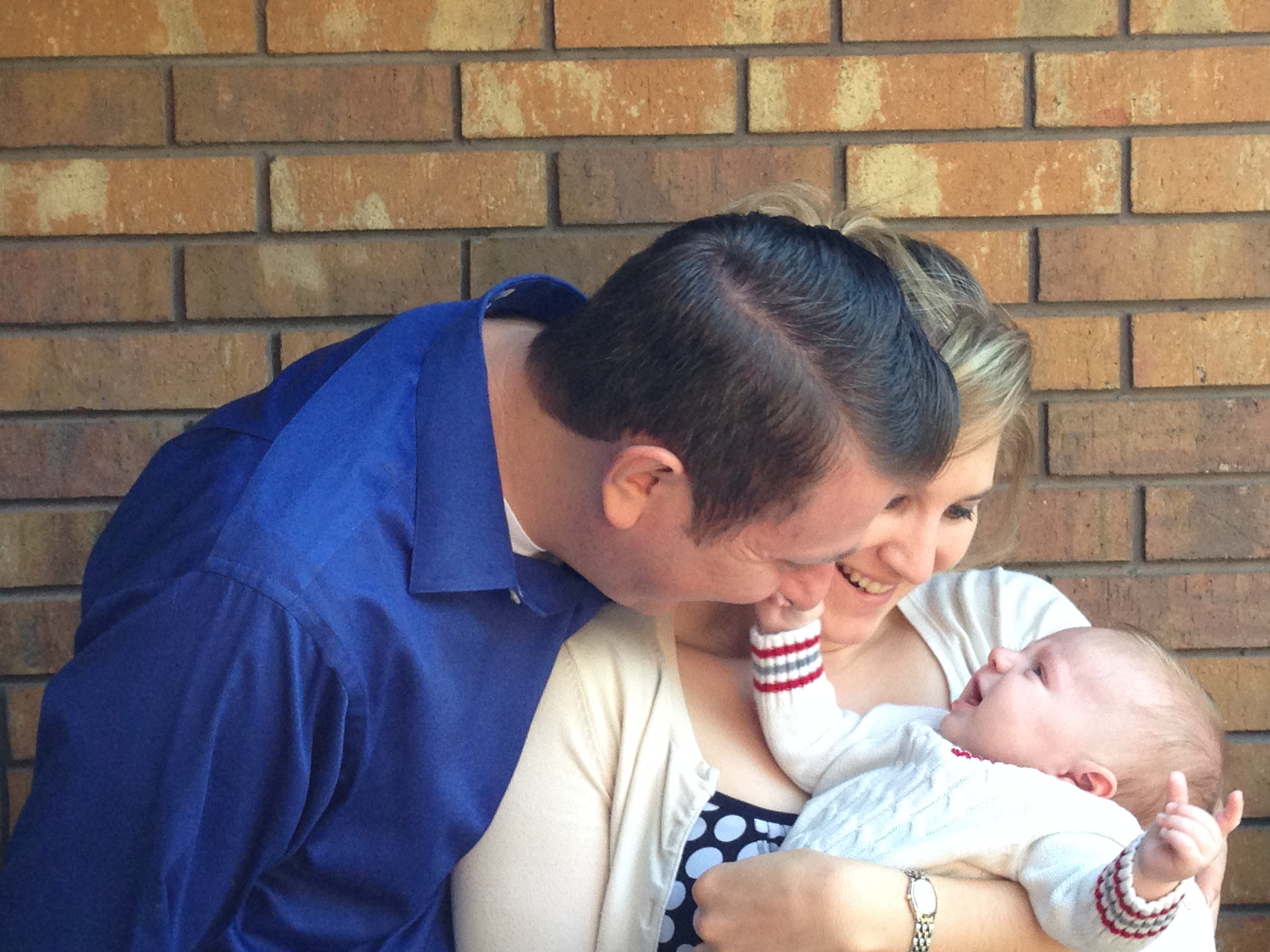
IMG_0800

I was married seven years before I decided I wanted kids. Don’t mistake me. I was not married seven years before I got pregnant by accident, or before we could financially support a child. I mean I was married seven years before God, one day, gave me a talking to, and utterly changed my plans.

One October day in 2012, I was simultaneously poring over my career options and getting flustered, as I did so often in those days. I was two months from finishing my master’s degree, after which I planned to get a doctorate and teach college…but I wasn’t happy. I hated graduate school, and the thought of four to eight more years of it constricted my heart like a vise grip.

“Okay, Lord,”I prayed, sitting at my desk, I need your help. Before me sat my list of possible graduate schools, and a blank notebook. These items represented the choice that had dogged me for months: grad school, or writing? Farther back in my mind was a third option, but I had never really been able to voice it. Deadlines were approaching. If was going to get my doctorate, I had to apply soon.

“Lord,”I muttered through clenched teeth, “This indecision has gone on long enough, and I can’t take it anymore. I’m asking you to please, make clear, once and for all, what you want me to do.”

Even as I spoke the words, I felt the answer thudding in my chest.

You know what to do, God said.

And as the tears started, I realized I had known for months.

“God!”I cried out. “This has been so excruciating! Why has it taken so long to decide?”

Fear, came the instant answer. You fear that Buc will die, or abandon you someday. You fear that one day you will be alone again, without support, without resources, and without a clear path.

“Oh, Lord!” I sobbed. “You know me so well. You know that my constant motion for the past few years had to do with protecting myself in case of future abandonment—it wasn’t just about being organized and ‘highly effective.’ You know that I’ve overextended myself at work and church to keep from feeling what was really underneath my skin. You know I struggled over the PhD because it led to a safe and predictable place.”

I stopped talking aloud then, and just sat, letting it all sink in. I was finally admitting to myself: my desire for the PhD was all for fear. It was never what I wanted.

I slipped to my knees and bowed at my desk. With tears still trickling down my face, I acknowledged and embraced my fear, and I prayed: “God, you’ve gotten me this far. It’s time to let you lead, fully. I can’t ignore my desires anymore. And it doesn’t make sense to try to keep forcing a shoe that doesn’t fit. I don’t want a PhD. Teaching I could take or leave. But writing? I can’t leave it anymore. It’s got to come out.

I slumped on the floor for several minutes more, as if held there by God’s hand, because I knew there was more to this prayer. There was something else God wanted to bring out of me, another fear he wanted to replace with his truth. And I knew I was finally about to articulate it.

After composing myself, I called Buc at work and urged him to come home early, saying, “We need to talk about our future.”

When he arrived home, I said, “Let’s drive to the state park and talk while we walk.”

I didn’t have a speech prepared, but when we started our nature walk, words started tumbling out of my mouth. I admitted to Buc that I was not going to find a PhD that would suit me, because a PhD—and the isolation that must come with it—was not the life I wanted.

Voice quavering, I told him, “Honey, I keep looking at my life in the last few years—how I’ve been running around, keeping so busy, trying so hard—and I just don’t know what I’m striving for anymore. I’ve lost sight of what I’m doing. I mean,” I added, voice climbing to hysteria, “I just don’t know who I’m trying to please anymore. Why am I trying so hard?”

Scenes of recent years flashed in my mind. My nose-to-the-grindstone approach, my endless lists of to-dos. My shuffling from here to there. My busyness. My endless pursuit of the next rung in my career ladder, my continual motion. The mere thought of it so exhausted me that I had to stop and catch my breath. Again, these realizations had hit me hard. But the one that next burst from my mouth almost knocked me over.

“I want to have kids!” I blurted.

Like a crashing wave this realization came. In all the years we’d been married, I had never been able to say that I wanted kids. The closest I’d ever come was to speak of it as a distant hypothetical.

“Is it possible,” I marveled aloud to Buc, “that all I’ve ever really wanted was to get back to having a family? To have kids? Is it possible that the one thing I’ve been so scared to embrace all these years is the one thing I’ve really just wanted to get back to?”

I was flabbergasted by the thought. As I talked about our future—a new future—I felt a weight lifting. Was it possible I was really letting go? Just letting the debris of my broken past settle, and finally settling myself? The thought was comforting, even as it brought new fear. To follow this impulse was to completely shift gears, to suddenly grind to a halt plans we’d been setting in motion for years.

I cringed as I looked up at Buc. Would he approve of this change of plans?

“Honey? What do you think?” I shifted my eyes down, as if to deflect a coming glare. “What would you think if I decided to stay home and write, and maybe have some kids?”

His eyes were soft. He clasped my hand. “Honey, I think that sounds nice. I like the idea.” And that was all.

Whoosh. My breath escaped in one glorious release.

“I just have one question,” Buc said, swinging my arm as we trounced through the brush. “Why now? Why after all these years are you finally ready to have kids?”

I thought for a moment before answering, letting the happiness of the moment sink in. Then I realized: happiness was the answer.

“I think I finally understand something.” I let my free arm drift across the tree leaves, feeling like a little girl again. “The best parents—I mean, the people who should be having kids—have them because they are already happy. They have them not to make themselves happy, but to share their happiness. To invite someone else into their special, intimate joy. They don’t ask their kids to bring their lives meaning, they ask to be able to share meaning with their kids.”

“Well said,” Buc beamed at me. “I think I’ve got a wise wife.”

“Not that wise,” I smiled back. “I’m just learning to take God’s lead.”

And that, I thought to myself, is something worth passing on to my kids!


Epilogue: A year and a half has passed since that day in the woods, and I thank God every day that he redirected my plans and gave me my (almost) four-month-old blessing, Sam Michael. Happy Mothers Day, Moms!


*This post was adapted from a chapter in my memoir manuscript.

He Slept Through the Night!

IMG_0633

This is a headline every new mom wants to publish, but my announcement is even more gratifying because it came as an answer to a Bible promise I claimed two weeks ago. You see, two Sundays ago I sat down and wrote a blog post about lack of sleep that I never published…because I got too busy to polish and then too tired to post it. (As I’ve written more than once, sleep deprivation is one of the biggest drains on new mothers.) But now I can publish that post with a happy ending.

Two weeks ago…

In a recent post I wrote that I was having trouble with my God time, so I fasted from secular books and TV last week. The fast is over, and it was a blessing, but I also realized it’s not enough to fast. You also have to refill what you’ve taken away. As if mothers have a need to fill any more time! This is where it takes a conscious effort to include God in your day.

My husband took Sam for the afternoon, and I was tempted to take a nap. However, after lunch and a delicious lactation smoothie I’m trying this week [after two weeks it sadly hasn’t helped much], I was revived enough to sit down and talk to God. I told him that I was frustrated. It’s hard for me to focus on the Bible right now. The Bible seems too vast, plus, unrelated to my daily mommy mire. I told him I wished there were a Bible, or a gospel, specifically for mothers of young children. Sometimes I don’t want to sift through the biblical language to find a personal application.

I asked God what he would have me do. He told me he wasn’t asking me to be a Bible scholar, just to be faithful with the time I have. I was impressed to continue reading through the Psalms like I’ve been doing, and to memorize at least one verse from my reading each week.

In the past, the Psalms have spoken to me even when I had little mental energy for Bible study. The themes are simple—God is in control; the righteous prosper, the wicked die; God created me and cares for me intimately; God is the creator of everything—but beautiful and reassuring. Just like they were good for a frazzled first-year teacher six years ago, they are good for a tired mommy today. And you know what? As I looked over the Psalms I read last week, searching for one verse to memorize, one jumped out.

“I will lie down and sleep in peace, for you alone, O Lord, make me dwell in safety” (Ps. 4:8). My Bible commentary told me this section pertained to when David fled from Absalom and feared for his life. The fact that he can lie down and sleep shows absolute trust in God.

As far as I can tell, my life is not in danger; but with a two-month-old, I crave to sleep in peace. It occurred to me that I could claim this verse for myself. I can trust God that he will help me sleep in peace, because he provides for my needs, just like he provided for David. I know it’s a somewhat silly comparison, but this verse made me feel loved by God.

I recited that verse several times a day for over a week…and within two weeks, Sam, eleven weeks old, slept 9 ½ hours two nights ago and then 7 hours last night. I was able to sleep in peace. God came through!

I am so thankful to serve a God who meets me where I am—even when that is a pathetically sleep deprived and droopy state. May he help me to continue honoring him with my time. If Sam keeps this up, it looks like I’ll be getting some quiet morning hours back—and I will do my best to spend them with God.


Reexamining Priorities as a New Mother

Photo Credit: "Chalkboard Numbers" by mimwickett
Photo Credit: “Chalkboard Numbers” by mimwickett

One great thing about a baby is that he forces you to reexamine your priorities. As the mother of a two-month-old, I’m reconsidering mine, and I’m ashamed. I’m talking about the fact that Bible study feels foreign to me these days.

Maybe that’s not surprising. Everything from my former life—exercise, writing my memoir—feels foreign. The exercise video that was once easy has become difficult. The memoir that seemed nearly sewn up now has gaping holes. The daily devotion that came as a joy now poses frustration. In short, my abs were not the only things left flabby by childbirth.

Feedings, Facebook, and the Today show replaced my morning devotions. Bottle washing and diaper changing ousted my daily workouts. Rocking, singing, and mad dashes to shower during naptime replaced the writing. And with all that breastfeeding, as you might remember, memoirs became my reading material of choice. Yes, I’ve had time to read, but I haven’t had the focus, a little voice inside has said.

That’s not good. In my former (pre-mother) life as a Christian, I learned where certain little voices come from. If it’s not the Holy Spirit, it’s, well, the other guy.

This is a tough truth to face. On the one hand, I want to plead, “But it’s not my fault! I wasn’t getting any sleep, and how can you expect a zombie to focus on her Bible?” Even now I feel this argument holds water…concerning at least the first few weeks. Just like one cannot be expected to function without food or water, I believe one cannot be expected to function (at least optimally) on inadequate sleep.

Concerning new parenthood, and I suppose other life upheavals (such as moves and new jobs), there has to be an adjustment period, and it’s bound to be rocky. If you don’t have someone spoon-feeding you your Bible lessons—or bottle feeding your baby, putting him to sleep at night, changing his diapers, holding him when he cries for the zillionth time (you get the picture)—it’s unlikely that even the most devout new parent will have a robust devotional life.

But then.

Then, that infant settles down a bit, so that you can expect a decent naptime each day. Then he sleeps to the extent that you are no longer a walking zombie. Then you have the time and the faculties available to reconsider your priorities. Then you are once again accountable for your actions.

So, I’ve decided I need to regroup. I need to get back to the Bible.

Being a good Christian doesn’t exclude some of the things I’ve been doing lately (perhaps with the exception of the Today show—I can’t help but notice how the worst of pop culture is always applauded, never condemned) but it means those things never take priority over Bible study or prayer.

Because I’ve had trouble hearing God’s voice lately, I decided to fast this week from secular books and TV. Until I am again comfortable with God and the Bible (although a Christian really should never get comfortable) I’m not turning on secular TV or picking up a memoir. So far this week I’ve bathed myself in the Bible, other inspirational reading, and religious programs such as those aired on Amazing Facts TV (If you want a spiritual boost, I recommend Amazing Facts; the speaker/director Doug Batchelor is a favorite of mine). Similar to my “Damascus Road year,” I’ve been convicted that I need to keep God front and center in my life. When I don’t, life is upside down, even more so than new motherhood makes it.

Listen, new motherhood throws your whole identity up in the air. It’s hard to redefine yourself, especially in relation to your work, if you were formerly career oriented. But I’ve decided that there is one aspect of my identity that need never be shaken, and that is my identity as a daughter of God. In Christ, I am called to be Christlike wherever I am in life. Maybe I don’t have the luxury of many uninterrupted minutes of Bible study. Maybe most of my prayers can’t be made with the backdrop of silence. But I can be faithful with what I have, be it five minutes of quiet time in which to read, or a whole noisy, busy day in which to converse with God.


Be Angry and Sin Not—Yeah, But How?

Image

What I saw in my kitchen this morning made me instantly angry, and I most certainly would have sinned, again, if I had not been meditating for the past two days on the Apostle Paul’s instructions to “Be angry and sin not” (Eph. 4:26).

The puppies tore up my rug, again, the one I had just fixed with duct tape (don’t laugh); and their water and food dish was empty, again, showing that my husband had shirked his duties for these puppies he wanted, again.

As I sat stewing at my dining room table, contemplating what to do with this welling anger (magnified greatly by past-due pregnancy hormones), I stroked my Bible. This was supposed to be my morning devotion time, but I was tempted to wake my husband and yell at him: “See what they did? You clean it up. See their empty food and water dishes? You fill them.”

I was also ravenously hungry by this point, and getting angry, yet again, that Buc has never in nine months of pregnancy made it a priority to get up and eat breakfast with me on the weekends. He always has to shower first and look at his news, which seems extremely selfish when I’m about to pass out. Because he won’t rearrange his routine, we miss eating breakfast together—because often I just can’t wait.

Anyway, this morning I had a decision to make. Was I going to pause and pray, or just react? Because I’d been mulling over Ephesians 4 for the last two days, I heard these words in my mind: “Be angry and sin not.” “Forgive others as Jesus forgave you.” “Speak only words that will encourage others, not tear down.” I also remembered an anecdote I’d just read about how Abraham Lincoln once advised a general to deal with his anger at a colleague. To summarize, Lincoln told his general:

Write a letter to that man in all honesty, in all nastiness, to express your feelings.

But…

When you are done with the letter, DO NOT send it. Reread it to yourself, then burn it. Now, write a new letter.

While my first impulse was not to pause and pray, or to write a letter, I asked Jesus for strength to overcome my instincts, my unreasoning hunger, and my prego hormones. And then I popped in a toaster strudel to tide my appetite, and pulled out a clean sheet of paper.

“To my husband,” I began. “I am very angry at you right now…” From there I quickly filled up the front and back. I could have gone on, but interestingly, part of my letter ended up detailing my own faults. Trying to see things from Buc’s perspective, I found myself writing things like, “I know you would tell I am too easy on the puppies, letting them get away with ruining my stuff, and how will I discipline a child if I can’t even handle dogs? Maybe you’re right; I just wish you could appreciate how damn hard this is for me. I’m not good at discipline.”

I paused for a moment, considering how small this morning’s events really were in comparison to life’s bigger mysteries—such as my son’s impending birth—realizing how sad it would be to ruin a morning just for the chewed up rug and empty water dish. And then, remembering what I’ve learned about fruits and roots, I wrote: “Maybe a root of this anger is that I feel unappreciated and disrespected. I feel you don’t understand how hard certain things are for me [like disciplining the dogs] or how important other things are [like breakfast on demand]. I just wish you would try to see things from my perspective and not brush off these things that are a big deal to me.”

By the end of two pages, I felt less volatile, but I still didn’t trust myself to speak in love. Remembering a tip from Dr. Laura’s The Proper Care and Feeding of Marriage, I pulled out a second clean sheet of paper. (The basic premise of Dr. Laura’s book is to kill your spouse with kindness—actively love him or her so much through words and deeds that he or she can’t help but respond in kind.)

ImageNow, I listed all the GOOD things about my hubby I could think of. Blinded as I was by my anger, I needed to remember that my husband wasn’t intentionally annoying me; and I knew that compared with all his good traits, this little issue would fade.

After I wrote for that one page (why is it so much easier to write bad than good?), I cracked open my Bible and reread Ephesians 4 in The Message version (yesterday I read the NIV), and then I went on to Ephesians 5 for good measure. Very funny, God. Chapter 5 is the one about wives submitting to their husbands. In my reading, which took no more than ten minutes, I was reminded of these key ideas:

1. Because I have been reborn, I can rely on Jesus’ blood and breath flowing through me, and Jesus’ love for my husband. I don’t have to rely on my own strength anymore.

2. Also because I have been reborn, God wants me to be mature, not childish anymore (Eph. 4:14-16; 21-24). How mature is it (I had to ask myself) to make a fuss over a torn rug and an empty water dish, or my empty stomach?

3. “Go ahead and be angry. You do well to be angry—but don’t use your anger as fuel for revenge. And don’t stay angry. Don’t go to bed angry. Don’t give the Devil that kind of foothold in your life” (Eph. 4:26-27).

4. “Make a clean break with all cutting, backbiting, profane talk. Be gentle with one another, sensitive. Forgive one another [husbands included] as quickly and as thoroughly as God in Christ forgave you” (Eph. 4:31-32). What a tall order this was! But compared to Christ, who forgave those who tortured and murdered him, what did I have to complain about?

5. “Figure out what will please Christ and then do it!” (Eph. 5:10). I was pretty sure it wouldn’t please Christ for me to explode at my husband or skip my morning devotional. I was also starting to feel that it would please Christ for me to, once and for all, admit that these frustrations with our puppies are largely due to me not preventing bad behavior I could, actually prevent. I figured it would please Christ for me to finally just deal with the problem so it wouldn’t waste any more of my time or energy. I resolved to submit to my husband’s good counsel (Eph. 5:21-28) and start being more assertive with the dogs, and not let them sleep in the main areas of the house anymore (we have a laundry room that will do as well) so as to avoid these unpleasant morning surprises.

When Buc sauntered into the kitchen, eyes widening at the fluff strewn all across the tile (I hadn’t had energy to clean it yet), I was just finishing my three-part anti-anger plan, and I had no desire to yell at him anymore. I also didn’t feel much like talking (which is sometimes the best recourse when you can’t say anything nice), so I left the list of good traits on the table and threw the nasty letter (ripped to pieces) in the trash. I went to take a shower, after which I started scrubbing the bathroom tile. Better to give myself lots of distance from the temptation to sin. After awhile, Buc approached me, and he lit up my day with three statements:

1. “Do you want to eat breakfast together?” (Yes, I did.)

2. “I found that list you wrote about me, and I know you’re mad at me, because you don’t write those good things when you’re not. But I appreciate the list, and I love you. And I cleaned up the dogs’ mess.” (I was gratified that he’d found the loving list, and he knew without me telling him that I was angry. I was also reproved by the fact that he thinks I don’t write good things about him unless I’m angry—something for me to work on.)

3. “I’m going to get cracking on organizing my closet and my gun supplies” (something I’ve wanted him to do for the last few weeks). “I appreciate you honey, and how you keep me organized.” (This made me feel especially good, because it told me he has noticed the extra efforts I’ve been putting in to get ready for our baby. I was also softened to see that Dr. Laura’s advice was working: I had chosen to be kind to him, and he chose to be kind back.)

Readers, this may seem a long post to recount a silly could-have-been spat this morning, but don’t take lightly how important these small moments of life really are. I believe our lives are made up of these small moments, these small choices (to yell or to pray, to speak kindly or to criticize) and they are the stuff our characters are made of in the end. One “silly” spat can ruin a whole day, just as the choice to submit to God in something as simple as pausing to pray (or to read, or to write a “fake” letter) can set off a full day’s worth of kind words and deeds.

I wrote this post for myself, to remind myself how important it is not to skip my daily time with God, but I hope I have reminded you of the same thing. Even born-again Christians need to be recalibrated on a daily basis.

My Ugly, Messy Rebirth Story: Conclusion

After giving my life to God, I was always on the lookout for tools to share my faith. I didn’t feel I was particularly good at this part of the Christian life, and I thought it was because I hadn’t yet found the right method. Enter Paul Coneff and The Hidden Half of the Gospel.

Paul  conducted a week of prayer at my church in the spring of 2012, and after just the first night, I knew his message was special: I sensed it might even be the missing link in my life and ministry, this “hidden half” of Jesus’ story. So, what was it? And how, if I’d been in church almost my entire life, had I missed it?

Lindsey HH Cover MasterThe Hidden Half of the Gospel

Paul began his presentation with a question: “What did Jesus do more of while on this earth: Teaching or healing?”

Healing was the obvious answer. Then Paul asked, “Why have we [churches and Christians] reversed Jesus’ model of ministry? Why do we do more teaching than healing, when he did more healing than teaching?”

He continued, “Now let’s say that I am sitting in my office and I am studying for a sermon. Some church member comes in and says, ‘I have been struggling with guilt and shame from an abortion.’ Is it easier to turn to that messiness and brokenness of her life, or is it easier to do a Bible study on the character of God? Give her some scriptures on forgiveness and say, ‘You know God has forgiven you,’ pray with her a thirty-second prayer, and walk away. Which is easier?”

His point? Many churches, and Christians, don’t know how to handle messy problems like this one (other common examples being pornography addiction, abuse, eating disorders, infidelity, and cutting ), so we don’t–meaning we don’t offer the help so many people need. He went on to prove his point with a concept he calls the “cycle of sin-and-forgiveness.” Many Christians come into the church and get forgiveness for their sins, only to fall back into their patterns of sin. Then they ask for forgiveness, but continue to sin, again and again and again. (In my own experience of praying with women, I’ve also seen a pattern of wallowing in guilt over past sins that the person is no longer committing.) Paul continued. “Why is it that so many Christians who have accepted the ‘good news’ of Christ still are not free?”

family-fighting
Photo Credit: Peacefulparenting.com

I was riveted. Exactly! I said to myself, remembering how my parents had been wooed into the church with lots of good information and had gotten baptized, only to leave our family scattered and scarred by an affair and divorce (see parts 1, 2, and 3).

For the first time, I saw my problems standing stark naked in church, and I was desperate to know: How can the church address these issues?

The Hidden Half of the Gospel is how Paul addressed them. This is a message I would come to know well when Paul later asked me to cowrite his book of the same title.

Two Pillars

There are two pillars to The Hidden Half:

lies
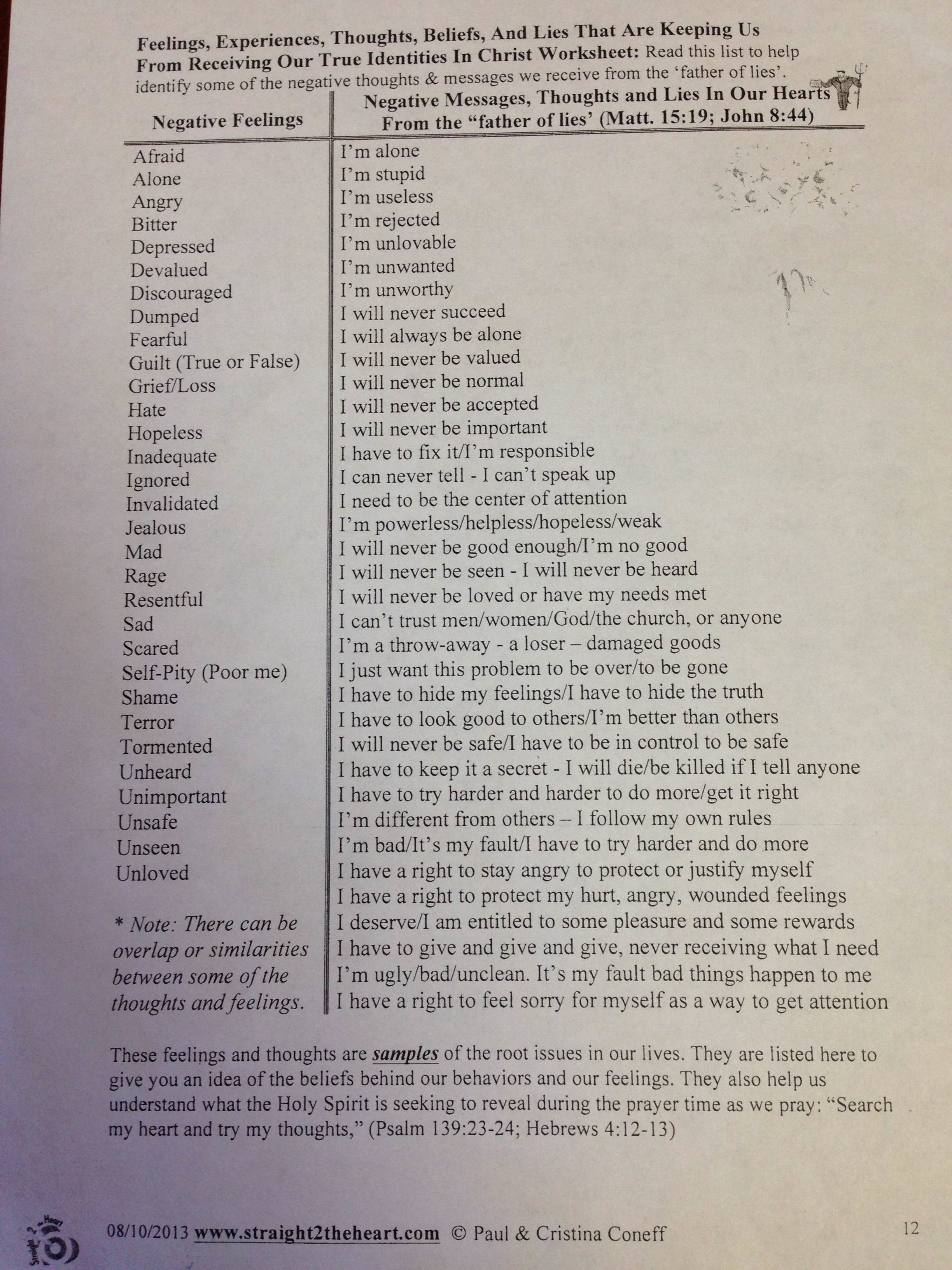
Here is a worksheet that can help you identify the lies Satan may be planting in your mind. I was able to recognize which lies applied to me because they were “thoughts” that ran through my head on a regular basis.

1. The root of our sin and suffering is Satan, the father of lies (John 8:44). This concept of roots is huge in Paul’s ministry. As Paul explained, all our negative behaviors and patterns are merely fruits of deep-seeded roots, or lies, planted by Satan. We cannot fix the fruits unless we first attack the roots. Thus, healing begins by identifying the Satanic lies driving our behavior. Once we know the roots, or the lies, we can take those to Jesus and let him deal with them, which leads to pillar 2.

2. The root of our healing and freedom is Jesus, our Suffering Messiah (Luke 9:22; Rev. 5:5; Col. 2:15; Isa. 53). The suffering of Jesus is the crux of The Hidden Half of the Gospel, and the key to our healing.

As Paul explained, many churches have overlooked this crucial aspect of Jesus’ gospel, instead choosing to focus on Jesus’ death and resurrection. The death and resurrection take care of forgiveness of sins, but often merely believing in and accepting these concepts doesn’t resolve suffering, or the cycle of sin-and-forgiveness. Putting “suffering” back into the definition of the gospel, as Jesus explained it to his disciples (see Luke 9:22), offers hope to those of us stuck in suffering—depression, abuse, addiction, etc.—because it means Jesus didn’t just nail our sins to the cross, but he also nailed our suffering there, as well. The Bible tells us Jesus “suffered and was tempted in every way” that we are tempted, to offer us help when we suffer and are tempted (Heb. 2:17-18; 4:14-16).

Why Jesus Had to Suffer

Photo from http://trutheran.blogspot.com/2012/10/the-burdens-of-sin-and-suffering.html

“Have you ever thought about why Jesus’ story had to be so gory?” Paul asked the audience.

I really hadn’t.

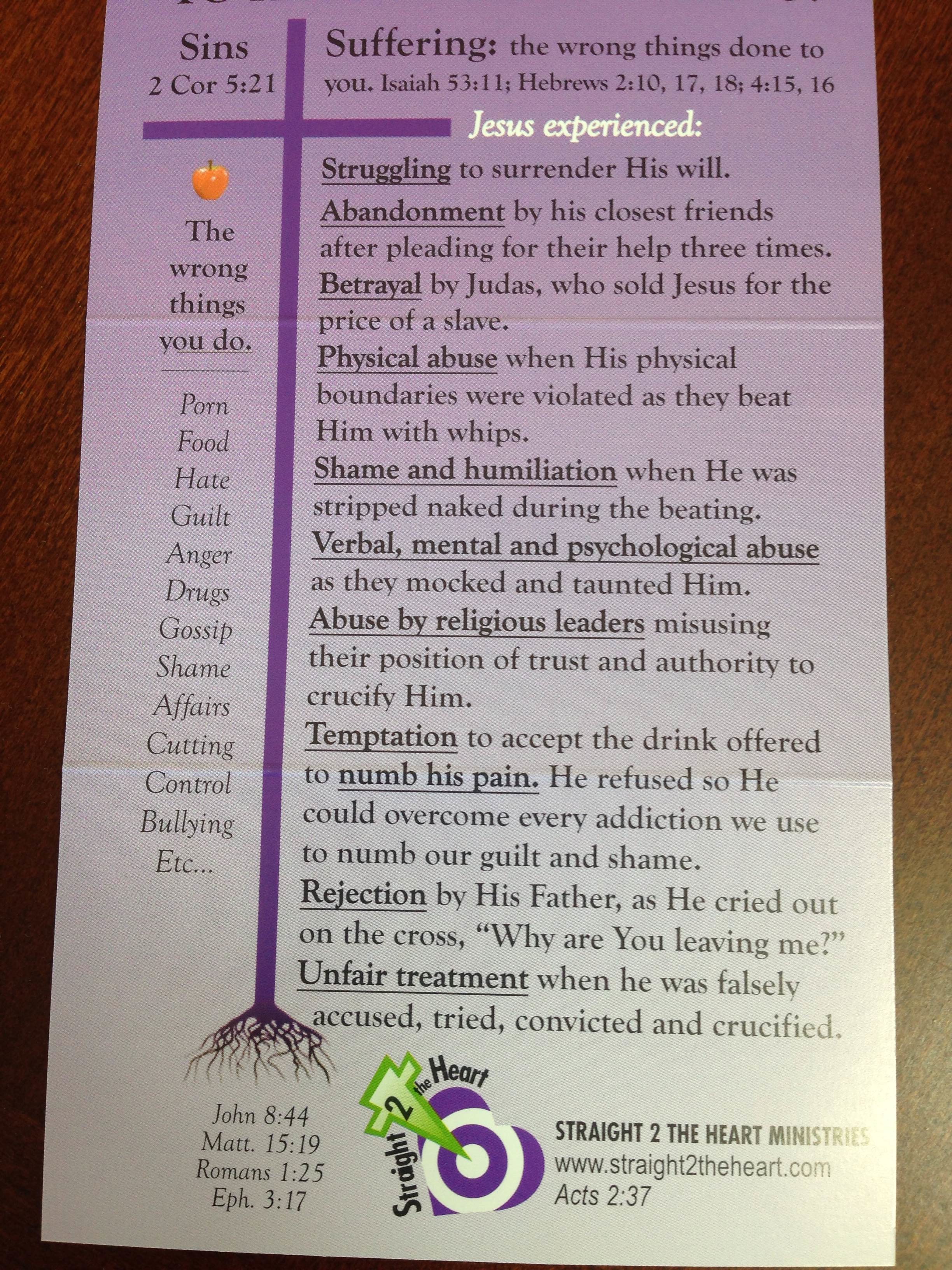
“Well, think about it.” Paul continued. “Jesus was abandoned; betrayed; physically violated; shamed and humiliated; and verbally, mentally, emotionally, and physically abused. Now, do you think He understands the pain that abuse victims feel? Does He understand when a parent abandons a child? Was He ever tempted to numb His pain?

“He suffered all these things and more so He could identify with us. So that he could understand every way we are sinned against, and every form of self-protection we develop in order to numb our pain.

Here is a list of some of the experiences Jesus went through (from the prayer card used during Straight 2 the Heart prayer sessions).

“What’s more, he suffered these temptations  and triumphed over them, which means that when we take time to connect our stories with Jesus, to pray and meditate on what it means that he suffered for us, and became sin for us, we can experience his victory.”

By this time, I was hooked. I wanted this in my life. I wanted a ministry that was relevant to the suffering I’d experienced, and that which I saw all around me.

So I signed on for Paul’s seven-phase, thirteen-week discipleship program. That’s right. A thirteen-week program. This wasn’t any “quick fix.” It was going to be an intense period of praying on a consistent basis, first for myself (to get more healing in my own life before I was expected to pass it on–a requirement of Straight 2 the Heart Ministries) and then for others. I was going to learn at the feet of Jesus (and the seat of Paul Coneff) for an extended period of time, sort of like the first disciples, before I set out to make more disciples.

Discipleship, Small-Group Style

Paul (right) training Mary to lead Charles through prayer.
Paul Coneff (right) training Mary to lead Charles through prayer.

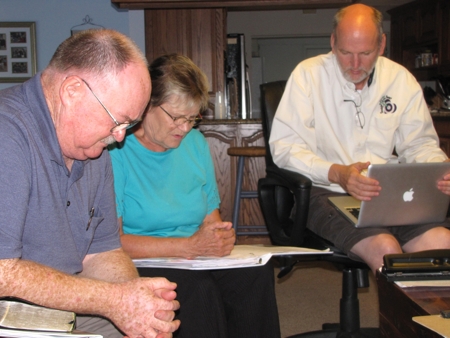
Paul spent the next four months with five of us, discipling us—praying with us, and training us to pray with others. And not quick, clean, thirty-second prayers. These were deep, messy prayer sessions that first asked Jesus to identify our negative roots, and then helped us connect our stories to Jesus’ story. It didn’t end there. We delved deeper, praying, “Lord, what else do you want me to know about these roots in my life? What blessings or barriers are there in these areas?” The prayers were recursive, connecting our stories to Jesus, then having us stop and listen to the Holy Spirit so he could take us one layer deeper into our negative roots. Always, by the end of the prayer sessions, which dredged up long-buried hurts and often tears, Jesus revealed blessings, too. He always brought to mind His promises to combat the negative roots our praying was churning up.

Our training ended, with the goal being that we would start more small groups in our church, beginning with a few men and women, hopefully to grow as disciples multiplied.

My Gateway to New Life at Home, at Work, and in Ministry

My life intersected with Paul Coneff’s message and ministry, Straight 2 the Heart, when I was at a crossroads in my life. I was coming up against the age of thirty, and was finding that pursuing my “chosen” path, graduate school to become a professor, was leaving me feeling empty. Here’s a summary of how God has since rerouted my plans through this life-changing prayer ministry.

Facing Remaining Negative Roots

tree roots
Photo Credit: “Exposed Tree Roots” by Colin Brough

First, Straight 2 the Heart has helped me to be honest about areas in my life that weren’t all healed yet (some of which are still in progress) such as:

  • Anger at the premature loss of my childhood family and, well, my childhood.
  • Resentment at my husband’s happy family (and any happy family).
  • Disillusionment with my church and religion because it “did not help me” in my time of crisis. Straight 2 the Heart helped me to see that my church didn’t help me because it didn’t know how—also, because I didn’t let them know I needed help in the first place. (It also provided the answer for how churches can help, when they have the right tools.)
  • My pattern of trying to control my life in my own strength so it would never get out of control again (or my attempts to never repeat my past depression, suicide attempts, broken family, etc., through over-planning, becoming over-busy, and more).
  • My avoidance of having kids out of the above need to maintain control.

Gaining Deeper Healing 

Second, Straight 2 the Heart has led to more healing for those negative roots in these ways:

  • The decision to let go of the “safe,” but wrong career path of academia.
  • The decision to finally pursue the identity God has for me, which has translated into sharing my story through writing and even teaching. This blog, my memoir-in-progress, and Paul’s and my forthcoming book, The Hidden Half of the Gospel, are all examples of me sharing my story for God’s glory.
  • The decision to have a baby.DSC_7783
  • The decision to be honest with other women, to reach out and accept relationships I had avoided but desperately needed (See my post “Friends in High Places”)
  • I am gaining more appreciation for my church as I look past its flaws (every church has flaws) and see the human beings there. Since deciding to be vulnerable with my own story, I’ve connected with many of these dear people in meaningful ways.  I am getting the authentic “fellowship of believers” experience I missed as a child, when my family was intent on covering up its problems.

Taking the Next Step in Ministry

S2Hlogo
Photo Credit: Cristina Coneff

Third, Straight 2 the Heart has helped me learn how to have a really relevant ministry, or how to help others who are stuck in negative places and patterns like those I’ve suffered. (It is through making Jesus’ gospel relevant to the everyday struggles of life—boldly connecting our messiness to Jesus Christ’s suffering and his full gospel to “heal the brokenhearted and set the captives free.”)

  • My partner in prayer ministry, Amanda, and I, prayed two new young women (now dear friends) through the thirteen-week prayer process, which helped lead them to lots of healing—and baptisms in our church!
  • Amanda and I also trained women at a neighboring church to facilitate the same thirteen-week prayer and discipleship process in their congregation.
  • With the help of Amanda and Mary, our other cohort from our initial 13-week training, I facilitated a third prayer group, consisting of around ten ladies, in my home for several months last fall. This group resulted in amazing healing for many of these women (for marital, parental, and other common problems) as well as facilitating much needed connection between these lovely, but often isolated church ladies.
  • Now I am working on rendering the miracles we saw in these women willing to be honest with one another and with God into the closing scenes for my memoir. I want my story to testify to how one changed life can ripple out to other lives, and still more lives from there. This is what discipleship is all about.

Now, what I’ve left out of my rebirth story (and there’s lots I’ve left out), I am working on telling in my memoir. Why did I call this my “ugly, messy” rebirth story? If you consider a real birth (and I’ve been considering it a lot lately), it’s a messy process. It’s no small thing when a new physical life is created—and the same is true for a new spiritual life. The creation of a life, and the re-creation of a life, are not simple or easy processes. At times they are painful, ugly, and messy—but to get to the birth, or the rebirth, they are necessary. That’s why I have unapologetically included the ugliness and messiness in my story—along with its beauty. Without either, my story would be incomplete.

 Read part 1      Read part 2      Read part 3     Read part 4      Read Part 5    Read Part 6

To read more about The Hidden Half of the Gospel, see the following articles Paul and I wrote on the subject:

“The Fruit and Root of Freedom from Addictions” Part 1

“The Fruit and Root of Freedom from Addictions” Part 2

To schedule Paul to speak at your church or to facilitate a discipleship group, contact him at www.straight2theheart.com.

And if you want to get a copy of our book, The Hidden Half of the Gospel: How His Suffering Can Heal Yours, follow this blog to be notified later this spring when the book is published!

My Ugly, Messy Rebirth Story, Part 6

Photo Credit: "Friends Talking" by Lusi
Photo Credit: “Friends Talking” by Lusi

One surefire way to tell you’ve been “reborn” is the desire to share your faith with others. On the other hand, if the idea of “sharing your faith” turns you off or even terrifies you, that’s a good sign you haven’t been reborn. For most of my life, born “Christian” though I was, that was my experience: I didn’t know what to share, and I didn’t know how.

After my “Damascus Road Year” (see part 5), for the first time in my adult life, I had abiding joy and peace, which led to faith. Finally, I had something to share. Now, I just had to figure out how to share it.

In the four years since my conversion, I’ve decided we born-again Christians can share our faith in two ways: implicitly, and explicitly.

Sharing Faith Implicitly

First, we can share our faith implicitly by living out our new identities in Christ. If we’ve truly been reborn, then our daily lives—our habits, our behaviors, our interactions with others—will naturally witness to Jesus Christ, because we will be emulating him. If we are following Jesus, we will not be living like the rest of the world, and people will take notice.

For example, after my conversion, my public high school students started to ask me questions about my faith, even advice about faith-related matters: “Why don’t you drink?” “Why do you go to church on Saturday?” “What do you think about marriage?” “How can I make my boyfriend see that prayer is an important part of the Christian life?” These questions came without me explicitly stating my beliefs—but I didn’t need to, because my behavior showed me to be different from most of the other teachers.

Sharing Faith Explicitly

Second, we can share our faith explicitly in a variety of ways, depending on our personalities. Note: This form of sharing does not come in a “one-size-fits-all” box. Unfortunately, some churches, preachers, and Bible teachers, try to make us feel like witnessing should look the same for everyone, thereby making some of us (i.e., those of us who don’t fit the traditional mold) feel like failures before we’ve even begun.

Two years prior to my conversion, I was the victim of one such discipleship training that was intended to prepare me to give Bible studies at the end of eight weeks. But after eight weeks, I was no more ready to give Bible studies than I’d been at the beginning, for two reasons. One: I hadn’t yet met the Lord personally (though I was active in my church and looked “good” on the outside), and two: the type of ministry wasn’t right for me.

The first fatal flaw of the training was that it didn’t show me how to have a personal experience with Christ before asking me to spread that experience to others. To its credit, the training frontloaded the concept of preparing our hearts for ministry. The speaker said we should deal with our own baggage before we try to minister to others—but she didn’t really explain or model how, exactly, I was supposed to rid myself of that “old man”—AKA my baggage. When I began the training, I was still depressed and self-centered, and it’s pretty hard to testify to Jesus’ redemptive power in that state of mind. Unfortunately, after the first night, it was assumed we were ready to learn how to “share our faith” with others. And that brings me to the second fatal flaw.

Photo Credit: "Hands on West Africa" from imbstudents.org
Photo Credit: “Hands on West Africa” from imbstudents.org

This training only presented one way of how to share my faith, as if that were the only way. I don’t want to unduly pick on my religion, but since it’s the one I know, it gets to be the example. In the Seventh-day Adventist tradition, the ol’ standby for sharing faith is knocking on doors and offering Bible studies. For Adventists, and probably a lot of other Christian religions, Bible studies equate to a series of topical handouts that progress through our beliefs by way of Q and A—with plentiful Bible verses listed to help answer the Q’s.

Let me be clear: I don’t think these studies are bad. I think they definitely have their place, especially for those who are completely new to the Bible. But when it comes to sharing my faith, these studies do not appeal to me. That’s because I did not personally or experientially come to know Jesus through these types of studies, and I find it hard to believe that others could, either (though I’m sure it’s happened).

When it comes to explicitly sharing our faith, we should choose a method we can be passionate about; it’s important that we honor our personalities, choosing and using a method that speaks to us. If you’ve found the Lord and are excited to share him, yet you’re still not sure how to do that explicitly, learn from my experience. Perhaps you just haven’t stumbled upon the right method yet.

Bible Study Bummer

When it came time to start my “explicit” phase of ministry, I knew who I wanted to reach out to—my friends and peers from church—but I didn’t know how. After a lifetime in the Adventist church, the only thing I could think was traditional Bible studies…so that’s basically what I did.

Now, I didn’t start with our prefabricated lesson studies, which usually progress through a series of doctrines. I wanted to focus more on the heart, because I believed that, more than head knowledge, my friends and peers needed a heart experience with the Lord—or what I’d recently found. So, I picked a book about having a heart experience, John Dybdahl’s Hunger: Satisfying the Longing of Your Soul, and made study guides for our meetings. My heart was in the right place, but my approach was wrong.

Photo Credit: "Small Group Bible Study" from manuscriptBiblestudy.com
Photo Credit: “Small Group Bible Study” from manuscriptBiblestudy.com

I had designed the studies similar to my high school handouts, complete with fill-in-the-blank answers. That’s a good way to short circuit good discussion and sometimes independent thought. As for prayer? By now I had somewhat of a vibrant personal prayer life (it involved a lot of writing to God in my journal), but I didn’t know how to facilitate really effective public prayer. So I duplicated the format we used at church: I asked for praises and then prayer requests. We went around the circle, said our praises and prayer requests, and then one person prayed, thanking God for the praises, listing the requests, and asking God to guide the study. It was a fine prayer, but it wasn’t going to result in hearts being transformed.

Despite my ineptitude, our Bible study consistently drew a crowd. I could tell my friends enjoyed coming (was it because I fed them?); and I even made some new, dear friends. I wasn’t running a particularly great study, but God brought blessings out of it (and therein is a lesson). However, after a year and half, I wanted something better. I’d read Trish Ryan’s Christian memoir, He Loves Me, He Love Me Not, and her small group was, as I read it, much more effective than mine. She wrote of things like group intercessory prayer that resulted in many heart conversions. It was then that I began to feel like a failure in ministry—and had my “Unexpected Breakdown” (check out what happened in this post that got me freshly pressed).

After two years of being on fire for the Lord, I burned out. After giving so much to my friends and to the church, I felt bankrupt myself.

Now about to finish a master’s degree and no longer sure I wanted to pursue a doctorate (would spending so much time in grad school be to bypass another calling the Lord had for me?) I needed to find strength again. I also needed (but didn’t know it) more healing for the roots of my former depression.

In the conclusion, learn about the prayer ministry that not only helped me heal, decide to have children, and decide to change career courses, but also taught me how to witness “straight to the heart.” It is the same prayer ministry that laid the groundwork for Writing to my Roots.

 Read part 1      Read part 2      Read part 3     Read part 4      Read Part 5

My Ugly, Messy Rebirth Story, Part 5

Photo Credit: from ubdavid.org

For a long time I waited to have the type of “Damascus Road” conversion that the Apostle Paul had. I wanted a cataclysmic experience to bring me to God, once and for all. Maybe I should have been careful what I wished for!

As I wrote in part 4, I was about to start my second year of teaching when my mom—who already had cancer—was hospitalized for bipolar disorder, and my little brother went into foster care. Because my hands were tied with one-hundred adolescents, one-thousand miles away, I fell to my knees and pleaded for God to do something. And he did.

Oh, but he didn’t change my outward situation–or my mom’s, or my brother’s–at least not at first. First, he changed me—from the inside out.

My Damascus Road Year

I believe that God is always growing those who seek him. While we don’t always sense our growth, sometimes we experience “growth spurts.” That year was my first spiritual growth spurt. With God’s leading, and with a little help from Steven Covey’s The Seven Habits of Highly Effective People, I was forming all kinds of good habits in my life.

By far the most important habit I formed that year was the habit of daily prayer and Bible study.

Photo Credit: "Bible Collage 4" by ba1969
Photo Credit: “Bible Collage 4” by ba1969

Next, I began memorizing Scripture so that, when negative thoughts came, I could re-set my mind on God’s promises. Without even having to think about it, I started pondering Scripture throughout the day and conversing with God. In turn, he responded to me by bringing certain Bible verses to mind that I had memorized.

Again, without my having to work at it, the words that I spoke, in conversation and in prayer, started to change. Rather than counting my losses, I started counting my blessings. My journaling naturally took a more thankful tone, too, as I wrote about how I was experiencing “happy days” like never before.

After allowing God’s words to take root in me for several months, I was generally not depressed anymore. When sad days came, I fought them off by reciting Scripture and reading the Word.

And that is the key to rebirth: we cannot changes ourselves, but God’s “living and active” Word must change us (Heb. 4:12-13). If there is one thing we can do, we can avail ourselves of the Word and prayer.

More Spiritual Fruit

Photo Credit: blog.zap2it.com
Photo Source: blog.zap2it.com

Not only were my devotional habits changing, but so were many other aspects of my life. During this time, I heard a pivotal sermon all about monitoring what we put into our minds and bodies. The speaker, evangelist Leo Schreven, raised tough questions for Christians, such as: Why do we listen to, read, and watch the same kinds of materials that the “world” listens to, reads, and watches?

As Schreven pointed out, so much of mainstream media and entertainment is opposed to Christian principles, such as the many pop, country, or rock songs crooning of infidelity. What about TV shows and movies fraught with violence? He pointed out that there is so much “trash” around us, yet we Christians sift through it as if through a dumpster, always hoping to find something halfway decent—instead of doing the sensible thing and avoiding the trash altogether.

Input, Output: By Beholding, We Become Changed

As a recovering depressive, this point hit me hard. I was beginning to realize that a large part of my depression came down to my thought patterns—and many of my post-adolescent thought patterns were determined by the music I listened to, the books I read, and the things I watched.

Photo Credit: "Man Watching TV" at www.digitaltrends.com
Photo Credit: “Man Watching TV” at http://www.digitaltrends.com

There was a reason I often felt cranky after watching secular movies or reading secular books: They were not uplifting. Even cute, seemingly harmless chick flicks left me desiring a more glamorous life, a more “storybook” marriage, a prettier figure, and a more successful career. In other words, they were leading me to desire almost everything but a relationship with the Lord.

Moreover, I realized with horror that when I listened to music with depressing or even suicidal lyrics (the band Evanescence came immediately to mind), I was cooperating with Satan by meditating on self-destructive thoughts.

Now I was beginning to understand why my older brother had tossed out his entire CD collection after his own rebirth experience. I realized these seemingly “harmless” hobbies are really insidious tools of the devil to speak lies to us.

Photo Credit: Jonah Bayer

So I threw out my CD collection, too—the bad part of it. For a time I stopped reading novels and switched completely to the Bible and self-help books (this was an odd and confusing thing for an English major to do). I also separated myself from certain friends (sadly, self-professed “Christians”) who habitually exposed me to R-rated movies. I knew these changes were all necessary to cleanse and fortify my sinful, depression-prone mind.

The other conviction I felt was a need to reach out to my friends, many of whom called themselves Christians, but who, like me, did not live like it. Why, if we were “Christians,” did we never come together to talk about Christ? The only times we got together, we watched secular movies and did other non-Christ-centered things. I made it a goal to start a young adult Bible study for these beloved friends.

Crisis Resolved

All of these changes were happening in me while Mom was in the mental hospital, my little brother in foster care, and myself tied up with teaching, 1,000 miles away from them. Later that fall, Mom was mentally stable and discharged from the hospital, and by November, she had my little brother back. The remaining unknown was Mom’s cancer.

Meanwhile, I marveled at how God was sustaining me. I believe God carried me on high that year, helping me soar above situations that could have otherwise devastated me.

The One Who Sustains

The truth is, no matter if we think we are sustaining our lives, God is the one who sustains. We couldn’t even breathe without him. We may think we’re the ones moving our lives forward—but we can do nothing of ourselves. The Apostle Paul wrote, “[God] himself gives all men life and breath and everything else,” and “It is God who works in you to will and to act of his good purpose” (Acts 17:25; Phil. 2:13). Jesus Christ, while he lived on this earth in human flesh, even said, “Of myself I can do nothing.”

On the Other Side of Hardship

Photo Credit: "Glass Tears" by Man Ray
Photo Credit: “Glass Tears” by Man Ray

Ever heard this saying?

Sometimes you have to be knocked flat on your back to look up.

I believe that God uses trials to get our attention. I’m not saying he causes bad things to happen, but he uses bad things to make us stop and realize how powerless we are. Without facing trials, we tend to get haughty, thinking we don’t need God. It is when we are knocked flat on our backs that we have to face the truth: we can do nothing without God.

After God has broken us, he can use us: “Before I was afflicted, I went astray. But now I obey your word” (Ps. 119:67). While most of us would never ask for hardships, sometimes they are the best things that can happen to us. The Apostle Paul recognized this. Knowing that “God’s strength is made perfect in weakness,” Paul said, “Therefore I will boast all the more gladly about my weaknesses, so that Christ’s power may rest on me” (2 Cor. 12:9). But what if we don’t have this attitude?

A Mature Faith

Please note: It is not natural to “boast about weaknesses,” or to thank God for hardship. It is only a mature person who can recognize the blessing in trials, and only a mature faith that can observe: “Godly sorrow brings repentance that leads to salvation and leaves no regret, but worldly sorrow brings death” (2 Cor. 7:10).

When hardships come, we will either experience godly sorrow, or worldly sorrow. One type of sorrow sees hardship as an opportunity to lean on God and grow, and the other sees it as a life-ender; that was me in parts 1, 2, and 3.

So what am I to make of those years when I tried to pray but did not feel God’s presence? Looking to James, I think the answer has something to do with developing perseverance. James says, “[T]he testing of your faith develops perseverance. Perseverance must finish its work so that you may be mature and complete, not lacking anything….” (James 1:2-4).

Sometimes we are not ready to receive the things of God. “The carnal [or worldly] mind is hostile to God. It does not submit to God’s law, nor can it do so” (Rom. 8:7). I would substitute the word “immature” for “carnal.” My immature mind was not ready to submit to God—plus, I was in so much pain, I couldn’t concentrate on anything else.

Photo Source: www.cafemom.com
Photo Source: http://www.cafemom.com

Why do some of us have to go through more pain than others to “get it”? I don’t know. I just know that, on the other side of pain, there can be great joy. “Blessed is the man who perseveres under trial, because when he has stood the test, he will receive the crown of life that God has promised to those who love him” (James 1:12).

As the writer of Hebrews said, “No discipline seems pleasant at the time, but painful. Later on, however, it produces a harvest of righteousness and peace for those who have been trained by it” (12:10-12).

This is how we know we have matured spiritually: when we can thank God for our trials.

After we have experienced a rebirth, how do we share our experience with others? Read part 6 to find out what worked (and what didn’t) for me.

Read part 1      Read part 2      Read part 3     Read part 4

My Ugly, Messy Rebirth Story, Part 4

While still in college, like many students, I was forever trying to figure out what career to pursue. But it wasn’t just about figuring out a career: I felt panic at the thought of college ending with nothing waiting for me on the other side. I needed a plan after college, because I still didn’t trust myself with free time. (Having kids was definitely out, because I couldn’t fathom passing along my dysfunction to another generation—much less the responsibility that comes with children.)

Photo Credit: "Reading Outdoors" by Lusi
Photo Credit: “Reading Outdoors” by Lusi

So, during my senior year of college, I spent many mornings at my kitchen table, praying: “God, what do you want of me? Why am I here? Why don’t I feel your peace? When is life going to get better?  And what the hell am I supposed to do when I graduate?”

For all my praying, I didn’t notice any response from God–except for the fact that I got only one job offer: teaching at a rural Texas high school. Feeling insecure and unprepared, I took the job.

Teaching Troubles

Photo Credit: "Young Woman Teacher" at kevinmccullough.townhall.com/blog
Photo Credit: “Young Woman Teacher” at kevinmccullough.townhall.com/blog

Teaching that first year became all about performance. The demands of the job, along with the sassy attitudes of my freshmen, sent me home every day exhausted and on the brink of tears. I lost sleep, I lost weight, and I lost confidence.

I woke early many mornings with knots in my stomach. I remember paging through the Psalms at 4 a.m. looking for comfort, but I never felt comforted. Every day the stress began all over again; I didn’t feel God’s hands guiding. Instead, I only sensed myself fumbling through the dark from August until June.

But somehow, I made it through the first year—and even agreed to come back for a second.

Hindsight and Foresight

During the summer, I couldn’t make much sense of what had gone on the previous year, except that I knew I could not repeat that year again. I resolved to plan ahead as much as I could for year two. There would be no more frantic school nights wondering what to teach the next day; there would be no more “dead” time during class. The students might still act up, but it wouldn’t be for lack of preparedness on my part.

7 habits 2
For more information, visit https://www.stephencovey.com/7habits/7habits.php

In July, my older brother, Kyle, suggested I read The Seven Habits of Highly Effective People, which I did.

A note on my brother: for a few years, I’d been noticing a change in Kyle that had me wanting what he had. When I was twenty-one, I’d first seen it: I’d walked in on him kneeling fervently in prayer—prayer that lasted over thirty minutes—and I’d heard him talk about his new relationship with God. He’d even prayed with me, looked up Bible verses with me, and encouraged me to “give it all to God” so I could find peace. But try as I might, I couldn’t find that dynamic God-relationship he’d found. Maybe I was doing it wrong; maybe I didn’t know how to pray properly. Whatever the case, as I read The Seven Habits, I felt myself come alive: here were concrete steps I could take not only to get my classroom in order, but maybe my life, too.

I began putting the habits to work immediately in my lesson planning: I was being proactive (habit 1) by starting well before the school year began; I was beginning with the end in mind (habit 2) by defining goals I wanted my students to reach by the end of the year. I was so taken with the seven habits, in fact, that I decided to make them my first unit of the school year. I ordered an audio presentation on The Seven Habits of Highly Effective Teens to play for my students, and I made powerpoints to go along with each segment. By August, I had a three-week unit ready to go, and I was excited for the year to begin.

But one week before it did, crisis hit.

Testing Time

I was notified that back in Minnesota my mom had gone off her bipolar meds and my ten-year-old brother, Caleb, had been put in a group home. To make matters worse, Mom had recently been diagnosed with cancer and was not accepting conventional treatment. Now, there was no way she would seek the medical help she needed—for either malady. In the past when I got this kind of news, I typically retreated to a solitary place and cried until I regained composure–sometimes I was incapacitated for days.

This time, I didn’t have that luxury. Now, I was one-thousand miles away from the problem and had one-hundred students to lead and guide. It was no time to collapse—except to collapse to my knees.

Photo Credit: "Young Woman Praying" from blogs.voices.com
Photo Credit: “Young Woman Praying” from blogs.voices.com

Oh Lord! I prayed. I feel so helpless! What is going to happen to Mom? What’s going to happen to Caleb? Is she going to die? Is he going to be left to foster care, or stuck with his drunk dad? God, I am lost right now. I’m so scared!

Lord, I don’t know what any of us are going to do, especially Caleb. Oh please protect Caleb! Please shield him from this somehow—he shouldn’t have to go through this. But I am not there to save him, and I cannot go to him right now. Oh Lord, HELP!

I cried myself to sleep that night, and when I woke intermittently, my stomach souring each time the reality washed over me, I began praying all over again: Help, Lord, please. Just please…help.

An Answered Prayer

Somehow I began my school year on the right foot. The students were responsive to the seven habits, and I fed off their energy. Six times each day for the first three weeks, I listened to the audio presentation about forming effective habits—and the material bore into me. I learned that it takes about three weeks to form a habit, and at the end of our three-week unit, I realized I’d formed a habit of my own: morning prayer and Bible study.

Driven to my knees by my utter helplessness at fixing the family drama, I was praying like never before. I had also started reading my daily Sabbath school lesson—the study guide put out by the Seventh-day Adventist church—and the Bible. Amidst a backdrop of uncertainty, I took comfort in the routine of reading God’s word in the quiet morning hours. I began talking to him during my commute, telling him my fears and concerns like he was my friend. And now, it was as if he’d opened my mind to concentrate on his truth—and he’d opened my heart to feel his presence.

While everything around me swirled in confusion, the peace that passes understanding filled my heart. I was able to stand in front of my students with a smile, knowing God was with me—knowing I didn’t have to know how things would turn out. All I needed to know was that God was in control.

For the first time in my life, I was surrendering everything to God: my fears, my feelings, and my attempts to control my life. My family’s situation had showed me how very powerless I was—and how my survival, Mom’s survival, and Caleb’s survival, depended on a higher power. If any good was to come of this, I knew it would have to be God’s doing.

In part 5, read what happened to my mom, Caleb, and me, as well as what God taught me about persevering through hardship.