My Ugly, Messy Rebirth Story: Conclusion

After giving my life to God, I was always on the lookout for tools to share my faith. I didn’t feel I was particularly good at this part of the Christian life, and I thought it was because I hadn’t yet found the right method. Enter Paul Coneff and The Hidden Half of the Gospel.

Paul  conducted a week of prayer at my church in the spring of 2012, and after just the first night, I knew his message was special: I sensed it might even be the missing link in my life and ministry, this “hidden half” of Jesus’ story. So, what was it? And how, if I’d been in church almost my entire life, had I missed it?

Lindsey HH Cover MasterThe Hidden Half of the Gospel

Paul began his presentation with a question: “What did Jesus do more of while on this earth: Teaching or healing?”

Healing was the obvious answer. Then Paul asked, “Why have we [churches and Christians] reversed Jesus’ model of ministry? Why do we do more teaching than healing, when he did more healing than teaching?”

He continued, “Now let’s say that I am sitting in my office and I am studying for a sermon. Some church member comes in and says, ‘I have been struggling with guilt and shame from an abortion.’ Is it easier to turn to that messiness and brokenness of her life, or is it easier to do a Bible study on the character of God? Give her some scriptures on forgiveness and say, ‘You know God has forgiven you,’ pray with her a thirty-second prayer, and walk away. Which is easier?”

His point? Many churches, and Christians, don’t know how to handle messy problems like this one (other common examples being pornography addiction, abuse, eating disorders, infidelity, and cutting ), so we don’t–meaning we don’t offer the help so many people need. He went on to prove his point with a concept he calls the “cycle of sin-and-forgiveness.” Many Christians come into the church and get forgiveness for their sins, only to fall back into their patterns of sin. Then they ask for forgiveness, but continue to sin, again and again and again. (In my own experience of praying with women, I’ve also seen a pattern of wallowing in guilt over past sins that the person is no longer committing.) Paul continued. “Why is it that so many Christians who have accepted the ‘good news’ of Christ still are not free?”

family-fighting
Photo Credit: Peacefulparenting.com

I was riveted. Exactly! I said to myself, remembering how my parents had been wooed into the church with lots of good information and had gotten baptized, only to leave our family scattered and scarred by an affair and divorce (see parts 1, 2, and 3).

For the first time, I saw my problems standing stark naked in church, and I was desperate to know: How can the church address these issues?

The Hidden Half of the Gospel is how Paul addressed them. This is a message I would come to know well when Paul later asked me to cowrite his book of the same title.

Two Pillars

There are two pillars to The Hidden Half:
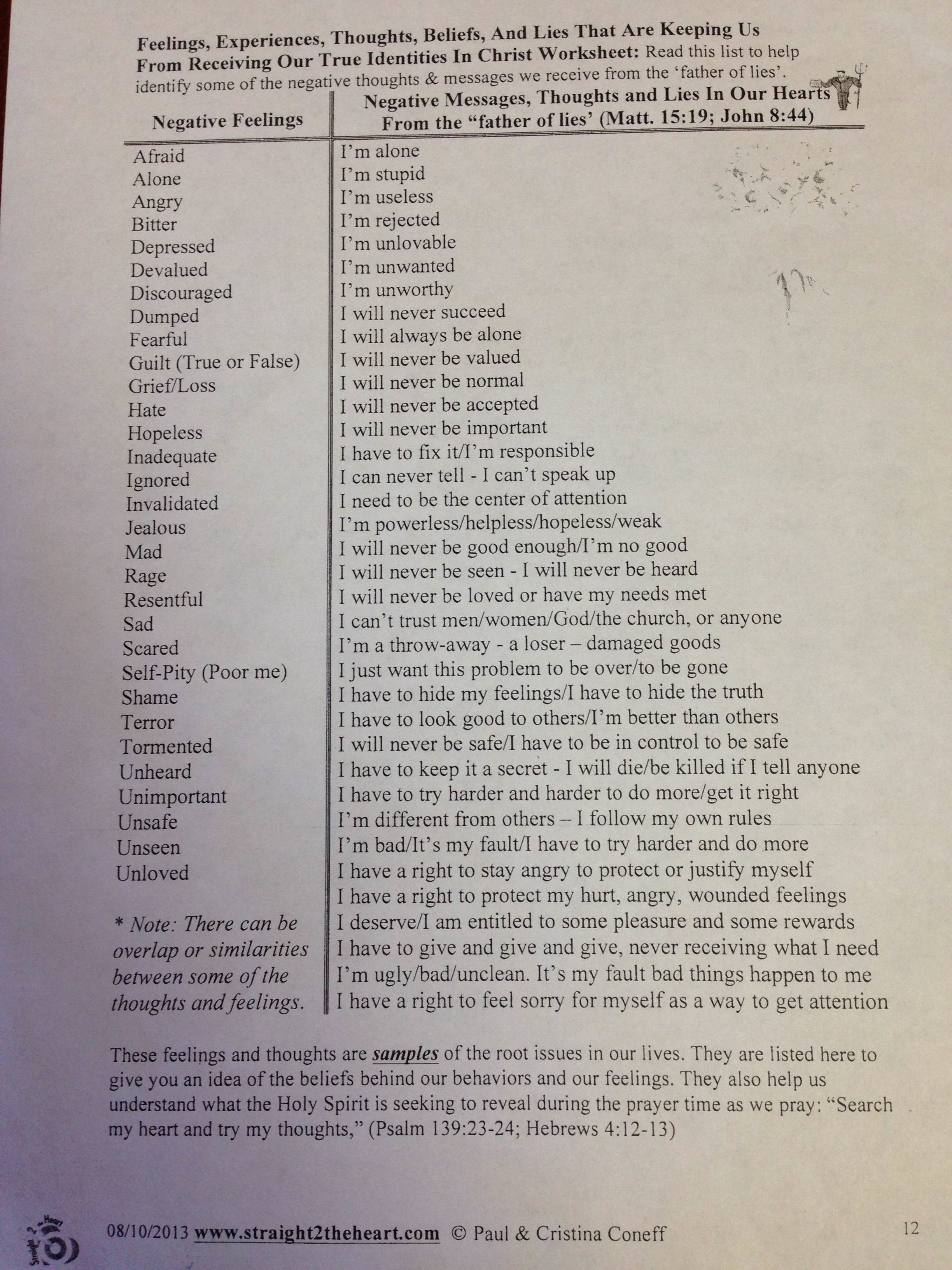
lies
Here is a worksheet that can help you identify the lies Satan may be planting in your mind. I was able to recognize which lies applied to me because they were “thoughts” that ran through my head on a regular basis.

1. The root of our sin and suffering is Satan, the father of lies (John 8:44). This concept of roots is huge in Paul’s ministry. As Paul explained, all our negative behaviors and patterns are merely fruits of deep-seeded roots, or lies, planted by Satan. We cannot fix the fruits unless we first attack the roots. Thus, healing begins by identifying the Satanic lies driving our behavior. Once we know the roots, or the lies, we can take those to Jesus and let him deal with them, which leads to pillar 2.

2. The root of our healing and freedom is Jesus, our Suffering Messiah (Luke 9:22; Rev. 5:5; Col. 2:15; Isa. 53). The suffering of Jesus is the crux of The Hidden Half of the Gospel, and the key to our healing.

As Paul explained, many churches have overlooked this crucial aspect of Jesus’ gospel, instead choosing to focus on Jesus’ death and resurrection. The death and resurrection take care of forgiveness of sins, but often merely believing in and accepting these concepts doesn’t resolve suffering, or the cycle of sin-and-forgiveness. Putting “suffering” back into the definition of the gospel, as Jesus explained it to his disciples (see Luke 9:22), offers hope to those of us stuck in suffering—depression, abuse, addiction, etc.—because it means Jesus didn’t just nail our sins to the cross, but he also nailed our suffering there, as well. The Bible tells us Jesus “suffered and was tempted in every way” that we are tempted, to offer us help when we suffer and are tempted (Heb. 2:17-18; 4:14-16).

Why Jesus Had to Suffer
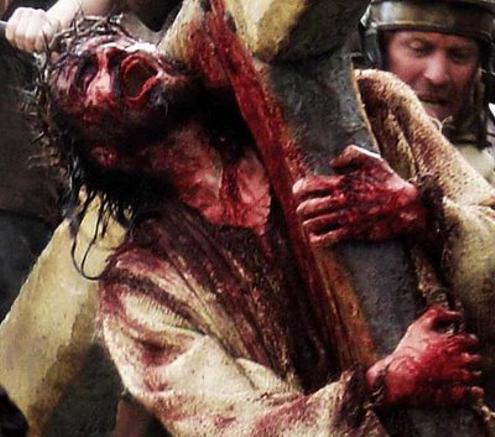
Photo from http://trutheran.blogspot.com/2012/10/the-burdens-of-sin-and-suffering.html

“Have you ever thought about why Jesus’ story had to be so gory?” Paul asked the audience.

I really hadn’t.

“Well, think about it.” Paul continued. “Jesus was abandoned; betrayed; physically violated; shamed and humiliated; and verbally, mentally, emotionally, and physically abused. Now, do you think He understands the pain that abuse victims feel? Does He understand when a parent abandons a child? Was He ever tempted to numb His pain?

“He suffered all these things and more so He could identify with us. So that he could understand every way we are sinned against, and every form of self-protection we develop in order to numb our pain.
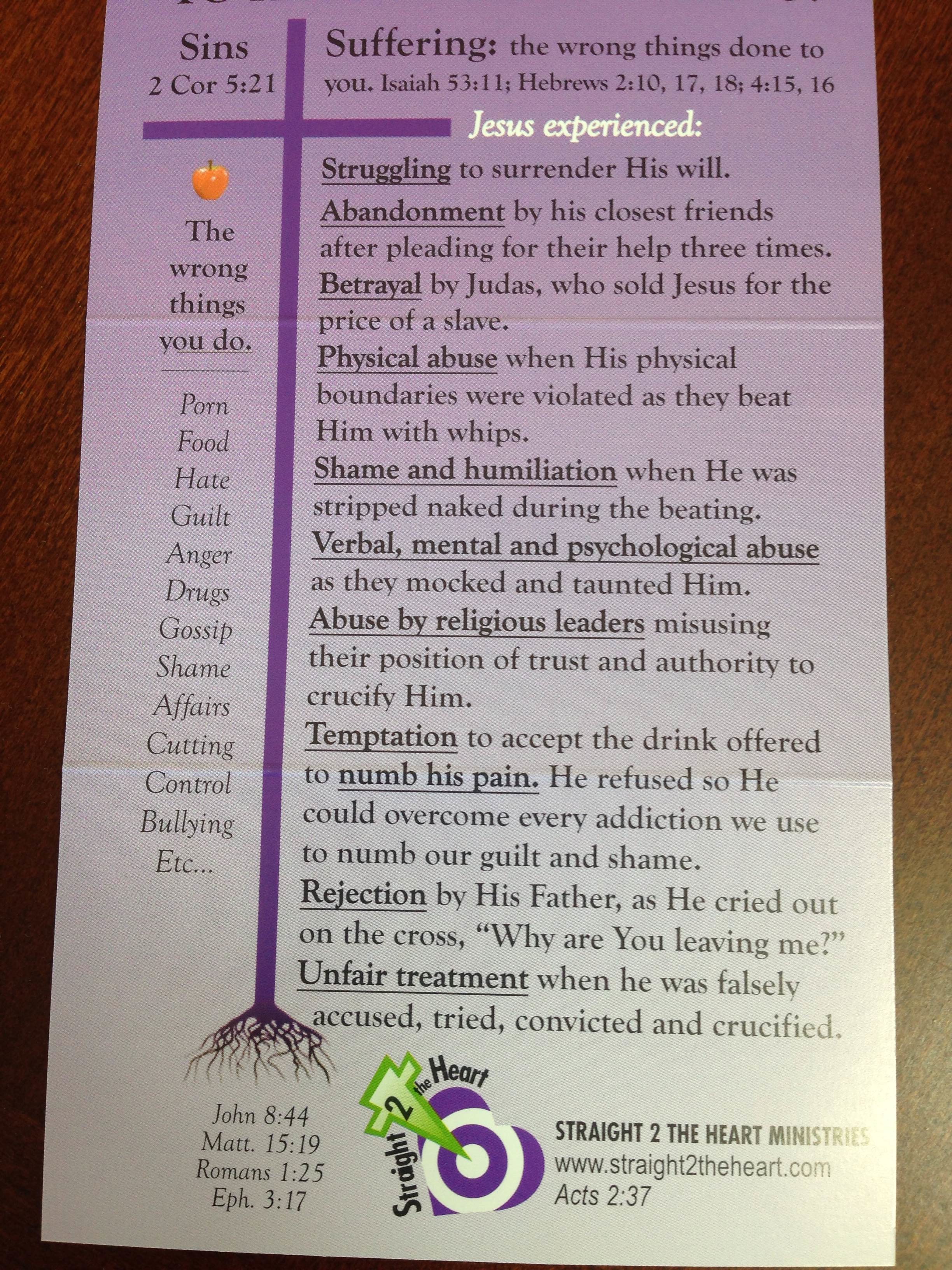
Here is a list of some of the experiences Jesus went through (from the prayer card used during Straight 2 the Heart prayer sessions).

“What’s more, he suffered these temptations  and triumphed over them, which means that when we take time to connect our stories with Jesus, to pray and meditate on what it means that he suffered for us, and became sin for us, we can experience his victory.”

By this time, I was hooked. I wanted this in my life. I wanted a ministry that was relevant to the suffering I’d experienced, and that which I saw all around me.

So I signed on for Paul’s seven-phase, thirteen-week discipleship program. That’s right. A thirteen-week program. This wasn’t any “quick fix.” It was going to be an intense period of praying on a consistent basis, first for myself (to get more healing in my own life before I was expected to pass it on–a requirement of Straight 2 the Heart Ministries) and then for others. I was going to learn at the feet of Jesus (and the seat of Paul Coneff) for an extended period of time, sort of like the first disciples, before I set out to make more disciples.

Discipleship, Small-Group Style
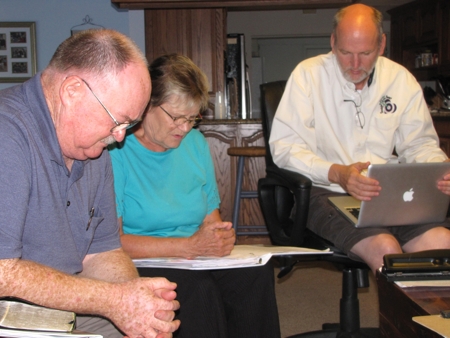
Paul (right) training Mary to lead Charles through prayer.
Paul Coneff (right) training Mary to lead Charles through prayer.

Paul spent the next four months with five of us, discipling us—praying with us, and training us to pray with others. And not quick, clean, thirty-second prayers. These were deep, messy prayer sessions that first asked Jesus to identify our negative roots, and then helped us connect our stories to Jesus’ story. It didn’t end there. We delved deeper, praying, “Lord, what else do you want me to know about these roots in my life? What blessings or barriers are there in these areas?” The prayers were recursive, connecting our stories to Jesus, then having us stop and listen to the Holy Spirit so he could take us one layer deeper into our negative roots. Always, by the end of the prayer sessions, which dredged up long-buried hurts and often tears, Jesus revealed blessings, too. He always brought to mind His promises to combat the negative roots our praying was churning up.

Our training ended, with the goal being that we would start more small groups in our church, beginning with a few men and women, hopefully to grow as disciples multiplied.

My Gateway to New Life at Home, at Work, and in Ministry

My life intersected with Paul Coneff’s message and ministry, Straight 2 the Heart, when I was at a crossroads in my life. I was coming up against the age of thirty, and was finding that pursuing my “chosen” path, graduate school to become a professor, was leaving me feeling empty. Here’s a summary of how God has since rerouted my plans through this life-changing prayer ministry.

Facing Remaining Negative Roots

tree roots
Photo Credit: “Exposed Tree Roots” by Colin Brough

First, Straight 2 the Heart has helped me to be honest about areas in my life that weren’t all healed yet (some of which are still in progress) such as:

  • Anger at the premature loss of my childhood family and, well, my childhood.
  • Resentment at my husband’s happy family (and any happy family).
  • Disillusionment with my church and religion because it “did not help me” in my time of crisis. Straight 2 the Heart helped me to see that my church didn’t help me because it didn’t know how—also, because I didn’t let them know I needed help in the first place. (It also provided the answer for how churches can help, when they have the right tools.)
  • My pattern of trying to control my life in my own strength so it would never get out of control again (or my attempts to never repeat my past depression, suicide attempts, broken family, etc., through over-planning, becoming over-busy, and more).
  • My avoidance of having kids out of the above need to maintain control.

Gaining Deeper Healing 

Second, Straight 2 the Heart has led to more healing for those negative roots in these ways:

  • The decision to let go of the “safe,” but wrong career path of academia.
  • The decision to finally pursue the identity God has for me, which has translated into sharing my story through writing and even teaching. This blog, my memoir-in-progress, and Paul’s and my forthcoming book, The Hidden Half of the Gospel, are all examples of me sharing my story for God’s glory.
  • The decision to have a baby.DSC_7783
  • The decision to be honest with other women, to reach out and accept relationships I had avoided but desperately needed (See my post “Friends in High Places”)
  • I am gaining more appreciation for my church as I look past its flaws (every church has flaws) and see the human beings there. Since deciding to be vulnerable with my own story, I’ve connected with many of these dear people in meaningful ways.  I am getting the authentic “fellowship of believers” experience I missed as a child, when my family was intent on covering up its problems.

Taking the Next Step in Ministry

S2Hlogo
Photo Credit: Cristina Coneff

Third, Straight 2 the Heart has helped me learn how to have a really relevant ministry, or how to help others who are stuck in negative places and patterns like those I’ve suffered. (It is through making Jesus’ gospel relevant to the everyday struggles of life—boldly connecting our messiness to Jesus Christ’s suffering and his full gospel to “heal the brokenhearted and set the captives free.”)

  • My partner in prayer ministry, Amanda, and I, prayed two new young women (now dear friends) through the thirteen-week prayer process, which helped lead them to lots of healing—and baptisms in our church!
  • Amanda and I also trained women at a neighboring church to facilitate the same thirteen-week prayer and discipleship process in their congregation.
  • With the help of Amanda and Mary, our other cohort from our initial 13-week training, I facilitated a third prayer group, consisting of around ten ladies, in my home for several months last fall. This group resulted in amazing healing for many of these women (for marital, parental, and other common problems) as well as facilitating much needed connection between these lovely, but often isolated church ladies.
  • Now I am working on rendering the miracles we saw in these women willing to be honest with one another and with God into the closing scenes for my memoir. I want my story to testify to how one changed life can ripple out to other lives, and still more lives from there. This is what discipleship is all about.

Now, what I’ve left out of my rebirth story (and there’s lots I’ve left out), I am working on telling in my memoir. Why did I call this my “ugly, messy” rebirth story? If you consider a real birth (and I’ve been considering it a lot lately), it’s a messy process. It’s no small thing when a new physical life is created—and the same is true for a new spiritual life. The creation of a life, and the re-creation of a life, are not simple or easy processes. At times they are painful, ugly, and messy—but to get to the birth, or the rebirth, they are necessary. That’s why I have unapologetically included the ugliness and messiness in my story—along with its beauty. Without either, my story would be incomplete.

 Read part 1      Read part 2      Read part 3     Read part 4      Read Part 5    Read Part 6

To read more about The Hidden Half of the Gospel, see the following articles Paul and I wrote on the subject:

“The Fruit and Root of Freedom from Addictions” Part 1

“The Fruit and Root of Freedom from Addictions” Part 2

To schedule Paul to speak at your church or to facilitate a discipleship group, contact him at www.straight2theheart.com.

And if you want to get a copy of our book, The Hidden Half of the Gospel: How His Suffering Can Heal Yours, follow this blog to be notified later this spring when the book is published!


Knowing When to Quit

exhausted
Photo Credit: “Exhausted,” posted on Thayer Memorial Library’s Website

I can talk a good game about living proactively, being productive, and striving for new heights; however, I’ve also found there’s a time to back off. The time is when you’ve made commitments that are not needful, helpful, or healthy for you to keep.

For a few weeks I’d been feeling stressed because I wasn’t finding enough time in my day to work on my memoir. I entered the fall planning to work on my book at least twenty-five hours per week. As I looked at my records for the past month, I saw that I was logging closer to ten. And because my baby’s due date was approaching, this was making me nervous. Could I still get my manuscript done by the time Baby Sam came?

My hubby has often said I tend to keep my plate full to the brim; he’s always known me to be stressed over what I’m not getting done. But since my unexpected breakdown, I had been trying to pare down the helpings on my plate. What had gone wrong?

As I’ve been learning to do when I get in a pickle, I prayed. But this time as I started to pray, my brain felt too scattered to even stay on track (this is a good sign you’ve got too much on your plate, or you’re pregnant, or both). So in my prayer journal, I began with a list of my current commitments, hoping to see a pattern or pick out something I was unnecessarily stressing over.


Let me fill in the background for you about the housecleaning item. In the past two months, thinking I needed to become a better homemaker for the baby, I picked up two books on housecleaning (three, if you count The Happiness Project), and started to try to drastically change my habits, per the books’ suggestions. I had started to feel positively weighted down by the thought of keeping my kitchen sink clean, de-cluttering a little bit every day, and deep-cleaning my kitchen.

When I made the list in my prayer journal and saw the housecleaning item mixed in with everything else, though, I realized something: Cleaning/organizaing my home doesn’t have to be a top priority right now. Especially since I’m not a dangerously messy person (i.e., my dust bunnies are not causing us physical health problems or my clutter creating safety hazards, like some people referenced in my cleaning books).

I asked the Lord to help me set some goals for what I actually needed to do for the time being. He told me, “You can stop reading the housecleaning books right now. If you want to focus on your own book [and I do], read stuff that inspires you to write [books on writing, or memoirs].

“Continue the habits of keeping your sink clean and purging your clutter when you can. But you don’t need to add anything else.”

This was making me feel lighter already. I was next able to list out some new, more manageable goals for my writing each week; although I had to admit it wouldn’t amount to twenty-five hours. This was because my unexpected teaching job had come up at the last minute, and it takes time to create curriculum when you’re teaching a brand new class. This was an item that was not negotiable.

The baby registry and choir cantata were pretty easy to resolve: I’d let them become overwhelming when I saw I couldn’t get the registry done in three sittings (but one more should do it), and the cantata piano music learned in two weeks (hopefully four more will do it—but if not, I have the out of purchasing the performance CD).

While my hubby had told me I shouldn’t feel bad about cutting back on my memoir work, I did feel bad, because this was the single most important thing I’d identified to get done before the baby came. I knew I wouldn’t cut back anymore than I had to, but God did help me see that I was worrying too much about getting the book done in my projected time frame. He helped me resolve this by reminding me that if I got the first section revised and a proposal written, I could start shopping the manuscript to agents/editors even if it was unfinished. This is how non-fiction publishing works, anyway.

Then, God gave me this list of do’s for my guilt:

  • Lighten up
  • Lessen your expectations
  • Give yourself a break. Unpredictable things (like the class and the puppies) have happened lately.

Finally, I realized that God would accomplish his work in his time. I didn’t need to worry about what wasn’t getting done, because he was seeing to it that everything that needed to get done was getting done.

When we are walking in God’s will, or doing our very best according to the light we have (based on reading his word and listening to his voice), we can “quit” certain good things with a clear conscience—and sometimes, to continue walking in his will, we must.

Leaders, Followers, and The Mob Mentality, Part 2

Read Part 1

While I hold to my convictions (and sometimes snobbery) on certain movements (I will never understand waiting in line for hours to see any movie at midnight), I find an abundance of examples proving that mobs can sometimes follow exceedingly good and worthwhile things. For instance, I’ve been simultaneously reading Marla Cilley’s Sink Reflections and Gretchen Rubin’s Happiness Project, both of which are enormously popular, but also, I think, pretty valuable: they offer advice, support, and coaching for improving one’s life.

flylady

Thanks to the “FlyLady,” Marla Cilley, I’m learning more effective ways to de-clutter my house, and because of Gretchen Rubin’s chapter on aiming higher in one’s work (chapter 3), I woke up this morning with ambitions (which I promptly wrote down) to start an actual author website in 2014.happiness project

The Downside of “Good” Mobs, from a Leader Perspective 

There is something funny that happens when I find a guru I admire, though, and maybe this is because I am a leader-type, not a follower: I get jealous of him or her. Rather than just taking the advice for what it is, I wish I had been the one to give said advice. Rather than just browsing Gretchen Rubin’s website and rejoicing over all the great tips she’s giving me, I start to feel pressured to match the greatness of her website. This is a particularly insidious part of being a leader (or the type of leader that I am) because I feel this insecurity not only when I observe “greats” in my lines of work (writing, teaching, blogging), but I feel it when I see almost anyone doing any job well.

This tendency to lust after other people’s talents hurts me more than I’m sure I want to know: Chiefmost, and rather ironically, it derails me from carrying out any task well. When I start admiring someone else’s work too much in the context of wishing I had done that—or thinking, “Maybe I should go get training for that”—I get distracted from what I’m really supposed to do.

For Example…

When I was newly married and trying to decide on a career path, my older brother came to visit us. I hadn’t seen him for almost a year, but when I saw him that time, I was struck with how “religious” he had gotten, and a what a great life path he had taken—he had attended a Bible college that trained him to lead Bible studies and prepare the way for evangelistic series—and I started to feel guilty that I needed to be doing the same thing. The problem was, I was a married woman now, rooted to a definite geographical location: I wasn’t a single person who could just up and just go anywhere for college, or, for that matter, be an itinerant traveler for my work after college (like he had become). As confused as I was about my career options at the time, my brother’s path should have been a clear “no” for me. But because of my personality, as soon as I saw what a good effect taking Bible training had had on my brother, I felt guilty that I wasn’t doing the same thing, and I carried that guilt for years.

Doing The One Thing We’re Meant to Do

The fact is (and what I’m learning as I read “follow-worthy” authors such as Cilley and Rubin and others, such as Bible writers who urge us to find our unique spiritual gifts), we can’t do everything—and we shouldn’t try to do everything. Rather, we must figure out what it is God has called us to do, and then do it. But how do we figure out what we’re supposed to do?

The answer came to my mind almost immediately (God is funny this way):

If you would be a leader in anything, first of all, you must submit. It’s there, all over the Bible: “Humble thyself in the sight of the Lord, and He will lift you up.” “The last shall be first, and the first shall be last.” “  (James 4:10; 2 Pet. 5:6; Luke 14:11; Matt. 23:12, just to name a few references). And let’s not forget that those of us claiming to be Christians are, by virtue of taking that title, also claiming to followers: We are followers of Christ.

So for those of us with leader personalities, we must first learn to submit to the Greatest Leader who ever lived—Jesus Christ. After that, I believe, is when we really start to find our path. As Isaiah chapter 30 puts it (and this is a great chapter to read if you’re struggling to submit or find some direction), only after we have submitted to God and allowed Him to direct us, will we hear “a voice behind [us], saying, ‘This is the way; walk in it’” (v. 21).

I can’t tell you what you’re meant to do; sometimes I can’t even tell myself. But I know this: when I take my eyes off Jesus and start looking to the world for my example (as in, I start thinking I need to become Gretchen Rubin, and not just glean some advice from her book and blog), I become frustrated, dissatisfied, and unfulfilled. I believe God has a specific calling for me that only I can do, and while others may give me some useful tips along the way, I must always, ultimately, go back to the one who can not only lead me, but live in me to help me carry out what I’m meant to do. “For it is God who works in you to will and to act in order to fulfill his good purpose” (Phil. 2:13).


Writing for an Audience

audience
Photo Credit: Auditorium by Ayla87

I started blogging because I needed an audience. After journaling for no one but myself for fourteen years, I needed to start thinking about writing for others, especially since I wanted to write and publish my memoir. I realized I had been self-centered, or writer-based, all those years. What’s more, I realized my previous education (even though I have bachelor’s and master’s degrees in English), had not helped me with the transition to writing for meaningful audiences. But now that I was serious about publishing a book, I had to become more reader-based.

If you’ve done any research on the publishing market, you know that being reader-based is essential to (traditional) publishing. If you’ve done that same research and you had an English education like mine, you might have concluded that many English teachers must not be writers—in the sense of trying to publish their writing.

Most of my English teachers gave me dead assignments, or what my thesis advisor called “orphaned texts” to write: papers that were not meant to go anywhere beyond their desk. My advisor also termed these assignments “autonomous texts”—texts that had no communicative element, no audience, and no purpose. This was in opposition to a superior type of writing situation: the rhetorical situation.

Last week I introduced my composition students to the rhetorical triangle—a way of thinking about writing that places a text in context of a specific speaker, audience, and topic. The major lesson is that if any element of the triangle changes, the text must also change.

Learning to think of writing this way—as a communicative act—has been changing my own writing dramatically. And it has tested me. First, on this blog, I have been forced to confront the self-pitying nature of so much of my past writing—and with that, the uselessness and counter-productivity of said writing. Considering my writing through the lens of a prospective audience has forced me to look in a mirror, as it were, and has helped me clear away the dross of my thoughts for current and future projects. The benefits of blogging have included even more healing for myself while looking in that “mirror,” and a push toward meeting my real goal of book publication.

Incidentally, I’ve just received my editor comments back on my memoir manuscript, which are further propelling me to write for an audience. I’m glad I had the training of eight months of blogging to prepare me to think about meeting the needs of book readers.

Trish Ryan’s assessment was great, pushing me to make some difficult changes I sensed I might need to make, but that I wasn’t emotionally ready to make earlier. I hope I am ready now. Time will tell as I enter the revision stage. Providentially, Trish told me I sent her the manuscript at just the right time to get feedback and intervention. I was glad to read that. I knew I wasn’t done with this project at first draft’s end, but I was at a point where I needed an experienced reader and writer to coach me to stretch limits for my intended audience.

Some of her best advice relating to audience was to lay out my story chronologically. Touché, as I had tried to bury or bypass some hard emotional scenes. I needed her to tell me that the audience needs more facts of my background to understand all the feelings I divulge throughout. She also urged me to err on the side of action versus reflection to keep things moving for readers. She said setting up a more complete background to my story in the beginning would help diminish the need for so much reflection later—readers would better understand my actions with the appropriate lead-up.

With her feedback, I am better equipped to revise my book for my audience, which will mean cutting out some material that was personally revelatory but not globally relevant. Though this may be hard, having  had an audience of one see and validate those parts of my story has heartened me to the task of cutting them from the final draft. (The tougher job now will be revisiting and writing those difficult parts of my past that need to be in the book).

So the final takeaway for this post? We writers, if we want to be published, and even if we just need to heal, need various audiences to push us to self-reflect on what we’re really accomplishing with our writing—and push us to take sometimes difficult steps. In the end, I believe writing for an audience is making me both a better person and a better writer, and it can do the same for you.

Professing—My Unexpected Blessing

With my manuscript deadline at hand, I knew this week would be busy. Before I got the job offer last Thursday, I didn’t know how busy. Suddenly, in addition to finishing my book manuscript in one week, I am becoming an adjunct professor, too!

I got the call last Thursday (six days before my first class—yikes!), and five days later, I am still in awe at God’s goodness. This past year has been all about me learning that when I humble myself in the sight of the Lord, He lifts me up (James 4:10). Repeatedly broken to knee-point this past year, I have found peace in the surrender to Jesus and His plans for me. I gave up certain plans I thought would not pan out (such as a PhD and professing at my alma mater) to follow new directions in which I felt called: authorship and parenthood. (By the way, we are supposedly finding out the baby’s sex this week, too!)

It was when I surrendered the professing idea that we got pregnant and the book really started taking shape. I thought: “This is okay; God’s really got this.” I haven’t been making any serious money for two years, but I’ve been faithfully sowing seeds in hopes that they will grow into a money tree (er, some kind of career), however small.

By sowing seeds I mean writing my memoir, which goes out to a professional author/editor this week for a consultation. The book is not in its final form, by any means, but at 256 pages, it is a complete draft that says, more or less, what I want it to say. There’s a part of me that wants to keep polishing it, but mostly, especially after faced with having to prepare a semester’s syllabus in a couple days, I think it wise to give the book (and my brain) a break while other eyes ponder it. It will be good to focus on something else for awhile and then come back refreshed to revise in a month or so.

The one-class professing gig on Mondays, Wednesdays, and Fridays (which happens to be right down the road) will be the perfect vehicle for me to do just that.

And I was just starting to miss the classroom a bit.

Today I can only shake my head and marvel at the wisdom of God’s plans and His timing. Maybe this turn of events doesn’t sound like that big of a deal, but for me, it is. I used to have such issues with needing to be in control of my future. I didn’t handle unknowns well. I got physically sick from anxiety. But since learning to let go (and please know that sometimes I still need remediation), life has become a joy, full of surprises and good gifts from the hand of God. Now, instead of being just a professor, or just a writer, or just a parent, I am suddenly all three! Daily I am reminded that God “is able to do immeasurably more than all we ask or imagine, according to his power that is at work within us” (Eph. 3:20).

If you’re struggling today over the plans for your future, or if you feel physically or emotionally sick from not knowing what’s to come, why not ask God to take the reigns and pave the path for you? He might not make things clear right away, but if you earnestly pray, you can rest in the knowledge that even when we don’t know what to pray for, “the Spirit himself intercedes for us through wordless groans.…And we know that in all things God works for the good of those who love him, who have been called according to his purpose” (Rom. 8:26, 28). Finally, when we put God first, we can rest in the promises that “there is no want to those who fear the Lord” (Ps. 34:9), and God shall supply “all” our needs “according to the riches of His glory in Christ Jesus” (Phil. 4:19). Amen!

For some inspiration today, check out the song “When I Let It Go” by Sierra. This is a throwback to one of my dad’s favorite Christian groups from the 90s, and lately it has brought me to tears (in a good way!).

This time I’ve got to trust You
I’ve got to accept Your plan
I have tried to guide my circumstance
But there’s just no way I can
When will I learn this lesson
Your ways are not like mine
Lord, help me to surrender
The control I try to have on my life
When I let it go
You take my hand and gently lead me
Then You let me know
Just how peaceful my life can be
When I let it go
Your never-ending blessings
Like a river start to flow
When I let it go
Too many times I’m searching
For the things I think I need
When I try to look for more
I always seem to give You less of me
Lord, help me gain this wisdom
My foolish mind still lacks
‘Til I find a way to let go
Of the part of me I’m holding back

Birthday Blessings

flowers
Photo Credit: Flowers by Just4You

Today is my 29th birthday, and I can’t think of a better way to spend it than sitting here at my favorite breakfast place writing, reflecting, and thanking God for the blessings of the past year. Here’s a recap of how my personal and professional lives have converged (and diverged) over the past twelve months—showing me how God takes a very personal interest in the mundane details of my life.

Last Summer

I was fretting over what I saw as conflicting desires, including the desire to write, teach, and (though I didn’t much tell anyone), have a baby. God started to drop things into place when Paul Coneff of Straight 2 the Heart ministries asked me to help him write his first book, The Hidden Half of the Gospel. During July of last year, I was also starting to write my master’s thesis (eventually 100 pages), which was a perfect warm-up for the book-length project I was taking on. Now busy with writing, I tabled my internal baby discussion for the time being.

2012-11-08 22.27.41

Last Fall

I was still working fervently on my two writing projects, but there came pausing points in both works, during which time I was left with nothing to do but finally start writing what was in my heart. Four notebooks and one month later, I had the rough draft of my memoir and the beginnings of this blog down on paper—both would wait for January for further development.

I looked around one day on campus and asked myself if this student life was what I wanted for five to eight more years. I didn’t see how that life would allow me to be the parent I knew I’d want to be—if we decided to have kids.

One day in October, while writing a paper for my last graduate class, I broke down at my computer and finally faced the truth: I was tired of this solitary student life; I wanted something more. I called my husband in tears and he came home early that day to take me on a walk-and-talk through the local state park. As I unknowingly acquired poison ivy, it was a relief to hear myself finally saying words I had been repressing for a long time: I want to have kids (this was a fun scene to write for my memoir).

In December I completed my master’s program and sent out two graduate applications—one MFA, and one PhD—just in case we didn’t conceive, and just in case God still wanted me in graduate school.

girl on bench

Last Winter

I did not get into either of the grad programs I applied to, which told me that was not God’s plan for me right now. I went off birth control in January, began this blog, and started officially calling myself a writer.

I spent the early months of the year feeling lonely and a bit depressed—now I was alone in our big house all day long, getting to write, yes, but without the promise of much people time during my days. I started really missing my family in Minnesota, whom I hadn’t seen since the previous June. I also realized I had been taking my husband for granted for most of our eight years of marriage—putting him on the back burner as I worked on emotional issues, self-improvement, and career development. I decided to be more family oriented.

Around the same time, God also brought many friends into my life to help alleviate my loneliness. This told me that God could meet my need for people contact with or without a baby.

Amanda and me

Last Spring

In May, when I wasn’t expecting it, I found out I was five weeks pregnant. Yay! We had a fun time surprising our family with the announcement, as most hadn’t been reading this blog and didn’t know we were trying. I rededicated my efforts to finishing my memoir “before thirty,” and now I also vowed to try to finish before baby.

2013-01-09 23.52.05

Currently

I have just returned from two weeks in Minnesota—probably my last trip to see my family before baby comes in January (I am four months along today). While in Minnesota I attended my ten-year class reunion and felt additional closure about God’s plans for my life. Though visiting Minnesota always makes me wistful, I clearly saw God’s wisdom in moving me away almost nine years ago. Visits back home used to be hard—brought painful memories—but more and more they bring happiness. Now, my husband and I are talking about getting a summer house in MN in a few years—which prospect fills my heart with joy.

My memoir is going well, and I have made contact with a favorite author of mine, Trish Ryan, who has agreed to consult on my book in late August to help me prepare it for publication (my hubby is giving me a “loan” because I told him it would be a good investment!). This fall I will be searching for an agent and/or publisher as I prepare for this baby’s arrival—and hopefully this winter I will have both a healthy baby and a manuscript headed for publication. The healthy baby is more important, of course—the book would just be a bonus. Regardless of how long it takes to get the memoir published, The Hidden Half of the Gospel will be published long before my next birthday—showing me that God heard my “before thirty” prayer six months ago.

It is 10:10 as I finish writing this, and my dentist’s office just texted, “Happy Birthday, I hope you have many reasons to smile today!” I am happy to say, “Yes, I do!” Today, I am smiling about my immediate future that will consist largely of family time, writing time, and more Minnesota time—and that doesn’t even compare to my eternal future!

Thank you, Lord, for taking such a personal interest in the mundane details of my life. Today I praise you for how you care about my heart’s desires and how you’ve led, not just for the past year, but for the past twenty-nine years.

Choosing the Write Path


2013-03-13 02.48.54

After breaking down from ministry overload, I started really questioning my priorities, and over the past few months I’ve had some definite impressions: Maybe God wants to fulfill me in ways I never dreamed, not only by making my love my life’s work, but also my mode of ministry. I’m talking about writing, of course.

You see, something I’ve been struggling with since I’ve been staying home to write is balancing my “work” life with my ministry life. I’ve tried setting goals for myself, such as writing twenty-five hours a week…and I can’t explain why accomplishing this has been so hard when I don’t technically hold another “job.”

As I’ve been praying about this, God has suggested some reasons for the difficulty: I’ve been too controlling of others, I’ve taken it upon myself to provide for others, and I’ve allowed myself to get pulled from my writing to do jobs that I really shouldn’t be doing. This ranges from using my daily writing time for ministry emails or phone calls to saying yes every time friends suggest an outing. Lately I’ve also recognized a danger of losing all focus on my work because I get too involved with other people.

I have struggled to place my work time above “people” time—it’s become hard to sort out when to say no and when to say yes. My hubby always encourages me to go for the people time: “Take a break!” he says to his chronically busy wife. But after several months of frequent “breaks,” I feel I’m too often setting aside work. I’ve been documenting my writing hours each week, and sometimes I’m struggling to even reach ten or fifteen. Lately I have the added challenge of being short on energy due to pregnancy—so my “usable” hours have shrunk. I literally don’t have energy to do as much as I used to.

So, I am forced to choose.

The things I do are all “good” things. Building ministries, building relationships, writing an inspirational book. But I can’t do it all. What should I do?

I have some other impressions, I think, telling me I have to focus on my work right now. Because it might be my calling. It might be the single most significant way I’m meant to minister to others. If this is true, therein lies the answer to my work/ministry balance. My work is my ministry.

Right now while I’m still unpublished (bookwise) it’s hard to see it. The fruits of my labor are not yet tangible, as they are in my prayer ministry, church choir, and former Bible study. I see no immediate return. This is where faith comes in. What if Noah had given up on building the ark during the 120 years before its use?

For now, I am praying for God to give me more faith. I need clarity and insight, too, in case I am misguided about what God really wants me to do. I need to know for certain if these impressions about writing are my true calling—and then, if they are, I need to resolve to walk in the path God has placed in front of me. That is, if God has appointed me to write for my life’s work and my ministry, I need to stop being distracted by other “good” things, and let him bring forth fruit where I’m most fertile.

“Look straight ahead, and fix your eyes on what lies before you. Mark out a straight path for your feet; stay on the safe path. Don’t get sidetracked; keep your feet from following evil.”

(Proverbs 4:25-27, NLT)

Some Keys to Being Freshly Pressed

key
Photo credit: “Key” by debsch

After achieving the feat of being Freshly Pressed, a sort of fear can set in, along with  negative thoughts like these: “I’m going to screw up!” “My next effort won’t be as good!” “I’ll disappoint all these new readers!” Happily, I’ve only had these feelings mildly, and they’re not sticking around. Instead of fear, I mostly feel hope. Rather than daunting me, the Freshly Pressed Status has buoyed my confidence as a writer (a writer whose work people want to read!), and it has encouraged me.

The Surface Answer

So, you want to know how to get Freshly Pressed? (Before last Tuesday, I wondered that, too.) The easy answer is that you just have to keep writing and hope one of your posts gets picked. On the day produced my “pressed” post, I was just doing my regular thing. I was praying and reading the Bible like I do every morning, then I started scribbling about the issues my prayer time had revealed to me. I let the writing sit for a weekend, and then on a busy Tuesday when I almost didn’t think I’d post, I tweaked a bit, paired it with a picture, and posted. It was one of the easiest pieces I’ve published, in fact, because I didn’t expect much out of it—not like some past posts I’d edited into mincemeat (hoping to be “pressed”).

It was a complete and total surprise when, three hours later, my inbox greeted me with: “Congratulations! You’ve been Freshly Pressed!” For the next few days I soaked up the extra comments, likes, and follows—and thanked God for blessing me when I wasn’t even asking.

The Deep Answer

Maybe that’s a key to receiving blessings: to stop trying to force them.

I think back to the small string of writing successes I’ve had so far. (You can liken my writing to whatever dream you’ve carried for most of your life.) In all honesty, when I’ve succeeded in writing, I wasn’t much expecting it. Conversely, when I’ve most expected to succeed, often I’ve actually flopped.

I know I’ve talked to God a lot over the years about my dreams. Heck, he was aware of these goals even before my birth. But when I started chasing them in the beginning, it was like I wanted God on call, ready to answer at the moment I asked. I was selfish (not that I’m a saint today, but I’m slowly learning patience). I wanted to be published, and I wanted it when I wanted it, in the way I wanted it.

Some Instructive “Flops”

In 2010 I prepared a manuscript based on my “oh-so-interesting” teenage journals and figured this just had to be my first book. After a pause in the project, during which time I encountered some pushback from one of the main “characters” in the memoir, I realized maybe this sensitive material wasn’t yet “book-ready.”

In 2011, when I was re-entering graduate school with the dual goals of professing and writing, I identified a PhD in Creative Writing program one hour away from me that I thought would be “so much better” than the bland rhetoric program I was currently in. So I fretted my way through months of manuscript and application preparation, then lay awake at night with knots, willing and wanting so badly for this to work out—only to be rejected a few months later.

In 2012 I tried again, this time a distance MFA program that specifically catered to writers of faith. This, I was sure, was the vehicle through which I would make my plans—my plans—happen. Only, I didn’t get in.

Today I’m not sorry I attempted that now-dead manuscript and those fruitless applications. I think it was good for me to try, especially since I felt God nudging me toward writing and I didn’t sense him expressly forbidding those things. Where I went wrong was becoming too bull-headed to recognize that God had other, better ways to make my dreams come true besides those few paths I could see.

Doing Our Part, Letting God Do His

So it is with any endeavor. Maybe we don’t exactly know if the thing we want is the same thing God wants, but we feel it might be. In that case, I believe our part is to work faithfully—do our homework, hone our craft, practice it, and perform it to the best of our ability (so we are not presuming on God)—but after we’ve done that, we should let go and let God.

When we live our lives like that, quietly and diligently doing those things that (to the best of our knowledge) God has appointed us to do, we might just be pleasantly surprised one day when our faithful efforts pay off. Since I’ve made writing a part of my daily routine (and dropped those arbitrary, self-imposed expectations, such as “the writing has to result in X”), I’ve had a few of those pleasant surprises, including three published (and paying!) magazine articles, a co-book project, and most recently a Freshly Pressed blog post.

It’s fun to get good news when you’re not expecting it. That’s not to say we shouldn’t expect good things from the hand of God. We should.  But we shouldn’t try to dictate what those things will be. As I’ve learned, God has a vast storehouse of blessings for me that I’m not able to see—and it’s bigger and better than anything I could ever come up with.

Today my prayer is that I will faithfully do the task God has given me while letting God be God, trusting that he will reward me according to his promises and for the purpose of his glory. If you need to get re-centered on what really matters today, I recommend reading Psalm 119 in its entirety, as I did this morning.

Dear Lord, “Turn my heart toward your statutes and not toward selfish gain. Turn my eyes away from worthless things; preserve my life according to your word. Fulfill your promise to your servant, that you may be feared.” (Psalm 119: 36-38)

How to Make Your Dream a Reality

Rule number 1: You have to DO something.

surfing
Photo credit: felipedan

It sounds really obvious, but so is most of the advice in any self-help book you can read. I complained for a lot of years that my dream of publishing a book was not coming true, but, um, it was no wonder. For a lot of years, I wasn’t doing anything about it. So then, one day, I sat down and started to write. And promptly ran into a problem.


Rule number 2: Push through roadblocks, however slowly

road sign
Photo credit: Jazza

It could be a lack of time, a mental block, or a naysayer. For me, my roadblock was not the oft-cited “writer’s block”; rather, every time I tried to sit down and write that book I had in my head, I’d be reduced to tears for the memories the work brought. And then there was the naysayer. Someone told me my book idea wasn’t respectful of my family…and I should reconsider what publishing it would do to them.

No matter which roadblocks you’re facing, there is always a way to keep going. For aspiring writers (or aspiring whatevers) with little time, the best advice I know of is to set a realistic goal for yourself, whether a daily or weekly goal, and stick to it. Maybe you’ve only got fifteen minutes a day. Maybe you’ve only got one hour a week. Whatever you have, build that time into your schedule, and then guard it with your dream.

When I started having those toxic emotional reactions to my work, which literally could incapacitate me from living the rest of my life, well, I shut down for awhile. But in hindsight, I realize that I eventually found other ways to keep moving in the direction of my dream. I came at it from another angle. Although I wasn’t yet ready to write that book in my head, I started reading up on the publishing industry, and I started reading about honing my craft. As I did this, I put the naysayer out of mind, and hoped for a better day to write and publish my book. And this leads to rule number 3.


Rule number 3: Learn from the masters

apprentice
Photo credit: krayker

So, how did you first develop that precious little dream of yours? I’d just bet it was from watching someone else who was doing that very thing, and saying to yourself, “I want to do that someday, too!”

So here’s the deal: the same place you go for inspiration—be it a bookshelf, a rodeo, or a runway—is the same place you should go to apprentice for your craft. Once I identified memoir as my medium, I became a student of the genre. Not only did I read books about how to write memoir, but I read memoirs. These days I have become a sponge for these things, keeping them by my nightstand, on the coffee table, and in my CD player in the car (audio books). Where I once read only for entertainment, now I read for craft and technique, story development and organization. I read with a critical eye, judging a book’s execution and effectiveness, asking myself, is this a technique I could use? Is it one I’d want to use? Whether a memoir is well done or not, I learn from it.


Rule number 4: Work through personal problems to clear room for your dreams

thinking
Photo credit: brainloc

Okay, this is probably the hardest rule to follow, and I can’t tell you how to do it; I can only point you to a blog post describing what worked for me. But if you do have some kind of mental or emotional block impeding your work, there must be something you’ll eventually have to deal with before getting on with your dream. If you have to “take time off” from your project to get your life or emotions in order, by all means, do it! This is not wasted time, because when you come back to your project free from the impediment, you will find that you have a vigor for your dream that you never had before.


Rule number 5: Set a deadline with measurable goals

list
Photo credit: mimwickett

This rule will vary from person to person, and obviously your timelines and deadlines can change. But the thing here is to write down steps, measurable goals, that will move you closer to your dream, bit by bit. If you can give yourself a deadline and stick to it, you will be much helped, as most people operate best with a deadline.

For myself, after I started doing something and I learned how to keep plugging away at it in some form, even when it was hard; after I had started bathing my mind in masterful examples, and after I had worked through my poisonous personal problems…I came up with a schedule for completing my dream that I’m hoping will carry me through to completion. For now, I am trying every day to “move in the direction of my dreams,” even if it means only fifteen minutes of work. I hope you will do the same, and good luck!

A Schedule for Completing My Dream

 The working title of my dream, AKA my memoir, is 1,000 Miles: A Memoir on Recovering Family, God, and Dreams from Depression. Below is the schedule I came up with for myself last week to help me push through to completion.

Note: When I made this schedule, I already had a rough draft of my book, so when I say “finish” a section, that means refining the roughness and filling in the gaps.

2013-01-09 23.52.05

 July 2013

  • Finish sections 3 and 4, and revise sections 1 and 2
  • Locate a professional editor to edit my book (Yes, even though I have a master’s in English, this is a piece of advice I’ve heard too many times to disregard.)

August 2013

  • Finish Sections 5-7
  • Ask 10-15 friends/family members to read my manuscript
  • By Friday, August 30, Send manuscript to editor, and to ten other readers

September 2013

  • Write book proposal/query letter and identify agents/publishers to query
  • Hopefully receive manuscript back by end of month

October 2013

  • Revise Manuscript based on feedback
  • Polish query and book proposal if needed

November 2013

  • Query 10-15 agents and/or publishers beginning of month (first round)

December 2013

  • Query 10-15 more agents/publishers (second round)

January 2014

  • (Baby due!)
  • End of month, follow up with first batch of queries

February 2014

  • Query 10-15 more agents/publishers (third round)
  • End of month, follow up with second batch of queries

You’ll notice I’ve left room for “failure,” by including several rounds of querying agents. Maybe, by God’s grace, I won’t need more than one round. But if I do, I will choose to see it as a learning process, and I will just keep moving forward…until, one day, I either get accepted, or my thirtieth birthday is upon me—at which point I will try another angle, and publish on Amazon (plan B). Blog readers: If you are interested in being one of my manuscript readers after August, please let me know!