Here’s something a little fun and different. Fellow blogger and author Luanne Castle nominated me to participate in the Work in Progress Blog Tour, so today I have an excuse to give you a preview of my memoir.
The rules of the blog tour are:
Link back to the nominating writer
Post the first few lines of the first three chapters of the work in progress (I included my prologue, as well)
Nominate a few other writers to do the same
Luanne began her blog, writersite.org, a few months before I began blogging in January 2013, and we have been following each other’s blogs for about that long. Not only does she blog, but she has a PhD and an MFA and has taught writing for fifteen years. Most recently, she published her first book, Doll God, which is a book of poetry. Luanne has been a delightful blogging colleague, and I look forward to one day reading her current work in progress, a memoir called Scrap.
My Work in Progress: All Things New: My Journey to Rebirth, Recovery, and a Relevant Faith
As for my own memoir, or work in progress, I have been resting from it since last August, when I queried a publisher who immediately asked to see the entire manuscript. In January, that publisher emailed to tell me they were still evaluating the work, and that “no news is good news in this case.” So I am hopefully awaiting more news!
Synopsis
From a young age, I decided that for faith to make sense, it had to make a difference in my life—a good difference. But when my childhood home gave way to an affair and other family secrets, our Christian beliefs had little to offer me. I fled to college desperate to shed my sad, secretive self. Unfortunately, at college my sadness only intensified; my thoughts turned suicidal. A college dropout, failed suicide attempt, and forty days in a mental hospital were my devastating launch pads into adulthood. They were also the beginnings of a decade-long search for a relevant God. Beginning with a blind date in Texas with a “nice Adventist boy,” a new family, and a secondary teaching job, and culminating with a life-changing prayer ministry, I finally found a Savior who suffered in every way I did, and then I shared him with other women who desperately needed a relevant faith, too.
Prologue
I can never tell, I thought from the back pew of a Texas church. What would they think of me if they knew what I was really like? A few months ago, I was the mysterious Minnesota girl who had showed up on Buc’s arm one Sabbath. Next, I became “Buc’s wife” and “Pastor Gendke’s daughter-in-law.” Buc and I had married in the quiet of my in-laws’ living room, with his father, the retired pastor of my new church, officiating. But we had not invited anyone. I had no wedding shower. There were no formal introductions.
Chapter 1
Playing the Game
1991
Bass notes, synthesizers, and Amy Grant’s alto voice drifted through the sheet that covered my doorway. I winced, pulled my blankets over my head, and rolled over. It was starting again. This was how every Saturday morning started. Just like light after complete blackness hurts the eyes, the drums from the cassette tape hurt my ears, drove me deeper beneath the four-deep pile of covers that substituted for central heating. Dad’s Sabbath music.
I smelled coffee, turkey bacon, and waffles. Dad’s cooking.
Suddenly I remembered: Mom was gone.
Chapter 2
Home Life
1994
Mom’s bare feet made a sucking sound as she peeled them, one after the other, off the blood-red linoleum, muffin pan in hand. That morning she wore her gray cargo pants and Dad’s blue flannel coat as she served breakfast. We thought the paint would be dry this morning, but it hadn’t dried over night.
Chapter 3
Bombshell
1998
I had big dreams the year my life crumbled. Days before I turned fourteen, my family moved into a newer, nicer house just outside of town. I thought life could only get better from here.
I Nominate…
C.C. Yager–a fellow blogger and author who recently published a novel, Perceval’s Secret, the first installment in a developing series. Cinda has been a great online writing “colleague,” faithfully following and commenting on my blog and posting quality articles on the craft, process, and business of writing.
Trish Ryan–a favorite memoirist whom I hired as my book consultant and who helped me through two drafts of my project. I first discovered Trish and her memoir, He Loves Me, He Loves Me Not, in my local library. Hers was one of the first quality Christian memoirs I had read, and her book and her feedback proved invaluable to me as I revised my manuscript.
Addie Zierman–another memoirist who has challenged Christians to overcome the many cliches we cling to. An MFA graduate and fellow Minnesotan, Addie has just finished her first draft of her second memoir, which follows up her debut When We Were on Fire. I read her memoir to get another example of a Christian memoir, and I have continued to read her blog for her beautiful prose, bare honesty, and unique perspective.
Good luck to these writers, and all of you, who have a work in progress!
We memoirists might look like gluttons for punishment, because writing about real life hurts, and no one makes us write but ourselves. But for many of us, writing about real life is just an extension of our “Perfect Melancholy” personalities; we write about our lives because we have to do something with all that self-analysis happening in our heads.
I’ve been reading Personality Plus by Florence Littauer, and the author’s description of my Melancholy personality hits home more than other personality tests or training I’ve taken. Other tests labeled my personality in less negative terms— Analyzer or Empathizer, for instance. But Melancholy cuts right to the chase. It describes me to an M.
The evidence is overwhelming—I am introspective, moody, artistic, and depression prone—and the personality test was indisputable. I am Melancholy through and through. True to Littauer’s description, I have been saddened by a small thing to which other personalities wouldn’t give a thought (the label of my personality); and more introspection is the result. I want another personality. I don’t want to have to work so hard to be happy. I don’t want to be Melancholy.
People who study personalities have long observed that artists and writers are commonly Melancholies, as opposed to Sanguines, Cholerics, or Phlegmatics, and this could be good or bad, depending on where you stand.
If you’re the one consuming the art, Perfect Melancholy is great: its existence enriches our culture by providing life-enriching and thought-provoking art.
If you’re the one providing the art, or struggling with “genius” tendencies (Littauer’s word, not mine) that you have trouble harnessing, Perfect Melancholy can be excruciating. Littauer notes that while Melancholies have the highest potential for achievement, they also experience the “highest highs and the lowest lows.” To my Melancholy-colored glasses, this data forces me into a dilemma that’s definitely false, but that seems so real: Would I rather be a “genius” (in writing), or be happy?
The Misery of Memoir
For much of my life, pursuing my art meant misery. All I could write about was my life; and my life, for a good chunk, was sad. Why didn’t I pick another topic, a happier topic, to write about? I go back to the personalities. Melancholy couldn’t get its mind off itself. I was trying to process hard things in my life, and as a writer, I naturally processed through writing.
Because it didn’t yet feel safe to talk about some of those sad things, I especially needed writing as an outlet. I had a strange relationship with writing, though. On the one hand, I felt like I needed to write to survive. On the other hand, what came out of my pen felt like it might kill me.
For almost ten years I would waffle on writing my story—I mean writing it for an audience as opposed to venting in journals. Typically here’s how it would go: I get the desire to write, I pull out old journals for inspiration, I spend a few hours working with the material, and I end up in a pool of tears because it hurts so much, followed by a crumpled heap in my husband’s arms because I am not ready to confront all the emotions these memories bring up. Then, I stuff the emotions, the memories, and my writing aspirations for another few months or years, only to repeat the process again and again.
Melancholies Can Write Happy Endings Too
This blog has borne witness to some of the healing process that finally got me writing again…and writing not only with sadness, but with gladness. God gave my story a happy ending. He not only redirected some of my worst circumstances, but he redirected my mind.
Now, even when more bad circumstances arise—which they inevitably do from time to time—I don’t have to give in to Melancholy. I don’t have to collapse in despair because “that’s just the way things are, and that’s just the way I am.”
God’s Word gives me a more accurate measure of how things really are, and how I really am. You might say he gives me a better personality test, or the ultimate Truth meter:
Though outwardly I am wasting away, yet inwardly I am being renewed day by day (2 Cor. 4:16).
The sufferings of the present time are not worthy to be compared with the glory which shall be revealed in me (Rom. 8:18).
If I wait on the Lord, he will strengthen me (Ps. 27:14); Isa. 40:31).
I can learn to be content in whatever state I’m in, knowing that God will supply all my needs according to his riches in Christ Jesus (Phil. 4:11, 19).
He will keep me in perfect peace if my mind is fixed on him (Isa. 26:3).
I can remember that weeping may endure for a night, but joy comes in the morning (Ps. 30:5).
And I can be confident that, even when progress seems slow, he who began a good work in me will keep working on me until Jesus comes back (Phil. 1:6).
Yes, this world is sad and often hard to navigate—especially, I think, for us over-analytical Melancholies. But this world is not the end, it is temporary and passing away, and that is life-giving knowledge I can cling to.
Yes, I am sinful and fallible and moody and depression prone. But Jesus didn’t come to this world to suffer and die to leave me that way. He came to pull me out of the pits, physical and mental; to retrain my mind on him; and to change me, from glory glory to glory, as I behold him.
And so the story continues. Many mornings I wake feeling unhappy by default. My Melancholy personality (and Satan) doesn’t want me to be happy. But as I make the choice, day by day, to seek God’s face, he gives me strength for what’s in front of me. So I keep praying through it, keep writing through it, and keep moving forward, little by little. A lot of my days end better than they start, because throughout the day I exercise my faith and allow God to smooth out the bumps. These are small rewards, little happy endings, that point me on to the day when Jesus comes to take me home, and give me my ultimate happy ending.
Most people agree that “Honesty is the best policy.” But as a writer and ministry leader who has made honesty her central message and MO, I wonder if it’s possible to sometimes be “too honest.” Not a few times as I’ve posted unflattering, embarrassing, content, I’ve wondered: am I hurting my influence by being so raw and real? After people read this, will they still look up to me?
I’ve found that honesty, at the level I go, can be hard to find in Christian writers, teachers, and leaders. Many I’ve observed in this group like to use honest illustrations and anecdotes…of other people’s struggles. Or, if the stories are first-person, they tend to remain on a safe, surface level. I once read an article by a Christian who used the analogy of scrubbing her floor to illustrate the filthiness in her heart. But she made no mention of what, exactly, was in her heart. “Scrubbing my dirty floor made me think of how God has to scrub my heart clean of sin. I thought, how much better if I kept it clean daily, instead of letting it all pile up?”
Illustrations of the gospel like this one don’t resonate with me. It’s not that they’re bad or untrue, it’s just that they’re so general, so vague so b-o-o-o-o-ring. Worst of all, illustrations like these are generally unhelpful when it comes to making real changes to behavior.
At the risk of assuming other humans think like I do, I would submit that humans long for authenticity. Especially when we’re talking about faith. If our sources of inspiration don’t hit close to home, addressing real issues we battle daily, they will be perceived as impotent, laughable, and even painful (because they minimize our struggles)—and they will be quickly abandoned.
That’s why I chose to be vulnerable in the memoir I wrote about discovering my new life in Christ.
It’s why I choose to be vulnerable almost every time I post on this blog.
I believe people are hungry for other people to relate to them—to say “I’ve been there, too. Look how screwed up I used to be, and how I still struggle sometimes. And yet, look what God was able to do with that mess!” I believe messages like this bring hope.
But what if I’m wrong? What if messages like this do the opposite? What if brutal honesty breeds distrust in God and disaffection for his “honest, messed-up followers?”
When leaders decide to be honest, this is a very real risk we take—the risk of our followers unsubscribing because we are not perfect.
I am willing to take this risk, not only for the reasons I listed above, but because a genuine Christian faith should not hinge on the words and deeds of any human being. (In other words, no one’s faith should hinge on me.) It should hinge on the person and words of Christ.
When Leaders Disappoint
A few years ago I was deeply disappointed when I learned that one of my spiritual heroes, Leo Schreven, committed suicide. Honestly, I felt betrayed and somewhat deceived by this man who previously appeared to “have it all together.” But I was able to weather this bad news by clinging to the truth that God is not, and never will be, totally represented by those claiming to be his followers. When we see good in Christians, that is from God. But when we see bad, that is from the enemy. We can’t lay every quality at Christ’s doorstep, because not every quality is from him.
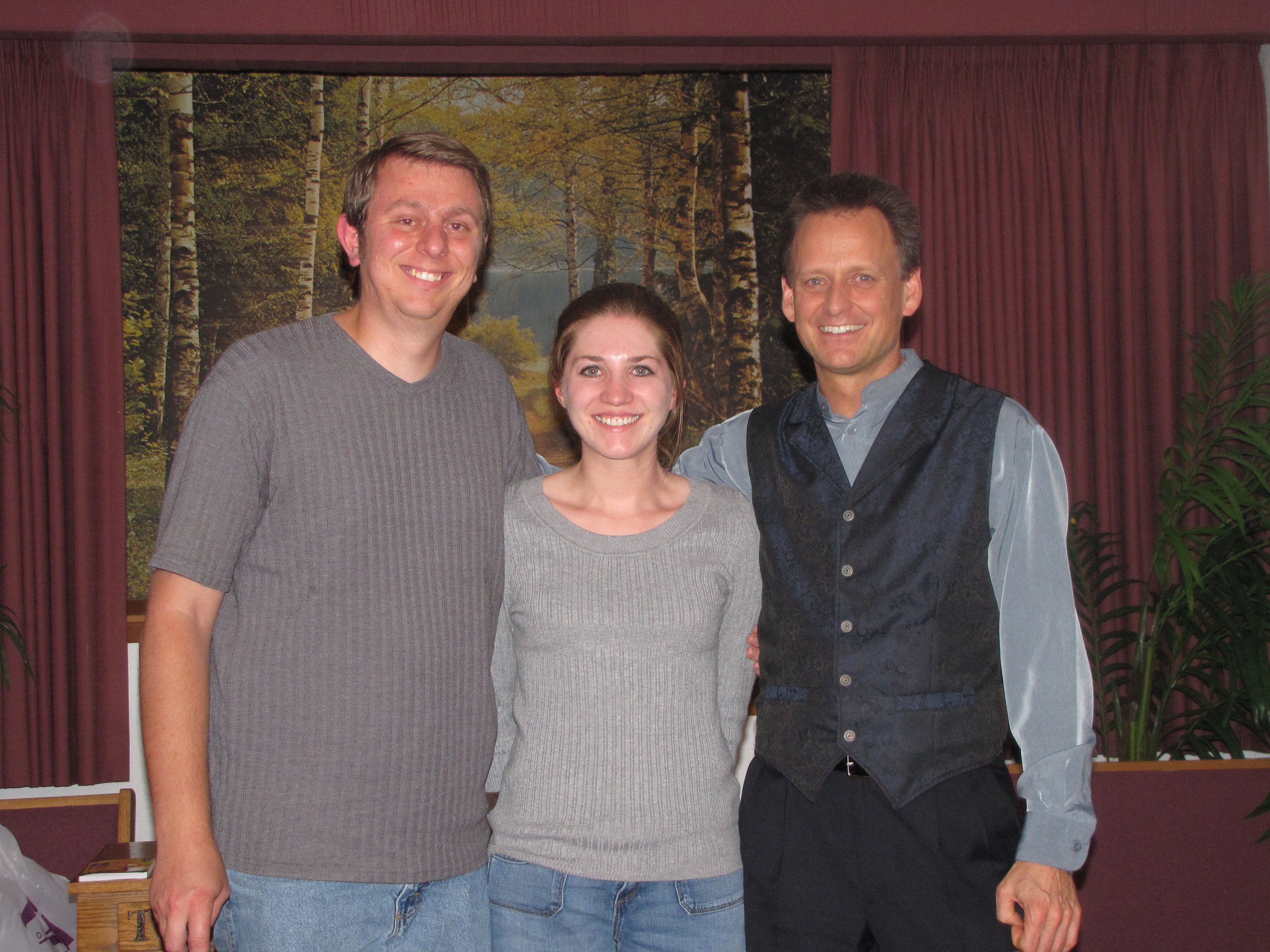
I had the privilege of meeting Leo Schreven in 2010 when he conducted a seminar at my church. My husband (left) had met him many years before and introduced me to Leo’s preaching through a set of seminar tapes that made me eager to meet him.
One quality I do believe is of God is the quality of honestly engaging our struggles as we seek His healing. I think I would have still respected my deceased spiritual hero if, in life, he had openly admitted his struggles. Perhaps I would have respected him even more for choosing bravery, rather than bravado—even though his brave sharing would have painted him as a fallible, sinful, wounded human being.
I have to add something here, to be fair. A family member of Leo Schreven’s contacted me after reading my blog post about Leo’s suicide, to tell me that my “hero” had struggled with psychological problems the public knew nothing about. This family member wanted me to have a fair, truthful view of Leo. The truth included mental illness, and as a former sufferer of mental illness, I empathized with that. I understood that I had put Leo on a pedestal. I also understood that his mental state may have precluded him from the type of honesty to which I am calling spiritual leaders.
Given the state of Leo’s mental health, it’s actually amazing that he enjoyed the long and successful career as evangelist and motivational speaker that he did. I have had similar thoughts, of course, about the late Robin Williams. Leo and Robin show us that there are exceptions to the standard of honesty I am putting forth. The exception applies to those who are not able to help themselves, or not able to let God help them, because of mental illness, or a genuine medical problem. Maybe they keep up the façade for the public for awhile, but in the end, we find out they are not the leaders we wished them to be. But then again, no one in whom we place our trust is immune to struggles, and to sin.
The Bible says that all have sinned and fallen short of the glory of God, so we know every person, Christian or non, ministry leader or not, has a mix of good and bad.
No matter what we know to be true about our leaders, hopefully we can sift the good from the bad, and remember and respect them for their good qualities. Hopefully we can go on learning from them, no matter what their lives reveal. Sometimes we may observe the right course, other times the non-example. As long as we are looking up to human beings, we should expect both. And if we are the ones being looked up to, we must trust Christ to be the one shining example our audiences need; we must be okay with being imperfect representations of him.
That said, I believe that we in positions of trust—ministry leaders, Christian writers, etc.—should do our best to represent Christ, and this includes being honest about how God is working in our lives and transforming our sinful patterns. We should also be honest about “wilderness” times, times when we struggle with our faith…but we should do it wisely.
Guidelines for Christian Leaders
Here are two guidelines I’ve found helpful in my own writing and ministry that can help Christian leaders determine when, where, and how much to share.
freedigitalphotos.net
1) First, we should consider timing. You can read various sins and struggles of mine on this blog that occurred at various stages in my life. I blog about problems long past and problems of last week.
The safer type of post is the one about problems past. These problems are ones I have likely had victory over. They are problems that have yielded personal lessons I can use to teach others. These types of posts, and this type of sharing, should be an absolute “yes” for all ministry leaders. Why wouldn’t we use our stories of redemption as teaching tools? What better examples of the gospel could we present than the ones that have played out in our own lives?
The murky area is problems of the present. How much should Christian leaders share about present problems? Here, we have to be wise about audience.
2) Audience is the second consideration. Consider who will be reading or hearing your message. If you are a preacher and it is your job to inspire hope, then it may not be the best time to insert a struggle that you do not have victory over, or at least cannot yet talk about in a positive way.
Sure, there are times when you are on the upside of a struggle—you can see the end in sight, and you are pressing through for victory. That might be material for an inspiring message, and if you are comfortable exposing that yet-unresolved pain, go ahead.
But other times, pain and sin is too raw to project to a large, or public, audience. That’s when you need a small, confidential audience. I’m talking a few trusted friends or advisors who can help talk and pray you through your problems. When you have worked through those problems, then they may become appropriate large-group material. But don’t rush it. Getting outside voices mixed up in your current personal problems could hurt the healing process, and you need to get healthy first so you can go back to being your motivational self.
One caveat for leaders working through personal problems: if your challenge handicaps your ability to do ministry, whether because the emotions involved take too much energy, or because a sin you are fighting “disqualifies” you to be a role model at the time, then it’s probably the right time to step out of ministry, at least for awhile. In the case of Leo Schreven, I would have much preferred hearing the news that he had stepped out of leadership for awhile to tackle some personal problems to hearing that he had committed suicide. We are ultimately the most helpful to others when we get the help we need, first.
On This Blog, What You See Is What You Get
To apply my guidelines to myself, I routinely post about my current struggles, but many times I have chosen to remain silent until I have prayed over them and exposed them to Scripture and the wisdom and counsel of a few trusted others. By the time I post on an issue, I want it to be, if not totally resolved, at least on the path to resolution. I want others to look up to me, yes, but I am happy to admit that sometimes the best example I can give is: “Look, I’m broken here, but I’m looking to Christ. And if you feel the same way, you need to do the same.”
By posting my struggles, past or present, I risk losing my readers’ respect, but I also keep myself accountable to Christ for resolution. I put a problem out there (such as my sleep-deprived, desperate, witchy state), and I say, “Okay, this is the mess this sinful world, or sinful me, has created today. But now, how am I going to find Christ in the middle of it?” My mission is to find out how Christ will come through for me, and then to share my victory with my readers.
Indeed, if “Superwoman Christian” is the role model you want, look somewhere else. Because on this blog you’ll just encounter a broken girl trying to depend on Christ, and trying to work out her faith, in all things big and little. After all, as so many examples in the Bible show (Kind David and the 51st Psalm come right to mind), a Christian leader worth listening to is not someone who claims to be above sins and struggles, but someone who fully admits their weaknesses; has learned how to let Christ lead in the hard times; and can discern which, of all their life experiences, will be helpful for lifting others up.
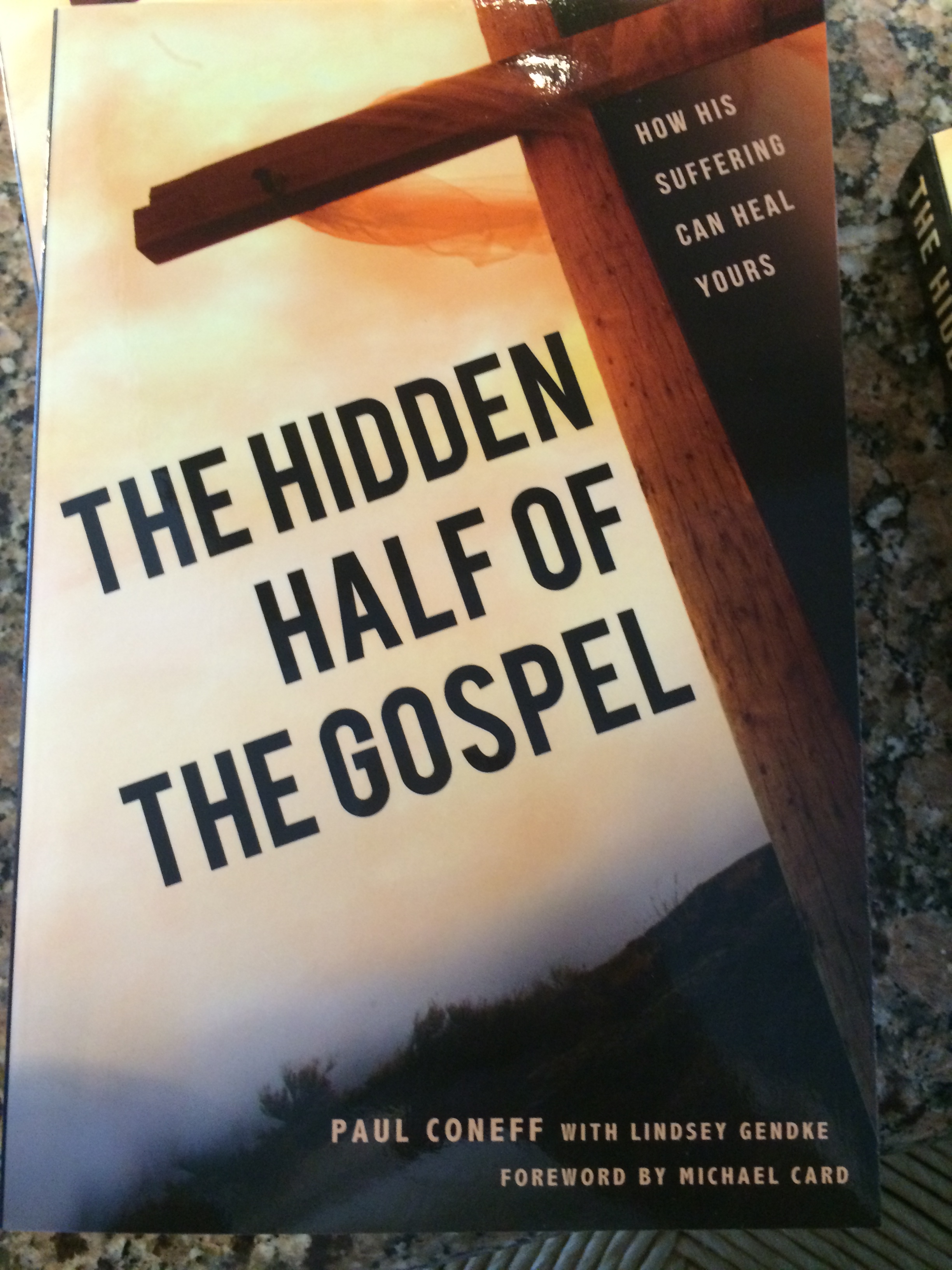
The Hidden Half of the Gospel is now in print, which means it’s time for me to sound promotion bells; but how about I just use a recent, personal example, to tell you why so many people (and maybe you) desperately need this message?
The other day I was listening to a radio show hosted by one of my favorite pastors. People call in with Bible questions, and this pastor answers them, usually with lots of scripture and high caller satisfaction. But one caller on the show did not receive a satisfactory answer.
Essentially, this caller wanted to know how he could get free from his past. He was fifty-two, had been abused as a child, and was still living “in bondage,” even though he went to church and prayed for the peace of the Holy Spirit. How, he wanted to know, could he experience the “new life” Christ promised, and the changes he read about when a person gets the Holy Spirit?
My heart broke for the man as the pastor proceeded to give pat answers that blatantly sidestepped the man’s apparent pain. “Let me ask you a question. Have you ever been to a funeral where the deceased sat up and complained about his past?”
“No.”
“Well, we can’t focus on the past. It’s done. As we drive through life, we can’t keep looking in the rearview mirror. We have to focus on what matters for eternity. We need to give the past to Jesus and then look to the future with him. Our pasts won’t matter in heaven. We need to believe that Jesus forgives us of our past sins and our guilt.”
Here I thought to myself, He totally didn’t address the man’s question: “How do you help someone who is trying, but is not experiencing, the Holy Spirit?” I wished I could contact this man and offer Paul’s and my book, The Hidden Half of the Gospel: How His Suffering Can Heal Yours. I wished I could talk to that pastor and give him our book, too, so next time he got a call like that, he could offer some real help: a complete picture of the gospel that not only addresses healing sin, but also healing suffering.
The Traditional Gospel Doesn’t Help Everyone
Sadly, this pastor was merely presenting the “status quo” gospel that so many Christian pastors, and Christians, promote. That is, “Christ died for our sins and rose again to forgive us and give us a new life.” Sounds nice. It is nice. This gospel has changed millions of lives. But what about those people who have already tried this gospel, who go to church and pray regularly, and who have even accepted Jesus’ forgiveness, and still live in bondage?
Today Christians and non-Christians alike live in bondage to things like divorce, abuse, addiction, depression, and cutting/self-harm (to name a few). More tragically, many Christians live in bondage to the negative thoughts and lies Satan slams us with in the aftermath and in the midst of these problems. Which means we end up living out false identities long after the initial pain of, say, childhood abuse.
I was one of those desperate people only a few years ago (see my seven-part series “My Ugly, Messy Rebirth Story“). But then God taught me what it really means to live a new life. Over a period of several years, I learned about Satan’s lies and how they take root in our minds and handicap our lives.
It’s insulting, and discouraging, when pastors or Christians tell us we should be “over it” just like that. It doesn’t work. And that’s why we need a better gospel, a complete gospel—the gospel that Paul Coneff unearthed as a young pastor in his search to minister to hurting individuals like that fifty-two-year-old Christian caller.
Jesus Preached a Better Gospel
When Jesus said He came to heal the brokenhearted and set the captives free, He didn’t just mean He would heal us when He came back again at His second coming, or set us free from our prisons of darkness when we get to heaven. His promise was for here and now. And that means it includes more than the gospel of forgiveness of sins. It has something for those of us who have been sinned against.
Our book, The Hidden Half of the Gospel, starts right where you are: in the midst of your misery. It doesn’t ask you to deny it or forget it, because that’s stupid; it’s impossible. Correction: by ourselves it’s impossible, but with God all things are possible. Specifically, for those of us who are suffering, healing begins with Jesus Christ’s life of suffering, and the promise that “He suffered in every way we did” so He could offer us his mercy and grace to help in time of need” (Heb. 2:17-18; 4:14-16). In our book, Paul and I flesh out the implications of these promises through stories of real individuals (like myself) who needed a Savior in the midst of suffering, and who found one who understands our pain exactly, because He has been through it.
Jesus was abandoned, betrayed, and abused; He was unfairly tried, convicted, and crucified; and in the midst of all this, he felt forsaken by his Father. As a “man of sorrows, well acquainted with grief,” He knows that we need time to heal, and He doesn’t expect us to do it overnight. He only asks that we look to Him and the victory He accomplished at the cross. As we look to Jesus and allow Him to tell us about the lies and wounds in our hearts, He can uproot them and replace them with a new identity. If this sounds like a message you could use, or one that you’d like to share with others, please visit hiddenhalf.org. There, you can read sample chapters, and if you like what you see, you can order the book. Happy reading!
Get a Discount on the book: When you click “buy the book,” the next page offers a discount box. Type in “HIS-story” to receive a 20% discount through October 31.
It’s hard to move on with life when your home is in shambles. I say this because of the never ending construction going on in my house right now—but I also mean it in the emotional sense.
Did you grow up in a home with lots of fighting? Uncertainty about the future? Fear that Mom and Dad might split? Then you might know what I’m talking about. It’s hard to move on, it’s hard to grow up, when your home life is in shambles.
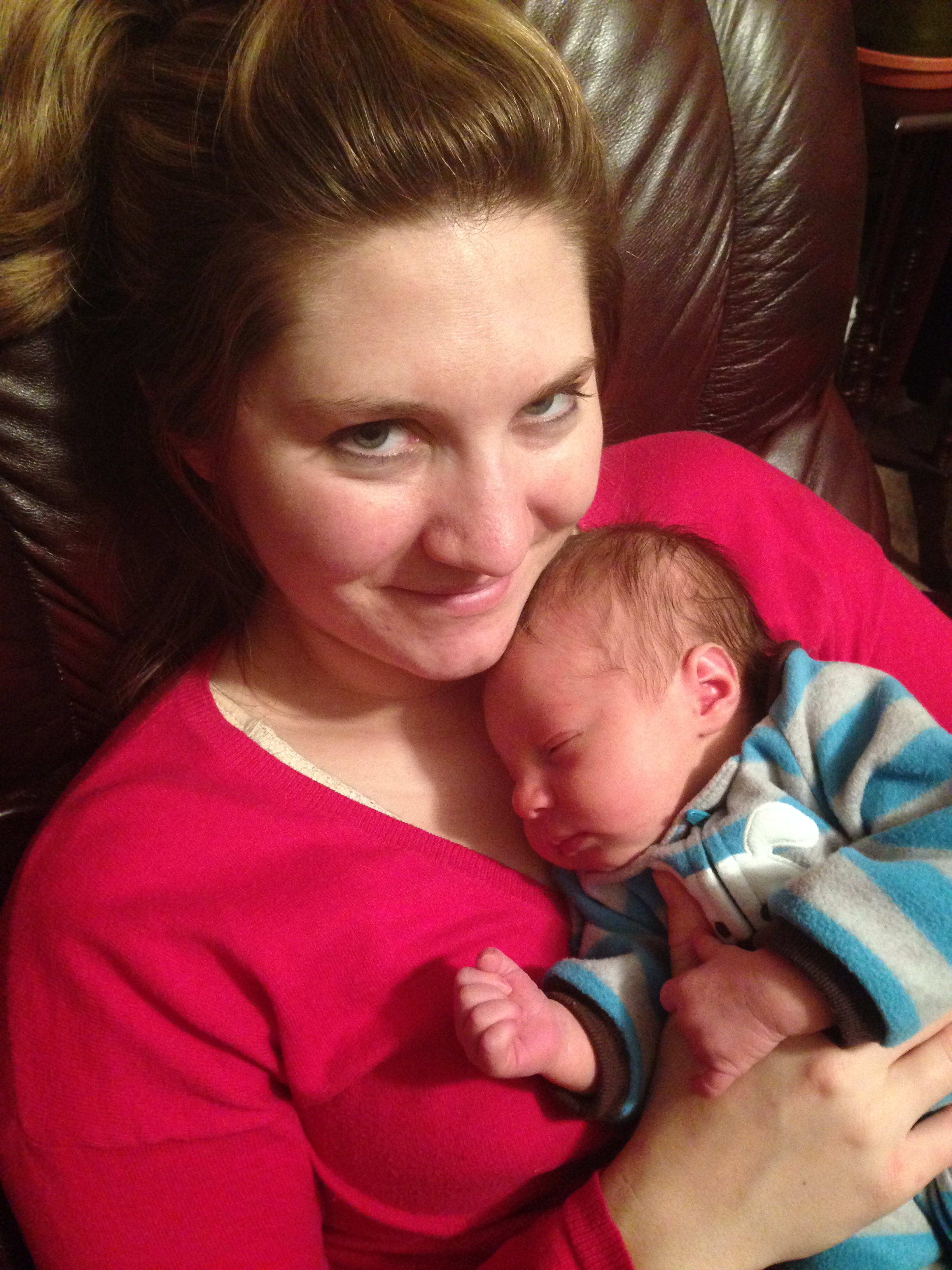
Today I had trouble focusing on my to-dos, primarily because my house is a wreck and has been for almost two months. When I finally got Sam down for a nap, I had to pray extra hard and reread my index cards of Bible promises just so I could move on with the day. My brain felt so cluttered I knew I could not be productive unless God cleared things up. The verse that most calmed me: “Thou wilt keep him in perfect peace whose mind is stayed on thee” (Isa. 26:3). As I concentrated on God, my scattered thoughts, well, scattered. And then, Sam woke up…an hour and a half before he was supposed to (grr). Glad God calmed me beforehand!
I wish I had learned to rely on God earlier in life. When I was a teenager, my home was in shambles, in the emotional sense, and I suffered in many ways, for many years to come.
I didn’t rely on God. I relied on keeping busy to numb my pain. I relied on building up myself and my skills, determined to acquire things that no one could ever take from me. In the early years, those things included a straight-A record, a good reputation, and lots of experiences to pad my college applications. In my adult life, they translated into two college degrees, a full plate at church, and a teaching career: AKA, resume builders.
These things aren’t bad in and of themselves. But they’re bad when you do them to avoid confronting your pain. Life gets lopsided really quickly when you do those pain-stuffing behaviors to the detriment of everything else.
I’ve come a long way from the life I’m describing. I finally gave up the career chase to have a kid, for one. And I’m making a concentrated effort to relax in my thirties (wait, did I just contradict myself?). But I still feel myself lagging behind in plenty of areas.
Because I married when I was twenty, I’ve been able to shunt many adult responsibilities onto my husband’s plate: paying bills; navigating home, life, and car insurance; and setting up internet service, to name a few. I don’t know the cost of our monthly bills, and I wouldn’t know who to call if our electricity went out. Perhaps, most shamefully, I still don’t understand how to read and/or fill out a W2 (or is a W4?) when I start a new job. I am always embarrassed at needing help to fill it out. (But amazingly, I don’t take the time to correct this lack of knowledge).
For that matter, many, many things around me go unnoticed, things I should know just by virtue of living on planet earth or living in Texas.
Exhibit A: When I was twenty, I voted in my first presidential election without knowing the difference between Republicans and Democrats.
Exhibit B: When my parents visited from Minnesota and we walked around my neighborhood and they asked, “What kind of tree is that?” “What kind of plant is that?” “What kind of bird is that?” I had to repeatedly answer, “I don’t know,” “I don’t know,” “I don’t know.” I did not know, and I did not care.
Exhibit C: Sam was born with a large birthmark on his shoulder (I mean LARGE), which turned out to be an “infantile hemangioma,” or a benign tumor, according to his skin care specialist—and when my friend asked me about the long-term effects and other basic questions, I had to answer, “I don’t really know, but the doctor said not to worry, so I’m choosing not to.” Shouldn’t a mom be curious about these things? Shouldn’t she bother to know? Nonetheless, I still haven’t done any research.
Why don’t I bother to know more about my surroundings, or my son’s skin condition?
Probably the biggest reason is I feel my brain only has so much room, and to overload it is to risk meltdown. (That must be a lie, a bad root, I gained in adolescence—I’ll have to pray about that one some more.) Similarly, I have trouble adding new things to my routine: for instance, everyone tells me I need a Pinterest account—”It would make life so much easier”—but the thought of having to regularly check one more website confounds me (keeping up with my blog is hard enough!).
I simply don’t have room in my brain to accommodate one more thing. Which is why I used to be oblivious to the news. My husband would ask me what I thought about some really big news item, and I’d respond with a blank stare. Happily, caring for Sam has helped me to turn on the news almost daily (I get bored with bottles and diapers all day), so my news knowledge has increased about 100%.
My point is that I’m still decompressing from growing up in an emotionally messy home. For many years it took all my energy to put one foot in front of the other and take care of myself (I didn’t realize that God already had my back)—how could I care about the world around me? It’s only by God’s grace that I’m here today, somehow swimming in the current of adult life.
God has been gentle with my transition back into the world, giving me a loving husband and plenty of guardian angels to guide and protect my uninformed, oblivious steps. It’s hard to move on, it’s hard to grow up, when your home life is in shambles. But by his grace, people can do it. And because of his goodness, I am.
With the help of a generous sister-in-law, I have returned to writing my book. One day a week until the end of the school year, she babysits Sam so I can write.
How has it been, reentering this manuscript I put aside three months ago?
There is the feeling of visiting a foreign country, as well as the feeling of returning to terrain I know very well. Above all, there is a clarity about the message of my book—and with that clarity, knowledge of what to cut and what to add. I surprised myself by spending most of my recent writing time cutting unnecessary chapters or scenes. Whereas several months ago I couldn’t have imagined cutting these scenes, now, there was no doubt about it: they had to go.
These cutting decisions signal so much: not only a writer’s process, but also a woman’s healing. Let me explain.
One of the standout tips I received from my professional book consultant last fall was: After the first few pages/chapters, cut the crying! (She elaborated: instead of describing your crying, describe for readers what made you cry). And related to that: Add in scenes with other key characters so we are not left alone with you and your brain for 300 pages.
In recent months I’ve thought a lot about how this advice relates to my memoir, which means I really have been working—thinking, planning, pondering—if not actually writing. I realized I had lots of crying in my book—in lots of solitary scenes, and my consultant helped me realize that this was not the best approach for a general audience. The types of books most people want to read are built around action, not a person sitting and thinking (and crying).
As I thought about why my first draft was sopping wet, I realized I wrote it for myself, and perhaps for the handful of friends and family members who read it last fall. Writing all those solitary crying scenes was a way for me to acknowledge how alone I felt in my pain. Having several loved ones read that manuscript allowed me to share that part of myself—and it felt good. Now I feel vindicated: that part of myself has not been shoved into a closet. However, that part of me (though present in the book) will not be the book’s focus.
What I am working on now is describing more of my healing, less of my hurting. To set the stage for why I became so broken (as requested by my consultant), I had to write over 100 new pages for the book’s beginning, just so readers could understand what led to my suicide attempt, eating disorder, sudden move to Texas, and shotgun wedding. But I am trying not to draw out the personal anguish after that (plenty of other memoirs excel in that area). As suggested, I am trying to show myself in contact with others—how I began to relate in more healthy ways to my family, and how I eventually extended my healing insights to others: my high school students, and then women in my church.
The new theme of the book, and maybe the new title, is “breaking silence.” I want to encourage readers who have suffered not to stuff their pain, but to get it out and deal with it—in the proper venues, of course. I believe I could have healed much faster had I not learned to hide my issues from friends, close family, and church family. What good are friends and family if we can’t tell them what’s going on? What good is religion and faith if we can’t get healing for our brokenness at church, and/or among our Christian friends? With my revised memoir, I hope to paint a picture of how honesty with ourselves, with God, and with certain loved ones is the right thing, the healthy thing, and the healing thing to do. Readers can take my advice or leave it, but for my book and my own health, I’ve learned honesty is a must.
Each time I think back to the moments of my son’s birth, these lines of poetry (which I studied in high school) come to mind:
My father groaned! my mother wept.
Into the dangerous world I leapt
(The real poem, “Infant Sorrow,” by William Blake, transposes the mother and father, but I remember the mother as the one weeping.)
See how I wept? I tried to hold them back, but as soon as little Sam exited the premises, the tears gushed.
I had what could be considered an “easy” labor and delivery, with an epidural that worked like ecstasy. But towards the end, I felt the tears on tap.
When he arrived “helpless, naked, piping loud,” these signs of life undid me. Finally, it was over. He was alive, he was healthy, and I could relax. Later, when I lay back watching my family gush over the baby, my eyes watered again. I felt a sense of love and pride thinking, “We made that!”
Was there any better feeling in the world?
Those early tears were for relief and joy, but as two weeks have worn on, other tears—of frustration, bewilderment, and sometimes resentment (when I’m running on vapors of sleep)—have followed. After a few days, I wasn’t sure I could do it anymore. (You should never trust your instincts when running on three nonconsecutive hours of sleep or less.)
In the first days, visitors and callers broke up the monotony, distracted from the sense of helplessness I otherwise felt when alone with baby Sam for several hours. A friend emailed to say she made it through the first two weeks just fine, but when the commotion died down, postpartum depression set in. The D-word. A word I was once well acquainted with. But I’m not D these days, unless D stands for (sleep) deprived.
My tears (which are becoming less and less), and the periodic panic that “I’ll never find time to write or finish my book or blog again” are just par for this course, especially for a new mother who took almost thirty years to decide on this course.
Amidst all the crying, feeding, sleep deprivation, and diaper changing, there are moments of every day I find myself just gazing at this new baby—our little miracle. It helps to look down at my son, even during one of the eight to twelve daily breastfeeding sessions (this alone is a full-time job!), and remember that the creative power of God that brought this precious, heart-stealing baby into being, is the same power that animates me, both physically and mentally. It is the same power that animates these other dreams I have–the dreams of writing and publishing that sprouted long before my dream of a baby. I must trust God that he will teach me how to live this new life. He will bring peace out of this (sometimes) chaos. One day, he will help me marry these two wonderful parts of my life. And one day I will again sleep through the night. Until I do, I won’t worry too much about the tears of new motherhood.
After giving my life to God, I was always on the lookout for tools to share my faith. I didn’t feel I was particularly good at this part of the Christian life, and I thought it was because I hadn’t yet found the right method. Enter Paul Coneff and The Hidden Half of the Gospel.
Paul conducted a week of prayer at my church in the spring of 2012, and after just the first night, I knew his message was special: I sensed it might even be the missing link in my life and ministry, this “hidden half” of Jesus’ story. So, what was it? And how, if I’d been in church almost my entire life, had I missed it?
The Hidden Half of the Gospel
Paul began his presentation with a question: “What did Jesus do more of while on this earth: Teaching or healing?”
Healing was the obvious answer. Then Paul asked, “Why have we [churches and Christians] reversed Jesus’ model of ministry? Why do we do more teaching than healing, when he did more healing than teaching?”
He continued, “Now let’s say that I am sitting in my office and I am studying for a sermon. Some church member comes in and says, ‘I have been struggling with guilt and shame from an abortion.’ Is it easier to turn to that messiness and brokenness of her life, or is it easier to do a Bible study on the character of God? Give her some scriptures on forgiveness and say, ‘You know God has forgiven you,’ pray with her a thirty-second prayer, and walk away. Which is easier?”
His point? Many churches, and Christians, don’t know how to handle messy problems like this one (other common examples being pornography addiction, abuse, eating disorders, infidelity, and cutting ), so we don’t–meaning we don’t offer the help so many people need. He went on to prove his point with a concept he calls the “cycle of sin-and-forgiveness.” Many Christians come into the church and get forgiveness for their sins, only to fall back into their patterns of sin. Then they ask for forgiveness, but continue to sin, again and again and again. (In my own experience of praying with women, I’ve also seen a pattern of wallowing in guilt over past sins that the person is no longer committing.) Paul continued. “Why is it that so many Christians who have accepted the ‘good news’ of Christ still are not free?”
Photo Credit: Peacefulparenting.com
I was riveted. Exactly! I said to myself, remembering how my parents had been wooed into the church with lots of good information and had gotten baptized, only to leave our family scattered and scarred by an affair and divorce (see parts 1, 2, and 3).
For the first time, I saw my problems standing stark naked in church, and I was desperate to know: How can the church address these issues?
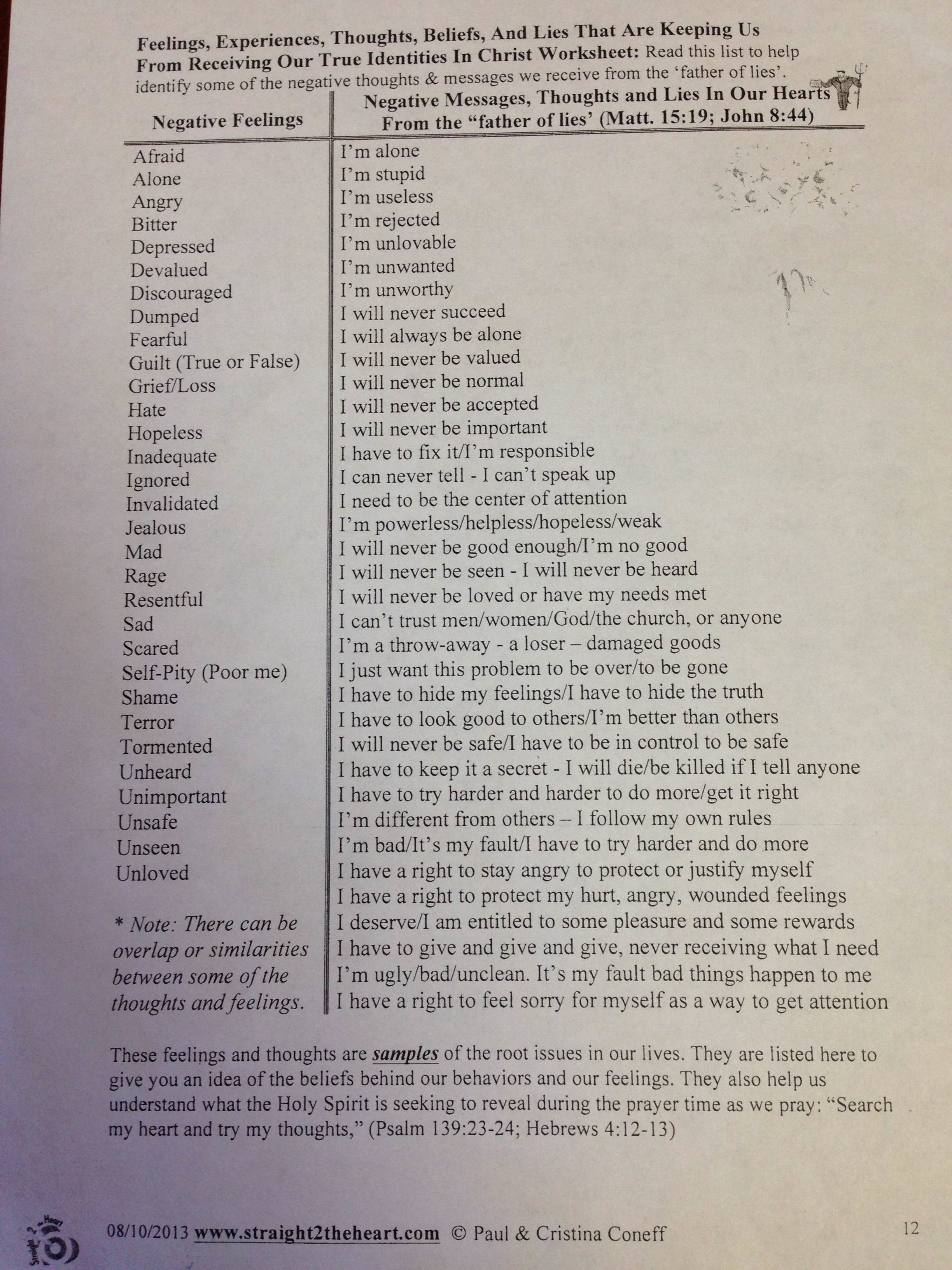
Here is a worksheet that can help you identify the lies Satan may be planting in your mind. I was able to recognize which lies applied to me because they were “thoughts” that ran through my head on a regular basis.
1. The root of our sin and suffering is Satan, the father of lies (John 8:44). This concept of roots is huge in Paul’s ministry. As Paul explained, all our negative behaviors and patterns are merely fruits of deep-seeded roots, or lies, planted by Satan. We cannot fix the fruits unless we first attack the roots. Thus, healing begins by identifying the Satanic lies driving our behavior. Once we know the roots, or the lies, we can take those to Jesus and let him deal with them, which leads to pillar 2.
2. The root of our healing and freedom is Jesus, our Suffering Messiah (Luke 9:22; Rev. 5:5; Col. 2:15; Isa. 53). The suffering of Jesus is the crux of The Hidden Half of the Gospel, and the key to our healing.
As Paul explained, many churches have overlooked this crucial aspect of Jesus’ gospel, instead choosing to focus on Jesus’ death and resurrection. The death and resurrection take care of forgiveness of sins, but often merely believing in and accepting these concepts doesn’t resolve suffering, or the cycle of sin-and-forgiveness. Putting “suffering” back into the definition of the gospel, as Jesus explained it to his disciples (see Luke 9:22), offers hope to those of us stuck in suffering—depression, abuse, addiction, etc.—because it means Jesus didn’t just nail our sins to the cross, but he also nailed our suffering there, as well. The Bible tells us Jesus “suffered and was tempted in every way” that we are tempted, to offer us help when we suffer and are tempted (Heb. 2:17-18; 4:14-16).
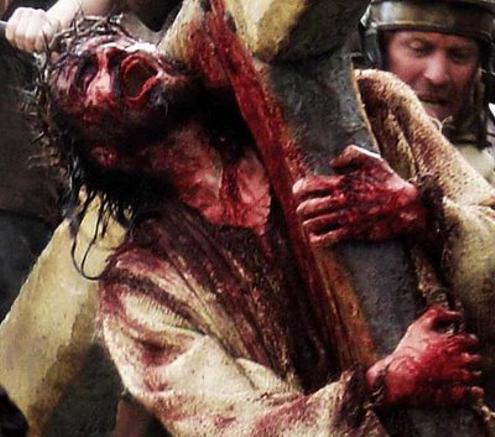
“Have you ever thought about why Jesus’ story had to be so gory?” Paul asked the audience.
I really hadn’t.
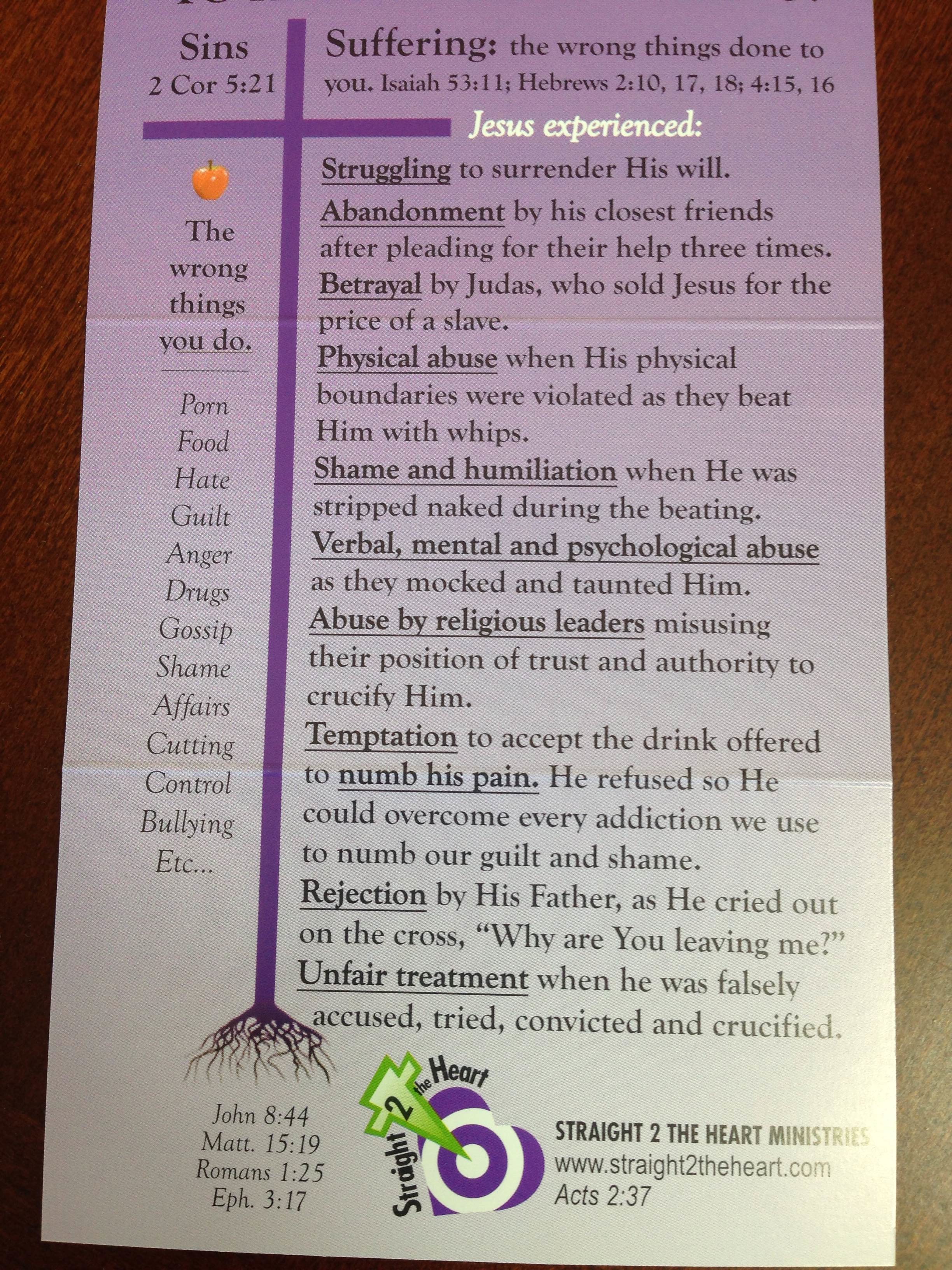
“Well, think about it.” Paul continued. “Jesus was abandoned; betrayed; physically violated; shamed and humiliated; and verbally, mentally, emotionally, and physically abused. Now, do you think He understands the pain that abuse victims feel? Does He understand when a parent abandons a child? Was He ever tempted to numb His pain?
“He suffered all these things and more so He could identify with us. So that he could understand every way we are sinned against, and every form of self-protection we develop in order to numb our pain.
Here is a list of some of the experiences Jesus went through (from the prayer card used during Straight 2 the Heart prayer sessions).
“What’s more, he suffered these temptations and triumphed over them, which means that when we take time to connect our stories with Jesus, to pray and meditate on what it means that he suffered for us, and became sin for us, we can experience his victory.”
By this time, I was hooked. I wanted this in my life. I wanted a ministry that was relevant to the suffering I’d experienced, and that which I saw all around me.
So I signed on for Paul’s seven-phase, thirteen-week discipleship program. That’s right. A thirteen-week program. This wasn’t any “quick fix.” It was going to be an intense period of praying on a consistent basis, first for myself (to get more healing in my own life before I was expected to pass it on–a requirement of Straight 2 the Heart Ministries) and then for others. I was going to learn at the feet of Jesus (and the seat of Paul Coneff) for an extended period of time, sort of like the first disciples, before I set out to make more disciples.
Discipleship, Small-Group Style
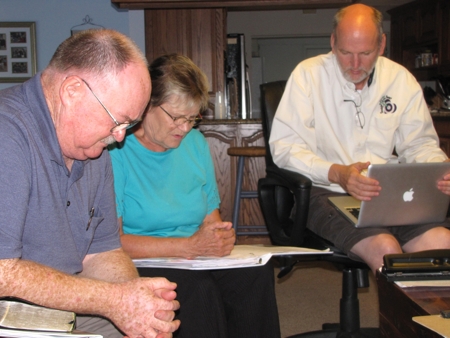
Paul Coneff (right) training Mary to lead Charles through prayer.
Paul spent the next four months with five of us, discipling us—praying with us, and training us to pray with others. And not quick, clean, thirty-second prayers. These were deep, messy prayer sessions that first asked Jesus to identify our negative roots, and then helped us connect our stories to Jesus’ story. It didn’t end there. We delved deeper, praying, “Lord, what else do you want me to know about these roots in my life? What blessings or barriers are there in these areas?” The prayers were recursive, connecting our stories to Jesus, then having us stop and listen to the Holy Spirit so he could take us one layer deeper into our negative roots. Always, by the end of the prayer sessions, which dredged up long-buried hurts and often tears, Jesus revealed blessings, too. He always brought to mind His promises to combat the negative roots our praying was churning up.
Our training ended, with the goal being that we would start more small groups in our church, beginning with a few men and women, hopefully to grow as disciples multiplied.
My Gateway to New Life at Home, at Work, and in Ministry
My life intersected with Paul Coneff’s message and ministry, Straight 2 the Heart, when I was at a crossroads in my life. I was coming up against the age of thirty, and was finding that pursuing my “chosen” path, graduate school to become a professor, was leaving me feeling empty. Here’s a summary of how God has since rerouted my plans through this life-changing prayer ministry.
Facing Remaining Negative Roots
Photo Credit: “Exposed Tree Roots” by Colin Brough
First, Straight 2 the Heart has helped me to be honest about areas in my life that weren’t all healed yet (some of which are still in progress) such as:
Anger at the premature loss of my childhood family and, well, my childhood.
Resentment at my husband’s happy family (and any happy family).
Disillusionment with my church and religion because it “did not help me” in my time of crisis. Straight 2 the Heart helped me to see that my church didn’t help me because it didn’t know how—also, because I didn’t let them know I needed help in the first place. (It also provided the answer for how churches can help, when they have the right tools.)
My pattern of trying to control my life in my own strength so it would never get out of control again (or my attempts to never repeat my past depression, suicide attempts, broken family, etc., through over-planning, becoming over-busy, and more).
My avoidance of having kids out of the above need to maintain control.
Gaining Deeper Healing
Second, Straight 2 the Heart has led to more healing for those negative roots in these ways:
The decision to let go of the “safe,” but wrong career path of academia.
The decision to finally pursue the identity God has for me, which has translated into sharing my story through writing and even teaching. This blog, my memoir-in-progress, and Paul’s and my forthcoming book, The Hidden Half of the Gospel, are all examples of me sharing my story for God’s glory.
The decision to have a baby.
The decision to be honest with other women, to reach out and accept relationships I had avoided but desperately needed (See my post “Friends in High Places”)
I am gaining more appreciation for my church as I look past its flaws (every church has flaws) and see the human beings there. Since deciding to be vulnerable with my own story, I’ve connected with many of these dear people in meaningful ways. I am getting the authentic “fellowship of believers” experience I missed as a child, when my family was intent on covering up its problems.
Taking the Next Step in Ministry
Photo Credit: Cristina Coneff
Third, Straight 2 the Heart has helped me learn how to have a really relevant ministry, or how to help others who are stuck in negative places and patterns like those I’ve suffered. (It is through making Jesus’ gospel relevant to the everyday struggles of life—boldly connecting our messiness to Jesus Christ’s suffering and his full gospel to “heal the brokenhearted and set the captives free.”)
My partner in prayer ministry, Amanda, and I, prayed two new young women (now dear friends) through the thirteen-week prayer process, which helped lead them to lots of healing—and baptisms in our church!
Amanda and I also trained women at a neighboring church to facilitate the same thirteen-week prayer and discipleship process in their congregation.
With the help of Amanda and Mary, our other cohort from our initial 13-week training, I facilitated a third prayer group, consisting of around ten ladies, in my home for several months last fall. This group resulted in amazing healing for many of these women (for marital, parental, and other common problems) as well as facilitating much needed connection between these lovely, but often isolated church ladies.
Now I am working on rendering the miracles we saw in these women willing to be honest with one another and with God into the closing scenes for my memoir. I want my story to testify to how one changed life can ripple out to other lives, and still more lives from there. This is what discipleship is all about.
Now, what I’ve left out of my rebirth story (and there’s lots I’ve left out), I am working on telling in my memoir. Why did I call this my “ugly, messy” rebirth story? If you consider a real birth (and I’ve been considering it a lot lately), it’s a messy process. It’s no small thing when a new physical life is created—and the same is true for a new spiritual life. The creation of a life, and the re-creation of a life, are not simple or easy processes. At times they are painful, ugly, and messy—but to get to the birth, or the rebirth, they are necessary. That’s why I have unapologetically included the ugliness and messiness in my story—along with its beauty. Without either, my story would be incomplete.
To read more about The Hidden Half of the Gospel, see the following articles Paul and I wrote on the subject:
“The Fruit and Root of Freedom from Addictions” Part 1
“The Fruit and Root of Freedom from Addictions” Part 2
To schedule Paul to speak at your church or to facilitate a discipleship group, contact him at www.straight2theheart.com.
And if you want to get a copy of our book, The Hidden Half of the Gospel: How His Suffering Can Heal Yours, follow this blog to be notified later this spring when the book is published!
For a long time I waited to have the type of “Damascus Road” conversion that the Apostle Paul had. I wanted a cataclysmic experience to bring me to God, once and for all. Maybe I should have been careful what I wished for!
As I wrote in part 4, I was about to start my second year of teaching when my mom—who already had cancer—was hospitalized for bipolar disorder, and my little brother went into foster care. Because my hands were tied with one-hundred adolescents, one-thousand miles away, I fell to my knees and pleaded for God to do something. And he did.
Oh, but he didn’t change my outward situation–or my mom’s, or my brother’s–at least not at first. First, he changed me—from the inside out.
My Damascus Road Year
I believe that God is always growing those who seek him. While we don’t always sense our growth, sometimes we experience “growth spurts.” That year was my first spiritual growth spurt. With God’s leading, and with a little help from Steven Covey’s The Seven Habits of Highly Effective People, I was forming all kinds of good habits in my life.
By far the most important habit I formed that year was the habit of daily prayer and Bible study.
Photo Credit: “Bible Collage 4” by ba1969
Next, I began memorizing Scripture so that, when negative thoughts came, I could re-set my mind on God’s promises. Without even having to think about it, I started pondering Scripture throughout the day and conversing with God. In turn, he responded to me by bringing certain Bible verses to mind that I had memorized.
Again, without my having to work at it, the words that I spoke, in conversation and in prayer, started to change. Rather than counting my losses, I started counting my blessings. My journaling naturally took a more thankful tone, too, as I wrote about how I was experiencing “happy days” like never before.
After allowing God’s words to take root in me for several months, I was generally not depressed anymore. When sad days came, I fought them off by reciting Scripture and reading the Word.
And that is the key to rebirth: we cannot changes ourselves, but God’s “living and active” Word must change us (Heb. 4:12-13). If there is one thing we can do, we can avail ourselves of the Word and prayer.
More Spiritual Fruit
Photo Source: blog.zap2it.com
Not only were my devotional habits changing, but so were many other aspects of my life. During this time, I heard a pivotal sermon all about monitoring what we put into our minds and bodies. The speaker, evangelist Leo Schreven, raised tough questions for Christians, such as: Why do we listen to, read, and watch the same kinds of materials that the “world” listens to, reads, and watches?
As Schreven pointed out, so much of mainstream media and entertainment is opposed to Christian principles, such as the many pop, country, or rock songs crooning of infidelity. What about TV shows and movies fraught with violence? He pointed out that there is so much “trash” around us, yet we Christians sift through it as if through a dumpster, always hoping to find something halfway decent—instead of doing the sensible thing and avoiding the trash altogether.
Input, Output: By Beholding, We Become Changed
As a recovering depressive, this point hit me hard. I was beginning to realize that a large part of my depression came down to my thought patterns—and many of my post-adolescent thought patterns were determined by the music I listened to, the books I read, and the things I watched.
There was a reason I often felt cranky after watching secular movies or reading secular books: They were not uplifting. Even cute, seemingly harmless chick flicks left me desiring a more glamorous life, a more “storybook” marriage, a prettier figure, and a more successful career. In other words, they were leading me to desire almost everything but a relationship with the Lord.
Moreover, I realized with horror that when I listened to music with depressing or even suicidal lyrics (the band Evanescence came immediately to mind), I was cooperating with Satan by meditating on self-destructive thoughts.
Now I was beginning to understand why my older brother had tossed out his entire CD collection after his own rebirth experience. I realized these seemingly “harmless” hobbies are really insidious tools of the devil to speak lies to us.
Photo Credit: Jonah Bayer
So I threw out my CD collection, too—the bad part of it. For a time I stopped reading novels and switched completely to the Bible and self-help books (this was an odd and confusing thing for an English major to do). I also separated myself from certain friends (sadly, self-professed “Christians”) who habitually exposed me to R-rated movies. I knew these changes were all necessary to cleanse and fortify my sinful, depression-prone mind.
The other conviction I felt was a need to reach out to my friends, many of whom called themselves Christians, but who, like me, did not live like it. Why, if we were “Christians,” did we never come together to talk about Christ? The only times we got together, we watched secular movies and did other non-Christ-centered things. I made it a goal to start a young adult Bible study for these beloved friends.
Crisis Resolved
All of these changes were happening in me while Mom was in the mental hospital, my little brother in foster care, and myself tied up with teaching, 1,000 miles away from them. Later that fall, Mom was mentally stable and discharged from the hospital, and by November, she had my little brother back. The remaining unknown was Mom’s cancer.
Meanwhile, I marveled at how God was sustaining me. I believe God carried me on high that year, helping me soar above situations that could have otherwise devastated me.
The One Who Sustains
The truth is, no matter if we think we are sustaining our lives, God is the one who sustains. We couldn’t even breathe without him. We may think we’re the ones moving our lives forward—but we can do nothing of ourselves. The Apostle Paul wrote, “[God] himself gives all men life and breath and everything else,” and “It is God who works in you to will and to act of his good purpose” (Acts 17:25; Phil. 2:13). Jesus Christ, while he lived on this earth in human flesh, even said, “Of myself I can do nothing.”
On the Other Side of Hardship
Photo Credit: “Glass Tears” by Man Ray
Ever heard this saying?
Sometimes you have to be knocked flat on your back to look up.
I believe that God uses trials to get our attention. I’m not saying he causes bad things to happen, but he uses bad things to make us stop and realize how powerless we are. Without facing trials, we tend to get haughty, thinking we don’t need God. It is when we are knocked flat on our backs that we have to face the truth: we can do nothing without God.
After God has broken us, he can use us: “Before I was afflicted, I went astray. But now I obey your word” (Ps. 119:67). While most of us would never ask for hardships, sometimes they are the best things that can happen to us. The Apostle Paul recognized this. Knowing that “God’s strength is made perfect in weakness,” Paul said, “Therefore I will boast all the more gladly about my weaknesses, so that Christ’s power may rest on me” (2 Cor. 12:9). But what if we don’t have this attitude?
A Mature Faith
Please note: It is not natural to “boast about weaknesses,” or to thank God for hardship. It is only a mature person who can recognize the blessing in trials, and only a mature faith that can observe: “Godly sorrow brings repentance that leads to salvation and leaves no regret, but worldly sorrow brings death” (2 Cor. 7:10).
When hardships come, we will either experience godly sorrow, or worldly sorrow. One type of sorrow sees hardship as an opportunity to lean on God and grow, and the other sees it as a life-ender; that was me in parts 1, 2, and 3.
So what am I to make of those years when I tried to pray but did not feel God’s presence? Looking to James, I think the answer has something to do with developing perseverance. James says, “[T]he testing of your faith develops perseverance. Perseverance must finish its work so that you may be mature and complete, not lacking anything….” (James 1:2-4).
Sometimes we are not ready to receive the things of God. “The carnal [or worldly] mind is hostile to God. It does not submit to God’s law, nor can it do so” (Rom. 8:7). I would substitute the word “immature” for “carnal.” My immature mind was not ready to submit to God—plus, I was in so much pain, I couldn’t concentrate on anything else.
Why do some of us have to go through more pain than others to “get it”? I don’t know. I just know that, on the other side of pain, there can be great joy. “Blessed is the man who perseveres under trial, because when he has stood the test, he will receive the crown of life that God has promised to those who love him” (James 1:12).
As the writer of Hebrews said, “No discipline seems pleasant at the time, but painful. Later on, however, it produces a harvest of righteousness and peace for those who have been trained by it” (12:10-12).
This is how we know we have matured spiritually: when we can thank God for our trials.
After we have experienced a rebirth, how do we share our experience with others? Read part 6 to find out what worked (and what didn’t) for me.
While still in college, like many students, I was forever trying to figure out what career to pursue. But it wasn’t just about figuring out a career: I felt panic at the thought of college ending with nothing waiting for me on the other side. I needed a plan after college, because I still didn’t trust myself with free time. (Having kids was definitely out, because I couldn’t fathom passing along my dysfunction to another generation—much less the responsibility that comes with children.)
Photo Credit: “Reading Outdoors” by Lusi
So, during my senior year of college, I spent many mornings at my kitchen table, praying: “God, what do you want of me? Why am I here? Why don’t I feel your peace? When is life going to get better? And what the hell am I supposed to do when I graduate?”
For all my praying, I didn’t notice any response from God–except for the fact that I got only one job offer: teaching at a rural Texas high school. Feeling insecure and unprepared, I took the job.
Teaching Troubles
Photo Credit: “Young Woman Teacher” at kevinmccullough.townhall.com/blog
Teaching that first year became all about performance. The demands of the job, along with the sassy attitudes of my freshmen, sent me home every day exhausted and on the brink of tears. I lost sleep, I lost weight, and I lost confidence.
I woke early many mornings with knots in my stomach. I remember paging through the Psalms at 4 a.m. looking for comfort, but I never felt comforted. Every day the stress began all over again; I didn’t feel God’s hands guiding. Instead, I only sensed myself fumbling through the dark from August until June.
But somehow, I made it through the first year—and even agreed to come back for a second.
Hindsight and Foresight
During the summer, I couldn’t make much sense of what had gone on the previous year, except that I knew I could not repeat that year again. I resolved to plan ahead as much as I could for year two. There would be no more frantic school nights wondering what to teach the next day; there would be no more “dead” time during class. The students might still act up, but it wouldn’t be for lack of preparedness on my part.
In July, my older brother, Kyle, suggested I read The Seven Habits of Highly Effective People, which I did.
A note on my brother: for a few years, I’d been noticing a change in Kyle that had me wanting what he had. When I was twenty-one, I’d first seen it: I’d walked in on him kneeling fervently in prayer—prayer that lasted over thirty minutes—and I’d heard him talk about his new relationship with God. He’d even prayed with me, looked up Bible verses with me, and encouraged me to “give it all to God” so I could find peace. But try as I might, I couldn’t find that dynamic God-relationship he’d found. Maybe I was doing it wrong; maybe I didn’t know how to pray properly. Whatever the case, as I read The Seven Habits, I felt myself come alive: here were concrete steps I could take not only to get my classroom in order, but maybe my life, too.
I began putting the habits to work immediately in my lesson planning: I was being proactive (habit 1) by starting well before the school year began; I was beginning with the end in mind (habit 2) by defining goals I wanted my students to reach by the end of the year. I was so taken with the seven habits, in fact, that I decided to make them my first unit of the school year. I ordered an audio presentation on The Seven Habits of Highly Effective Teens to play for my students, and I made powerpoints to go along with each segment. By August, I had a three-week unit ready to go, and I was excited for the year to begin.
But one week before it did, crisis hit.
Testing Time
I was notified that back in Minnesota my mom had gone off her bipolar meds and my ten-year-old brother, Caleb, had been put in a group home. To make matters worse, Mom had recently been diagnosed with cancer and was not accepting conventional treatment. Now, there was no way she would seek the medical help she needed—for either malady. In the past when I got this kind of news, I typically retreated to a solitary place and cried until I regained composure–sometimes I was incapacitated for days.
This time, I didn’t have that luxury. Now, I was one-thousand miles away from the problem and had one-hundred students to lead and guide. It was no time to collapse—except to collapse to my knees.
Photo Credit: “Young Woman Praying” from blogs.voices.com
Oh Lord! I prayed. I feel so helpless! What is going to happen to Mom? What’s going to happen to Caleb? Is she going to die? Is he going to be left to foster care, or stuck with his drunk dad? God, I am lost right now. I’m so scared!
Lord, I don’t know what any of us are going to do, especially Caleb. Oh please protect Caleb! Please shield him from this somehow—he shouldn’t have to go through this. But I am not there to save him, and I cannot go to him right now. Oh Lord, HELP!
I cried myself to sleep that night, and when I woke intermittently, my stomach souring each time the reality washed over me, I began praying all over again: Help, Lord, please. Just please…help.
An Answered Prayer
Somehow I began my school year on the right foot. The students were responsive to the seven habits, and I fed off their energy. Six times each day for the first three weeks, I listened to the audio presentation about forming effective habits—and the material bore into me. I learned that it takes about three weeks to form a habit, and at the end of our three-week unit, I realized I’d formed a habit of my own: morning prayer and Bible study.
Driven to my knees by my utter helplessness at fixing the family drama, I was praying like never before. I had also started reading my daily Sabbath school lesson—the study guide put out by the Seventh-day Adventist church—and the Bible. Amidst a backdrop of uncertainty, I took comfort in the routine of reading God’s word in the quiet morning hours. I began talking to him during my commute, telling him my fears and concerns like he was my friend. And now, it was as if he’d opened my mind to concentrate on his truth—and he’d opened my heart to feel his presence.
While everything around me swirled in confusion, the peace that passes understanding filled my heart. I was able to stand in front of my students with a smile, knowing God was with me—knowing I didn’t have to know how things would turn out. All I needed to know was that God was in control.
For the first time in my life, I was surrendering everything to God: my fears, my feelings, and my attempts to control my life. My family’s situation had showed me how very powerless I was—and how my survival, Mom’s survival, and Caleb’s survival, depended on a higher power. If any good was to come of this, I knew it would have to be God’s doing.
In part 5, read what happened to my mom, Caleb, and me, as well as what God taught me about persevering through hardship.





 I simply don’t have room in my brain to accommodate one more thing. Which is why I used to be oblivious to the news. My husband would ask me what I thought about some really big news item, and I’d respond with a blank stare. Happily, caring for Sam has helped me to turn on the news almost daily (I get bored with bottles and diapers all day), so my news knowledge has increased about 100%.
















 Lindsey Gendke