Until his first smiles, I’m counting on funny expressions like this one to keep me endeared to little Sam.
So this is what it comes down to: if I want to write a blog post, I have to do it while lying on my side feeding my son, awkwardly typing with a crick in my neck. This makes me think of a humor book on parenting I read (Sippy Cups Are not for Chardonnay), in which the author joked that the new definition of “sexy” for mothers is just getting to wash their hair.
I won’t lie: after just three weeks, both my hubby and I are having doubts about parenthood. What did we get ourselves into? we’ve asked. And, Does our baby come with a return policy? I feel terrible even typing those things, but from all the parenting books I’ve read (blame it on graduate school), these seem to be normal enough questions. Yet I’ve rarely heard them spoken by friends and acquaintances who have kids. Have they just forgotten what the early days were like? If so, here’s a reminder.
My newborn son takes round-the-clock work, but offers not one smile in return. More like it, he cries, and he screams—morning, noon, and night. Although just a week or so ago all his crying made me cry, too, now I roll my eyes, pick him up again, talk to him in silly voices (perhaps desperate pleas), or, if all else fails, I lay him down to scream for ten to fifteen minutes. I can’t take more than fifteen minutes.
When I do get him down for a nap, it’s all I can do to grab a shower or a bite to eat, or, if I’m really lucky, get some laundry or dishes done. Yesterday I was able to sweep the mud room where our dogs constantly track in, well, mud, and that was a major accomplishment. Some days I also manage to get dinner made before hubby comes home, and that is always cause for profuse thanksgiving.
In the beginning (just a couple weeks ago), I remember laying Sam down for a nap and praying, Lord, can you please let him sleep for one hour? Now, with the wet blanket of reality smothering me, I have started praying, Lord, thank you for every minute—and I really mean every single minute—that Sam sleeps. Sometimes it’s fewer than ten minutes. Yesterday’s two-hour nap was a happy milestone. But no matter how long or short it is, it is always just long enough…for me to get at least one thing done. Maybe it’s just a shower, maybe it’s just washing my breast pump accessories so I can be ready to pump again after the next feeding. Stressed though I am, God sees to it that my needs are met. That’s life right now.
Right now, I’m only accomplishing the most basic necessities. For an overachiever like myself, this is near torture. But, sigh, it’s good for me. It’s good to remember how dependent I am on God for my most basic necessities: food, clothing, shelter. Little Sam has reminded me of this. Because he is taking his sweet time to regain his birth weight, I’ve been worried about my milk supply. I’ve been worried about him. When I’m tempted to resent him for “chaining” me to a feeding schedule, I am softened to remember that, with all these feedings, this little, helpless being is totally depending on me for his life. Suddenly, all these mundane feedings are hardly small or insignificant. Likewise, motherhood.
Lord, when I’m tempted to see my new “job” as merely frustrating, difficult, and insignificant, remind me what a privilege it is. Help me see my job as a miracle—I’ve gotten to play a small part in creating a life, and now I get a small part in sustaining it. I get to understand what your job is like just a little more. I get to experience your love just a little deeper.
So this is what it comes down to (after forty minutes of feeding): a sweet, helpless baby sleeping silently on my chest, depending totally on me for his sustenance, his life. How can I stay angry at a sleeping baby? It’s impossible. This must be one of the survival mechanismsGod built in to all newborn babies—for them and for their parents.
For a long time I waited to have the type of “Damascus Road” conversion that the Apostle Paul had. I wanted a cataclysmic experience to bring me to God, once and for all. Maybe I should have been careful what I wished for!
As I wrote in part 4, I was about to start my second year of teaching when my mom—who already had cancer—was hospitalized for bipolar disorder, and my little brother went into foster care. Because my hands were tied with one-hundred adolescents, one-thousand miles away, I fell to my knees and pleaded for God to do something. And he did.
Oh, but he didn’t change my outward situation–or my mom’s, or my brother’s–at least not at first. First, he changed me—from the inside out.
My Damascus Road Year
I believe that God is always growing those who seek him. While we don’t always sense our growth, sometimes we experience “growth spurts.” That year was my first spiritual growth spurt. With God’s leading, and with a little help from Steven Covey’s The Seven Habits of Highly Effective People, I was forming all kinds of good habits in my life.
By far the most important habit I formed that year was the habit of daily prayer and Bible study.
Photo Credit: “Bible Collage 4” by ba1969
Next, I began memorizing Scripture so that, when negative thoughts came, I could re-set my mind on God’s promises. Without even having to think about it, I started pondering Scripture throughout the day and conversing with God. In turn, he responded to me by bringing certain Bible verses to mind that I had memorized.
Again, without my having to work at it, the words that I spoke, in conversation and in prayer, started to change. Rather than counting my losses, I started counting my blessings. My journaling naturally took a more thankful tone, too, as I wrote about how I was experiencing “happy days” like never before.
After allowing God’s words to take root in me for several months, I was generally not depressed anymore. When sad days came, I fought them off by reciting Scripture and reading the Word.
And that is the key to rebirth: we cannot changes ourselves, but God’s “living and active” Word must change us (Heb. 4:12-13). If there is one thing we can do, we can avail ourselves of the Word and prayer.
More Spiritual Fruit
Photo Source: blog.zap2it.com
Not only were my devotional habits changing, but so were many other aspects of my life. During this time, I heard a pivotal sermon all about monitoring what we put into our minds and bodies. The speaker, evangelist Leo Schreven, raised tough questions for Christians, such as: Why do we listen to, read, and watch the same kinds of materials that the “world” listens to, reads, and watches?
As Schreven pointed out, so much of mainstream media and entertainment is opposed to Christian principles, such as the many pop, country, or rock songs crooning of infidelity. What about TV shows and movies fraught with violence? He pointed out that there is so much “trash” around us, yet we Christians sift through it as if through a dumpster, always hoping to find something halfway decent—instead of doing the sensible thing and avoiding the trash altogether.
Input, Output: By Beholding, We Become Changed
As a recovering depressive, this point hit me hard. I was beginning to realize that a large part of my depression came down to my thought patterns—and many of my post-adolescent thought patterns were determined by the music I listened to, the books I read, and the things I watched.
There was a reason I often felt cranky after watching secular movies or reading secular books: They were not uplifting. Even cute, seemingly harmless chick flicks left me desiring a more glamorous life, a more “storybook” marriage, a prettier figure, and a more successful career. In other words, they were leading me to desire almost everything but a relationship with the Lord.
Moreover, I realized with horror that when I listened to music with depressing or even suicidal lyrics (the band Evanescence came immediately to mind), I was cooperating with Satan by meditating on self-destructive thoughts.
Now I was beginning to understand why my older brother had tossed out his entire CD collection after his own rebirth experience. I realized these seemingly “harmless” hobbies are really insidious tools of the devil to speak lies to us.
Photo Credit: Jonah Bayer
So I threw out my CD collection, too—the bad part of it. For a time I stopped reading novels and switched completely to the Bible and self-help books (this was an odd and confusing thing for an English major to do). I also separated myself from certain friends (sadly, self-professed “Christians”) who habitually exposed me to R-rated movies. I knew these changes were all necessary to cleanse and fortify my sinful, depression-prone mind.
The other conviction I felt was a need to reach out to my friends, many of whom called themselves Christians, but who, like me, did not live like it. Why, if we were “Christians,” did we never come together to talk about Christ? The only times we got together, we watched secular movies and did other non-Christ-centered things. I made it a goal to start a young adult Bible study for these beloved friends.
Crisis Resolved
All of these changes were happening in me while Mom was in the mental hospital, my little brother in foster care, and myself tied up with teaching, 1,000 miles away from them. Later that fall, Mom was mentally stable and discharged from the hospital, and by November, she had my little brother back. The remaining unknown was Mom’s cancer.
Meanwhile, I marveled at how God was sustaining me. I believe God carried me on high that year, helping me soar above situations that could have otherwise devastated me.
The One Who Sustains
The truth is, no matter if we think we are sustaining our lives, God is the one who sustains. We couldn’t even breathe without him. We may think we’re the ones moving our lives forward—but we can do nothing of ourselves. The Apostle Paul wrote, “[God] himself gives all men life and breath and everything else,” and “It is God who works in you to will and to act of his good purpose” (Acts 17:25; Phil. 2:13). Jesus Christ, while he lived on this earth in human flesh, even said, “Of myself I can do nothing.”
On the Other Side of Hardship
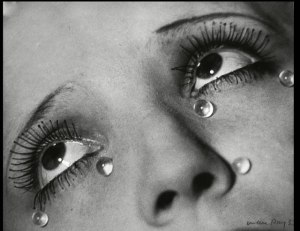
Photo Credit: “Glass Tears” by Man Ray
Ever heard this saying?
Sometimes you have to be knocked flat on your back to look up.
I believe that God uses trials to get our attention. I’m not saying he causes bad things to happen, but he uses bad things to make us stop and realize how powerless we are. Without facing trials, we tend to get haughty, thinking we don’t need God. It is when we are knocked flat on our backs that we have to face the truth: we can do nothing without God.
After God has broken us, he can use us: “Before I was afflicted, I went astray. But now I obey your word” (Ps. 119:67). While most of us would never ask for hardships, sometimes they are the best things that can happen to us. The Apostle Paul recognized this. Knowing that “God’s strength is made perfect in weakness,” Paul said, “Therefore I will boast all the more gladly about my weaknesses, so that Christ’s power may rest on me” (2 Cor. 12:9). But what if we don’t have this attitude?
A Mature Faith
Please note: It is not natural to “boast about weaknesses,” or to thank God for hardship. It is only a mature person who can recognize the blessing in trials, and only a mature faith that can observe: “Godly sorrow brings repentance that leads to salvation and leaves no regret, but worldly sorrow brings death” (2 Cor. 7:10).
When hardships come, we will either experience godly sorrow, or worldly sorrow. One type of sorrow sees hardship as an opportunity to lean on God and grow, and the other sees it as a life-ender; that was me in parts 1, 2, and 3.
So what am I to make of those years when I tried to pray but did not feel God’s presence? Looking to James, I think the answer has something to do with developing perseverance. James says, “[T]he testing of your faith develops perseverance. Perseverance must finish its work so that you may be mature and complete, not lacking anything….” (James 1:2-4).
Sometimes we are not ready to receive the things of God. “The carnal [or worldly] mind is hostile to God. It does not submit to God’s law, nor can it do so” (Rom. 8:7). I would substitute the word “immature” for “carnal.” My immature mind was not ready to submit to God—plus, I was in so much pain, I couldn’t concentrate on anything else.
Why do some of us have to go through more pain than others to “get it”? I don’t know. I just know that, on the other side of pain, there can be great joy. “Blessed is the man who perseveres under trial, because when he has stood the test, he will receive the crown of life that God has promised to those who love him” (James 1:12).
As the writer of Hebrews said, “No discipline seems pleasant at the time, but painful. Later on, however, it produces a harvest of righteousness and peace for those who have been trained by it” (12:10-12).
This is how we know we have matured spiritually: when we can thank God for our trials.
After we have experienced a rebirth, how do we share our experience with others? Read part 6 to find out what worked (and what didn’t) for me.
Making time for family photos is one of my weaknesses. In almost nine years of marriage, we have never had professional pictures made. Not even for our wedding.
This week has been a roller coaster. Imagine me moping because friends and family finally pushed me to choose a baby bedding set; yelling at my husband because he “can’t do anything right”; panicking because we have less than two months to paint the room; sobbing because I can’t get Target’s baby registry website to work; and generally freaking out because “I don’t know how I’m going to handle this all!”
Yeah. It’s finally sunk in. I’m gonna be a mom. And suddenly, all my shortcomings are hitting me, smack dab, in the face. The necessity of dealing with the baby room, especially, has slammed me with bad memories from my childhood, where I never knew how to decorate my bedroom and was always dissatisfied with my pathetic attempts. My mom tried her best to make our shabby houses nice, with inexpensive touch-ups like a coat of paint and tablecloths, but decorating wasn’t her strong point, either. To this day, she and I both freeze at the prospect of even hanging pictures.
I knew this would happen. I knew having a baby would call on me to face my weaknesses: decorating a room, learning to be a better homemaker, learning to depend on others, and setting aside my own goals in favor of the family. In short, Baby Sam is calling on me to be less selfish.
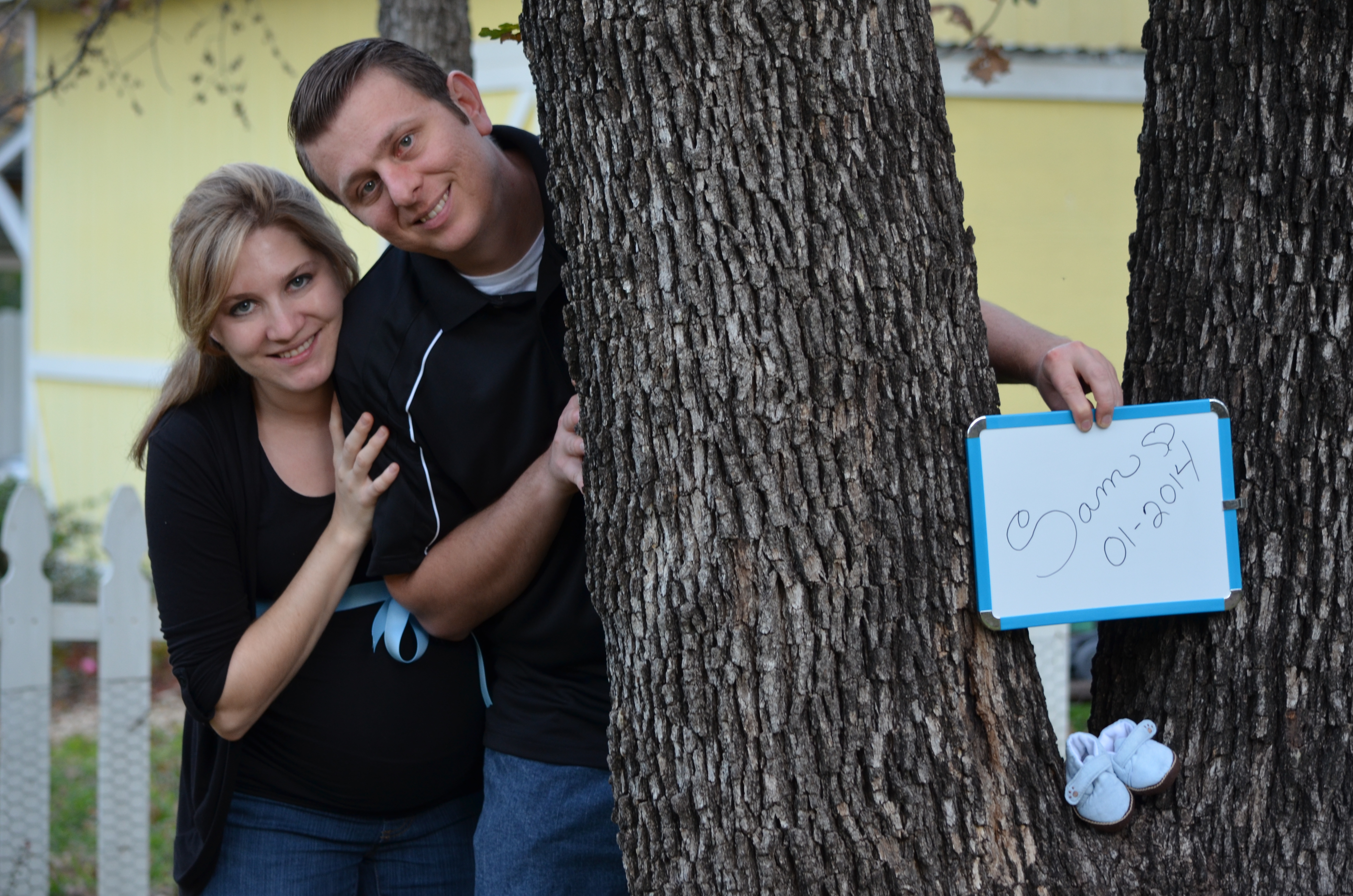
David and Tasha, some of our good friends, offered to take semi-professional pictures of my husband and me about two years ago for Christmas. This last weekend, we finally took them up on the offer. Baby Sam made the difference.
But everyone knows that. It’s obvious that parents have to be less selfish. It’s also common knowledge that parenting calls forth people’s weaknesses. I knew this all along, and that’s why I put off children for my first eight years of marriage. I knew kids would test me, and until now, I wasn’t ready for that test. Instead, I subjected myself to lots of other tests, earning bachelor’s and master’s degrees, where all the questions were safely embedded in a two-dimensional world. There wasn’t much to mess up—at least, it would be hard to mess up someone else’s life. Now, the game has changed. Now, my decisions can make or break someone’s life.
Ironically, I know I’ve done some messing with my husband’s life by keeping too busy and being self- and career-absorbed over the years. It wasn’t really possible for me to live a self-contained life: our decisions always impact others. I just wasn’t ready for the mega impact of a parent-to-child relationship.
Good news, though. God is stepping in, like he always does. The verse I keep hearing this week is 2 Cor. 12:9-10. “My grace is sufficient for you, for my power is made perfect in your weakness.” Thank God for that!
We were tempted to cancel our photo shoot, because it came after a long day of grocery shopping for me and outdoor work for hubby: my feet were swelling, and his whole body ached from putting up a greenhouse.
One practical demonstration of God’s sufficiency (“my God shall supply all your needs,” Paul writes) has been a new friend, who enthusiastically agreed to help me with the baby room. She came over on Tuesday and helped me order a bedding set. She talked me through using the breast pump my other friend gave me. She went shopping with me to choose paint and other baby supplies. And she’s coming again today to help make some decorations for the baby room. Maybe these things seem trite to you homemaker women out there, but to me, they have been a godsend.
I don’t think my new friend realizes why this stuff is so hard for me—it’s fun for her. But that’s because she’s a hands-on woman; I’m a hands-off type (read: I like to work with words, ideas—basically stuff I can’t break). Amidst my wallowing that “I suck” this week, God has turned my sorrow (and raging hormones) into joy.
The beginning of the week was hard, but the end is getting better. So I know that homemaking is not one of my strong points. So what? God’s power is made perfect through my weakness, and through friends and loved ones he sends to make up for what I lack. I feel so blessed this week to be surrounded by friends and family who can help me. Generally I don’t like to ask for help, but this lack of dependency is just another weakness God is helping me through. It’s a weakness I intend to ditch, because I know if I hope to get through parenthood, I’ll need some help. It sounds corny, but that old adage is really true: the first step to change is admitting we need help.
Thank you so much, Lord, for sending help just when I needed it.
But we went to take pictures anyway, tired and grumpy. In the end we had a lot of fun, and now we will always have the memory of this moment. Thanks to Deborah, Tasha’s mom, for the great pictures!
I’ve said my dream was to be a writer. I developed this dream in childhood—I don’t know exactly when, but it was early. I read profusely from age eight on, and I’m guessing my writing dreams developed as my reading list grew.
At that age it was enough to have a foggy notion, a sort of affinity, a general inclination or tendency to writing. Writing was fun! I did it without overly thinking about it. I jotted silly stories and poems, and when I started playing the piano at age eight, also penning song lyrics. Back then I never thought about the practicalities of getting published, the imminent necessity of earning a living, the eventuality of needing a schedule to keep oneself on track to produce enough, often enough, to survive. No, back then my dream was a hobby, a thing I did at whimsy with no outside provocation. I did it because I enjoyed it. It brought me joy. It was fun.
How wonderful to be a child, to be innocent of worldly and societal expectations, or implications of adulthood. How I wish, as I write this, that I could go back.
Is that impossible?
It seemed impossible when life threw me its first really traumatic curveball at fourteen, when tragedy struck so quickly it seemed childhood was snatched away overnight. Then it was, I have to think, that Satan really went in for the kill on my identity. And with it, my dreams.
Suddenly I was no longer a capable, positive, promising child. I was an incapacitated, negative, doomed child. My world as far as I could see had collapsed around me. I couldn’t see beyond the walls of my home, now torn apart by dissension and hatred and despair.
Though a family breakup may not be our fault, it has everything to do with us. It has everything to do with how we see and understand our place in the world, everything to do with how we define ourselves. I’m not saying this is how it should be, or even that it’s logical, just that this is how it is.
This family event affected everything about me. It redefined me in negative, defeated ways. I became, in my eyes, a pitiable child, one who couldn’t speak up or have needs, either at home or at school.
Instead of being an empowered writer, I became a closet writer. That dream of writing got shoved in a closet, shoved under cover—literally, under the covers of journals—as I took to writing about my family plight and my own plight for no one’s eyes but my own. I guarded my writing, and with it, my pain, like I guarded the family secret. This was not healthy. And yet, by God’s grace, he even used that period of writing to myself for good. Even though the subject matter was bad, it kept me growing at least as far as a writer. The writing kept my joints oiled, kept me in practice. The practice was being perverted, but it was leading to something only God could see.
Photo Credit: “Happy Life” by Lusi
Today I feel I have regained the joy of writing–maybe I’m even embarking on my second childhood! Gone are the dark days and the need to hide who I am, because God has restored to me my value and my worth. I rejoice because my identity is not defined by what was done TO me, but by what God has done FOR me. He saved me. He restored me. And He has returned me to the joy of my youth. Thanks for sharing my journey!
After achieving the feat of being Freshly Pressed, a sort of fear can set in, along with negative thoughts like these: “I’m going to screw up!” “My next effort won’t be as good!” “I’ll disappoint all these new readers!” Happily, I’ve only had these feelings mildly, and they’re not sticking around. Instead of fear, I mostly feel hope. Rather than daunting me, the Freshly Pressed Status has buoyed my confidence as a writer (a writer whose work people want to read!), and it has encouraged me.
The Surface Answer
So, you want to know how to get Freshly Pressed? (Before last Tuesday, I wondered that, too.) The easy answer is that you just have to keep writing and hope one of your posts gets picked. On the day I produced my “pressed” post, I was just doing my regular thing. I was praying and reading the Bible like I do every morning, then I started scribbling about the issues my prayer time had revealed to me. I let the writing sit for a weekend, and then on a busy Tuesday when I almost didn’t think I’d post, I tweaked a bit, paired it with a picture, and posted. It was one of the easiest pieces I’ve published, in fact, because I didn’t expect much out of it—not like some past posts I’d edited into mincemeat (hoping to be “pressed”).
It was a complete and total surprise when, three hours later, my inbox greeted me with: “Congratulations! You’ve been Freshly Pressed!” For the next few days I soaked up the extra comments, likes, and follows—and thanked God for blessing me when I wasn’t even asking.
The Deep Answer
Maybe that’s a key to receiving blessings: to stop trying to force them.
I think back to the small string of writing successes I’ve had so far. (You can liken my writing to whatever dream you’ve carried for most of your life.) In all honesty, when I’ve succeeded in writing, I wasn’t much expecting it. Conversely, when I’ve most expected to succeed, often I’ve actually flopped.
I know I’ve talked to God a lot over the years about my dreams. Heck, he was aware of these goals even before my birth. But when I started chasing them in the beginning, it was like I wanted God on call, ready to answer at the moment I asked. I was selfish (not that I’m a saint today, but I’m slowly learning patience). I wanted to be published, and I wanted it when I wanted it, in the way I wanted it.
Some Instructive “Flops”
In 2010 I prepared a manuscript based on my “oh-so-interesting” teenage journals and figured this just had to be my first book. After a pause in the project, during which time I encountered some pushback from one of the main “characters” in the memoir, I realized maybe this sensitive material wasn’t yet “book-ready.”
In 2011, when I was re-entering graduate school with the dual goals of professing and writing, I identified a PhD in Creative Writing program one hour away from me that I thought would be “so much better” than the bland rhetoric program I was currently in. So I fretted my way through months of manuscript and application preparation, then lay awake at night with knots, willing and wanting so badly for this to work out—only to be rejected a few months later.
In 2012 I tried again, this time a distance MFA program that specifically catered to writers of faith. This, I was sure, was the vehicle through which I would make my plans—my plans—happen. Only, I didn’t get in.
Today I’m not sorry I attempted that now-dead manuscript and those fruitless applications. I think it was good for me to try, especially since I felt God nudging me toward writing and I didn’t sense him expressly forbidding those things. Where I went wrong was becoming too bull-headed to recognize that God had other, better ways to make my dreams come true besides those few paths I could see.
Doing Our Part, Letting God Do His
So it is with any endeavor. Maybe we don’t exactly know if the thing we want is the same thing God wants, but we feel it might be. In that case, I believe our part is to work faithfully—do our homework, hone our craft, practice it, and perform it to the best of our ability (so we are not presuming on God)—but after we’ve done that, we should let go and let God.
When we live our lives like that, quietly and diligently doing those things that (to the best of our knowledge) God has appointed us to do, we might just be pleasantly surprised one day when our faithful efforts pay off. Since I’ve made writing a part of my daily routine (and dropped those arbitrary, self-imposed expectations, such as “the writing has to result in X”), I’ve had a few of those pleasant surprises, including three published (and paying!) magazine articles, a co-book project, and most recently a Freshly Pressed blog post.
It’s fun to get good news when you’re not expecting it. That’s not to say we shouldn’t expect good things from the hand of God. We should. But we shouldn’t try to dictate what those things will be. As I’ve learned, God has a vast storehouse of blessings for me that I’m not able to see—and it’s bigger and better than anything I could ever come up with.
Today my prayer is that I will faithfully do the task God has given me while letting God be God, trusting that he will reward me according to his promises and for the purpose of his glory. If you need to get re-centered on what really matters today, I recommend reading Psalm 119 in its entirety, as I did this morning.
Dear Lord, “Turn my heart toward your statutes and not toward selfish gain. Turn my eyes away from worthless things; preserve my life according to your word. Fulfill your promise to your servant, that you may be feared.” (Psalm 119: 36-38)
There have been times in my life when a breakdown seemed imminent, and lo and behold, I had one. After those incidents, people in my life—like parents, counselors, and doctors—looked back on the circumstances surrounding the breakdown and agreed, “Yeah, it’s no wonder.” I, too, understood where those meltdowns came from.
But about six months ago when I short-circuited (not to the point of self-harm or anything, just had an incapacitating freak-out for a few days), it didn’t seem imminent. It was unexpected. And people around me would have said the same thing. Today I’m writing to try figure out: What was up with that? And is there a bigger issue (a hidden root) I need to deal with?
Most people when they look at my life wouldn’t say I’ve got a problem: They’d probably say I’m really organized and driven—not breakdown material. I’m a leader in my church and have labored for the past two years to bring others to Christ, because I was so excited when I finally found him. So, in 2011, I started a small group Bible study with the intent of providing a place for my “Christian” friends to talk about Christ. Prior to that, I noticed we didn’t really talk about him together. Go figure.
Then, I got involved with a prayer ministry called Straight 2 the Heart. I took a three-month training, co-wrote a book with the program’s mastermind, and several months later my prayer partner and I started praying with two other friends to help them experience the freedom and joy we had found.
Concurrent with my prayer training, I took on the position of music leader at church and drummed up all kinds of “great” ideas to bring our fragmented church back together. One of them was starting a choir, and another was putting song leaders into teams to create community.
Last fall, 2012, I was on a roll, doing just everything in my little power to “revive” my church, which, I thought, had grown stale. I was proud when my older brother, now a missionary, visited us and observed that our home, with its two Bible study/prayer meetings a week had become an outreach center. I basked in the glow of his approval: if you haven’t guessed, I thrive on such accolades.
Breaking Point
Then, December came, and I had ten musical programs to line up, including the music all that month for church, and five vespers programs. Halfway through the month an out-of-state choir was to come perform, and I thought I had it all under control. I arrived at the church a safe thirty-five minutes early, or so I thought, only to be met by a disgruntled choir director who informed me I was supposed to have opened the church for them an hour in advance for set-up. She swore we’d discussed this detail on the phone, but I had absolutely no recall of it. Between setting up meetings, making phone calls, sending group emails to my Bible study and prayer groups, and coordinating choir things, my mind was too full to accommodate the memory.
It was then that I excused myself for the bathroom and broke down. In the farthest stall from the entrance, I sat and I cried and cried and cried. I started hyperventilating and couldn’t catch my breath. I called my hubby to ask what I should do. I was supposed to go out and introduce the choir in a few minutes, and I couldn’t stop crying.
Someone else ended up introducing them for me. Meanwhile, I missed almost all of Handel’s Messiah while I huddled in that bathroom stall trying to compose myself.
After December was done and I’d met my immediate commitments, I stayed home from church most of January, and I cancelled our home Bible study. People didn’t understand why I’d just quit cold turkey, and I couldn’t explain.
Making Sense of Things
Six months later, I know I had taken on too much. Not only did I take on too many jobs, but I took on the burden of other people’s salvation, and the burden of our church’s brokenness. Under the guise of “doing the Lord’s work,” I committed the sin of trying to play God himself, as if I could “save” my friends’ souls and fix my church’s issues.
I know I had the best of intentions, but now I also know I had a big problem. You see, after you’ve had a mountaintop spiritual experience, as I’d had during the prayer ministry, Satan swoops in with new wiles to trap you. After receiving so much healing, I felt on top of the world. And that’s when Satan must’ve suggested that I could make this healing happen for others. And do it in my own strength.
This week I’ve been praying about the same problem. After a bit of a ministry hiatus, I’ve been dipping back into outreach. As the church’s newly elected prayer coordinator, I’ve initiated a new prayer group at church, and as the communications secretary, I’m already dreaming big dreams for connecting our church in some new ways.
If I don’t watch out, I’ll end up barreling headfirst into another breakdown. How do I counter this good, yet bad, tendency?
Avoiding Future Breakdowns
Not long after said breakdown, I heard a sermon on Elijah’s “mountaintop” experience, after which he promptly sank into a despondent state (sounded familiar; see 1 Kings 18 and 19). The speaker said it’s common to fall low after experiencing a high, because we are worn out, and we let our guard down. Then he talked about how God actually commanded Elijah to rest for awhile, take care of himself, and then delegate work to someone else (shortly thereafter, he passed his prophetic mantle to Elisha).
This idea about resting after a strenuous effort was advice I needed to hear. So was the part about delegating. And it also reminded me of some other Bible passages I’d already read on this subject.
As I pondered this topic, God brought to mind the story in Exodus where he actually commanded Moses to dole out his work to seventy elders. I also remembered how the early apostles doled out food preparation duties when their numbers were growing rapidly so they could devote themselves to prayer and ministry of the word (Acts 6:3, 4). I also stumbled on other verses that encouraged me, such as Matthew 9:38 and Ephesians 4:11-13, which tell me God has a specific, special work for me—and it doesn’t include doing everything I theoretically and possibly could do for the Lord, or the church.
So how do I avoid future breakdowns?
Now I know that answer has something to do with delegating, taking some pressure off myself. And I know it also entails homing in on my specific appointed work from God and not getting sidetracked by any and every possible thing I could do for God, because then I’d never get a break (except when I break down!).
I also need to keep praying, to uproot the false beliefs that keep telling me I have to do it all. And I have to keep praying for God to reveal why I feel the need to control things—and I have to let him release me. Like every growing and healing experience, this one will take time.
“The hopes of the godly result in happiness, but the expectations of the wicked are all in vain.” (Proverbs 10:28, NLT)
When I read this verse today, two questions immediately sprang to mind.
1) First, am I godly?
2) Secondly, what are my hopes—in other words, my goals? I have the sense that they have changed in just a few short years—and I’m not sure I’ve really defined them.
You should understand something about me. A few years ago, after my older brother recommended the book The Seven Habits of Highly Effective People, I got a little obsessive about my life’s goals. Looking for ways to improve my abysmally ineffective first year of teaching, I lapped up those seven habits, even making my second-year students endure a three-week unit on said habits.
During my third year of teaching, on my own I completed some exercises found in the back of my new 2011 Covey planner. These entailed writing out my roles and goals, my values, and my bucket list. You can find that list here.
On paper, my goals look good, but in retrospect, I think I’ve done badly—at least on the relationship points.
A Few of My Failures
“Conscious steps toward building or maintaining my relationships.” Maybe a few. We did start a weekly small group Bible study after I left teaching. But it took my new Bible-study-buddy, Tasha, to get me out of my comfort zone for social outings–sporadic spa days.
“Avoid overcommitting myself in areas that do not desperately require my attention.” My hubby’s feedback heavily suggests otherwise. In fact, just now I am kicking myself for getting too involved at church, yet again, this year.
“Don’t forget to make and take time for friends.” I’ve forgotten often. I have plenty of relationships that have fallen by the wayside, a topic for another time, but the biggest relationship I’ve neglected by far is my marriage.
This is hard to admit. Suddenly I see that all these years I’ve tried to blame him for our shortcomings as a couple. I’ve deluded myself into thinking I was the one doing most of the giving…he most of the taking…but now I’ll put the question to myself: What have I really done for our marriage?
As I think back on the eight years we’ve been in this union, all I see is a panorama of achievements I’ve chased—degrees and jobs and dreams—that were all selfishly motivated. To this day, I can list lots of things I’ve done for myself, but it’s hard to say what I’ve done for our marriage.
The Undefined Emptiness
Lately, with plenty of quiet time on my hands, I can’t help but reexamine my life, and what keeps coming up is that I have an emptiness inside. None of the degrees or achievements have filled it. God and my husband have done much to soothe it, but after much time on my knees, I feel it will not be enough to keep to myself—just me and my God and my husband and my writing.
There is something else I’m supposed to be doing. I know I need to be less selfish in my marriage, yes–and I’m working on it–but to deal with this maddening quiet when he’s not here—when it’s just me and my writing and my restlessness—is there something else?
So this morning I prayed: “Lord, please: I’d like a breakthrough of some sort. A pregnancy. A job. An acceptance letter [from my MFA program]. Some other place to belong,some other place to get my mind off myself.”
And you know what I heard?
“Lindsey, you are troubled about many things. But only one thing is needful.”
In his sequel to The Seven Habits, entitled First Things First,Stephen Covey uses an illustration involving a ladder and a wall, saying it will do no good to climb a ladder if it is leaning against the wrong wall. He’s right, of course, but only because it was God’s principle, first.
So says God and Stephen Covey: Lindsey, you better focus on question 1) Am I godly? Before you (re)tackle 2) What are my goals (and Where should I go, What should I do)? Because without getting number 1 right, number 2 is a moot point.
“Seek ye first the kingdom of God, and His righteousness, and all these things [whatever they are] shall be added unto you.”
God: God is my Redeemer; he is the reason for my existence and my ultimate destination
I put God first every day
I use God’s word as my compass for all my life’s decisions
I strive to be Christlike and to be a witness to others in the way I conduct myself and live my life
I do what is right even in the face of opposition
Family and Friends: My family members and friends are the most precious gifts from God I have on this earth, therefore:
I take conscious steps toward building or maintaining my relationships with family members, such as family Bible study or spending quality time with them
I avoid doing things that would harm my family relationships, especially with my husband, such as over-committing myself in areas that do not desperately require my attention
I don’t forget to make and take time for friends; I keep my friendships in good standing; I do not “hoard” or limit my friendship; I am open to making new friends
Workmanship/Artistry: I have been endowed with specific gifts from my creator which I strive to develop to his glory
I write to share the story of what God’s done for me and to bring others to Christ
I play to be a service to others (such as in church, at funerals, etc.)
I use my talents not to uplift myself but to uplift God
Education: God has given me a wonderful mind to be filled with all that is lovely, pure, and true
I continue to learn constructive new things everyday that will benefit my own or others’ quality of life
I share what I learn with others
I obtain greater education for the purpose of bettering my life or the lives of others
I avoid that which is emotionally harmful, mentally dwarfing, depressing or vulgar
Health and Fitness: My body is the temple of God, to be cared for accordingly
I choose to eat as healthily as is possible and realistic in my current lifestyle
I learn and implement new healthy recipes as often as I can
I exercise regularly to keep my body in good physical shape and to keep my mind clear
I choose to be happy with the body God has given me and my own personal “best”
I do not measure myself by unrealistic, worldly standards of beauty
Stewardship: I use all that I have to the best of my knowledge and ability to glorify God
I use my time constructively
I spend my money wisely
I treat my body as a vehicle of service for God and input accordingly
Roles
Christian
See Item 1 above
I read and learn what the Bible says, first, to prepare myself to witness, then, to know what and how to share with others
Wife
I am supportive
I think before speaking
I choose my battles wisely
I use my energy to encourage rather than nag
I find meaningful ways to show and reinforce my love for him everyday
Daughter/Sister
I am learning to have normal relationships with my parents and brothers
I call on a more regular basis
Teacher
To the best of my abilities, I teach the kids what will be most necessary, useful and uplifting to them
I am a positive role model
I maintain an active interest in their wellbeing and salvation
I discipline them when needed, even if it is hard for me to do so
Artist
I spend a significant amount of time (or that which is feasible) each week developing or practicing my talents, especially writing
I use my writing for a healthy emotional outlet
I use my talents to benefit others
What one thing could you accomplish in your professional life that would have the most positive impact?
Get my doctorate
What one thing could you accomplish in your personal life that would have the most positive impact?
I don’t know…
Start a small-group Bible study?
Have a child and learn how to have a normal, healthy family life?
The kind of person I want to be:
Self-confident
Loving
Wise/Discerning
Spiritual
All the things I would like to do (Bucket List):
Read through the entire Bible
Get my masters
Get my doctorate
Be an English Professor
Publish my writing for significant pay and in the venue that will impact as many people as possible
Take aerobics or Pilates classes for fun!
Be an aerobics instructor
Live in MN again, even if just in the summers
Lead a group Bible study for young adults
Find and participate in a ministry or service activity that both my husband and I are interested in and can do together
Compose music in a preserve-able form (learn how to use a music program to write electronic sheet music)
Achieve financial freedom so that money is never an obstacle, say, in taking trips to visit my family
Maybe adopt kids or do some kind of foster care or service for children
Get over my issues with technology; embrace that technology which is good
Become a Women’s Ministries Leader after my children have grown or I decide I’m not having children
Learn to see the best in people; never facilitate or further gossip
All the things I would like to have during my lifetime
Continual assurance of salvation; every day an open connection with God
A healthy, happy marriage every day
Maybe kids; don’t know yet
A lake house in Minnesota
My own study or writing room
A grand piano
A maid
Note: These prompts and questions come from my Stephen Covey planner from 2011. They spring from the principles of The Seven Habits of Highly Effective People, and I include my responses from 2011 here to help readers make sense of my next blog post, Reviving Relationships–Rethinking Goals.
I’d love to read any goals or bucket list items my readers would like to share! I look forward to your comments!
My dad called last night to check on me. He’d been reading my posts from last week and wanted to make sure I was “okay.” Also to confirm travel plans for this week when I will go see him.
“So you’re feeling depressed? Are you feeling better?”
Since another family member has long been diagnosed as bipolar, I think Dad is extra sensitive to signs of mental illness. It’s understandable. And though I didn’t appreciate these inquiries when I was sixteen, today I think they’re sweet. He and my mom are the only ones who really ask about my mental health anymore, since I’ve been off medication for about eight years.
Thankfully I am able to answer, as I did last night, “I’m feeling much better, thank you. It was just a bit of the blues, and some female hormones getting the best of me.”
Thank God, I do feel better.
But that’s the thing these days. Even when something painful triggers bad feelings, I know they’re just passing feelings. None of that abysmal stuff of the past.
Like with visits home.
Used to be these visits triggered deep depths of anger and sadness.
Because of the divorce, I always miss half of my visit time with each parent and my little brother. The ‘rents live hours apart (and both are far from the airport), so though I buy a plane ticket for a week, I only get to see each for about half that time.
Needless to say, visits are complicated.
For years, when I was about to make a visit, I would typically spend the days leading up to it grumbling about the inconvenience. Anger bubbling up again at the awkwardness left over from divorce. Sadness that the awkwardness would never go away.
And, oh, I can get pretty low rubbing my nose in the past—and I have. Sometimes, in the past, returning from a visit was even worse, as I got to thinking about how a few days were not enough—and how long it would be until the next visit (usually six months to a year).
Maybe some of these thoughts were unconsciously playing in my head last week as I felt the illusion of the abyss, though I didn’t acknowledge them.
But over the weekend, something happened to remind me: my life is not that bad.
After church, I found myself talking to a new couple from Romania, the first real conversation I’d had with them since they’ve started visiting our church.
The woman is pregnant, and due this very week, in fact. Because I knew they were from far away—and I am sensitive to being far from home—I got to wondering: Does this lady have any friends or family nearby to help with the baby?
So I asked her.
After describing how miserable the pregnancy had been in the beginning—constant vomiting, dangerous weight loss, and inability to eat or sleep—she told me she’d lost both parents at a young age. Now she has only one or two family members left…and they are still in Romania. In the states, her husband is really all she has. Still new to this area, she doesn’t even have a church family yet.
“That must be hard,” I said, over the lump growing in my throat.
“Oh, it’s not so bad,” she said, eyes bright, face brave. “We’re always seeing and hearing interesting things; we get to meet a lot of interesting people.”
She proceeded to tell me about the groups of people they’ve met at various churches they’ve attended over the years, moving from state to state for her husband’s job.
Through it all, she kept a smile on her face.
Does she really mean it? I wondered. If I were her, all alone and pregnant in a new state without so much as a church family to call my own, I think I’d be depressed. Perhaps she really is. But she carries on, as we all must.
Readers, I have to apologize. I want this blog to be positive and godly and uplifting. But sometimes I find myself hovering a little closer to melancholy than I want to.
Though it’s not an excuse, my parents tell me I was a melancholy child. My husband agrees that my personality still drifts that direction.
I want to show you how far I’ve come from depression and sadness, but sometimes, with a personality that tends toward the negative, it’s hard. And I’m not going to lie.
So I write about sad feelings hoping you realize I’m just being honest—to show that, though one’s life might, overall, be “re-set” from broken and despairing to hopeful and healing—that doesn’t mean all sadness leaves.
It just doesn’t stay like it used to.
But knowing, recognizing, and acknowledging when bad roots are stirred up allows me to take them to God once again. Allows me to open my heart, once again, and say:
“God, it hurts. And I don’t ask you to fix everything just today (because I know you will in the future). But for today, here’s my heart. Thank you that Jesus died for my broken heart. Thank you that His heart and Your heart were broken as He carried all my hurt and pain to death on the cross, as He suffered and died for me, and rose again in victory over the death and decay of our mortal bodies and wounded hearts, so I could claim my inheritance as Your daughter.”
Though I have to pray this way daily, He delivers daily. Fresh batches of grace every time I need them. And I’m sure I’ll need them again, soon.
This week I’ll get to my dad’s and have a jolly good time laughing and talking over Scrabble and coffee—and at Mom’s I’ll enjoy the home-cooked meals and those mother-daughter conversations I can’t have with anyone else. It’ll be a good time, and infinitely more fulfilling than past visits, when walking over the old family threshold used to bring tears.
I’ll probably battle some more resentment when I have to part from Dad on day three—then I’ll face it again as I wave goodbye to Mom and little bro at the airport on day seven.
But I will recover quickly, as I remember that it won’t be too long until I go home for good—my real home—where there will be no more tears, no more regret, no more long car rides, limited visitations, or broken families. This is the hope that heals—and brightens bad days.
Then I saw a new heaven and a new earth, for the old heaven and the old earth had disappeared. And the sea was also gone. And I saw the holy city, the new Jerusalem, coming down from God out of heaven like a bride beautifully dressed for her husband.
I heard a loud shout from the throne, saying, “Look, God’s home is now among his people! He will live with them, and they will be his people. God himself will be with them.He will wipe every tear from their eyes, and there will be no more death or sorrow or crying or pain. All these things are gone forever.” (Rev. 21:1-4, NLT)
So apparently in India, you can get a Mcveggie burger. We vegetarians in the states are still waiting.
Oddly enough, today again I find myself sitting in Mcdonalds, writing. Why would a vegetarian go to Mcdonalds, you ask?
Over the past few months of being homebound, I have discovered that Mcdonalds is actually a nice place to come and write. That’s true, of course, except when you sit down in an empty play area only to have it fill up with screaming kids (which happened to me a few weeks ago.)
But seriously. At Mcdonald’s, coffee is just a buck, and you get free refills.
And this was a pleasant surprise: Mcdonalds has renovated to make itself more modern and coffee-shop like. A poor man’s Starbucks, really.
Right now, in fact, I’m sitting on a cushy couch-like thing in front of a fake fireplace, with a flat-screen TV just to my upper left. It’s 10:18 a.m., with few people here except for some good-natured seniors in the corner over my right shoulder, smiling over their senior-sized coffees and chatting. (Once I interrupted a high-spirited Bingo game in the Playroom on a Friday. Kindly, the Bingo players let me sit quietly in the corner and blog.)
There are four Mcdonalds relatively close to where I live, so I have rotated among them, trying not to look like that loser who has nothing better to do than go sit solo in the same place day after day. So far I think I’ve remained relatively anonymous. I mean, I don’t go every day. Just when the house feels too empty.
Well, actually, that’s kind of the point. Why would a vegetarian go sit at Mcdonalds, you ask? And why am I drinking coffee, anyway? Health conscious Christian that I am, I’ve tried to quit several times. I was successful for a few weeks in 2010 when I had my heart conversion and found myself cutting out lots of old, icky stuff from my life.
But for the most part, I’ve been a steady drinker for almost ten years, ever since I dropped out of college and entered the most lonely phase of my life.
This is kind of embarrassing to admit, because in my particular church, caffeine use is seen as a bad thing. We focus lots on good physical health. That’s why I’m a vegetarian, in fact. And good physical health is a lovely thing.
But what happens when your bad physical habits are a result of bad mental health? Bad emotional health?
As I’ve learned in the past year, all bad behaviors stem from negative beliefs we have developed. Our negative patterns are reactions to negative thoughts and feelings implanted by Satan, the father of lies (see John 8:44), such as I’m alone, I have to protect myself,or I deserve to reward myself.
This is one of two “pillars” in The Hidden Half of the Gospel, the book I’m co-writing with Paul Coneff of Straight 2 the Heart ministries.
This is the gist of what our book cover will look like. Currently, we are in round two of a three-round editing process. Thanks to Paul for letting me use this image.
And for me, it’s not just some high falutin’ theory. Nope. It’s what my own introspection keeps confirming. Day after day. Mcdonalds visit after Mcdonalds visit.
So I order my Egg McMuffin without meat. So I’m a healthy weight and Iexercise pretty regularly.
So what?
I’m still here today—the lonely vegetarian—sipping joe with seniors. (Is that sad?)
At least I’m not sipping deadly medicinal cocktails.
“You’ve come a long way, baby.”
Is that God’s voice I hear?
Well, maybe someone else said that.
Anyway, I think God understands that recovery is slow. And egg McMuffins are good. Not vegan, but I think He understands: heart health is more than meat or drink.


















 Lindsey Gendke