Book Review: The Glass Castle

Glass_Castle

Here’s a little memoir writing inspiration for you today, or just a great read (if you’re looking for either): Jeannette Walls’s The Glass Castle. After skipping past it several times in Half Price Books, I had to finally read it when both a comrade in my writers’ group and my editor suggested it.

Here are three reasons why you should read it:

1)    The story. The story of two genius, yet crazy parents and how their eccentricities drag their four kids down, it’s wacky enough to the point of being unbelievable; but I’m taking Walls at her word that this is what she remembers of her childhood. Imagine an engineer dad and an artist mom who are too freethinking to be shackled to regular jobs, who do the “skedaddle” whenever they get in trouble with the law. Imagine parents who would rather have their family live in shacks, ditches, or inside their van than have air conditioning and heating and plumbing and food—all in the name of chasing their dreams. It’s particularly fascinating watching young Jeannette and her siblings come of age amidst the chaos of their parents’ childishness (mental illness? I still can’t decide what would possess parents to act like this) and note the strength they muster because, well, they must. A fascinating psychological portrait of a dysfunctional family, as well as an amusing, and at times, heartbreaking, read.

2)    The writing. Vivid, fast-moving, and clear, Walls sucks the reader in on the first page and doesn’t let go until the end. As my editor put it, note the detachment with which Walls describes the “wacky and terrible things her parents did to her.” Walls writes details that a child would notice with the diction of a well-trained writer—and she doesn’t get overly analytical. Instead, she lets the reader point to her family in horror and amusement and disbelief and disgust. As my editor also said, children aren’t able to process what certain things mean; all they know is, “Here’s what happened.” Reading about the horrors of living in such a dysfunctional family from the perspective of a speaker who can only report, not analyze, is fascinating. Just fascinating.

3)    The reassurance that your own family isn’t that bad. After reading about Walls’s family, I felt a lot better about my own. If you can’t say the same, I am truly sorry for you, but at least you have the makings of a great memoir in your head!

glass-castle
The book’s title comes from Jeannette’s dad’s grand plan to build the family a “glass castle” in which to live someday. This image becomes increasingly ironic and heartbreaking as the book progresses and the family slides deeper into a squalor from which, the children slowly realize (and readers much sooner understand), they will never emerge.

The one criticism I would levy at the book is this: I feel there is no way an adult could remember in such clear detail (as Walls seems to) what happened in childhood. Though I ate up every scene with each painstakingly stinky or ugly detail, I found myself disbelieving that she could really remember what she said at three years of age, or what her home looked like at four, or the fight her parents had when she was five, etc.

I voiced this to my editor, saying, “I could never write about my childhood so vividly,” to which she replied, “It’s amazing what children with dysfunctional backgrounds can remember.” I’ll have to research that, but for the sake of a great story, I was willing to suspend my disbelief and grant that Walls reported to the best of her ability (without needlessly embellishing) a story that was real and true, as far as she could remember. In the end I have to grant that, for a memoir writer, memories, however we filter them, are truth. So hats off to Jeannette Walls for letting us in on the horrors of her memory. Today I go back to my own memories feeling strengthened to report.


Writing for an Audience

audience
Photo Credit: Auditorium by Ayla87

I started blogging because I needed an audience. After journaling for no one but myself for fourteen years, I needed to start thinking about writing for others, especially since I wanted to write and publish my memoir. I realized I had been self-centered, or writer-based, all those years. What’s more, I realized my previous education (even though I have bachelor’s and master’s degrees in English), had not helped me with the transition to writing for meaningful audiences. But now that I was serious about publishing a book, I had to become more reader-based.

If you’ve done any research on the publishing market, you know that being reader-based is essential to (traditional) publishing. If you’ve done that same research and you had an English education like mine, you might have concluded that many English teachers must not be writers—in the sense of trying to publish their writing.

Most of my English teachers gave me dead assignments, or what my thesis advisor called “orphaned texts” to write: papers that were not meant to go anywhere beyond their desk. My advisor also termed these assignments “autonomous texts”—texts that had no communicative element, no audience, and no purpose. This was in opposition to a superior type of writing situation: the rhetorical situation.

Last week I introduced my composition students to the rhetorical triangle—a way of thinking about writing that places a text in context of a specific speaker, audience, and topic. The major lesson is that if any element of the triangle changes, the text must also change.

Learning to think of writing this way—as a communicative act—has been changing my own writing dramatically. And it has tested me. First, on this blog, I have been forced to confront the self-pitying nature of so much of my past writing—and with that, the uselessness and counter-productivity of said writing. Considering my writing through the lens of a prospective audience has forced me to look in a mirror, as it were, and has helped me clear away the dross of my thoughts for current and future projects. The benefits of blogging have included even more healing for myself while looking in that “mirror,” and a push toward meeting my real goal of book publication.

Incidentally, I’ve just received my editor comments back on my memoir manuscript, which are further propelling me to write for an audience. I’m glad I had the training of eight months of blogging to prepare me to think about meeting the needs of book readers.

Trish Ryan’s assessment was great, pushing me to make some difficult changes I sensed I might need to make, but that I wasn’t emotionally ready to make earlier. I hope I am ready now. Time will tell as I enter the revision stage. Providentially, Trish told me I sent her the manuscript at just the right time to get feedback and intervention. I was glad to read that. I knew I wasn’t done with this project at first draft’s end, but I was at a point where I needed an experienced reader and writer to coach me to stretch limits for my intended audience.

Some of her best advice relating to audience was to lay out my story chronologically. Touché, as I had tried to bury or bypass some hard emotional scenes. I needed her to tell me that the audience needs more facts of my background to understand all the feelings I divulge throughout. She also urged me to err on the side of action versus reflection to keep things moving for readers. She said setting up a more complete background to my story in the beginning would help diminish the need for so much reflection later—readers would better understand my actions with the appropriate lead-up.

With her feedback, I am better equipped to revise my book for my audience, which will mean cutting out some material that was personally revelatory but not globally relevant. Though this may be hard, having  had an audience of one see and validate those parts of my story has heartened me to the task of cutting them from the final draft. (The tougher job now will be revisiting and writing those difficult parts of my past that need to be in the book).

So the final takeaway for this post? We writers, if we want to be published, and even if we just need to heal, need various audiences to push us to self-reflect on what we’re really accomplishing with our writing—and push us to take sometimes difficult steps. In the end, I believe writing for an audience is making me both a better person and a better writer, and it can do the same for you.

Professing—My Unexpected Blessing

With my manuscript deadline at hand, I knew this week would be busy. Before I got the job offer last Thursday, I didn’t know how busy. Suddenly, in addition to finishing my book manuscript in one week, I am becoming an adjunct professor, too!

I got the call last Thursday (six days before my first class—yikes!), and five days later, I am still in awe at God’s goodness. This past year has been all about me learning that when I humble myself in the sight of the Lord, He lifts me up (James 4:10). Repeatedly broken to knee-point this past year, I have found peace in the surrender to Jesus and His plans for me. I gave up certain plans I thought would not pan out (such as a PhD and professing at my alma mater) to follow new directions in which I felt called: authorship and parenthood. (By the way, we are supposedly finding out the baby’s sex this week, too!)

It was when I surrendered the professing idea that we got pregnant and the book really started taking shape. I thought: “This is okay; God’s really got this.” I haven’t been making any serious money for two years, but I’ve been faithfully sowing seeds in hopes that they will grow into a money tree (er, some kind of career), however small.

By sowing seeds I mean writing my memoir, which goes out to a professional author/editor this week for a consultation. The book is not in its final form, by any means, but at 256 pages, it is a complete draft that says, more or less, what I want it to say. There’s a part of me that wants to keep polishing it, but mostly, especially after faced with having to prepare a semester’s syllabus in a couple days, I think it wise to give the book (and my brain) a break while other eyes ponder it. It will be good to focus on something else for awhile and then come back refreshed to revise in a month or so.

The one-class professing gig on Mondays, Wednesdays, and Fridays (which happens to be right down the road) will be the perfect vehicle for me to do just that.

And I was just starting to miss the classroom a bit.

Today I can only shake my head and marvel at the wisdom of God’s plans and His timing. Maybe this turn of events doesn’t sound like that big of a deal, but for me, it is. I used to have such issues with needing to be in control of my future. I didn’t handle unknowns well. I got physically sick from anxiety. But since learning to let go (and please know that sometimes I still need remediation), life has become a joy, full of surprises and good gifts from the hand of God. Now, instead of being just a professor, or just a writer, or just a parent, I am suddenly all three! Daily I am reminded that God “is able to do immeasurably more than all we ask or imagine, according to his power that is at work within us” (Eph. 3:20).

If you’re struggling today over the plans for your future, or if you feel physically or emotionally sick from not knowing what’s to come, why not ask God to take the reigns and pave the path for you? He might not make things clear right away, but if you earnestly pray, you can rest in the knowledge that even when we don’t know what to pray for, “the Spirit himself intercedes for us through wordless groans.…And we know that in all things God works for the good of those who love him, who have been called according to his purpose” (Rom. 8:26, 28). Finally, when we put God first, we can rest in the promises that “there is no want to those who fear the Lord” (Ps. 34:9), and God shall supply “all” our needs “according to the riches of His glory in Christ Jesus” (Phil. 4:19). Amen!

For some inspiration today, check out the song “When I Let It Go” by Sierra. This is a throwback to one of my dad’s favorite Christian groups from the 90s, and lately it has brought me to tears (in a good way!).

This time I’ve got to trust You
I’ve got to accept Your plan
I have tried to guide my circumstance
But there’s just no way I can
When will I learn this lesson
Your ways are not like mine
Lord, help me to surrender
The control I try to have on my life
When I let it go
You take my hand and gently lead me
Then You let me know
Just how peaceful my life can be
When I let it go
Your never-ending blessings
Like a river start to flow
When I let it go
Too many times I’m searching
For the things I think I need
When I try to look for more
I always seem to give You less of me
Lord, help me gain this wisdom
My foolish mind still lacks
‘Til I find a way to let go
Of the part of me I’m holding back

Why I “Took Out” My Ex-Boyfriends

scissors
Photo Credit: “Cutting” by Lusi

This title’s a little misleading. I’m not talking about violence here, or the raging emotions of a woman scorned; rather, I mean making cuts to my memoir. You see, last week I inadvertently axed my ex-boyfriends from my manuscript when I deleted a chapter by mistake. Oops. While I was initially ticked, turns out this was one of the best things that could’ve happened.

You see, I was falling into that writer’s trap of wanting to put every “interesting” detail about my life into my story—but not every “interesting” detail belongs there.

At first it’s a hard reality to swallow. You’ve heard that analogy that likens cutting one’s writing to severing a limb. It’s true. But I’ve got good news: the more time and distance you put between yourself and your writing, the easier it gets. After awhile it becomes easier to see what really stinks and what doesn’t, or what actually fits and what are merely rabbit trails.

Accidentally cutting out my boyfriends, whom I’d slapped into a “junk” chapter that wasn’t quite fitting anywhere, freed me up to clarify the real players in my story: that’d be myself (obviously), my hubby, my family, and my immediate in-laws (I’m not sure they know this yet!). The story I’m telling is far advanced beyond the twenty-year-old version I imagined, when I was still hurting from love gone wrong with those unsuspecting exes. It picks up with my wedding day and the violent emotions that ceremony stirred up, and follows me through my twenties to unravel just what was so traumatizing about entering marriage.

The story’s not about my past dating failures; it’s about finding peace within myself, with, God, and with family. The only relevance the exes have to this story is that they became unfortunate pitfalls on my way to searching for the right kind of love, which I eventually found in my hubby, then in God, and finally, with other loved ones around me. Now I realize, thankfully, that a couple paragraphs is more than sufficient to treat those unfortunate detours in this journey.

However, that doesn’t mean I’m not saving those memories for a future story, or maybe even a piece of fiction! As I explained these manuscript developments to my hubby last night, along with how a memoirist sometimes must rearrange or compress events for narrative efficacy, we had fun laughing over what a composite of my past lovers would look like. Ready for this? I think I can protect identities here by squeezing them all into one. Macho, yet effeminate, hunter under house arrest for drug possession and Dad of three who likes to collage…who ultimately turns out to be gay. See? Interesting. But way too distracting for the story I’m trying to tell!

If you’re working on your memoirs, remember: focus, focus, focus! Keep the main story the main story, and don’t let yourself get distracted by every “interesting” detail. And now I’m back to work, excited to see what today’s writing session reveals!


How to Make Your Dream a Reality

Rule number 1: You have to DO something.

surfing
Photo credit: felipedan

It sounds really obvious, but so is most of the advice in any self-help book you can read. I complained for a lot of years that my dream of publishing a book was not coming true, but, um, it was no wonder. For a lot of years, I wasn’t doing anything about it. So then, one day, I sat down and started to write. And promptly ran into a problem.


Rule number 2: Push through roadblocks, however slowly

road sign
Photo credit: Jazza

It could be a lack of time, a mental block, or a naysayer. For me, my roadblock was not the oft-cited “writer’s block”; rather, every time I tried to sit down and write that book I had in my head, I’d be reduced to tears for the memories the work brought. And then there was the naysayer. Someone told me my book idea wasn’t respectful of my family…and I should reconsider what publishing it would do to them.

No matter which roadblocks you’re facing, there is always a way to keep going. For aspiring writers (or aspiring whatevers) with little time, the best advice I know of is to set a realistic goal for yourself, whether a daily or weekly goal, and stick to it. Maybe you’ve only got fifteen minutes a day. Maybe you’ve only got one hour a week. Whatever you have, build that time into your schedule, and then guard it with your dream.

When I started having those toxic emotional reactions to my work, which literally could incapacitate me from living the rest of my life, well, I shut down for awhile. But in hindsight, I realize that I eventually found other ways to keep moving in the direction of my dream. I came at it from another angle. Although I wasn’t yet ready to write that book in my head, I started reading up on the publishing industry, and I started reading about honing my craft. As I did this, I put the naysayer out of mind, and hoped for a better day to write and publish my book. And this leads to rule number 3.


Rule number 3: Learn from the masters

apprentice
Photo credit: krayker

So, how did you first develop that precious little dream of yours? I’d just bet it was from watching someone else who was doing that very thing, and saying to yourself, “I want to do that someday, too!”

So here’s the deal: the same place you go for inspiration—be it a bookshelf, a rodeo, or a runway—is the same place you should go to apprentice for your craft. Once I identified memoir as my medium, I became a student of the genre. Not only did I read books about how to write memoir, but I read memoirs. These days I have become a sponge for these things, keeping them by my nightstand, on the coffee table, and in my CD player in the car (audio books). Where I once read only for entertainment, now I read for craft and technique, story development and organization. I read with a critical eye, judging a book’s execution and effectiveness, asking myself, is this a technique I could use? Is it one I’d want to use? Whether a memoir is well done or not, I learn from it.


Rule number 4: Work through personal problems to clear room for your dreams

thinking
Photo credit: brainloc

Okay, this is probably the hardest rule to follow, and I can’t tell you how to do it; I can only point you to a blog post describing what worked for me. But if you do have some kind of mental or emotional block impeding your work, there must be something you’ll eventually have to deal with before getting on with your dream. If you have to “take time off” from your project to get your life or emotions in order, by all means, do it! This is not wasted time, because when you come back to your project free from the impediment, you will find that you have a vigor for your dream that you never had before.


Rule number 5: Set a deadline with measurable goals

list
Photo credit: mimwickett

This rule will vary from person to person, and obviously your timelines and deadlines can change. But the thing here is to write down steps, measurable goals, that will move you closer to your dream, bit by bit. If you can give yourself a deadline and stick to it, you will be much helped, as most people operate best with a deadline.

For myself, after I started doing something and I learned how to keep plugging away at it in some form, even when it was hard; after I had started bathing my mind in masterful examples, and after I had worked through my poisonous personal problems…I came up with a schedule for completing my dream that I’m hoping will carry me through to completion. For now, I am trying every day to “move in the direction of my dreams,” even if it means only fifteen minutes of work. I hope you will do the same, and good luck!

A Schedule for Completing My Dream

 The working title of my dream, AKA my memoir, is 1,000 Miles: A Memoir on Recovering Family, God, and Dreams from Depression. Below is the schedule I came up with for myself last week to help me push through to completion.

Note: When I made this schedule, I already had a rough draft of my book, so when I say “finish” a section, that means refining the roughness and filling in the gaps.

2013-01-09 23.52.05

 July 2013

  • Finish sections 3 and 4, and revise sections 1 and 2
  • Locate a professional editor to edit my book (Yes, even though I have a master’s in English, this is a piece of advice I’ve heard too many times to disregard.)

August 2013

  • Finish Sections 5-7
  • Ask 10-15 friends/family members to read my manuscript
  • By Friday, August 30, Send manuscript to editor, and to ten other readers

September 2013

  • Write book proposal/query letter and identify agents/publishers to query
  • Hopefully receive manuscript back by end of month

October 2013

  • Revise Manuscript based on feedback
  • Polish query and book proposal if needed

November 2013

  • Query 10-15 agents and/or publishers beginning of month (first round)

December 2013

  • Query 10-15 more agents/publishers (second round)

January 2014

  • (Baby due!)
  • End of month, follow up with first batch of queries

February 2014

  • Query 10-15 more agents/publishers (third round)
  • End of month, follow up with second batch of queries

You’ll notice I’ve left room for “failure,” by including several rounds of querying agents. Maybe, by God’s grace, I won’t need more than one round. But if I do, I will choose to see it as a learning process, and I will just keep moving forward…until, one day, I either get accepted, or my thirtieth birthday is upon me—at which point I will try another angle, and publish on Amazon (plan B). Blog readers: If you are interested in being one of my manuscript readers after August, please let me know!

Writing the Hard Stuff

If you’re currently writing your memoir, maybe you’re having some of the same issues I am, so let’s commiserate for a moment on two key ones.

IMG_2230

Writing the Hard Stuff (Content)

It’s inevitable. If you’re writing a memoir that’s remotely honest, you have to touch some stuff that’s quite icky. One tip I have for dealing with this ickiness is to first decide whether the icky topic is a main idea, or a supporting one. Right now, for instance, I’m trying to figure out how to deal with past boyfriends I’m not proud of—and in the least self- and sin-glorifying ways. Since my story is about recovery and rebirth, I’ve decided these guys are not THE story–but supporting actors who can help create backstory and a setup for the main show. For other memoirists who draw out the ickiness in excruciatingly gory detail (almost as if the authors enjoy remembering their lives in darkness), the descent into hell IS the story. Fair enough, except this doesn’t much help those of us going for a more uplifting effect.

Writing Scene Versus Exposition (Form)

Once we’ve decided what and how much of the gory past to include, we memoirists must also decide how to tell the various parts of our stories. Does that ex-boyfriend get a well-developed scene, complete with sensory details and lots of feeling, or should he get a passing glance, a quick summary, only enough to  get us from point A to B?

In many memoirs I’ve read, authors choose to dwell on their descent into depression, addiction, and despair for most of their memoir…and only at the end do we get a glimpse—a chapter or two and/or an afterword at most, and that usually of drab summary—of the upswing.

2013-06-03 23.50.37

So far, my strategy as a Christian/motivational writer is shaping up somewhat differently: I am leaning away from dwelling too, too much on the icky; and trying to trade chapters and chapters of the macabre for a couple well-placed, representative scenes. As Bill Roorbach says in his excellent book Writing Life Stories, “A good scene replaces pages and pages of explaining, of expositional excess, of telling. Instead of a passage about your family’s socioeconomic status, you show your dad pulling up in the brown Ford wagon, muffler dragging. Or does he pull up in a shiny Mercedes? Or does he walk up the hill with his jacket over his shoulder, car traded for shares in a new invention?” (pp. 35-36).

One caveat for me: I’m finding that there are certain parts of my past that I’m just so disgusted by, I cannot bring myself to honor them with fully-fledged scenes. For these moments, I think some succinct summary is sufficient. In contrast with other, better developed scenes, these sparse selections can make their own statement to the reader: This is a part of my past you have to know about, but I’m not proud of it. At least, that’s the message I’m hoping to send.

A Strategy for Separating Scenes—Writing the Hard Stuff

Not that I’m an expert by any stretch, but here is a suggestion that might be helpful—one that I am testing this very week.

If you kept a journal for those years you are currently memoir-izing, sit down in a good chair, at a sturdy table, and reread those journals, along with any pertinent letters or other artifacts, with a notepad handy. As you read, take notes on what’s there, so you can begin to separate out what is important from what’s not—as well as get an idea of the “arc of your story.”

For my own memoir, I’ve divided the ten years I’m writing about into seven sections—three of those focused mostly on the grime of the past, and four dedicated to climbing out.

I decided that each section needs to have an “arc of story”; and therefore, I need to get reacquainted with the key trajectory, and key moments, for each section. My memory is quite bad, so my journals are helping immensely here.

Yesterday, I sat down and reread the journals that would fall into my first section. I did not try to write any new scenes or develop any exposition during this time; I only took notes on each journal entry—a brief line or two to characterize what was going on in each. I highlighted the entries that seemed particularly important—either as potential scenes, or as “scenes” in and of themselves.

2013-06-03 23.52.41

Note that I already have many pages of writing completed for all sections of my book—perhaps I even have most of the pertinent facts—but now I am going back to try to fill in any gaps I’ve left, and develop that which still needs developing.

Today, I’m going to look over the notes I took yesterday and answer some key questions:

  • Where do I want this section of my memoir to start? On what scene, or using bit of exposition?
  • Where do I want it to end? On what scene, or what bit of exposition?
  • What key questions do I need to answer in this section? Or, what facts does my reader need during this section of the book?
  • How will I do that? Or, which questions and facts should be answered with scene, and which should be answered by exposition?
  • How will I order these scenes and snippets of exposition?

Once I have answered these questions, I can assign myself a list of scenes I still need to write up, and the sections of exposition that I’ve not yet covered. If I get stuck, because section one is turning out to be the grimiest, ickiest section of them all, I may hop over to section two for awhile, but now that I have a plan, I feel confident that I can do this…no matter how dirty the job.

Meanwhile, my writer friends, I’m curious to know: What’s tripping you up in your memoir? And what solutions are you finding?

Finding “My People”

Do you feel like you’ve found “your people?” Once in graduate school, one of my professors took offense to some writer who had bashed Christians, saying, “Hey, those are my people!”

I heard her use this phrase almost two years ago and didn’t think much of it then (Christians gets bashed all the time in graduate school), but it came back to me this past Sunday as I sat in a circle with five other women, all writers, all of whom were sharing fragments of their memoir with the group.

This was my first time meeting with this particular writers’ group—or any writers’ group, for that matter—but soon it became clear to me that the group was about much more than just moving our careers forward. It was about sharing stories we’d been bottling for years, it was about giving one another permission to be real, and it was about being validated for said scary task.

During those two hours, I listened to one woman’s struggle to make sense of the sexual abuse in her family; another’s decision to move forward with her education after years of being squelched by a verbally abusive parent; still another’s first attempt at writing the “good memories” for a wounded daughter; and another’s chronicle of life after leaving her third husband. The piece I brought that day was the (rough) first scene of my memoir: the day I emerged from the mental hospital, numb to joy, resigned to life, yet stripped of all expectation and desire.

Some of the feedback I got: “I can feel your numbness.” “The stripping of humanity that comes from staying in a place like this is clear.” “Your point about emotional pain and invisibility hits home.” “I can identify.”

I liked the last comment best, because it came from every single woman at the table. As, one by one, the women admitted that they, too, had found themselves at this place in life before (either literally or figuratively), I felt a sense of relief washing over me. Although I’d known these women less than two hours, it was a relief that they already knew more about me than so many of my acquaintances. That day I also gained strength to continue with what is sometimes an emotionally difficult project, and validation that my project actually matters. Best of all, by the end of the session, I felt I could finally say, “I’ve found my people.”

Of course, like my graduate professor, I could certainly say the same of my church family. I could also truthfully say it of my family family. But somehow, connecting with people because of shared religious convictions or shared bloodlines isn’t the same as connecting to people emotionally. Because rather than falling by default into a category, this type of writing, and this type of realness, is a choice we make—even a dream we share.

Why did I ever wait to join a writers’ group?


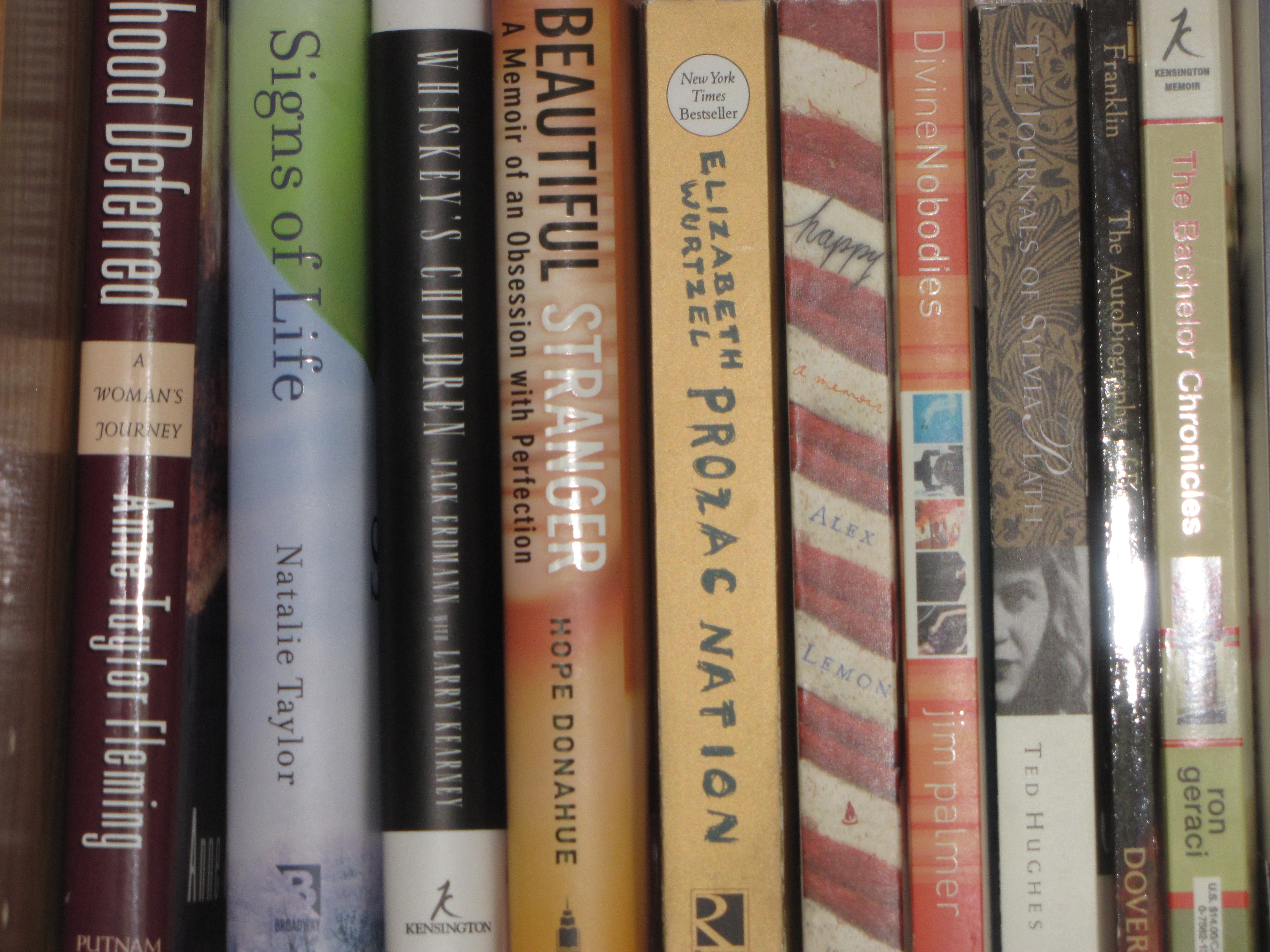
Prozac Nation—Review by a Former Pill Popper

200px-ProzacNationBook
Photo Credit: Wikipedia

In her memoir on depression, Prozac Nation, Elizabeth Wurtzel paints an annoying picture of herself as a depressive, which includes being desperate and clingy, prone to panic attacks, dependent on boyfriends for her identity, ungrateful for all the good in her life, and selfish.

Reading this book, even I, a sympathetic co-sufferer, became frustrated. When is she going turn a corner? Why is she telling me this? I wondered. And, How can she presume to be the authority on this when her past was not as heartbreaking as mine?

In her afterword, Wurtzel responds to impatient readers like me, saying, basically, “If you got angry at me, good. I wanted you to feel that way.”

The Book’s Bummers

As Wurtzel explains, she wanted to convey what it was actually like to be around a depressive and, more ambitiously, wanted to give the reader the feeling of being trapped in a mental prison similar those in which depressives finds themselves.

Indeed, most of her book grovels in the quagmire of her own circumstances—her parents’ divorce, her father’s abandonment, her failed relationships, her struggle to get adequate medical attention—and this is what gets so  annoying . But at key points she surfaces from her self-obsessed soliloquy to take stock of what her situation reveals about her whole generation—and this is what resonates with me.

The Book’s Brilliance

What Wurtzel does particularly brilliantly is characterize the displacement that she and her whole generation faced as a result of the cultural revolution in the sixties. Her parents divorce is, of course, no very remarkable thing these days, but her brilliance is zooming in on this seemingly “small” detail.

She expresses outrage on behalf of a whole generation whose parents have led them to dismiss marriage like so many other traditions that used to give people roots—she expresses anger at the fact that nothing is held sacred anymore—and that individual whim reigns supreme. She characterizes how such a world–where individuality and mobility, not family ties or roots, are seen as virtues—leaves its children feeling hopeless and depressed. She doesn’t go as far as diagnosing the cause of the explosive use of Prozac in the 90s, and the booming popularity of depressed-obsessed punk rock bands like Kurt Cobain’s, but the suggestion is heavily weighted toward the disintegration of the American family.

Where We Agree—The Family’s Demise Spells Depression

Like Wurtzel, I firmly believe that by our disregard for the family unit we have self-imposed many of our problems. In our quest for self-gratification, we have damned and doomed the next generations. I think this is what the Bible refers to when it speaks of parents’ sins becoming a curse to the third and fourth generations. It’s not that God unfairly punishes children for what their parents did. It’s that children can’t help but be cursed when parents choose to be self- rather than God-centered.

How My Take on Depression Differs

I’m glad Wurtzel wrote this book, because now I  don’t have to. Years ago, a book about my life would have closely resembled hers, as far as the inspiration meter. Low.

Of course, inspiring readers wasn’t the purpose of the book. It wasn’t to make the reader feel warm and fuzzy, but to portray what depression feels like.

Although I used to envision writing such a book, once I had my conversion I no longer felt comfortable writing such a book. But now, having read Wurtzel’s contribution, I see that such literature has its place, even on a Christian’s bookshelf. Jesus didn’t look away from human suffering, and we shouldn’t either. My problem before was I felt I was wallowing. But now I see that the wallowing effect came from my audience and purpose for writing. My audience? Anyone who would listen, preferably those who had failed me earlier in life. My purpose? To get the sympathy now that I never felt I got when at my lowest points.

In all seriousness, maybe I could write a depressing book like Wurtzel’s these days without wallowing, but that’s only because I would no longer be focused on getting sympathy for my past wounds, but offering empathy to fellow sufferers. Yes, these kinds of books have their place. But since by God’s amazing grace I’ve emerged from that black hole, I’m glad that I don’t have to fill that market niche. And now, I can focus on the upward swing, not the downward slope.

Is My Writer Seeping Through?

Image

Since deciding to be a “real” writer, I’ve kept a low profile. Not wanting people to know I’ve embarked on a low-paying (sometimes no-paying) job, I’ve hidden my true profession behind a façade of graduate student and teacher.

I haven’t been a teacher since May 2011, but until last December, I really was a graduate student, putting the finishing touches on my one-hundred-page master’s thesis. Mostly I was done by October, but I still let my classmates offer condolences for “how hard” the writing must be.

It wasn’t hard, really, because my advisor let me write the way I wanted to write: creatively and personally (with a little academic jargon sprinkled in). I guess this “practical” approach worked because the topic was practical: best practices for teaching writing.

When a few of my fellow students heard about my personal [slash] creative [slash] academic project, they seemed intrigued.

“I’d never have thought of that,” some said.

As they scrambled to turn up sources on the databases, scouring search engines and library shelves, giving themselves ulcers looking for an original angle, I just sat back and wrote. I started from the inside—I knew what I wanted to say, and I didn’t much care about citing the scholarly conversation that had come before me, or that would come after.

I know this sounds sort of pompous, and it wouldn’t work in some of the disciplines where original voice is not prized. But thankfully, English departments operate on this truth: If a voice is engaging enough it doesn’t really matter what it’s saying—people will read it for the good writing.

And that’s the truth in the real world, isn’t it?

People who don’t care a lick about golf will watch Tiger Woods because he excels in his sport. Same for most Olympians and Olympic sports. Who watches bobsledding or curling on a regular basis?

But millions watch the Olympics because it’s fun to watch pros do what they do best.

Funny, then, that I feel I’m still hiding in the wings, waiting for permission to “come out” to do what I do best.

Well, not so funny, I guess. I have no doubt that the hiding is due to the overwhelming personal content of my writing. (It’s not really about the money.)

In order for me to write about the things I write about (mental illness, family dysfunction, deepest fears) and be respected, I feel I have to be either a mental health professional or a pastor, or some other authority who can talk on these things at a close, yet safe, distance. That, or I have to make the writing itself attractive. Because the topics just aren’t.

Still, I am convinced that these topics are worth discussion. Worth a master’s thesis, a doctoral dissertation, and many book series. I am convinced that all this painful self-reflection is what more people ought to be doing, but aren’t. But if it’s so worthwhile, why aren’t more people doing it?

Because: Like graduate students fumbling for research topics, we are afraid of ourselves, and we are afraid of what self-examination might reveal. So we look for other voices to latch onto. Let someone else be the guinea pig—or the “straw man,” to use an academic term. Then, if our life thesis fails, we can partially blame the voices on whom we’ve built our own.

Well, I’ll stand behind my own work. To the thesis examiner who said my work got uncomfortably personal at times, I would remind her that everyone else who read it said it was the most memorable thesis they’d ever seen. She was more comfortable in the theoretical realm, and that’s where she encouraged me to return. Toward the end of the defense, we had a more informal discussion about how we felt about publishing—how we felt about others reading our work—and this professor said she felt terrified thinking others would read her academic writing (not to mention any personal stuff).

Just like she couldn’t understand me being so personal in writing, I couldn’t understand her being so guarded (about dry academic prose). Perhaps she is worried that others will smell a rat—that of inauthenticity. And I guess if I were not being true to myself, I might worry about the same thing.

But after denying myself public expression for so long, I think having to live in hiding is far worse than living exposed. After spending time in a theoretically constipated English department, I think living vulnerable is better than living jealous of writers whose real-world topics you only dare poke with a critical stick.

Perhaps my guarded professor would even agree. At the end of the day, she passed my thesis unconditionally. Call my writing what she will, that day she called me a master.