Theme of 2024: Writing and Speaking Like a “Boss”

In July of 2023, I became a boss (read: chair of the English department). In July of 2024, to mark my 40th birthday, I journaled a version of what appears here. But I didn’t post it. I’ve been too shy to write publicly about this new season of life. Plus, I’ve just been too busy. But I’m re-purposing my 40th birthday post now, as a New Year’s post, in hopes of re-starting a hobby I love. It’s time to look away from the never-ending leadership challenges and carve out space again to write and heal, and maybe help someone else do the same. So here you go…a retouched 40th birthday post, five months late…

Life as a Leader, Life at 40

The nutshell of life at 40 is this: In this season, my emotions roller coaster more often than I’d like. I have some awesome days, but also days (even weekends) when I fall into bed, beaten down, not understanding how to do this: run a department, run a family, just get supper on the table. In this season, I bargain with God and talk to my counselor about my life’s assignment that sometimes feels too heavy. And I keep coming back to questions like these:

How can we be in this world when we are bowed down with grief or pain? When we feel dark and depressed, how can we function at work, or with our kids, or even with ourselves?

As I’ve journaled and prayed and counseled over the last two years, one clear answer God has given for surviving my current season–my leadership season–is voice transformation. Below are three steps that have helped me adopt a newer, healthier voice when that intruder voice in my head tells me, “I can’t show up today.”

Step 1: Redirecting Negative Voices

This first step involves redirecting our “default” voice–or suppressing what initially wants to come out. This step involves exercising self-control in public places, and then funneling the negative voice into controlled avenues for expression, like a journal, with a friend, family member, or counselor.

We should suppress our negative feelings a good amount of time, because how else would we function at work, school, and home (especially us pessimists)? Especially now that I’m in leadership, I’ve realized it’s good to squelch that negative voice sometimes. However, we should not squelch it forever. If you’re familiar with my writings, you know that I have often expressed my pain in order to work through it. But now as a boss lady, it’s not appropriate to vent my emotions just anywhere. I have to be more selective.

For my dissertation, I had to make a conscious shift in tone and person. See, I identified so much with the college students I was writing about, that I wrote my early drafts using first-person pronouns. “As a college student, I needed to be able to write about my life experiences and be able to connect them to classroom learning.” But by the final drafts, my voice had to shift from a personal, vulnerable voice into a voice of authority.

Step 2: Exercising a Voice of Authority

So, I stepped into my teacher voice. For later dissertation drafts, I transformed my first-person pronouns (I/me) into third-person pronouns (they/them): “Our college students need to be able to write about experiences in their lives and connect those to classroom learning.” In this way, I put distance between myself and the topic. Just as we ask our college students to gain the “discourse of the academy,” writing my dissertation in this way was a good exercise in assuming a voice of authority.

As I revised my dissertation, my chair, Dr. Jim Warren, helped me make this transformation. He pointed out where my work was too personal, and where I was stepping out of the bounds of my authority as an English teacher/scholar. “Do you want to be a writing teacher, or a therapist?” he once asked me. “Both,” I answered, grinning. But I digress.

Developing a Voice of Authority at Home

Outside of work, I’ve also worked with my counselor to develop my voice of authority at home. Many sessions have been spent pouring out my worries about how I am ill equipped to be a mom, how I don’t want to screw up my kids. And my counselor has helped me take a step back and consider things more objectively: “Are your children neglected?” No. “Is there addiction or abuse in your household?” No. “Are your kids fed, clothed, and do they generally feel safe?” Yes. “Do they know that you love them?” Yes. “Then celebrate what is going well.” “Be the mom, be the boss, and don’t feel bad for setting limits. God does this with us: He says, choose life, or choose curses. Just do it God’s way.”

Thank God for the tool of voice transformation. By His grace, I am transforming into someone my kids can be proud of. Speaking of kids and college students, sometimes I still feel like one…and that’s when I realize I need remediation for arrested development.

Step 3: Remediating Arrested Development

Arrested development. That’s what trauma does to you. Hijacks the brain, so you can’t focus on those skills you should be learning at your given life stage–but instead you are working to simply remain calm, breathe, process seemingly threatening input in your environment (usually you are not in actual danger, but your senses say you are).

So, you can find yourself 30, 40, even 50, 60, and 70, trying to learn coping skills you should’ve learned much earlier in life. Anyone with me?

Parent or Child? Boss or Subordinate? Or Both?

Many times in the past ten years of parenthood, I have identified more with the child role than the parent role. At work, I still sometimes have to remind myself that I am the boss, and not the freshly graduated newbie (oh wait…I kind of am that, too;). So, I am both the child and the parent, the subordinate and the boss. Broken, yet called to heal.

Actually, this is the human condition. Because this is a broken world, we are all broken, and we all need care, while we are called to provide care to others. Wow. Heavy.

Yes indeed, often we find ourselves in a strange double role. I thank my God that He has allowed me to lead even while I still have so much to learn–to be a “boss” while I’m still quite a mess.

Actually, admitting that I am still a mess has, strangely, helped me be a better boss. Providentially, some of the skills I’ve needed for motherhood I’ve also needed for the job, and vice versa. Little kids are not the only ones who need comforting and soothing; sometimes seasoned men and women on the team need those things as well.

And I realize we give a gift to our children, and our team members, by allowing them to express themselves, and then dwelling with them while they calm down. They (the kids, and the coworkers, and the college students) and I are working on these skills together (although they might not realize it)–talking ourselves down from emotional heights, transforming our voices, telling ourselves and others, “It’s okay.”

As I’ve learned from my counselor, it has typically been the mother’s job to soothe her children. Often the mother’s voice is the first one children hear when they need emotional care. In thinking about all of this, I realize that, in a strange twist, I’ve now become a mother at work. Just like when I was a new baby mama, now, as a new “professional mother,” I need to seek out other mothers–and fathers. I am thankful for those colleagues who have mentored and are mentoring me. None of us can do this job–work, home, LIFE–alone.

So, to return to my opening questions: How can we be in this world when we are bowed down with grief or pain? If we feel dark and depressed, how can we function at work, or with our kids, or even with ourselves?

We do two things: we seek help for the deep hurts and seasonal growing pains with counselors, prayer partners, or other trusted people. But in the meantime, we exercise our God-given ability to choose new, appropriate voices for the various public roles and responsibilities we have to maintain. In so doing, we can inhabit and grow into our God-given identities–we can write and speak to our roots, to return to where this blog all started. Thank you, God, for giving us the tools of writing, speaking, expressing, and transforming* into the roles YOU assigned us.

May 2025 be a year in which God continues the work He has started in all of us (Phil. 1:6). Happy New Year, my Friends! Love, peace, and a big virtual hug to you all.

*Both in and out of English studies, theorists contend that language creates or constructs reality–and identity. As an English scholar, I am not comfortable with many of the current theories on the table. As a Christian, I believe we have to be careful when we talk about constructing reality, or identity, with our words. These days, people are using language to claim identities that are not God-given; and Christians, while they should show love to all, should not participate in such reconstructions. Rather, for those who call themselves Christians, the test of identity should entail consulting the Bible and asking whether God intended us to have those identities or not.

Permanent Head Damage (AKA, PhD)

On May 13, 2022, I was awarded my PhD in English. But for me, the letters PHD mean much more than a degree: they equate three types of Permanent Head Damage.

Permanent=no going back

Head=brain chemistry has been changed by mental, physical, or emotional trauma

Damage=what happened hurts. It may continue to hurt the rest of your life

PHD.

Brain Damage Type 1: Trauma

As I mentioned, I did a PhD in English during the height of the COVID-19 pandemic. My areas of research were composition pedagogy, writing as healing, and life writing. Just like it sounds, Life Writing is an umbrella term for all kinds of personal writing; it also covers the kind of writing I’ve done for a long time. Through my research, I made exciting discoveries about the therapeutic functions of life writing; and for my dissertation, I wrote about the benefits of including life writing in the college classroom. For one, I argued that life writing was especially important now, given the increased rates of mental illness these days.

Although my PhD committee directed me to keep my dissertation professional, I very much personalized the topic. How could I not? All throughout my PhD, I struggled with my mental health, as did much of the world. You can read more about that in my only post from 2020.

After researching life writing and healing, I have learned that the root of my anxiety and depression is probably trauma. My brain and my nervous system have never quite forgotten the trauma of earlier life. This is one type of head damage I can speak to: the long-lasting effects of trauma. I still deal with anxiety almost daily, but I’m thankful for many tools I didn’t always have that are helping me through. One of those tools continues to be life writing.

Brain Damage Type 2: the Academic Degree (PhD)

Another type of head damage I can now appreciate is that of doing a PhD. An old joke among academics is that PhDs cause Permanent Head Damage. Now I can attest. Brains change permanently after years of information overload.

Previously a stay-at-home mom, previously a lady who didn’t turn on the news, and previously a high school English teacher who did not understand that sex and gender were two different things (which obviously complicates teaching pronoun usage), I had no idea of the sledgehammers of enlightenment that were about to drop. Entering grad school in 2019, I soon stumbled out of a sheltered forest into the raging streets of Minneapolis post George Floyd (not literally, but through angry class discussions), and the contentious election of 2020. Lots of crazy things were happening in the country and the world–not entirely unprecedented–but my attention to the events was unprecedented.

How thankful I am that my family started visiting a new church in February 2020, several weeks before COVID hit, where my pastor, Philip Sizemore, spoke plainly and directly about world events, and related these events to the Christian life. Now that I was hearing the secular side of the issues in grad school, I needed help making sense of things. It didn’t take writing a dissertation to figure out that our country had turned some drastic corners, from which there would be no going back.

Speaking of dissertations, while I was outwardly writing about life writing in the classroom, I realized I was also writing through numerous personal issues related to media. No, not the news media, but the popular culture I consumed for much of my life through books, movies, music, etc. Throughout my dissertation process, I came to realize that such media consumption can constitute another type of brain damage. I’m not sure what to call this one, but Pastor Sizemore once used the phrase “a seared conscience.”

Brain Damage Type 3: A Seared Conscience

Much of my life has been spent consuming popular culture through classic literature and other media. My mom was an English major who filled our lives with books and library visits. My dad was an avid music lover and movie watcher. There was no shortage of things to watch, read, or listen to in my childhood home, though we were poor in other ways. I grew to love reading and music, and then I completed a BA in English literature, followed by an MA and then a PhD in English.

However, now at the end of it all, I have concluded the following: over these many years of consuming media, I damaged my brain. I would have been much better off without a lot of what is considered “good” media by much of the world.

Okay, you say. So what? What’s the bottom line of this dreary exposition on brain damage?

Takeaways for the Brain Damaged Among Us

The first conclusion I’ve come to is that I can treat and negate brain damage somewhat, but I cannot totally fix it. It will be permanent until Jesus comes back to give the world a new start. And that leads to takeaway number two.

Namely, while we’re still on this earth, it’s good and healthy to talk about permanent brain damage. By that, I mean it’s healthy to talk about life’s hurts. One thing I gained from grad school was many diverse perspectives of others. Oppression, racism, sexism, and similar terms were constant topics of discussion. Through many readings and class discussions, I learned much about traumatic experiences I have not personally lived, and I’m grateful for that broadening, and I will carry those perspectives with me.

I’ll say it again: Everyone’s story deserves to be heard. We don’t often get to choose our stories, and stories that include trauma especially need to be talked about and heard–that’s how healing happens! Sometimes issues even need to be addressed at a societal level, even need to be honored with righteous anger–amen for justice!

But then, after honoring the story, after angering at the appropriate targets, if we actually want healing, a shift must occur.

The third takeaway I have from my PhD is that it’s not healthy to stay angry. It’s not wise to resist healing and reconciliation. However, the mindset I encountered while completing my degree–I’m referring to the mindset of many intellectuals–resists reconciliation. This mindset wants to stay angry, and I contend that this mindset points to some very deep hurts that many will not admit. Rather than looking inward at the pain–a brave and difficult thing to do–this mindset deflects the personal introspection that would actually heal, and instead points fingers at systems and histories and other humans. Sadly, this mindset wants to insist that if there’s a problem, it’s not with me, it’s with somebody else.

While there are a lot of somebodies to blame–and sometimes rightly so–I think the healthiest, wisest line of attack must also include humility. True intellectuals will embrace a healthy skepticism both of the world and of themselves; they will accept that “I” am not beyond criticism. True intellectuals will realize that, even though the world may be an unjust place (of course it is!), perhaps I might need to do some personal growing and changing and healing along with everyone else.

Sadly, this is not an attitude many in our world seem willing to adopt these days–perhaps because this requires submission to a higher power, and admission that we are not ultimately in charge of our own lives (nor are we capable of fixing the world’s problems). Far from it. Sadly, when we don’t submit to a higher power, we cannot ultimately help ourselves with our brain damage. Worse yet, by not getting help for our pain, we often perpetuate the damage in others.

After my Permanent Head Damage, I have emerged with a final conclusion: a person can look really smart in the eyes of the world, yet still miss out on the only knowledge that really matters–knowledge of the Author of Universe. Personally speaking, I hope that conclusion never applies to me. Now that I am a “professional intellectual,” I hope and pray I will always use my hard-earned knowledge to serve and obey Him. After all, He’s the only one who can permanently heal my, and your, and the world’s damage (Revelation 20). Now that sounds way better than any solutions I’ve heard down here.

Giving Thanks in Stressful Times–Plus, a Job Announcement

Note: This was not our Thanksgiving dinner…this was a rare dinner out with my husband last weekend, shortly before I got COVID. In this pic, we were feeling very thankful (and we still do) for our recent good news!

Hi Friends! Long time, no write.…but as it turns out, this week has afforded extra down time.

Just yesterday, the day before Thanksgiving, I was diagnosed with COVID. Thankfully, this has meant an opportunity to reconnect with you via this blog. So, happy Thanksgiving! And it is a day for Thanksgiving in my household, even though COVID screwed up our plans for celebration this week.

What we are celebrating today, this week, is a job offer that came last week…a job offer, finally, after three years of subsisting on (financial) bread crumbs, slogging through grad school, and playing the job market. I’ll announce the job at the end…so skip down if you want to know, or keep reading if you care to hear about my life in recent years:)

Of course, you know about some of it–we’ve all been living through this pandemic, and many of us have been facing new (or old) mental health issues. Two extra life-quakes faced by my household included the death of a parent and the addition of the surviving parent to our household. For myself, the pandemic and grad school have also led to a flare of post-traumatic stress symptoms, along with a disturbing political awakening.

The PTSD and political awakening I am still struggling to find words for, as I work to conclude my doctoral dissertation. However, what I can articulate about these last three years is that I’ve learned much more than I wanted to about chronic stress–and I hope to convince my readers that chronic stress is nothing to sniff at.

About six months ago, I took the Holmes-Rahe Life Stress Inventory, which assigns numbers based on recent life events. In this inventory, a sum of 300 is a mega-stress score, and comes with the prediction of a “major health breakdown in the next two years.” I scored at 350. Maybe I should blame my COVID diagnosis on chronic stress?

I’ll write more publicly about these years at some point, perhaps after I finish my dissertation, but for today, I want to praise God that He has sustained me and my family through these years of chronic stress. I give Him glory that He is providing coping skills and tools I did not learn earlier in life, including various types of writing that I have been able to study and practice (mostly privately) while in grad school.

Although I feel beat up by the scholarly life–a very competitive, scholar-eat-scholar enterprise, if you want to know–I thank God that He led me to worthwhile topics that have provided me needed coping mechanisms for this period of my life. In fact, one task of my dissertation is to explain the mental health benefits of private writing for college students–a topic that I feel has not been sufficiently explored. I have a burden for college students who are struggling with mental health–and stats say at least one-third of them do. But as I’ve researched and written on this topic, I have remained aware that I am in this category, too.

Did you know that graduate students are three times more likely than the average American to suffer mental health disorders and depression? Or that roughly half of all PhD students drop out of their programs before graduating? Again, I want to give glory to God that He has sustained me to this point, and I have so many more coping skills now than I did at age nineteen, when I dropped out of my freshman year of college. So there is a poetic through line to my many years in college. While I wish I hadn’t had to go through all this chronic stress, I see that God is using it for His glory, using me to help stressed college students, like I once was (and like I still am).

What I love about God is that, while He allows us to go through these seasons of stress, He also delivers us. He knows such seasons are not sustainable; we are not meant to live like this long-term. Sometimes we have the choice to alleviate these insupportable stress levels; other times we are truly at God’s mercy: we have done what we can do, but there are circumstances that we really cannot change, and we must wait on our Maker to move.

Early last week I was praying to this effect: “God, I am at your mercy. I cannot change this situation: this multi-year job search that keeps ending in no’s, this mentally heavy doctoral work that must be gone through (to follow the path you’ve laid out), this house that my family has outgrown; this need for stability, including a living wage for my family. I truly need you to move, please.” And He did.

 Right before Thanksgiving break, Southwestern Adventist University offered me my old job back–but this offer was better than last time’s temporary, one-year contract. I have accepted a full-time, tenure-track position that begins July 1, 2022.*

Finally, after three years, the search is over. Praise God! As I sit here resting physically because of COVID, I praise God that, in many ways, I can now also rest mentally.

The hard work is not over, of course. I still have a dissertation to finish. But my stress level is getting back to a sustainable amount. Soon we will have real insurance again, and we will have a new house that fits us all; for now, I have the security of knowing that I don’t have to job search while also dissertating (PRAISE GOD; I already played that game last year, job searching while studying for comprehensive exams…and I don’t recommend it). I know that other seasons of stress will come, but for now I am truly thankful during this Thanksgiving season. Glory be to God who helps us in our weaknesses, who gives strength and answers when we have none. Thank you, Heavenly Father.

If you’re at the end of your rope this holiday season, I hope you’ll take time to reconnect with (or get to know) The Man Upstairs. And if your brain is on overload, like mine has been for these past three years, try some therapeutic writing–perhaps writing out your stressors in a prayer journal. Also, for you over-stuffed intellectuals out there, remember that connecting with God doesn’t always have to mean reading yet one more thing; sometimes, it means expressing yourself, crying out, or even having a good cry while listening to some good Christian tunes.* As these recent years have taught me, God’s in the business of fixing our problems–as well the business of sustaining us when solutions take longer than we want them to.

*I distinctly remember one day last year, when I was working virtually in my makeshift she-shed, that I felt overwhelmed, cognitively overloaded, and stumped as to how to connect with God. I remembered a song I’d heard on the radio and looked it up; then I sat there and cried as I listened to these lyrics: “When you don’t know what to say, just say Jesus.” Normally this song would be a bit rock-y for my taste, but that day, it really spoke to me; for three minutes, it was pure worship. While I couldn’t formulate words, I just cried, and I let the song express what I could not. Afterwards, I felt better and I was able to get to the day’s work. In short, I highly recommend making an anti-stress playlist and using it as often as needed! Be well, friends!

College Students and Mental Health

While teaching freshman composition at UTA last semester, I got to teach on a subject that is near and dear to my heart: college students and mental health.* The subject is near and dear to me, of course, because I struggled with my mental health as an undergraduate college student. It is also still near (but maybe not dear) to me because, at this phase of life I’m in–graduate student/mother/wife/teacher–I am again battling some anxiety.
At a public university, I couldn’t talk openly about what has most helped me since my own depressed undergraduate years. That is, prayer and meditating on Bible promises to replace negative thoughts. But I did tell my students I had struggled mightily in the area of mental health, and that I had gained some victories by learning to better express myself in a variety of contexts: talking honestly with friends, arguing “nicely” with my husband (as in Rogerian argument), and practicing expressive (personal) writing in private as well as in public settings, to name a few.

“Communicating well is an essential life skill,” I told my students from the beginning. As the course progressed, I increasingly talked about good communication as an aid for better mental health. In the middle of the semester we practiced some small group communication on several “mental health Mondays.” Following, we read a chilling ESPN article by Kate Fagan, entitled “Split Image,” about a college freshman who struggled to communicate a true picture of herself and ended up committing suicide. The article begins, “On Instagram, Madison Holleran’s life looked ideal: star athlete, bright student, beloved friend. But the photos hid the reality of someone struggling to go on.” We read the long article out loud with our desks in a circle, and I posed the questions Why did she do it? and What is the “argument” of the article? One astute and un-shy student said, “People who look great on the outside aren’t necessarily feeling good on the inside. They can be living a double life.” True, that.

My class of 24 was the quietest class I’ve ever taught. Very few of my students ever spoke voluntarily in class, even to one another. But when we took an anonymous mental health survey at mid-semester, my students learned some troubling things about their classmates. One-third said they were struggling with mental health to the point that it was interfering with their normal activities. (This statistic supports national research we read in the class.) One student was clearly suicidal, based on his or her anonymous comments. Forty percent reported they were in college not because they wanted to be, but because their parents wanted them to be.

Around the time I gave that survey, a handful of students stopped showing up. A couple did not turn in their second required essay. Though all my students started strong, four of them eventually failed or took incompletes. Except for a couple students whom I couldn’t reach, the strugglers eventually admitted to me–via emails, essays, or in person–that they were struggling with depression, anxiety, or relationships (romantic or parental), or all of the above. None of the failing students was academically incapable of succeeding in the class.**

I find often in life at large–not just in college life–that our failures are due to struggles of the mind (stinking thinking some call it), and/or the inability to ask for help. The longer I observe humanity, the more convinced I become that it’s simply hard for people in general to communicate honestly  about their feelings. It’s hard for people to ask for help. Sometimes it is hard for us to even recognize or admit that we need help. This is a sad reality.

Another sad reality is a persistent belief, common among the older generations, that mental health struggles are myths. I was saddened when I read statements in my students’ final essays like “My dad doesn’t believe in depression; he just thinks people who claim it are weak.” I was also saddened to learn how reluctant my students were to simply talk openly with their parents. Some students admitted to me that they literally didn’t feel safe expressing their needs to their parents. One student wrote in her final reflection that she had changed her major from the one her parents selected (a major she hated), but she was keeping the news from them as long as possible out of fear of their reaction. Another admitted that her parents had threatened to disown her if she did not go to college.

Wow. My quiet class of twenty-four, though they didn’t speak up much in class, spoke loudly and clearly by the end of the semester: they have lots of legitimate (and normal) struggles, but they were generally uncomfortable sharing those struggles with others. They lacked skills in healthy self-expression that I believe could do much to prevent normal struggles from turning into mental health issues.

This is why I feel teaching college writing is not just a career, but also a calling. As I’ve transitioned back into professor-mode over the last year and a half, I’ve had many “aha” moments of why God has put my feet on this path. Namely, my life story has been one of figuring out how to communicate in order to achieve or maintain stable mental health. Now I can use what I’ve learned, and what I am still learning, to help young adults learn critical skills of communicating at a critical, crisis-inducing time.

Yes, communication–in a relational, expressive sense–is an essential life skill. These basics of communication are even more essential than academic writing, I believe–yet how much time do parents, teachers, and church leaders take to teach these “basic” skills? When we can’t express our feelings and/or ask people for help–healthy stress responses, by the way–we resort to unhealthy stress responses: fighting, fleeing, or freezing.

Over the last year and a half, I have seen that young people today need caring adults who won’t dismiss their struggles, but who will listen without judgment. Are you one of those adults?

If you are reading this blog post and have college-age kids in your life, or any age kids, for that matter, I hope you will ask yourself: Am I a safe place for these young people? Do I respond to their struggles and concerns in such a way that I invite them to share with me? Or do I react in ways that would lead them to want to hide from me, and not communicate honestly?

And some questions for self-assessment:

Do I know how to communicate my own needs to the people around me? When I am stressed, do I engage in healthy responses such as journaling, praying, or talking to trusted friends? Do I do the best I can with the resources around me to manage my mental health?

Aside about Managing My Own Mental Health

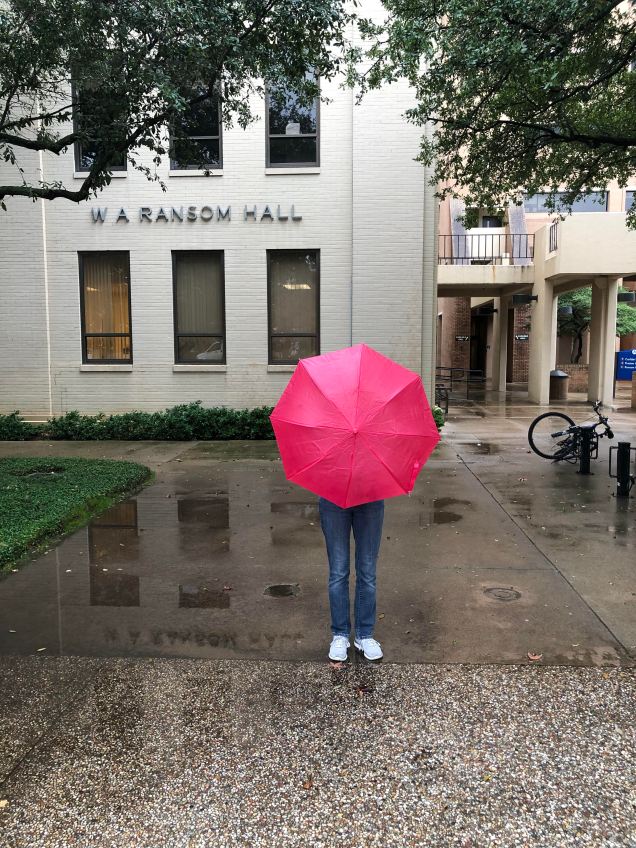
One of the resources I used to manage my anxiety last semester is CAPS, the free counseling and psychological services UTA offers its students. I first visited Ransom Hall (pictured above) in July of last year, when I was home for the summer and felt the familiar anxiety coming back. We were smack-dab in the midst of transitioning my mother-in-law and her possessions into our household, and me transitioning my possessions and my full-time professor position from my office at SWAU to my garage and my new office and roles at UTA. I called off a visit to see my parents in Minnesota in July because the thought of the trip, on top of everything else, was making my anxiety worse.

When I started my semester at UTA in late August, the anxiety improved for awhile–I do better at work than at home–but as the semester wore on, life crowded in on me, like it did to my students, and I felt myself struggling to breathe. I couldn’t find much time to journal or talk to friends, much less my husband (though I did pray on a lot on my commute). I was physically sick for about half the semester, so I couldn’t exercise much. However, I made use of the resources available. Ransom Hall is right next to my office in  Carlisle Hall, so at mid-semester, I sought counseling (controlled crying and venting?) again. At the end of the semester, faced with another long break at home (I felt the anxiety coming), I sought again anxiety medication at the campus clinic.

Before Christmas, I made a playlist of anti-anxiety songs and played it over and over for a couple weeks. I saw a couple friends, but not as much as I would have liked (they’re mostly all busy moms, too). After a year and a half of crazy transitions and not seeing my family, I desperately wanted to escape to Minnesota, but failed to communicate to my family how important such a break was soon enough, and never made that trip. We did fly my little brother here for a visit, though, and his presence has been a comfort. And last week my dad happened to call me while I was having a panic attack, and, hearing my sobbing and hyperventilating over the phone (a quite unusual call for us), he planned a last-minute trip to Texas during the last few days of my break. I wish I could have communicated better, earlier, and less dramatically my needs to my family, but so be it. There is a lesson in this. I am still learning to communicate my needs to the close people around me in order to take care of my mental health. I am still a work in progress. But I have learned a lot, and I have a lot to share. Sharing uncomfortably personal things seems to be the ministry God has given me, in fact, and I embrace it gladly, happy that sharing my hurt can lead to someone else’s hope.

End of Confession

You don’t need a college education to improve in these areas (communication, mental health management, being supportive of others in their struggles). You just need a willingness to be honest with yourself and others, and a willingness to listen. If you feel like you need help in some basics of communication, you might benefit from a radio interview I had the privilege of doing this past October with Adventist Radio London on “Overcoming Depression.” Praise God that depression is no longer a part of my story!

Again, Happy New Year, friends! I’ll sign off this post the way I signed off my class last semester: good communication and good mental health to you!

*Providentially, this “topic cluster” was added to the First Year Writing folder just this year–just for me, it seems.

**All the trends I’ve noted in this paragraph also applied to a 25-person Research Writing class I taught last year at Southwestern Adventist University, a private Christian school. An interesting comparison.

Two a.m. Soul Cry: Finding Release Valves for the New Year, and Your Current Season

img_5269I didn’t write a Christmas letter or send out Christmas cards in 2019. I found that, at the end of the fall 2019 semester, I was too emotionally exhausted to do much of anything but cry. All semester I went to school/work to be a student/teacher, and I came straight home to be a mom/wife. That was my semester. Everything else got put to the side. This week, our family is decompressing and ringing in the New Year in a cabin in Arkansas. I am still trying to unwind from that crazy semester, as well as the crazy Christmas season. As well as just, well, life as we’ve known it for the past couple years.
I still don’t have words to express all the feelings I have about my personal life right now–except perhaps what I could only get out in some free verse in October. One night after coming home late from a night class, I couldn’t sleep, and a poem spilled across my notebook pages at 2 a.m. (This was unusual at this stage of life. My readers know I’m not a poet.) Perhaps what comes through in the poem is that I don’t know how to tend to some important relationships right now while also trying to stay mentally sound myself. I feel like, for the past few years, every six months or so we have had a huge life upheaval: two job losses, moving to a new state, a mom-dad role switch, the death of a parent, a parent added to the household, two new jobs, re-entry into graduate school…what have I missed? Anyway. stressful times.

My dad has a tradition of sending out an annual Christmas poem, and since I didn’t write any Christmas communications, I’ll dedicate my October poem to my dad, and to my mom, and to my brothers, Kyle and Caleb. All of these dear ones live at least a thousand miles away, and I have seen none of them for at least a year and a half. I also dedicate the poem to my good-humored husband, Buc. One needs a sense of humor at times like these. During stressful seasons we humans need some release valves like crying, talking with friends, writing poetry, or doing whatever leaves us with a little more peace. May you take your human and/or artistic license in 2020 and do whatever emotionally uplifting, nonviolent, non-destructive-to-relationships, and legal things you need to do to weather whatever season you’re going through. God bless you, Friends, and Happy New Year.


Showing Up
10/20/19

Sometimes life is about showing up
being present
hugging a screaming, inconsolable child
saying I love you or
praying with you
when, really, that’s all I can do.
I can’t fly over the ocean to you
or even across five states for you.
I can’t take my family, your grandsons,
to visit you.
I have nothing to give.
Nothing but wishes and prayers and a
heart full of emotions I can’t express.
Life just doesn’t cooperate.

The house is a mess.
And I have to go to work.
And I could work my life away,
forgetting to stop and sit with you.
Neglecting to sit and eat with you.
Not bothering to look you in the eye.
Just giving up trying to connect…
because connecting seems so hard.

Where do we go when we run out of
answers?
When Mom, Dad, Husband, Wife, and “Higher Education”
cease to fill us, delight us, comfort us?
And when, after a lifetime of reading and
school and straight A’s, we can’t learn
what we need to know, no matter how
much we study?
Only here. Crumpled in a chair at 2 a.m.,
heart racing, praying, knowing I don’t
know much of anything. But it’s okay.
He knows.
You know, God.
You know it’s going to be okay.
The world doesn’t rest on my shoulders–
it rests on yours.

And so.
I can breathe. I can sit. I can put
work away. I can leave that dust.
I can give up so many expectations
that never did anything for me
but strangle me.
What if Mom is not all put together?
(And I mean she, and I mean me.)
I’ll speak for myself and say
I’m a mess. Emotionally.
I can clean all day–clean my life away–
but what will that do if I alienate you?
I’m sorry, Family.

I see me now, or I’m starting to.
It’s not totally my fault. I didn’t make
this mess (completely). But neither did you.
It’s a long legacy, passed down to us from
our first mother, our first father.
We’re just the latest installation in a
forever-back line.
We were gifted the curse at birth.
And so we grow up nasty and defiant,
a collective screaming child. Rude, disrespectful,
selfish, self-centered “I’s.”
Our parents wounded us, though it’s the
last thing they wanted to do.
We grew up to do it, too.
We’re messy people, producing more messy people.
Heaven help us–Jesus help me.
For on my own, I can do no better than
live out this human legacy.
Human nature tells me to leave–
don’t stay the course–do what’s easy.
Emotions go cold–play mind games.
Get angry, bitter, blame him, blame her.
Don’t take responsibility.

But.
You came to change the story,
Jesus. You came here, by me–right
beside me, and us, in this mess.
You flowered in the fray–
a tender shoot from dry ground.
Unsupported, despised, rejected.
Unfairly treated, betrayed, and abandoned.
Abused, misused, and unfairly accused.
If anyone had the right to be angry,
it was you.

But what did you do?

You showed up.
You prayed, You pled, You loved, and You bled.
You cried and You prayed, even while betrayed.
You kept Your eyes on the skies and on
better days (One day
you will see me coming in the clouds,
You said.)
Still–You prayed and You pled, and You
loved, and You bled.
You didn’t turn cold or deny the pain–
You uttered this refrain:
God, if it is possible, take this cup from
Me. But if it’s not possible, Thy will
be done.
And God didn’t take the cup away, because
this suffering was Your mission.

And when they beat You and hit You,
kicked and spit at You–tore off
Your clothes and dressed You in robes,
nailed Your body to a tree,
You prayed,
Father, forgive them for they know not what
they do.

Oh, what those eyes could see.
Me. (And I mean you.)
How could I be so stupid?
Life wasn’t supposed to be like this.
Forgive me. I didn’t know what I was doing.
And I still don’t know what I’m doing, Lord.
And I don’t know how to fix it–
this pain in me and this pain around me–
And the pain inflicted on me, and the pain
I inflict on others.

But praise God.
I don’t have to know.
Because it’s not my job to know.
And it’s not my job to fix it.
You know, and it’s Your job.
That’s why You came and lived
and prayed, and pled, and loved, and bled,
and suffered, and died,
and rose again.

It’s 2 a.m. and the night is almost gone.
Day will rise, hope will rise, again.

And sometimes, like today,
life is just about showing up.
Being present.
Hugging a screaming, but consolable, child.
Saying I love you to my husband.
Sending I love you’s to my mom, my dad, and my brothers
(thousands of miles away).
Praying with a friend who’s with me now.
That’s all I can do.
And that’s all I have to do.


img_5270

Year of Blessings: Update Post

Write Spot
I had the privilege of directing the Write Spot, the campus writing center, at Southwestern Adventist University for the 2018-19 school year.

Okay, after ten months of silence, it’s time for a blog post. Last you heard from me, I was starting a new job as an English professor at Southwestern Adventist University. Well, that position is ending, and a new chapter is starting. I’ve begun my PhD at the University of Texas at Arlington (UTA); as of this coming fall, I’ll be working on a doctorate fulltime and teaching part-time for UTA.

Guys, one year ago as a stay-at-home mom, I had no idea I’d be back in grad school right now; no idea I would have fallen in love with teaching college composition, and have decided that this is what I was made to do. Life simply continues to be a whirlwind of changes. The 2018-19 teaching year was a blessing, on so many fronts. It was also a year of heartache, fear, and anxiety.

The Heartache of Losing a Loved One, the Blessing of Extra Time

My husband lost his job in March of 2018, as you may recall. We were then in Missouri, detached from any family (his family being in Texas, mine in Minnesota). After considering many options, without a job lined up, we decided to move back to Texas. We didn’t know then that Buc’s dad would pass away just seven months after our return. We didn’t know that I’d get a one-year position at Southwestern Adventist University and Buc and I would essentially switch roles for this year, but in hindsight, oh, what a blessing! We will ever cherish the extra time we got to spend with our Dad and “Poppa” Gendke. I am thankful that it was Buc at home, and not me, to be able to spend extra time with his father, and later, to bring extra comfort to his mother. Buc loved the job he lost, but he loved his father so much more. If this had been the only blessing of our job loss and move, it would have been worth it.

But there’s more.

The Blessing of Going Back to Work

If you read this blog, you may remember that I was a floundering mama in Missouri. Wow, was I a mess. Staying home with kids simply seemed to bring out the worst in me. I’d love to say I love being home all the time with my kids, but the truth is, no, I don’t. There’s a complex explanation here that involves my roots: my upbringing, my fears, and my sinful nature. Maybe I’ll unfold that in writing later. But the simple explanation is that providing childcare for littles does not call forth my strengths. On the contrary, it ramps up my anxiety like almost nothing else I’ve experienced. So, while I love my boys dearly and I’m so glad I have them…

Oh-my-goodness.

I’m so relieved I got to go back to work this past year! And not just to any job. Guys, this past year, I think I literally worked my dream job. I’m so amazed at how great a fit this position was for me. Suddenly, after years of feeling like a colossal failure, daily feeling bad about myself and my performance with my littles, I felt comfortable and confident again.

The Blessing of Finding my Calling

In the college classroom, specifically in teaching my writing classes, I found a passion that is second only to writing. In my comp classes, I provided learning experiences for a young audience, but now young adults (not young children). And this seems to be my sweet spot as a teacher. (Maybe this will be my sweet spot as a parent, too.) I knew how to talk to young adults, how to connect with them—in short, how to help them. It was nice to finish a day of work and feel I had really helped people; I had really provided skills they needed.

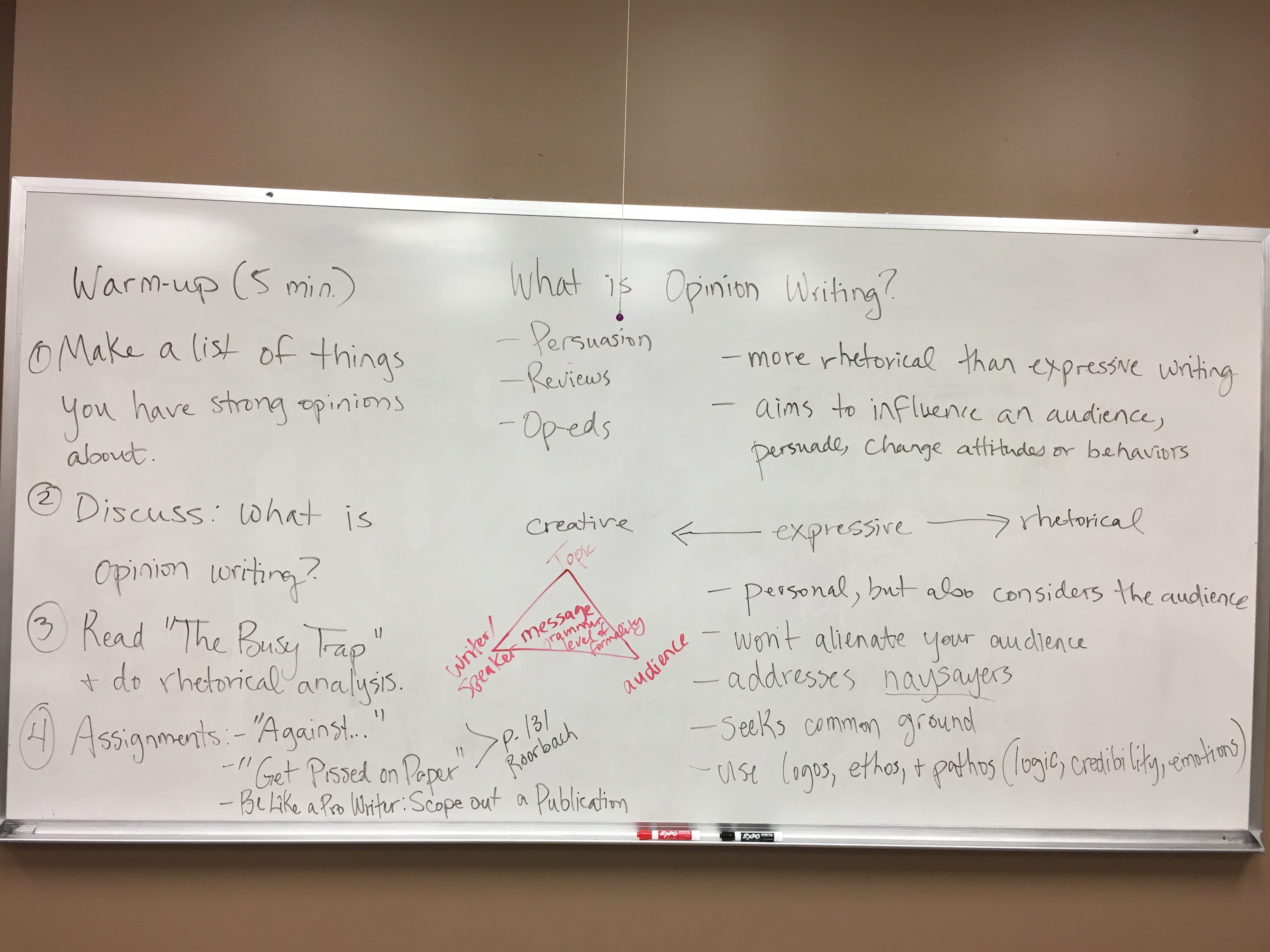
When teaching, I like to write on the white board. Here’s a taste of my Essay and Opinion Writing class, fall 2018. Did you realize that many college kids just take pictures of the board, now, in lieu of writing down their own notes? This was news to me this year!

You may or may not recall that I taught high school English for three years before having my children and writing my books. Well, this feeling of satisfaction did not accompany the high school job. Thus, I really didn’t expect to fall in love with teaching as I did this past year. What a blessing to have had this year to figure out my audience as a teacher.

At the end of the year, having to tell my beloved college students that I was not coming back was sad and felt a little confusing. I didn’t want to leave. I did reapply when my position was reopened. But I was not re-hired. No one was. The position, my position, has been cut at this time for budgetary reasons.

The Fear and Anxiety

The months leading up to this news were chaotic and stressful. Ever aware of the impending hiring decision, I was doing everything I could to keep my job. I updated my resume, wrote a heartfelt cover letter, re-interviewed with the English department, put my best foot forward in a departmental presentation—I even enrolled in a PhD program and one night class, not because I wanted to do a doctorate (I ended grad school last time with mixed feelings), but simply because I wanted to keep my job.

All year, I kept my head down, eyes off Facebook and this blog, and instead focused on teaching, and trying to keep my job. All my extra time went to my kids and husband. I’d say all other relationships—the ones outside my home—suffered. By January, because I felt so anxious, I decided to take part in a depression and anxiety recovery program at my church on Monday nights. Well, it was a good try at dealing with my situational anxiety, but unfortunately, the demands of the seminar—eight weeks, Monday nights for two hours, with hours of assigned reading each week and personal homework—created more anxiety. I simply didn’t have the space in my schedule for it.

The Blessing of Losing my Job, and Gaining Graduate School

By the time my boss informed me I would not be rehired, the last day of my spring break, the news actually came as a relief. Although teaching was going well, overall, I was being stretched in too many directions: fulltime job, PhD work, mother of small children, and a once-a-week anxiety seminar that I didn’t have time for. So, after spring break, I had Monday nights back, and closure about my job. I still had to get through the rest of the semester, though, which included teaching a full load, and my Thursday night class, for which I had to write a twenty-five page paper.

Here’s a last look down the SWAU English department hallway (and into my office) before I move my stuff out. It’s quiet now, for summer break, and I may take advantage of that peace and quiet a few more times before I transition my office to UTA.

Actually, the sting of losing my job was greatly lessened by my concurrent involvement with the doctoral program. With that twenty-five page paper looming, and questions of, What will be my areas of research for the next three to five years? I had plenty of new material to occupy and distract my mind from the job loss. In addition, toward the end of the spring semester, I was awarded a doctoral assistantship, which will pay for my tuition, and also pay me to teach one or two writing classes at UTA.

UT-Arlington_DirectoryLogo.gifI couldn’t have predicted it, but I actually feel happy to be back in graduate school. I’m so much more ready to focus on graduate studies and a career now than I was in 2012 when I finished my master’s degree. At that time, I decided to step away from grad school and a career and have kids and write. That decision led to the beginning of this blog, in fact. Back then I was still trying to heal from childhood trauma. I needed to do some hardcore expressive writing, and focus on family.

The Blessing of Buc (My Hubby)

As I type that line, I imagine some readers asking, What about your family now? Don’t your kids need you at home?

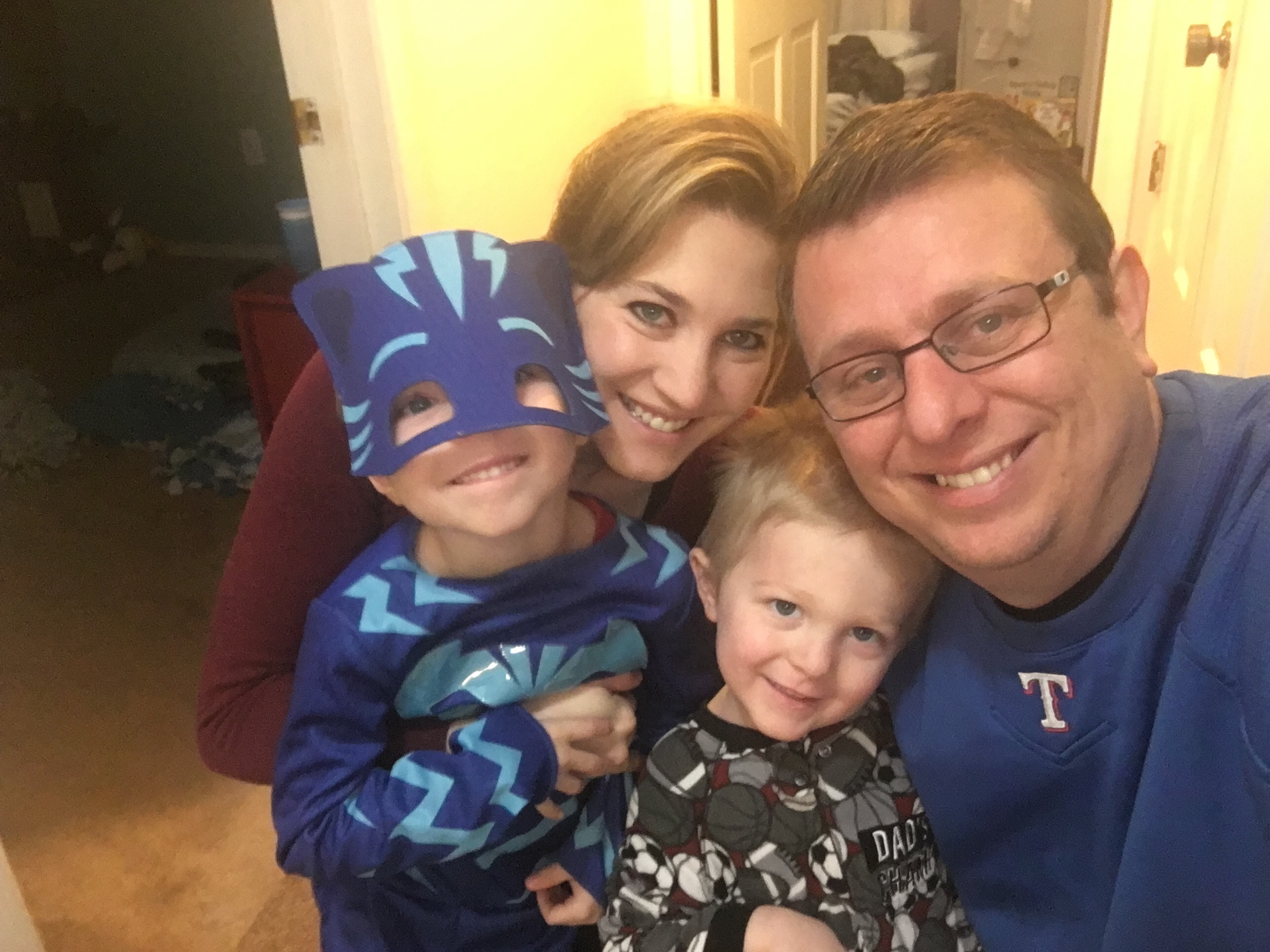
This picture was taken on the morning of January 21st of this year, Sam’s fifth birthday. It was dress-up day at school, and he chose to go as Catboy from PJ Masks. This photo makes me happy.

Do my kids need me? Yes, they do. But do they need me to be the parent who is predominantly at home? Or is it possible that, in my particular family, Dad is the one better suited for this job? I’d like to write more about these particular dynamics in another post, but suffice it to say, this past year of Buc staying home with the kids (mostly Seth, since Sam entered preschool) has proven to be another huge blessing, as well. Buc did great! We are finding that, for our family, Dad is the better parent to stay home.

This Summer…

It still pains me that staying home with my kids seems to bring out the worst in me. On summer break currently, I am again suffering some anxiety. I keep remembering back to something I said to a friend on the brink of turning thirty, when I first became a mom: “I want my thirties to be more relaxed.” When I said that, I’m not sure I knew what I meant by “relaxed.” I think somewhere in my imagination, I wanted “relaxed” to equate to staying home with my babies and happily living life on the porch, a glass of lemonade (okay, coffee, lots of coffee) in hand. Well. It didn’t take long to discover that, for me, being at home was not relaxing.

As I write, I am about to turn thirty-five. I have a husband, a three-year-old, and a five-year-old. I have a house and a yard to take care of. I also have an appointment to teach and study for my doctorate fulltime in the fall. Before you judge me as crazy (for taking on so much at once), or a bad mom, please know that going back to work has saved me. It has saved my mental health. And maybe it was the first step in preventing psychological damage in my kids.

This summer, I’m going to try to be a happy, hands-on, blessing of a mom. For me, that takes a lot of prayer, planning, and energy (it stretches me much more than being in the classroom). So, I’m trying to leave margin, trying not to fill up my plate with much. That means blogging won’t be a high priority, although I hope to blog sporadically. My other goal is to reconnect with some family and friends, and actually try to rest a bit before the busy-ness starts up again fulltime in the fall. I hope to continue reflecting on this year of blessings that has just concluded, and prepare mentally for the busy year ahead.

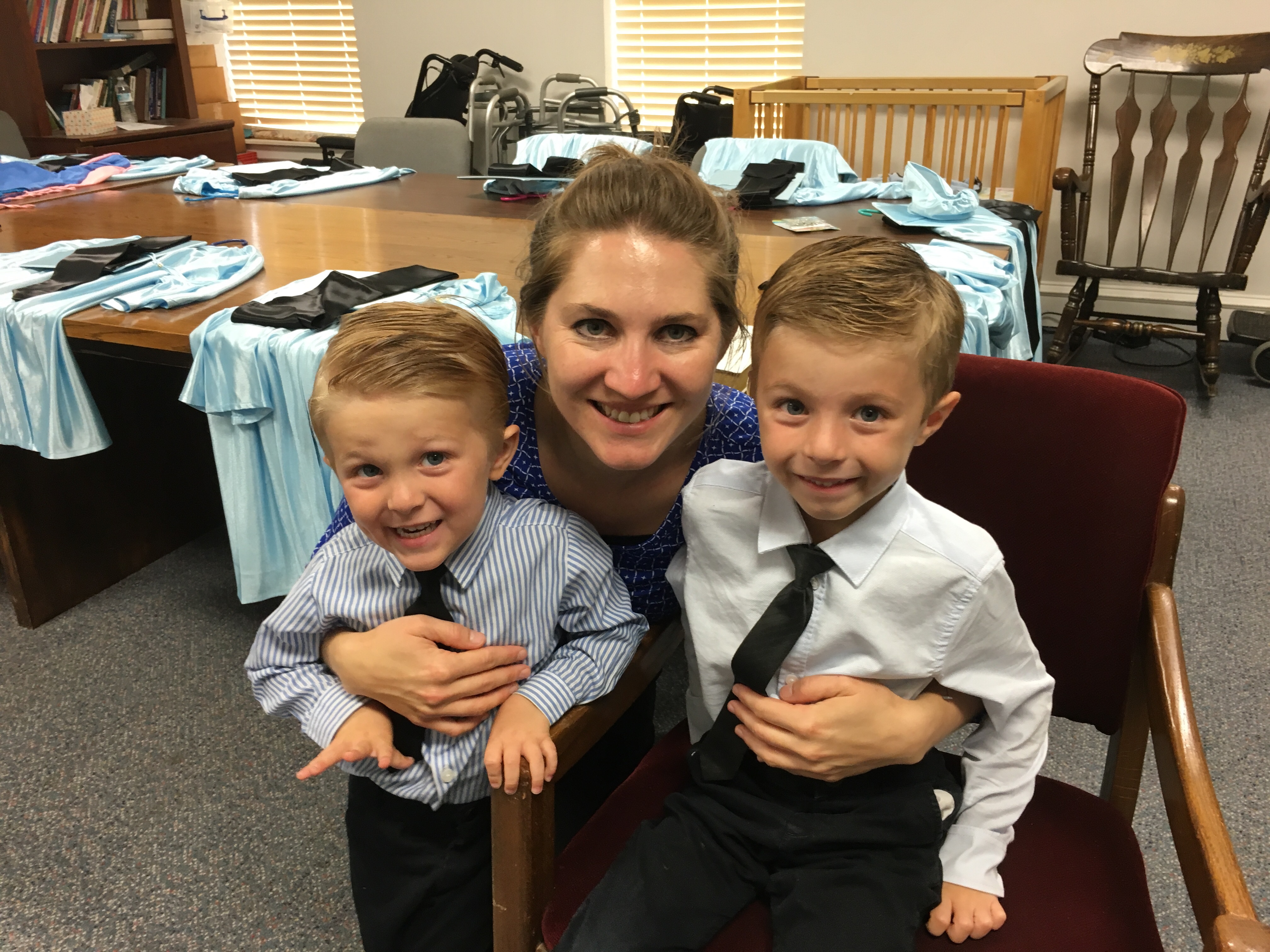
Look at my handsome little dudes! Even though I write about mothering struggles, I am still a proud mom, and I know the best days are yet to come. This photo was taken May 20th, right before Kindergarten graduation at Sam’s school. As a preschooler, Sam (right, 5 years old) still participated in the program; Seth (3 years) even got to cut the ribbons for the pre-K and K classes before they walked down the aisle.

Thanks for taking time to catch up with me. I hope and pray you have a blessed summer, and can find some time to reflect on the blessings in your life and/or rest, plan, and pray about whatever difficulties you may be facing.

Back to Work

SWAU Logo

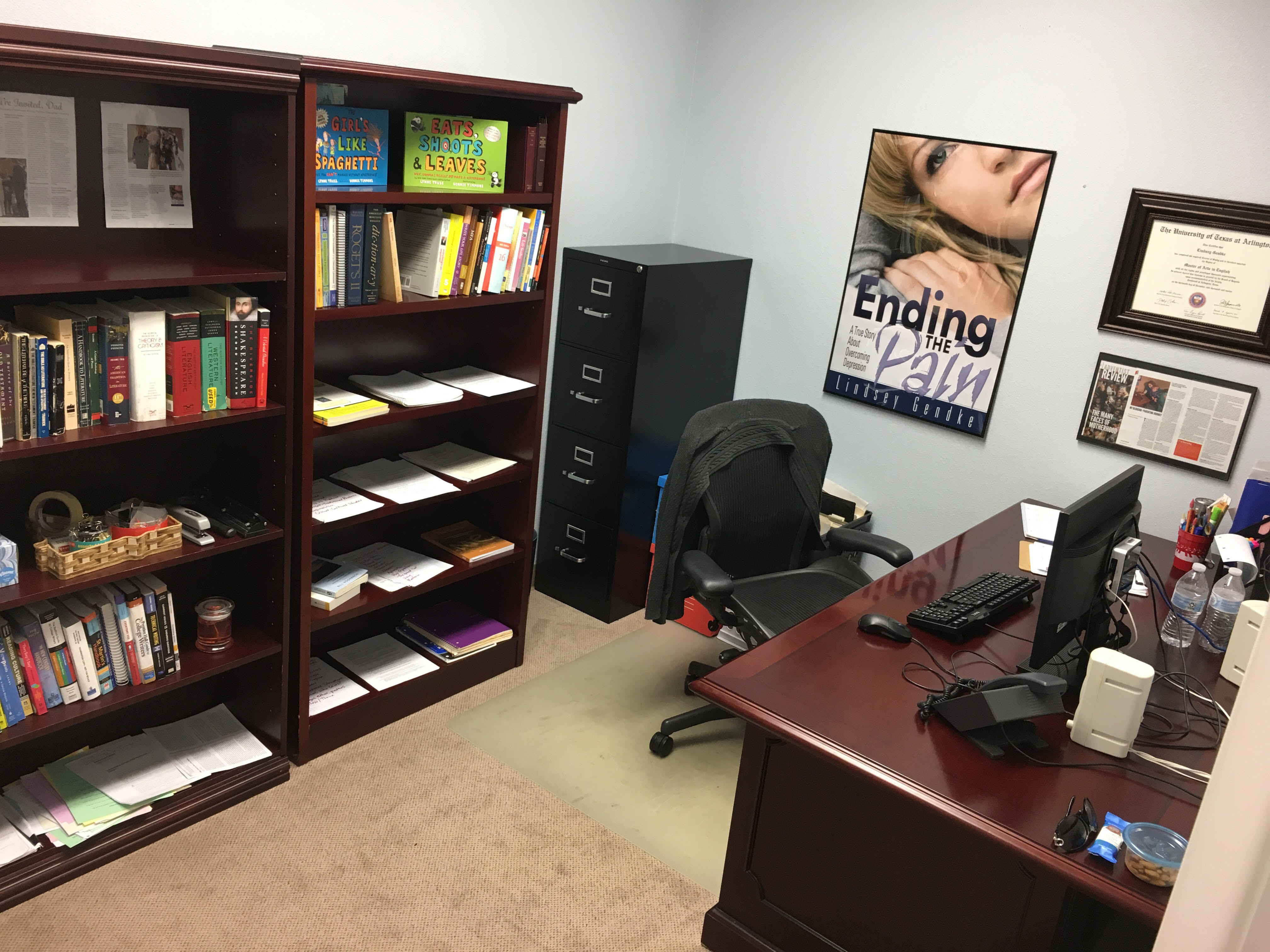
office 1If you missed the news, I got a full-time position teaching college English at my alma mater, Southwestern Adventist University. As of July 1, I became the “working spouse” in our home; Buc became the stay-at-home parent. Now we are trying to figure our new roles, and those are not always clear-cut.
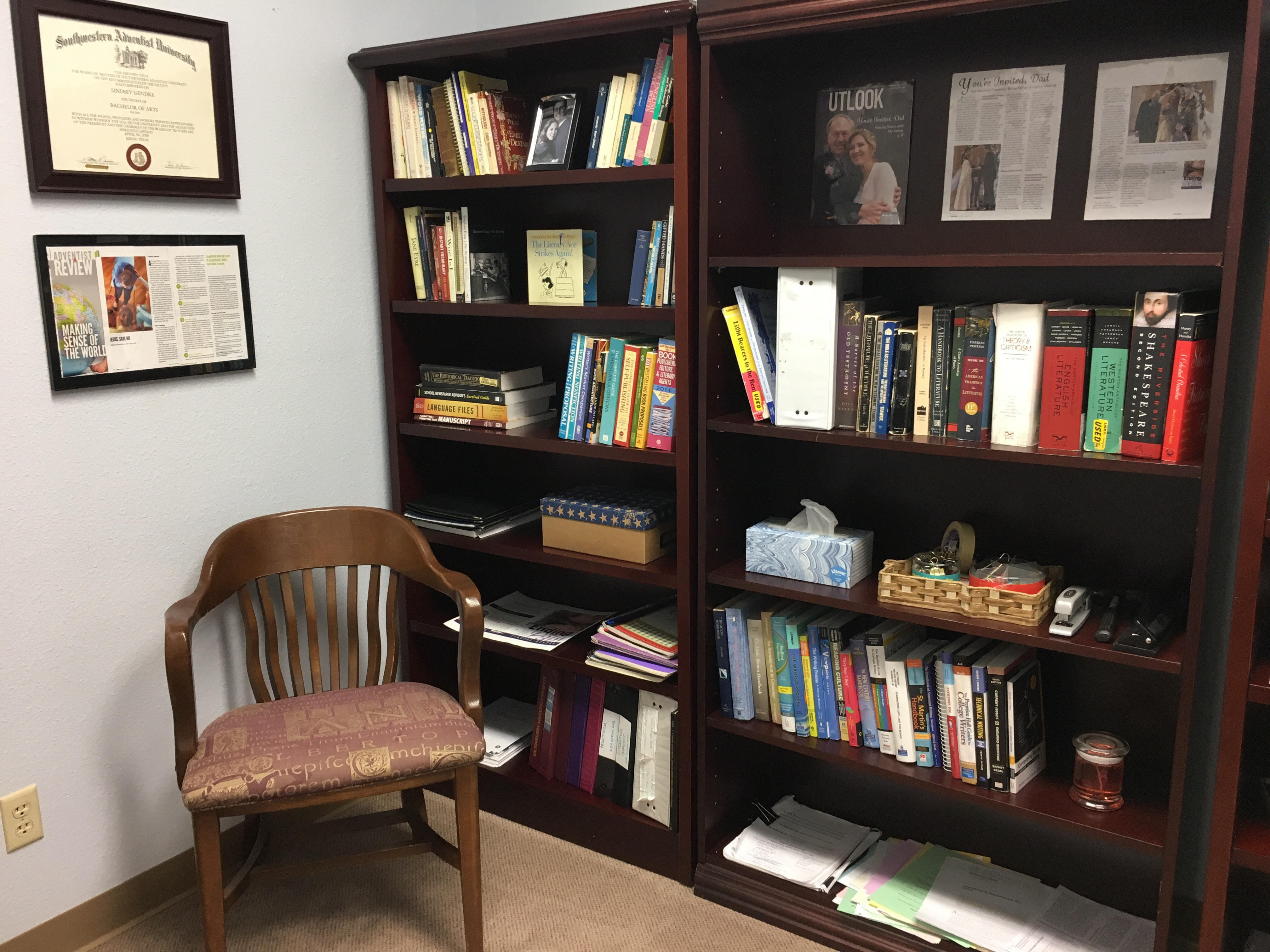
One thing is clear, though: I have trouble letting go of control when it comes to the home front, so it’s been an interesting summer with me transitioning my time more and more to the office and less and less at home.

I am blessed that Buc has wholeheartedly supported me getting back to work—almost pushing me out the door some days—because it can be hard for me to let go at home. Sometimes I need that little push to leave things in his hands.

Though the home-to-office transition has been a bit clunky (trying to get my mind out of mom-mode and back into academia), after weeks of hammering out syllabi, nosing through textbooks, and scratch-outlining assignments, I feel excited for the school year to come.

It helps that I’ve been assigned a list of “fun” classes: Essay and Opinion Writing, Composition Theory, Advanced Grammar, and Research Writing (“fun” being a relative term, there:) I think this English department sensed my nerdy, writerly self coming, which is why they also appointed me to become director of the campus writing center. I realize that, to some, this would be a bummer of a task; but not me. Every time I report to the quiet of my office, hunker down to hammer out writing curriculum and dream up teaching ideas, I thank God for allowing me to work at something I love.

And work at something that comes easily.

office 2

I love my job as a mom, too. But, gosh, that job has not come easily. On the day I drafted this post, I was at home with two kids who had both been sick recently–including one very clingy and one very defiant child. I was also sleep deprived, and I felt panic rising. The tears welled up. I took an anxiety pill, which pills I haven’t needed very often since going back to work. But this little panic reminded me to look up and thank God for how He is working in my life—and in my family.

“Go to work. Please, go to work,” Buc has been saying since I got my keys to my office—not only because I tend to micromanage (and annoy) him at home, but also because he knows it is good for me. In my moments of panic, he adds the words: “I’m glad you’re going back to work so I can be the one to handle the kids more; they don’t affect me like they affect you.” (Wonderful, supportive spouse. Thank you, Lord.)

It is humbling to admit I feel so powerless and helpless as a mom. But I admit it so that I can praise God that He has seen and heard my struggle, and He has provided a way for our family to get through it: Mom going back to work and Dad staying home. Oh, and our vibrant and social Sam starting preschool in the fall with his “Nanny,” my mother-in-law and a brilliant Pre-K and K teacher. This is a beautiful blessing, too. (God bless all you family members, mentors, church members, community members, who choose to step into a child’s life and be a positive influence; we parents just can’t do it all on our own—and we are grateful for your support!)

Friend, whatever you are going through, no matter how frustrating, hopeless, panic-inducing it seems, please take heart. Know that God sees you. He knows your struggle. He understands, and He has infinite ways to lead you through the wilderness. When you don’t know the answers, when you don’t know the way, when you don’t know how to pray, here’s a little script for you:

Lord, thank you that you promise to provide ways I do not know, ways I have not seen. You promise to do a “new thing” in my life—when I seek You. You promise that I will find you when I seek you with all of my heart. And when I seek you first, you promise to add all these other things [the needs I worry about meeting] unto me. You promise to provide. Thank you for providing a way, even before I can see it. Now, just help me trust you to lead me there, and lead me through.

At God’s leading, and with my husband’s and mother-in-law’s overwhelming support, I am happily heading back to work.

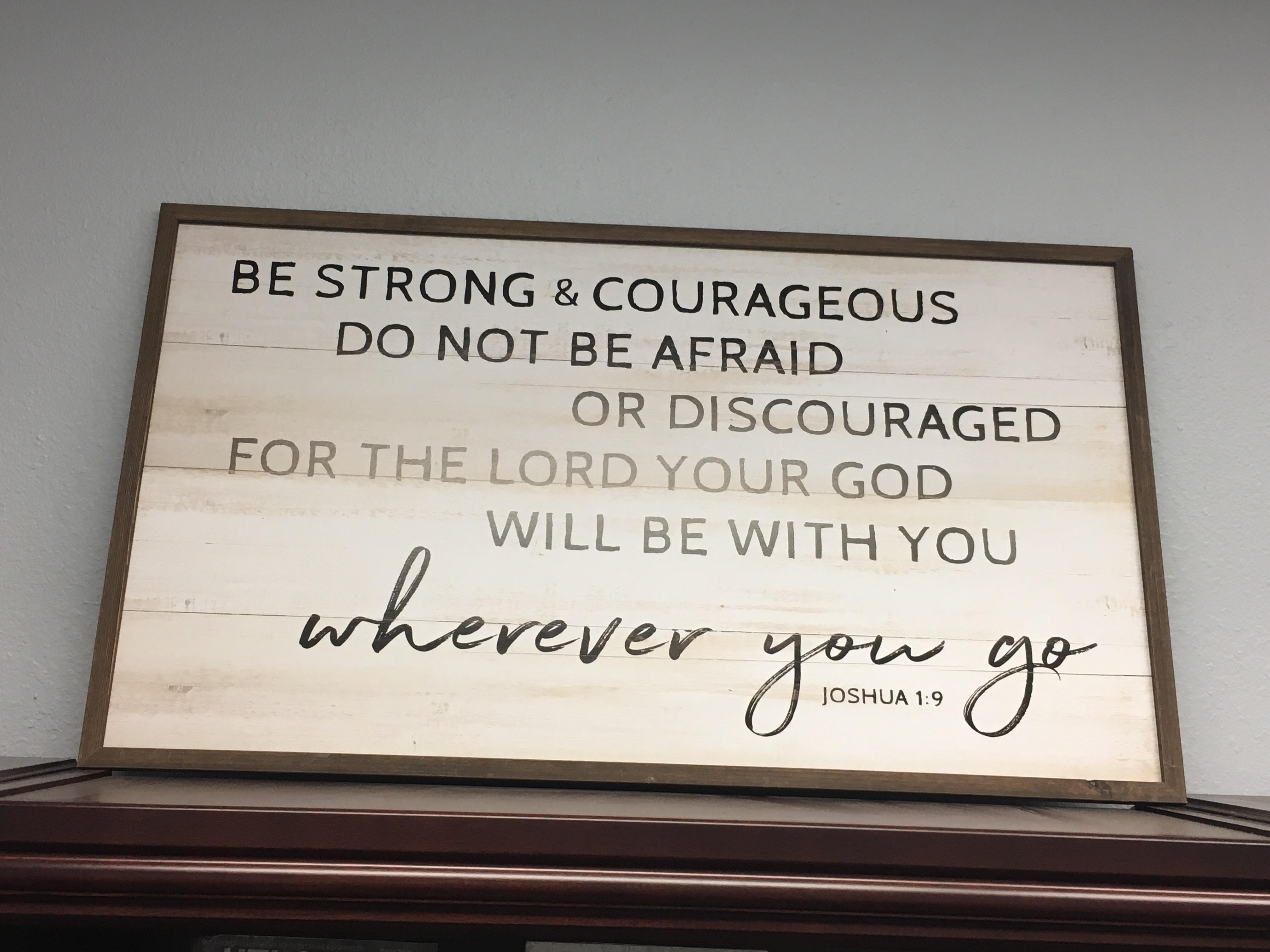
be strong sign
I wanted something inspirational to greet me when I go to work every day, so I placed this sign where I would see it first thing when I come to my office every day.