One Big Tangle: Thoughts on Blogging versus Book-writing

As you may know, Writing to my Roots is chronicling the writing and publication of my first memoir—or the progress toward my lifelong goal. In other words, I’m writing about writing, both about how it’s going as a writer, and also about what’s happening in the writing—what roots I’m uncovering. In other words, where is the writing taking my story, book-wise, and me, person-wise?

Trying to untangle all of the above is not an easy task. And tangled is the right word. I feel so tangled up right now with conflicting tasks in storytelling. I’m telling you a story about a story I’m telling—and I find myself worrying about telling both stories right.

Something tells me I’m going about this all wrong. At least the blog. A book should be carefully organized, but a blog is a place to be more free, right? We’ll go with that for today, so I can get on with writing about writing.

Book Progress and Problems Since October, 2012

For starters, I have penned (literally, written with a pen) around 350 pages of my book. This morning I think I may have even written the last scene and decided on my title. So the writing is going well. Indeed, I feel like I have all the component parts of my book recorded in some form or fashion. I’ve got most of the big themes and thoughts I want to include collected into those once-empty notebooks I told you about last week.

But now comes the hard part. Revising and organizing. Shaping this amorphous blob of memories and musings into something pretty. The other night my dad asked me how many chapters I had written, and I had to just shake my head and say, “Dad, it doesn’t work like that.” (He’s a radio-advertising salesman who occasionally writes copy for commercials. How could he understand the complexities of drafting, revising, and organizing a book-length manuscript?)

I told my dad that my first draft was just emerging through the recording of scenes and ideas as they came to me. I’ve just been trying to get it all out of me, and then worry about organizing it. But that’s not so easy to do these days. The organizing, I mean.

Some Concerns Faced by “Real” Writers (especially Memoirists)

If you read contemporary memoir, you know that stories don’t always unfold chronologically. “Real” writers (and I think I have a little pride about being one, even though I probably shouldn’t, being that I have not yet published a book) make difficult literary maneuvers such as

  • flashback
  • flash forward
  • magnification
  • compression

Writers also

  • make use of extended metaphors and symbols, sometimes all throughout the book
  • pay attention to pacing and placement of scenes
  • carefully select and balance important versus unimportant detail.*

(see chapter two of The Portable MFA in Creative Writing for more)

*For memoirists, specifically, this selection and balance of detail is particularly hard, because all the details are personal. Which ones do you share, and which ones do you shelve? Here, we have tangled up literary concerns with personal, and sometimes moral, ones. There is so much to think about!

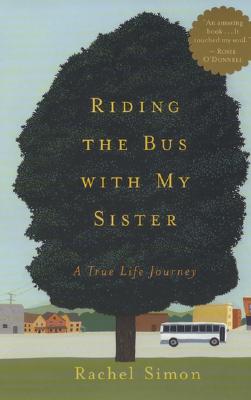
These are just a few of the challenges I’m encountering as I progress through the writing of my book. And I’m nowhere near close to figuring them all out. But yesterday I did find hope for making sense of my thoughts—and bringing order to my writing…through reading the memoir Riding the Bus with my Sister by Rachel Simon.

Riding the Bus with my Sister: Inspiration for the Aspiring Memoirist

In a nutshell, Simon tells the story of what she learned through one year of riding city buses with her mentally handicapped sister, Beth. At the beginning of the book, I expected the story to revolve around this year of bus-riding—I thought that was the core story. But the further I got into the book, I realized that, with carefully chosen, carefully placed flashbacks, Simon was telling the story of her family’s breakup, and her broken heart. Ultimately, it was through riding the buses with Beth, by slowing down to enjoy life again, and by remembering her roots, that Simon found a great deal of healing by book’s end (there’s more to it, of course, but I’m compressing).
Image

Wow, I thought, teary-eyed by the closing scenes. That was a job well done. Not only was her literary execution great, but her story was worth telling. And she didn’t go overboard with her tale of woe. Indeed, I was shocked halfway through to read of the horrific things that happened in her teenage years—so that was why she has all these problems in her adult life…not getting close to people, overworking, lacking hobbies. Suddenly the journey described in the book became much deeper than just a year of bus-riding with her sister. It was a journey of healing for herself.

In both Simon’s writing and her story, I see visions of myself. The personal story is similar to mine, although without the handicapped sister; and the sum total of her book’s organization leaves the effect I want my own book to have. What a great story—and what a great way to tell it, I want my readers to think of my book (just like I thought of Simon’s).

So, for today, I will disentangle myself just a bit with this: at least if my blog is not pretty, I want my book to be. For today, I’m feeling grateful to Rachel Simon for her story—and hoping you’ll ride with me as I untangle the telling of my own.

Really, Kim? It ‘Couldn’t Be Planned for?’ A Challenge to Kim Kardashian to Take Responsibility

Image

You can view this photo here.

I’ve been trying this morning to figure out why Kim Kardashian would make the brainless remark I heard from her today on NBC: Regarding her unexpected pregnancy with Kanye West during her pending divorce with another man, she said: “It couldn’t be planned for.”

Notice her use of the passive voice to avoid placing herself in the subject position—or the position where she must logically be the one planning things. The only reason I can come up  with for her saying this is that her sense of shame is equal to her sense of responsibility: absolutely none.

And the only reason I am giving her space on my blog is to speak out against the insidious, (I think Satanic) lies she is clearly living by:

1)    The lie that she doesn’t have to take responsibility for her actions.

2)    The lie that her actions don’t matter to others.

From a Christian perspective (but mostly just that of a logical human being), I’d like to correct her erroneous beliefs by asking:

  • In response to #1: Before getting pregnant, was she aware of the biological implications of having sex? Nuff said.
  • In response to #2: Has she ever been affected by her own parents’ decisions?

Note on #2: I’ve resisted getting too cozy with the Kardashian family, so I don’t know much about her background. I seem to have heard, however, that it is only because of family connections that she is even famous (what does she do, anyway?)

But I digress. I don’t really want to talk about Kim Kardashian; I’m actually using her to speak to a societal problem at large, and finally, to talk about myself.

What Happens When Parents Don’t Plan (or Satan Screws Things Up)

I’m sure it’s only because I have personally seen the damage of irresponsible parental planning (or lack thereof) like Kim’s that I care so much about this topic—that I was positively incensed to hear such flippancy about the parental role.

I’m sure it’s for the same reason that, in a class discussion with my seniors while I was still teaching, I was similarly incensed. That day, a “free” discussion day, we were talking about sex, and one of the boys, when asked why he had it (it was a very open class), simply said, “Because it feels good.”

Oh really? I asked him, proceeding to launch into a tirade that went something like this:

Have you thought about the long-term implications of “feeling good”? Have you thought that “feeling good” could result in a baby? And what about that baby? Will he be glad his dad enjoyed some “good sex” when he gets old enough to wonder why mom and dad don’t love each other, why they aren’t together?  When he is old enough to wonder who he is, if not a child that was planned for by a mommy and daddy that cared enough to provide a solid foundation for his well-being and self-understanding?

In class that day I didn’t reveal the roots underlying this outburst, but I will allude to some of them here.

Though I know that my parents made a much better effort to plan than it seems Kim has done, well, Satan intervened and screwed things up (that’s how all bad roots start).

Family life was good until age fourteen, when it all fell apart. And then came the displacement that grows out of broken homes. Then came the emptiness that sprouts from seeing your parents weren’t meant to be together—and that I was a product of a failed relationship (did that make my existence a failure?). Then, there was the anger that results from realizing that someone didn’t care enough to plan for me, to think about what I would need, not just as an infant, but as a child, a teenager, and a young adult.

And these bad roots sprang up even from a Christian home where the parents never planned for divorce. Heaven help those homes (and hearts) where it is no secret that the parents were never even trying to build a home, or a family.

What Is the Takeaway?

So, after all that, where is the nugget of hope that you should expect from a Christian blogger like me? Where is the hope for a society ravaged by divorce, broken families, and brokenness? Where is the hope when bad things can happen that we didn’t plan for?

I’ll be answering all of those questions over time. However, for today, I would just offer two lessons sparked by Kim Kardashian (oddly enough):

1)    Know what you can plan for, and take responsibility for it. Do you know that sex produces babies? Okay then. Did Kim know it? Uh oh…there’s the loophole.

Lot’s of people knowingly plan for babies out of wedlock, or at least are not bothered by the thought of it. That’s because, I suppose, in Kim’s world (our world?), this is normal—we have been so brainwashed by Hollywood as to feel no sense of obligation to the family unit and its societal implications—instead, we tend to put ourselves first. Which brings up my second lesson of the day, this one from Scripture:

2)    By beholding we become changed. I think this verse immediately sprang to mind today because, as I watched Kim speak, and speak none too intelligently, I felt a fascinated outrage (you know, that kind when you just can’t look away?) that these are the types of celebrities our young people are beholding on a regular basis.

These are the poster people whom “reputable” stations like NBC are only too happy to beam to the world, disguising the poster people’s brainlessness, brokenness, and immorality by makeup, glamour, and glitz. Newscasters who seem responsible are trained to treat yet another illegitimate baby, and with it, a home-wrecking legal battle, as fun, lighthearted news. She, the newscaster, smiles and nods as Kim bats her eyelashes and explains that, in light of her fertility issues, this pregnancy was just a “happy surprise.” (Conversely, neither Kim nor the newscaster makes any mention of the devastation to follow as the child grows up out of these unfavorable beginnings). The clip ends with the newscaster plugging Kim’s new show and wishing her well. Kim is praised for her infidelity, immorality, and promiscuity. America applauds.

By beholding, we are becoming changed.

Readers, what do you think? Have I got it right? And are you frightened, too, by our society’s our children’s, fascination with role models like Kim Kardashian? Do we actually buy it, or am I just a wounded, overgrown child overreacting? Will Kim’s kid someday be able to laugh and dismiss an absent dad (or mom) and his sense of rootlessness when Kim, flashing her winning smile, explains, “Honey, it just couldn’t be planned for”? [Will the kid also ask, What do you mean by ‘it,’ anyway?]

I Can Think Clearly Now, the Depression is Gone

Last week I let a mess of dishes, food globs, and flour dust sit on my countertops; ditto dirty laundry on my floors. Perhaps the only productive thing I did over the last seven days was to start this blog—which I did from the confines of my bedroom while coughing, hacking, and otherwise fighting the fuzzy-headedess that comes with the flu.

You see, after cooking a lovely dinner for my husband Monday night, I came down with the bug—and until Thursday, I couldn’t even fathom standing up long enough to clean my dishes. Ditto the laundry in the living room. Some of it was even folded and ready to be put away, and yet, the effort would have cost too much.

Now that I’m feeling better, here’s what I’ve decided I think about the flu: it’s a lot like depression.

You see, with both, it’s a burden to wake up. With both, sometimes you feel like you can’t breathe. With both, your thoughts are cloudy and you can’t plan, because the future seems to hold nothing but pain. With both, your life seems downright inhospitable to you; and sometimes, like this week, even the weather will not smile on you.

Imagine feeling that way every day for months, even years. Given how hard it is to get out of bed when afflicted with the flu—a physical malady—now try to fathom making plans for your life, much less for one day, with depression—a mental illness. It’s virtually impossible.

Now why am I digging into all this junk that doesn’t describe my life anymore, not since I gave my life to God several years ago?

Only this: When I woke up this morning to discover I could breathe easy, wasn’t dizzy, and felt like doing something for the first time in a week, it reminded me of how blessed I am, in general, to no longer suffer mental illness. It also reminded me of how important it is to have something to live for. Because when I was sick, I didn’t feel like I did. It’s a bad memory, but that is the essence of depression: not having a reason to live.

However, for today, the flu has reminded me to give thanks. And so: Thanks, God, for not only saving my life, but also for making it meaningful.

In my next post I will talk more about how the meaning I’m currently deriving from life goes back to my roots—those good ones that my book project, and blogging, is helping me to rediscover.


Time, Space, and Empty Notebooks: My Book-Writing Recipe (for now)

So, I’ve made this goal to write and publish a book before I’m thirty. But how is that going to happen, you may or may not be wondering. (I’m thinking of those friends and family members who have heard me talking about publishing this so-called “book” for years, still with no results to show for all the pretty talk.)

  • First, I’m swallowing my embarrassment at all the talk and failed prior attempts.
  • Second, I’m really going to be serious about this. For the first time ever, it is going to become my “fulltime job.”
  • Third, I’m going to write. Well, that overlaps number two. Of course I’m going to write. How else can a book get written?

But although I’ve always self-identified as a writer, there is something scary about actually saying it is my job. Before, when I was a teacher, or a graduate student, I could blame my other commitments for my lack of production. Now? It’s just my keyboard and me, full days at my disposal in which to make literary things happen.

Now the rubber the meets the road; now is where I prove myself. Do I have what it takes?

Time will tell; however, can I just share one thing that makes me hopeful?

Last October (three months ago), after I had submitted my master’s thesis for review, and when I was on a break from my other book project (more on that later), I produced like crazy.

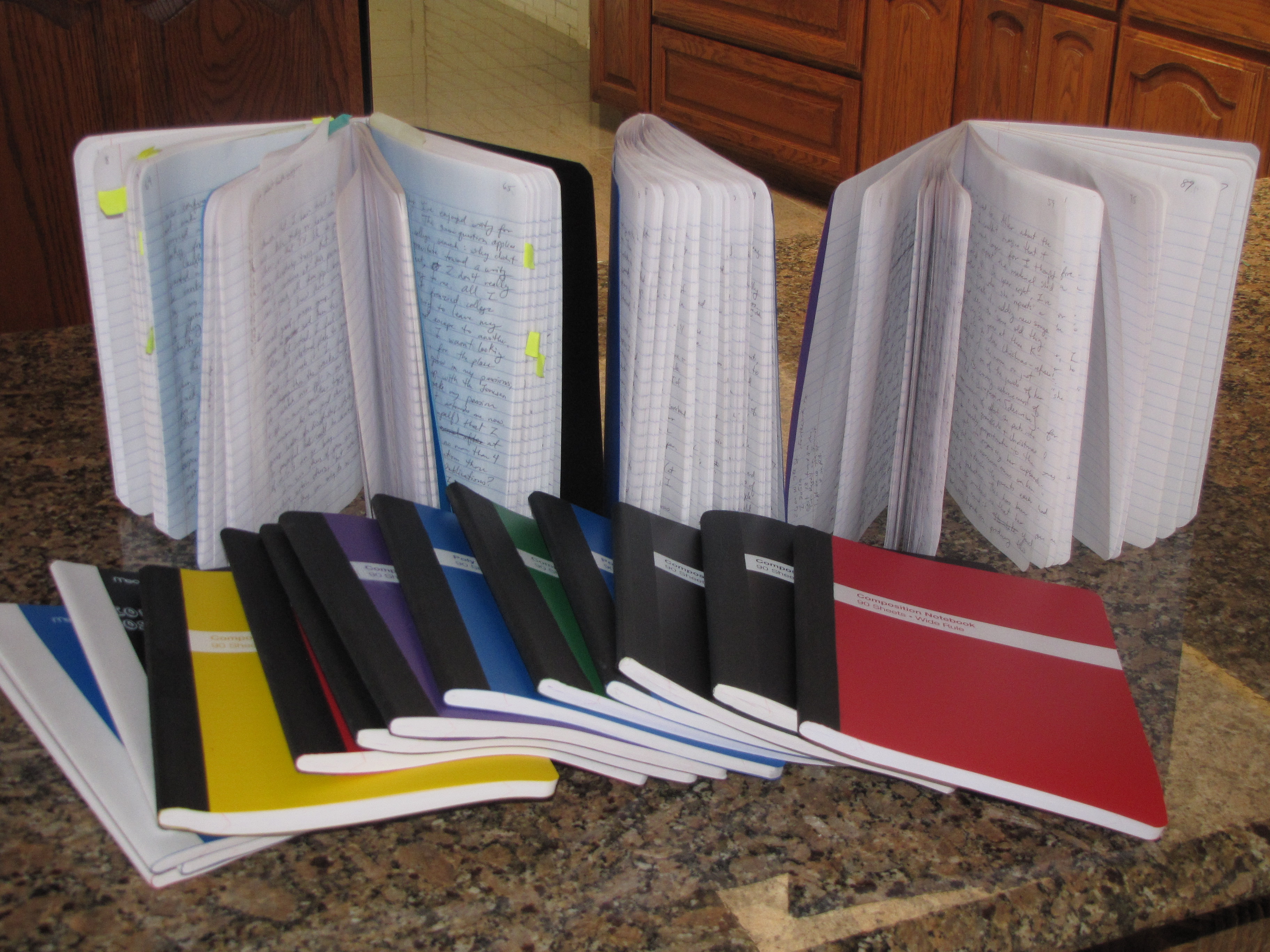
Prior to October, I had found this great sale on composition books at Target, had snapped up about twenty, and had promised myself I would fill them when I got a chance. So, for the month of October, and a bit of November, I did.

Having nothing more pressing to do each day, I headed off to one of several coffee shops (either to feel like a real writer, or just because it gets lonely at the house) and wrote. And wrote. And wrote. By the end of the month, I’d filled two books’ pages, front and back, and had produced the germ of this nebulous book I’m now blogging about.

Image

Soon, life interrupted again, as I had to finish my thesis, defend it, and graduate, among other things. So not much writing happened for the rest of the year. But now, a new year stretches before me, days of possibility call me.

Already I can see the challenges: I’m not good at saying no to people, and it could be easy to let my own projects take a backseat when other people or responsibilities come a-callin’. I’ll have train myself to keep to a schedule; I’ll have to learn uncomfortable things like using social media; and most importantly, I’ll need to stop feeling guilty if I have to say no sometimes in order to work.

But after I overcome those issues, I have faith that all will be well. If the past is any indication, I can do it. Given space and time to write, I do—I always have (even if not for an audience)—and I love it. At the end of the day, I have these things going for me: space, time, and love for my work. What more do I need? Only to dedicate all of the above to God (Prov. 16:3). Thanks, God. May you be uplifted in my space, my time, and my writing this year. 

A Book, a Blog, and a Dream: My ‘Before Thirty’ Project

Have you ever felt like there’s something you’re supposed to do, had a nagging feeling that’s followed you, kind of like your shadow, for most of your life—and yet, you’ve never done it? Have you found yourself wondering why you just can’t make yourself do that one thing you seem meant to do? Have you felt disgusted, even, because you’ve let other stuff get in the way? Or, another possibility, have you been so beaten down by circumstances that you’ve lost sight of your true purpose, and with that, your true identity?

Well, for me, that something is writing a book. And this blog is proof that I’m finally doing it. This blog started as a graduate class project for which I was researching and writing how to get published. But when my professor pushed us to write our last essay for a real-world audience, I felt it was time to take action.

I’d been waiting over ten years to publish a book; I was at the end of my master’s degree; and I was at a crossroads. As I wrote in my MFA application essay, I can’t fight this feeling anymore (some eighties band might have said that, too). Anyway, for months now, ideas have been spewing out of my pen, and although I don’t know what next year holds—I have applied for both PhD and MFA programs, and talks of kids are underway—for now I have a semester “off”; and I have decided to write.

But what am I writing about? Friends and family have asked. It’s not enough just to want to write—you also have to have an idea.

Look again at my first paragraph. That, in a nutshell, is what my book, and this blog, is about. It’s not just about my journey to publishing a book (although that’s part of it). It’s about pursuing dreams that were interrupted by depression and other disasters. In the words I have chosen to describe my project, it’s about writing to my roots: the roots of what I was meant to have, be, and do—and the roots of what kept me from having, being, and doing all of the above for most of my adult life.

Thank God, after praying through a lot of the bad roots in myself, I am ready to write to the good ones (though there’s always more healing to do). That said, in order to document the tangible feat of publishing a book by the time I’m thirty, I’ll also want to tell you about the many intangible feats it took for me to get here. I’ll tell you about how I’ve survived a broken family; how I’ve overcome a debilitating mental illness; and how I’m finally learning to redefine myself after, at age twenty, leaving everything I had and everything I knew—family, job, school, and friends—to move one-thousand miles and marry a man I’d known only four months. Spoiler alert: my story has a happy ending.Image