A Memoir for Disillusioned Christians: Addie Zierman’s When We Were on Fire

when we were on fireSometimes when you have grown up in a certain discourse community, or a group of people who share a common “language,” you learn to spout off sayings without even thinking about them. In the Christian world, some of these sayings include “born again,” “saved,” “lost.” You forget that outsiders don’t really know what these things mean. You yourself become desensitized to their real meaning. You can lose your faith when you realize that fellow church goers aren’t interested in probing for deeper meaning, or for deep relationships. Such was the case with Addie Zierman, who has recorded her experiences for curious readers.

Summary

Addie’s memoir, When We Were on Fire, shares the experience of someone who was steeped in evangelical culture from birth, thought she was on fire for God…and then fizzled out, realizing that what she’d always believed in was a lot of clichés that didn’t personally ring true.

Addie goes through a period of disillusionment, in which she starts to see that many of the Christians she knows don’t really care to get to know her and her problems; they want to gloss over the messiness of life with quick fixes, like “You will never be lonely with Jesus.”

“Yeah, but that thing about never being lonely? Sometimes I am,” Addie tells her Bible study group, and the leader responds, “Thanks for the feedback, Addie, we’re not really going there today. Now, let’s move on to question five” (a paraphrase).

Never being “heard” in Christian circles leads Addie to her rebellious-slash-depressed period, in which she tries to drown her sorrows in alcohol and an “almost” affair.

A turning point, if there is one, comes when Addie finds out she is pregnant. She decides she doesn’t want to be bitter for her son’s sake; plus, it feels like time to get over the past.

It’s sad to me that she’s still sort of cynical at the end; although the place she leaves the book might be just right for making her point that faith isn’t simple. A testimony can’t be broken into before and after, black and white, dark and light (and this is a point I’ve made on my blog, too).

Analysis

I really appreciate Zierman’s honest look at how her faith hurt her. Particularly well done were her scenes dealing with her ex boyfriends, paragons of virtue she aspired to imitate. She makes the point that a heart can be broken even if one “saves herself for marriage”; this happened to her by her boyfriend Chris, who, in trying to be a model missionary, exploited Addie’s innocence and broke her heart.

I also was affected by the theme of Christian clichés throughout the book—or Addie’s point that certain “evangelical-words-turned-weapons” “have grown so heavy; they groan, now, under the weight of all their baggage.” Some of her examples:

Like when you say, Sorry, I’m dating Jesus right now in order to terminate the possibility of a relationship with all its messiness, all of its complexity, all of its potential for breaking your heart.

You say, I’m saving myself for marriage, as if the heart can only be broken by the act of sex…

You tell the Church People you are lonely, and they say, Let God be your friend or they say, What a friend we have in Jesus! And what you hear is that you don’t have the right to be lonely, that if your faith was stronger than this, bigger than this, you would be happy.

And then, the main point of her book (to me):

And it occurs to you that the real work of faith has nothing to do with saying the right words. It has to do with redefining them, chipping away at the calcified outer crust until you find the simple truth at the heart of it all. Jesus.

I read through this book ravenously, because it spoke to some of the same issues I am lately unearthing by writing to my roots. I feel Addie’s rage at being fed cliché after cliché without equally experiencing practical demonstrations of Christ’s love. The thing is, as she writes in her author’s interview, people like her ex, Chris, are so steeped in the language, the clichés of Christianity, that they don’t even realize that, in following a God-appointed “mission,” they are hurting others directly in their path—doing “what Jesus would never do.”

It’s not entirely fair to blame other Christians. As Addie admitted, and as I will admit, we are guilty of also being the “Super Christian, bowling over others’ feelings with [our] passion. [We] have been unkind and careless more times than [we] care to admit. [We’ve] missed the loneliness of others simply because [we weren’t] really looking.” Yes. I know I’ve done that. And I repent of it, and after reading someone else’s experience of being on the other end, I pray God helps me to stop it!

Dislikes 

The F-bomb (along with lots of alcohol) starts showing up in the latter parts, when Addie enters her “rebellious” stage (warning, for you sensitive souls). Though it hurt my sensibilities, too, I did have to chuckle when she wrote, post-rebellion: “Though I’m trying to watch my language, sometimes fuck is just the right word” (paraphrased again). I see in Addie aspects of myself that I’m not proud of, but that are nonetheless there. She’s right; sometimes it is (the right word). Though I don’t condone swearing, I have to admit I do it sometimes; moreover, I think Addie’s done an important work  in being real on the page so we imperfect Christians can finally relate.

I would have liked to see Addie delve deeper into why she fell so low. As my book consultant wrote in her review of this same work, it seems Addie didn’t quite reach as deeply as she could have to describe what plummeted her into depression. It seemed to come too quickly, without enough explanation. Maybe the excellent foregoing chapters of her childhood/adolescence were the explanation, though. I can testify that a long build-up of factors can suddenly mushroom into catastrophe; after a lot of disappointment in life, you don’t need a cataclysmic rainstorm to wash you out—maybe just a little sprinkle.

Recommendation

I highly recommend this book if you have issues with your faith or want to understand evangelical culture better. For me, the book has been inspiring on multiple levels: I feel both validated as a disillusioned Christian, and energized to write about my similar, yet different, experience. My memoir (currently in revision stages) ends in a better place than hers: that is, I don’t leave my church, and I discover a real answer for the clichés, which is The Hidden Half of the Gospel, or the message of my first co-written book, expected to come out in January. Maybe when the book comes out, I’ll send Addie a copy. I feel we could be good friends.

Knowing When to Quit

exhausted
Photo Credit: “Exhausted,” posted on Thayer Memorial Library’s Website

I can talk a good game about living proactively, being productive, and striving for new heights; however, I’ve also found there’s a time to back off. The time is when you’ve made commitments that are not needful, helpful, or healthy for you to keep.

For a few weeks I’d been feeling stressed because I wasn’t finding enough time in my day to work on my memoir. I entered the fall planning to work on my book at least twenty-five hours per week. As I looked at my records for the past month, I saw that I was logging closer to ten. And because my baby’s due date was approaching, this was making me nervous. Could I still get my manuscript done by the time Baby Sam came?

My hubby has often said I tend to keep my plate full to the brim; he’s always known me to be stressed over what I’m not getting done. But since my unexpected breakdown, I had been trying to pare down the helpings on my plate. What had gone wrong?

As I’ve been learning to do when I get in a pickle, I prayed. But this time as I started to pray, my brain felt too scattered to even stay on track (this is a good sign you’ve got too much on your plate, or you’re pregnant, or both). So in my prayer journal, I began with a list of my current commitments, hoping to see a pattern or pick out something I was unnecessarily stressing over.


Let me fill in the background for you about the housecleaning item. In the past two months, thinking I needed to become a better homemaker for the baby, I picked up two books on housecleaning (three, if you count The Happiness Project), and started to try to drastically change my habits, per the books’ suggestions. I had started to feel positively weighted down by the thought of keeping my kitchen sink clean, de-cluttering a little bit every day, and deep-cleaning my kitchen.

When I made the list in my prayer journal and saw the housecleaning item mixed in with everything else, though, I realized something: Cleaning/organizaing my home doesn’t have to be a top priority right now. Especially since I’m not a dangerously messy person (i.e., my dust bunnies are not causing us physical health problems or my clutter creating safety hazards, like some people referenced in my cleaning books).

I asked the Lord to help me set some goals for what I actually needed to do for the time being. He told me, “You can stop reading the housecleaning books right now. If you want to focus on your own book [and I do], read stuff that inspires you to write [books on writing, or memoirs].

“Continue the habits of keeping your sink clean and purging your clutter when you can. But you don’t need to add anything else.”

This was making me feel lighter already. I was next able to list out some new, more manageable goals for my writing each week; although I had to admit it wouldn’t amount to twenty-five hours. This was because my unexpected teaching job had come up at the last minute, and it takes time to create curriculum when you’re teaching a brand new class. This was an item that was not negotiable.

The baby registry and choir cantata were pretty easy to resolve: I’d let them become overwhelming when I saw I couldn’t get the registry done in three sittings (but one more should do it), and the cantata piano music learned in two weeks (hopefully four more will do it—but if not, I have the out of purchasing the performance CD).

While my hubby had told me I shouldn’t feel bad about cutting back on my memoir work, I did feel bad, because this was the single most important thing I’d identified to get done before the baby came. I knew I wouldn’t cut back anymore than I had to, but God did help me see that I was worrying too much about getting the book done in my projected time frame. He helped me resolve this by reminding me that if I got the first section revised and a proposal written, I could start shopping the manuscript to agents/editors even if it was unfinished. This is how non-fiction publishing works, anyway.

Then, God gave me this list of do’s for my guilt:

  • Lighten up
  • Lessen your expectations
  • Give yourself a break. Unpredictable things (like the class and the puppies) have happened lately.

Finally, I realized that God would accomplish his work in his time. I didn’t need to worry about what wasn’t getting done, because he was seeing to it that everything that needed to get done was getting done.

When we are walking in God’s will, or doing our very best according to the light we have (based on reading his word and listening to his voice), we can “quit” certain good things with a clear conscience—and sometimes, to continue walking in his will, we must.

Writing Towards Honesty

2013-06-03 23.52.41

At first I thought I was writing a book about recovery from depression, the love story that brought my husband and me together, and finding a relationship with the Lord. Now that I am revising for my book consultant, Christian memoirist Trish Ryan, I feel the topics expanding. She wanted me to set a greater context for why I ever got to the point of suicide and bulimia and all the other struggles I write about in the first place. She wanted to know more about my faith in God as a child and my family. In short, she asked me to venture into places I realized I didn’t want to go (which is why I originally did not go there).

Now that I’ve been trying to write scenes from childhood for the last several weeks (and they are coming out messy and muddled and badly), I’m finding that my story might be bigger than I thought, and it all has to do with being honest about how the church has failed me.

The more I write, the greater anger I uncover at a church culture that would not let me speak up and share what kind of help I needed. This theme also shows up when it comes to my relationships with friends and relatives—people you’d think it should be okay to share with! The revisions I am working on now are slowly bringing me to new conclusions about why I became suicidal in the first place. Maybe I will never totally understand why or how it happened, and maybe it’s not a problem that is specific to me or my family or my church. But through the messy, ugly, painful writing coming out in the last few weeks, I know it has something to do with speaking up, and the fact that I felt I couldn’t for so many years.

Sometimes it’s discouraging to think that after a year of working on this memoir, I’m only just keying in to the real point of it all—and maybe I’ll decide next month that I need to backtrack yet again. But maybe it all goes back to this blog and why I started writing it: I needed to share with people.

I’m working on a series of blog posts about my ugly, messy rebirth experience, and these posts, more than anything I’ve yet written on Writing to my Roots, have given me pause: Do I want to publish them? Do I want to share how I feel my church failed me, how it failed my parents, and how that resulted in a family’s demise and a girl’s death wish?

I feel a need for Christians to be honest about their struggles; it’s just hard to be one of the leaders in this “genre” of witnessing. I told Trish I felt like there were very few memoirs on the market like the one I’m trying write: that is, Christians seem to write really simplified accounts of how they found Christ (and what a difference he made to the before and after of their lives), which leave me hungry for the real details. Show me a life story I can relate to! Conversely, the writers who are willing to divulge the messy details of their lives are, for the most part, those who haven’t really emerged from the mess—so the story is real and raw and often literarily well executed, but not uplifting. I want my story to be all of the above.

Trish agreed with my assessment of the market, saying that when we writers undertake a project like she’s done and like I’m trying to do, we put ourselves out there as screwed up Christians, saying, “Okay, I’ll go first.” Not easy, but necessary if we hope to change the climate of things.

So if I publish some things that put my church or my religion in a bad light, it’s not that I’m denouncing my faith. It’s that I want us to take an honest look at where we’ve gone wrong, so we can fix it! Jesus came to heal the brokenhearted and set the captives free, and I just want to help the church see how we can help fulfill his mission. Sometimes, that means being brutally honest with where we’ve failed.

If you feel the same way, please pray for this writing project as it moves forward—that it would tell a story the world (and maybe just the Christian world) needs to hear, and that God would give me the wisdom and discernment to tell it.


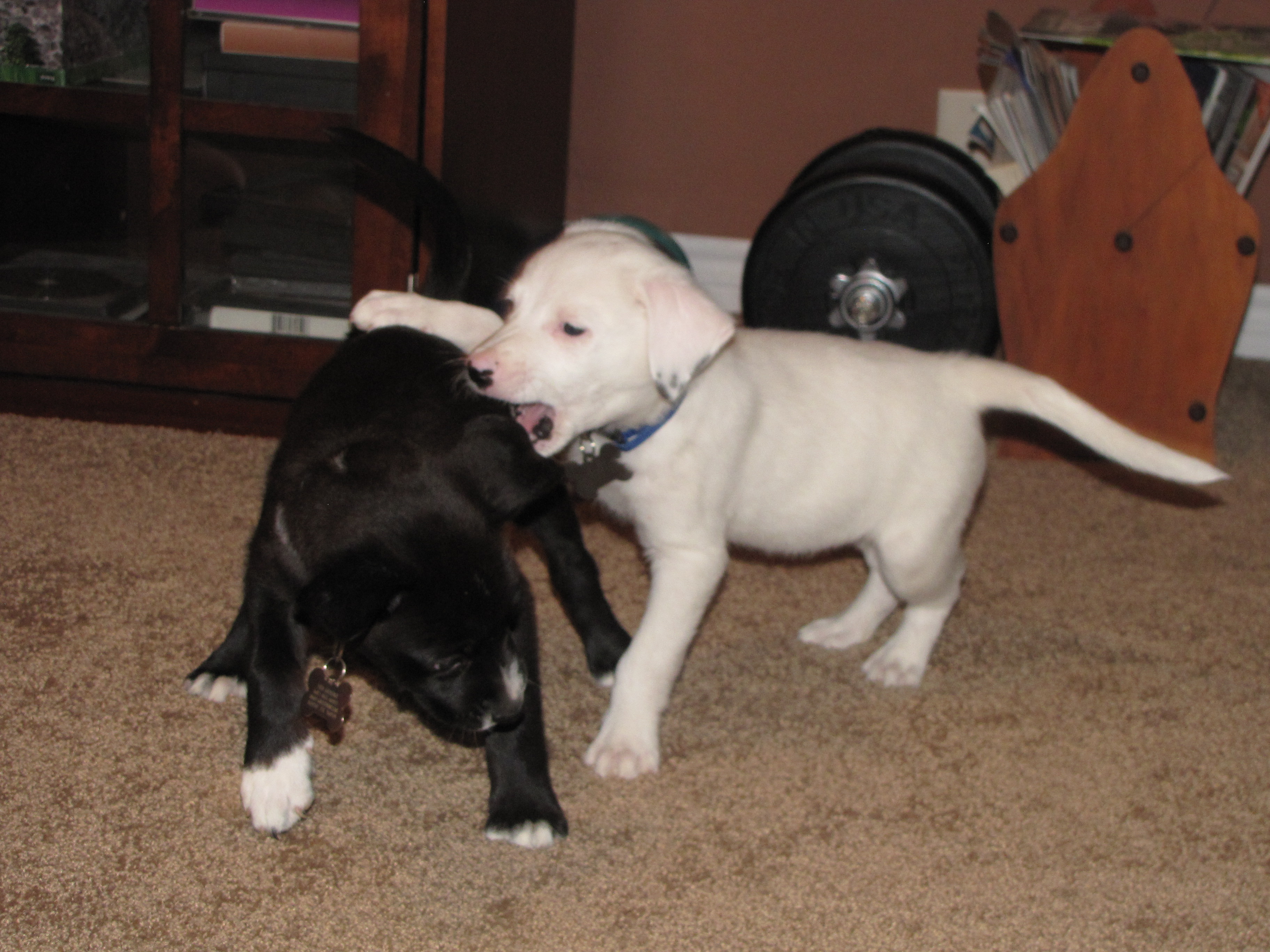
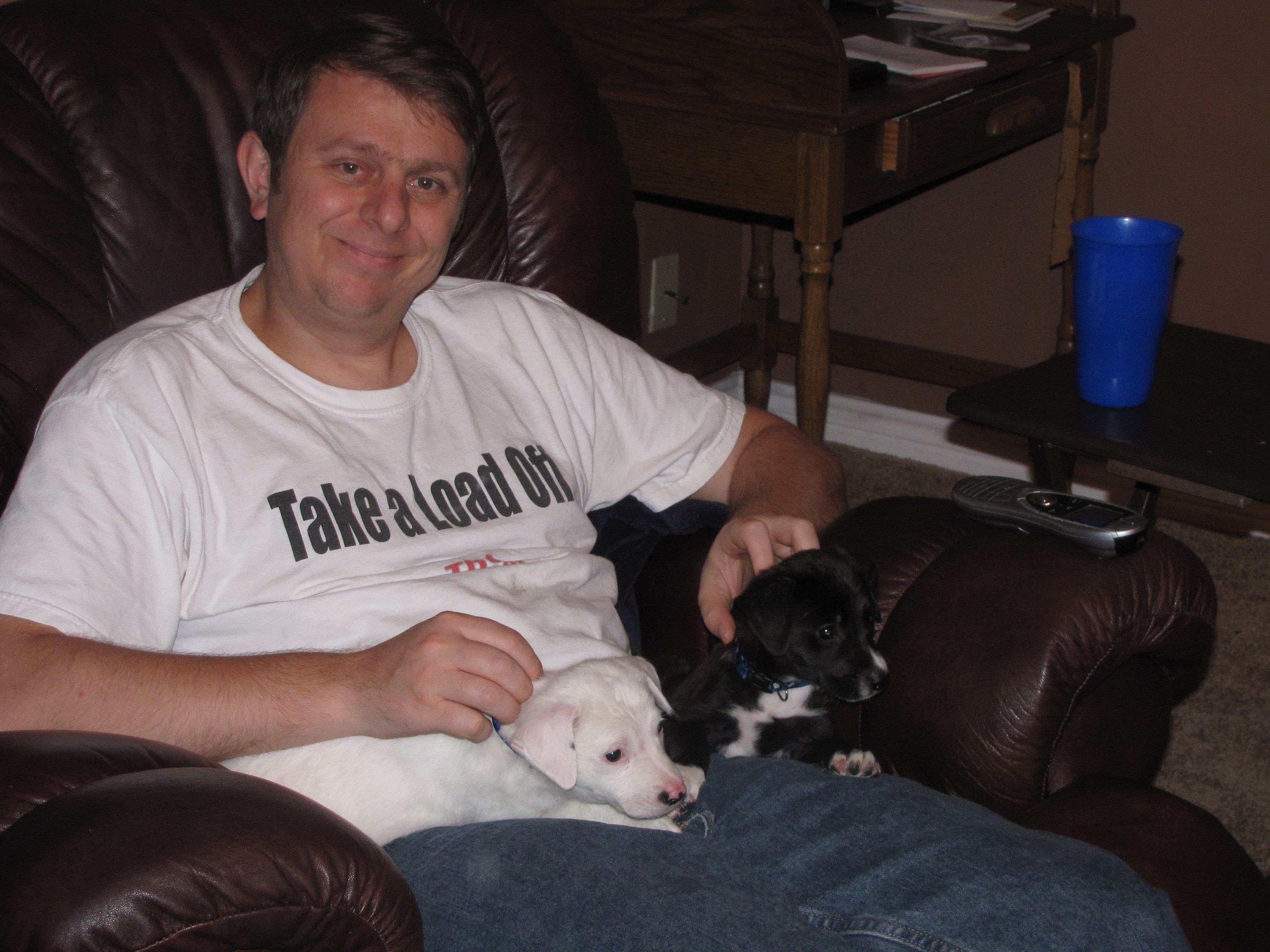
Meet Bill and Ted, my Premature Furry Babies!

2013-10-05 01.12.55
For “baby” names, we wanted something simple and symbolic–a dynamic duo. I think Bill and Ted was an excellent choice, don’t you?

When we decided to have a baby, I didn’t plan on getting two puppies with the deal. Alas, my house is filling up with testosterone faster than I can keep up!

Ever since our dachshund, Hope, died last December, my husband has been bringing up the subject of more dogs…and when my brother-in-law found these two darlings abandoned on the side of the road last week, well, all signs pointed to our house.

2013-10-01 07.46.31
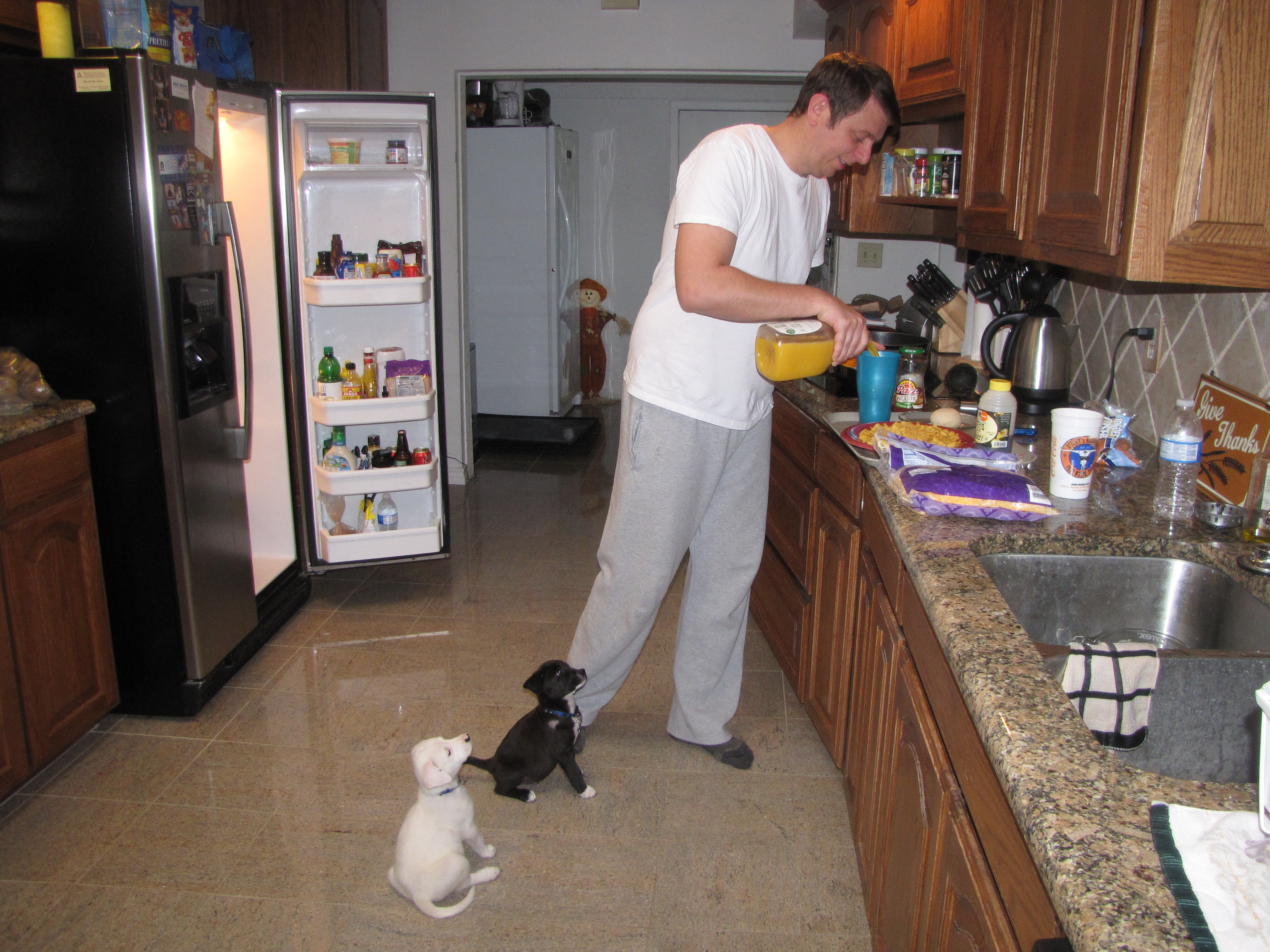
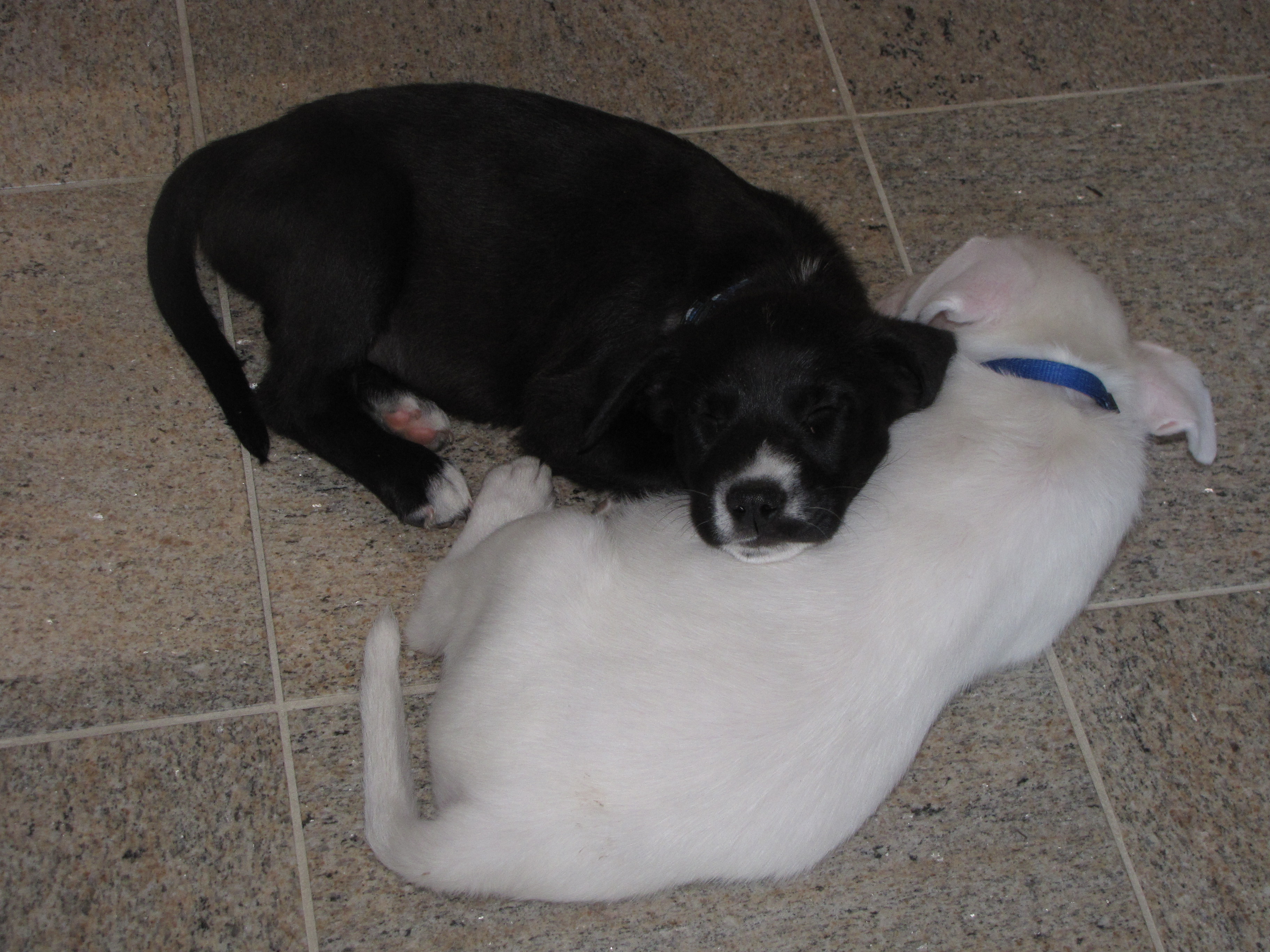
Bill is the white one, Ted, the black one. If you’ve seen the movie, though, you might have guessed that!

I was initially hesitant to get more dogs, because I knew I’d be the primary caregiver. I knew we’d get more dogs at some point, but I wanted to guard my last few months of freedom before baby. However, I’ve discovered my life is not my own anymore (never was, it turns out), and God is preparing me for motherhood by way of these puppies.

Some life changes I’ve had to make are:

  • Getting up in the middle of the night for potty breaks. Of course, I have already been doing this frequently for awhile, but the pups make it a little less easy to just flop back into bed.
  • Getting up earlier for “feedings.”
  • Putting up baby gates.
  • Cleaning up poop and pee.
  • Having to make arrangements every time I leave the house.
  • Worrying all the time what the “babies” are doing; trying to keep them in my sight.

I know there are some larger spiritual applications to all this motherhood training, but today I may be in too much of a hurry to see them. You see, it’s almost noon, and I haven’t even gotten down to the business of working on my memoir yet. As I thought about how my morning had gone so far, I realized I could either get frustrated that I hadn’t gotten any “work” done yet, or I could change my expectations for myself, because—hello—my life is changing pretty drastically.

I could choose to see my day so far as worthless because I haven’t yet  worked on my profession, or I could choose to see what I’d done as worthwhile because I am a wife and mother taking care of her household.

2013-10-04 06.23.16
Bill and Ted are interested in whatever we are doing, especially if it involves food!

Since getting up, I have fed the puppies; spent much needed time with the Lord; knocked on the doors of two neighbors trying to get to the bottom of two large (and scary-looking) dogs that wandered into my backyard this morning (protecting both my puppies and the neighborhood); baked a loaf of banana bread for my college-age niece who stays over on Tuesday nights; and I have put ingredients in the bread maker for French bread for my husband, who told me he wanted a spaghetti dinner tonight.

2013-10-03 22.44.22
Although they like to fight, Bill and Ted still aren’t too “grown up” to show one another affection. I love it when they sleep like this!

I have never really defined myself as a homemaker—I haven’t wanted to be the one who stays home and sees to it that everyone else is fed and clothed and clean and sane for their careers, because I wanted to have my own career. I still want to. I want to be a writer and a teacher, just like I’m doing (with more or less success, depending on the day). But the Lord is teaching me it’s okay if some of my days are spent doing homemaking things instead of career-building things. In fact, I know that the homemaking is probably ultimately more important. How quickly I forget that if there’s not happiness in the home, life is dismal. My home was unhappy, my life dismal, for too many years growing up, and because of my beautiful marriage today, I sometimes take for granted that a happy home is well worth the investment.

But each day I’m learning to take a little more joy in the simple things: puppies, babies, sunshine, lollipops, and rainbows…you get the picture! I continue to thank the Lord that he is straightening out my priorities, and my roles. Now, if I can just figure out how to balance them all!

2013-10-01 07.47.58
So far Bill seems to be Buc’s dog and Ted, my dog. Bill is more laid back, while Ted has a hard time sitting still (and a temper that flares up sometimes at Bill)…hmmm, yes, the analogy works!

Book Review: The Glass Castle

Glass_Castle

Here’s a little memoir writing inspiration for you today, or just a great read (if you’re looking for either): Jeannette Walls’s The Glass Castle. After skipping past it several times in Half Price Books, I had to finally read it when both a comrade in my writers’ group and my editor suggested it.

Here are three reasons why you should read it:

1)    The story. The story of two genius, yet crazy parents and how their eccentricities drag their four kids down, it’s wacky enough to the point of being unbelievable; but I’m taking Walls at her word that this is what she remembers of her childhood. Imagine an engineer dad and an artist mom who are too freethinking to be shackled to regular jobs, who do the “skedaddle” whenever they get in trouble with the law. Imagine parents who would rather have their family live in shacks, ditches, or inside their van than have air conditioning and heating and plumbing and food—all in the name of chasing their dreams. It’s particularly fascinating watching young Jeannette and her siblings come of age amidst the chaos of their parents’ childishness (mental illness? I still can’t decide what would possess parents to act like this) and note the strength they muster because, well, they must. A fascinating psychological portrait of a dysfunctional family, as well as an amusing, and at times, heartbreaking, read.

2)    The writing. Vivid, fast-moving, and clear, Walls sucks the reader in on the first page and doesn’t let go until the end. As my editor put it, note the detachment with which Walls describes the “wacky and terrible things her parents did to her.” Walls writes details that a child would notice with the diction of a well-trained writer—and she doesn’t get overly analytical. Instead, she lets the reader point to her family in horror and amusement and disbelief and disgust. As my editor also said, children aren’t able to process what certain things mean; all they know is, “Here’s what happened.” Reading about the horrors of living in such a dysfunctional family from the perspective of a speaker who can only report, not analyze, is fascinating. Just fascinating.

3)    The reassurance that your own family isn’t that bad. After reading about Walls’s family, I felt a lot better about my own. If you can’t say the same, I am truly sorry for you, but at least you have the makings of a great memoir in your head!

glass-castle
The book’s title comes from Jeannette’s dad’s grand plan to build the family a “glass castle” in which to live someday. This image becomes increasingly ironic and heartbreaking as the book progresses and the family slides deeper into a squalor from which, the children slowly realize (and readers much sooner understand), they will never emerge.

The one criticism I would levy at the book is this: I feel there is no way an adult could remember in such clear detail (as Walls seems to) what happened in childhood. Though I ate up every scene with each painstakingly stinky or ugly detail, I found myself disbelieving that she could really remember what she said at three years of age, or what her home looked like at four, or the fight her parents had when she was five, etc.

I voiced this to my editor, saying, “I could never write about my childhood so vividly,” to which she replied, “It’s amazing what children with dysfunctional backgrounds can remember.” I’ll have to research that, but for the sake of a great story, I was willing to suspend my disbelief and grant that Walls reported to the best of her ability (without needlessly embellishing) a story that was real and true, as far as she could remember. In the end I have to grant that, for a memoir writer, memories, however we filter them, are truth. So hats off to Jeannette Walls for letting us in on the horrors of her memory. Today I go back to my own memories feeling strengthened to report.

Writing for an Audience

audience
Photo Credit: Auditorium by Ayla87

I started blogging because I needed an audience. After journaling for no one but myself for fourteen years, I needed to start thinking about writing for others, especially since I wanted to write and publish my memoir. I realized I had been self-centered, or writer-based, all those years. What’s more, I realized my previous education (even though I have bachelor’s and master’s degrees in English), had not helped me with the transition to writing for meaningful audiences. But now that I was serious about publishing a book, I had to become more reader-based.

If you’ve done any research on the publishing market, you know that being reader-based is essential to (traditional) publishing. If you’ve done that same research and you had an English education like mine, you might have concluded that many English teachers must not be writers—in the sense of trying to publish their writing.

Most of my English teachers gave me dead assignments, or what my thesis advisor called “orphaned texts” to write: papers that were not meant to go anywhere beyond their desk. My advisor also termed these assignments “autonomous texts”—texts that had no communicative element, no audience, and no purpose. This was in opposition to a superior type of writing situation: the rhetorical situation.

Last week I introduced my composition students to the rhetorical triangle—a way of thinking about writing that places a text in context of a specific speaker, audience, and topic. The major lesson is that if any element of the triangle changes, the text must also change.

Learning to think of writing this way—as a communicative act—has been changing my own writing dramatically. And it has tested me. First, on this blog, I have been forced to confront the self-pitying nature of so much of my past writing—and with that, the uselessness and counter-productivity of said writing. Considering my writing through the lens of a prospective audience has forced me to look in a mirror, as it were, and has helped me clear away the dross of my thoughts for current and future projects. The benefits of blogging have included even more healing for myself while looking in that “mirror,” and a push toward meeting my real goal of book publication.

Incidentally, I’ve just received my editor comments back on my memoir manuscript, which are further propelling me to write for an audience. I’m glad I had the training of eight months of blogging to prepare me to think about meeting the needs of book readers.

Trish Ryan’s assessment was great, pushing me to make some difficult changes I sensed I might need to make, but that I wasn’t emotionally ready to make earlier. I hope I am ready now. Time will tell as I enter the revision stage. Providentially, Trish told me I sent her the manuscript at just the right time to get feedback and intervention. I was glad to read that. I knew I wasn’t done with this project at first draft’s end, but I was at a point where I needed an experienced reader and writer to coach me to stretch limits for my intended audience.

Some of her best advice relating to audience was to lay out my story chronologically. Touché, as I had tried to bury or bypass some hard emotional scenes. I needed her to tell me that the audience needs more facts of my background to understand all the feelings I divulge throughout. She also urged me to err on the side of action versus reflection to keep things moving for readers. She said setting up a more complete background to my story in the beginning would help diminish the need for so much reflection later—readers would better understand my actions with the appropriate lead-up.

With her feedback, I am better equipped to revise my book for my audience, which will mean cutting out some material that was personally revelatory but not globally relevant. Though this may be hard, having  had an audience of one see and validate those parts of my story has heartened me to the task of cutting them from the final draft. (The tougher job now will be revisiting and writing those difficult parts of my past that need to be in the book).

So the final takeaway for this post? We writers, if we want to be published, and even if we just need to heal, need various audiences to push us to self-reflect on what we’re really accomplishing with our writing—and push us to take sometimes difficult steps. In the end, I believe writing for an audience is making me both a better person and a better writer, and it can do the same for you.

Professing—My Unexpected Blessing

With my manuscript deadline at hand, I knew this week would be busy. Before I got the job offer last Thursday, I didn’t know how busy. Suddenly, in addition to finishing my book manuscript in one week, I am becoming an adjunct professor, too!

I got the call last Thursday (six days before my first class—yikes!), and five days later, I am still in awe at God’s goodness. This past year has been all about me learning that when I humble myself in the sight of the Lord, He lifts me up (James 4:10). Repeatedly broken to knee-point this past year, I have found peace in the surrender to Jesus and His plans for me. I gave up certain plans I thought would not pan out (such as a PhD and professing at my alma mater) to follow new directions in which I felt called: authorship and parenthood. (By the way, we are supposedly finding out the baby’s sex this week, too!)

It was when I surrendered the professing idea that we got pregnant and the book really started taking shape. I thought: “This is okay; God’s really got this.” I haven’t been making any serious money for two years, but I’ve been faithfully sowing seeds in hopes that they will grow into a money tree (er, some kind of career), however small.

By sowing seeds I mean writing my memoir, which goes out to a professional author/editor this week for a consultation. The book is not in its final form, by any means, but at 256 pages, it is a complete draft that says, more or less, what I want it to say. There’s a part of me that wants to keep polishing it, but mostly, especially after faced with having to prepare a semester’s syllabus in a couple days, I think it wise to give the book (and my brain) a break while other eyes ponder it. It will be good to focus on something else for awhile and then come back refreshed to revise in a month or so.

The one-class professing gig on Mondays, Wednesdays, and Fridays (which happens to be right down the road) will be the perfect vehicle for me to do just that.

And I was just starting to miss the classroom a bit.

Today I can only shake my head and marvel at the wisdom of God’s plans and His timing. Maybe this turn of events doesn’t sound like that big of a deal, but for me, it is. I used to have such issues with needing to be in control of my future. I didn’t handle unknowns well. I got physically sick from anxiety. But since learning to let go (and please know that sometimes I still need remediation), life has become a joy, full of surprises and good gifts from the hand of God. Now, instead of being just a professor, or just a writer, or just a parent, I am suddenly all three! Daily I am reminded that God “is able to do immeasurably more than all we ask or imagine, according to his power that is at work within us” (Eph. 3:20).

If you’re struggling today over the plans for your future, or if you feel physically or emotionally sick from not knowing what’s to come, why not ask God to take the reigns and pave the path for you? He might not make things clear right away, but if you earnestly pray, you can rest in the knowledge that even when we don’t know what to pray for, “the Spirit himself intercedes for us through wordless groans.…And we know that in all things God works for the good of those who love him, who have been called according to his purpose” (Rom. 8:26, 28). Finally, when we put God first, we can rest in the promises that “there is no want to those who fear the Lord” (Ps. 34:9), and God shall supply “all” our needs “according to the riches of His glory in Christ Jesus” (Phil. 4:19). Amen!

For some inspiration today, check out the song “When I Let It Go” by Sierra. This is a throwback to one of my dad’s favorite Christian groups from the 90s, and lately it has brought me to tears (in a good way!).

This time I’ve got to trust You
I’ve got to accept Your plan
I have tried to guide my circumstance
But there’s just no way I can
When will I learn this lesson
Your ways are not like mine
Lord, help me to surrender
The control I try to have on my life
When I let it go
You take my hand and gently lead me
Then You let me know
Just how peaceful my life can be
When I let it go
Your never-ending blessings
Like a river start to flow
When I let it go
Too many times I’m searching
For the things I think I need
When I try to look for more
I always seem to give You less of me
Lord, help me gain this wisdom
My foolish mind still lacks
‘Til I find a way to let go
Of the part of me I’m holding back

A Joy Restored

girl 2
Photo Credit: “Jump” by Jana_Koll

I’ve said my dream was to be a writer. I developed this dream in childhood—I don’t know exactly when, but it was early. I read profusely from age eight on, and I’m guessing my writing dreams developed as my reading list grew.

At that age it was enough to have a foggy notion, a sort of affinity, a general inclination or tendency to writing. Writing was fun! I did it without overly thinking about it. I jotted silly stories and poems, and when I started playing the piano at age eight, also penning song lyrics. Back then I never thought about the practicalities of getting published, the imminent necessity of earning a living, the eventuality of needing a schedule to keep oneself on track to produce enough, often enough, to survive. No, back then my dream was a hobby, a thing I did at whimsy with no outside provocation. I did it because I enjoyed it. It brought me joy. It was fun.

How wonderful to be a child, to be innocent of worldly and societal expectations, or implications of adulthood. How I wish, as I write this, that I could go back.

Is that impossible?

It seemed impossible when life threw me its first really traumatic curveball at fourteen, when tragedy struck so quickly it seemed childhood was snatched away overnight. Then it was, I have to think, that Satan really went in for the kill on my identity. And with it, my dreams.

Suddenly I was no longer a capable, positive, promising child. I was an incapacitated, negative, doomed child. My world as far as I could see had collapsed around me. I couldn’t see beyond the walls of my home, now torn apart by dissension and hatred and despair.

Though a family breakup may not be our fault, it has everything to do with us. It has everything to do with how we see and understand our place in the world, everything to do with how we define ourselves. I’m not saying this is how it should be, or even that it’s logical, just that this is how it is.

This family event affected everything about me. It redefined me in negative, defeated ways. I became, in my eyes, a pitiable child, one who couldn’t speak up or have needs, either at home or at school.

Instead of being an empowered writer, I became a closet writer. That dream of writing got shoved in a closet, shoved under cover—literally, under the covers of journals—as I took to writing about my family plight and my own plight for no one’s eyes but my own. I guarded my writing, and with it, my pain, like I guarded the family secret. This was not healthy. And yet, by God’s grace, he even used that period of writing to myself for good. Even though the subject matter was bad, it kept me growing at least as far as a writer.  The writing kept my joints oiled, kept me in practice. The practice was being perverted, but it was leading to something only God could see.

happy life
Photo Credit: “Happy Life” by Lusi

Today I feel I have regained the joy of writing–maybe I’m even embarking on my second childhood! Gone are the dark days and the need to hide who I am, because God has restored to me my value and my worth. I rejoice because my identity is not defined by what was done TO me, but by what God has done FOR me. He saved me. He restored me. And He has returned me to the joy of my youth. Thanks for sharing my journey!

Why I “Took Out” My Ex-Boyfriends

scissors
Photo Credit: “Cutting” by Lusi

This title’s a little misleading. I’m not talking about violence here, or the raging emotions of a woman scorned; rather, I mean making cuts to my memoir. You see, last week I inadvertently axed my ex-boyfriends from my manuscript when I deleted a chapter by mistake. Oops. While I was initially ticked, turns out this was one of the best things that could’ve happened.

You see, I was falling into that writer’s trap of wanting to put every “interesting” detail about my life into my story—but not every “interesting” detail belongs there.

At first it’s a hard reality to swallow. You’ve heard that analogy that likens cutting one’s writing to severing a limb. It’s true. But I’ve got good news: the more time and distance you put between yourself and your writing, the easier it gets. After awhile it becomes easier to see what really stinks and what doesn’t, or what actually fits and what are merely rabbit trails.

Accidentally cutting out my boyfriends, whom I’d slapped into a “junk” chapter that wasn’t quite fitting anywhere, freed me up to clarify the real players in my story: that’d be myself (obviously), my hubby, my family, and my immediate in-laws (I’m not sure they know this yet!). The story I’m telling is far advanced beyond the twenty-year-old version I imagined, when I was still hurting from love gone wrong with those unsuspecting exes. It picks up with my wedding day and the violent emotions that ceremony stirred up, and follows me through my twenties to unravel just what was so traumatizing about entering marriage.

The story’s not about my past dating failures; it’s about finding peace within myself, with, God, and with family. The only relevance the exes have to this story is that they became unfortunate pitfalls on my way to searching for the right kind of love, which I eventually found in my hubby, then in God, and finally, with other loved ones around me. Now I realize, thankfully, that a couple paragraphs is more than sufficient to treat those unfortunate detours in this journey.

However, that doesn’t mean I’m not saving those memories for a future story, or maybe even a piece of fiction! As I explained these manuscript developments to my hubby last night, along with how a memoirist sometimes must rearrange or compress events for narrative efficacy, we had fun laughing over what a composite of my past lovers would look like. Ready for this? I think I can protect identities here by squeezing them all into one. Macho, yet effeminate, hunter under house arrest for drug possession and Dad of three who likes to collage…who ultimately turns out to be gay. See? Interesting. But way too distracting for the story I’m trying to tell!

If you’re working on your memoirs, remember: focus, focus, focus! Keep the main story the main story, and don’t let yourself get distracted by every “interesting” detail. And now I’m back to work, excited to see what today’s writing session reveals!


Birthday Blessings

flowers
Photo Credit: Flowers by Just4You

Today is my 29th birthday, and I can’t think of a better way to spend it than sitting here at my favorite breakfast place writing, reflecting, and thanking God for the blessings of the past year. Here’s a recap of how my personal and professional lives have converged (and diverged) over the past twelve months—showing me how God takes a very personal interest in the mundane details of my life.

Last Summer

I was fretting over what I saw as conflicting desires, including the desire to write, teach, and (though I didn’t much tell anyone), have a baby. God started to drop things into place when Paul Coneff of Straight 2 the Heart ministries asked me to help him write his first book, The Hidden Half of the Gospel. During July of last year, I was also starting to write my master’s thesis (eventually 100 pages), which was a perfect warm-up for the book-length project I was taking on. Now busy with writing, I tabled my internal baby discussion for the time being.

2012-11-08 22.27.41

Last Fall

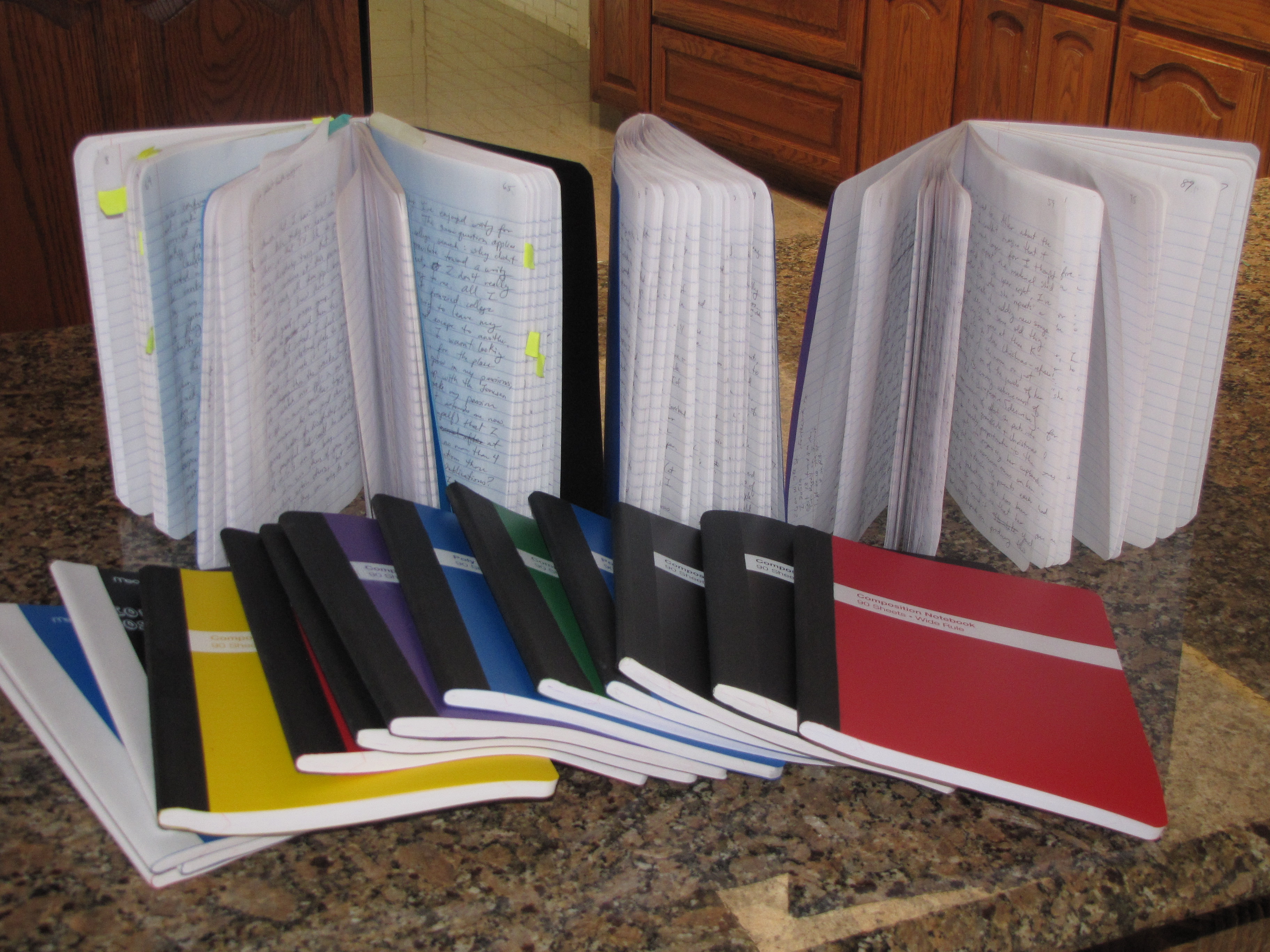
I was still working fervently on my two writing projects, but there came pausing points in both works, during which time I was left with nothing to do but finally start writing what was in my heart. Four notebooks and one month later, I had the rough draft of my memoir and the beginnings of this blog down on paper—both would wait for January for further development.

I looked around one day on campus and asked myself if this student life was what I wanted for five to eight more years. I didn’t see how that life would allow me to be the parent I knew I’d want to be—if we decided to have kids.

One day in October, while writing a paper for my last graduate class, I broke down at my computer and finally faced the truth: I was tired of this solitary student life; I wanted something more. I called my husband in tears and he came home early that day to take me on a walk-and-talk through the local state park. As I unknowingly acquired poison ivy, it was a relief to hear myself finally saying words I had been repressing for a long time: I want to have kids (this was a fun scene to write for my memoir).

In December I completed my master’s program and sent out two graduate applications—one MFA, and one PhD—just in case we didn’t conceive, and just in case God still wanted me in graduate school.

girl on bench

Last Winter

I did not get into either of the grad programs I applied to, which told me that was not God’s plan for me right now. I went off birth control in January, began this blog, and started officially calling myself a writer.

I spent the early months of the year feeling lonely and a bit depressed—now I was alone in our big house all day long, getting to write, yes, but without the promise of much people time during my days. I started really missing my family in Minnesota, whom I hadn’t seen since the previous June. I also realized I had been taking my husband for granted for most of our eight years of marriage—putting him on the back burner as I worked on emotional issues, self-improvement, and career development. I decided to be more family oriented.

Around the same time, God also brought many friends into my life to help alleviate my loneliness. This told me that God could meet my need for people contact with or without a baby.

Amanda and me

Last Spring

In May, when I wasn’t expecting it, I found out I was five weeks pregnant. Yay! We had a fun time surprising our family with the announcement, as most hadn’t been reading this blog and didn’t know we were trying. I rededicated my efforts to finishing my memoir “before thirty,” and now I also vowed to try to finish before baby.

2013-01-09 23.52.05

Currently

I have just returned from two weeks in Minnesota—probably my last trip to see my family before baby comes in January (I am four months along today). While in Minnesota I attended my ten-year class reunion and felt additional closure about God’s plans for my life. Though visiting Minnesota always makes me wistful, I clearly saw God’s wisdom in moving me away almost nine years ago. Visits back home used to be hard—brought painful memories—but more and more they bring happiness. Now, my husband and I are talking about getting a summer house in MN in a few years—which prospect fills my heart with joy.

My memoir is going well, and I have made contact with a favorite author of mine, Trish Ryan, who has agreed to consult on my book in late August to help me prepare it for publication (my hubby is giving me a “loan” because I told him it would be a good investment!). This fall I will be searching for an agent and/or publisher as I prepare for this baby’s arrival—and hopefully this winter I will have both a healthy baby and a manuscript headed for publication. The healthy baby is more important, of course—the book would just be a bonus. Regardless of how long it takes to get the memoir published, The Hidden Half of the Gospel will be published long before my next birthday—showing me that God heard my “before thirty” prayer six months ago.

It is 10:10 as I finish writing this, and my dentist’s office just texted, “Happy Birthday, I hope you have many reasons to smile today!” I am happy to say, “Yes, I do!” Today, I am smiling about my immediate future that will consist largely of family time, writing time, and more Minnesota time—and that doesn’t even compare to my eternal future!

Thank you, Lord, for taking such a personal interest in the mundane details of my life. Today I praise you for how you care about my heart’s desires and how you’ve led, not just for the past year, but for the past twenty-nine years.