Memoir and Melancholy: A Perfect Pair

despair, hope

We memoirists might look like gluttons for punishment, because writing about real life hurts, and no one makes us write but ourselves. But for many of us, writing about real life is just an extension of our “Perfect Melancholy” personalities; we write about our lives because we have to do something with all that self-analysis happening in our heads.

I’ve been reading Personality Plus by Florence Littauer, and the author’s description of my Melancholy personality hits home more than other personality tests or training I’ve taken. Other tests labeled my personality in less negative terms— Analyzer or Empathizer, for instance. But Melancholy cuts right to the chase. It describes me to an M.

The evidence is overwhelming—I am introspective, moody, artistic, and depression prone—and the personality test was indisputable. I am Melancholy through and through. True to Littauer’s description, I have been saddened by a small thing to which other personalities wouldn’t give a thought (the label of my personality); and more introspection is the result. I want another personality. I don’t want to have to work so hard to be happy. I don’t want to be Melancholy.

People who study personalities have long observed that artists and writers are commonly Melancholies, as opposed to Sanguines, Cholerics, or Phlegmatics, and this could be good or bad, depending on where you stand.

If you’re the one consuming the art, Perfect Melancholy is great: its existence enriches our culture by providing life-enriching and thought-provoking art.

If you’re the one providing the art, or struggling with “genius” tendencies (Littauer’s word, not mine) that you have trouble harnessing, Perfect Melancholy can be excruciating. Littauer notes that while Melancholies have the highest potential for achievement, they also experience the “highest highs and the lowest lows.” To my Melancholy-colored glasses, this data forces me into a dilemma that’s definitely false, but that seems so real: Would I rather be a “genius” (in writing), or be happy?

The Misery of Memoir

For much of my life, pursuing my art meant misery. All I could write about was my life; and my life, for a good chunk, was sad. Why didn’t I pick another topic, a happier topic, to write about? I go back to the personalities. Melancholy couldn’t get its mind off itself. I was trying to process hard things in my life, and as a writer, I naturally processed through writing.

Because it didn’t yet feel safe to talk about some of those sad things, I especially needed writing as an outlet. I had a strange relationship with writing, though. On the one hand, I felt like I needed to write to survive. On the other hand, what came out of my pen felt like it might kill me.

For almost ten years I would waffle on writing my story—I mean writing it for an audience as opposed to venting in journals. Typically here’s how it would go: I get the desire to write, I pull out old journals for inspiration, I spend a few hours working with the material, and I end up in a pool of tears because it hurts so much, followed by a crumpled heap in my husband’s arms because I am not ready to confront all the emotions these memories bring up. Then, I stuff the emotions, the memories, and my writing aspirations for another few months or years, only to repeat the process again and again.

Melancholies Can Write Happy Endings Too

This blog has borne witness to some of the healing process that finally got me writing again…and writing not only with sadness, but with gladness. God gave my story a happy ending. He not only redirected some of my worst circumstances, but he redirected my mind.

Now, even when more bad circumstances arise—which they inevitably do from time to time—I don’t have to give in to Melancholy. I don’t have to collapse in despair because “that’s just the way things are, and that’s just the way I am.”

God’s Word gives me a more accurate measure of how things really are, and how I really am. You might say he gives me a better personality test, or the ultimate Truth meter:

Though outwardly I am wasting away, yet inwardly I am being renewed day by day (2 Cor. 4:16).

The sufferings of the present time are not worthy to be compared with the glory which shall be revealed in me (Rom. 8:18).

If I wait on the Lord, he will strengthen me (Ps. 27:14); Isa. 40:31).

I can learn to be content in whatever state I’m in, knowing that God will supply all my needs according to his riches in Christ Jesus (Phil. 4:11, 19).

He will keep me in perfect peace if my mind is fixed on him (Isa. 26:3).

I can remember that weeping may endure for a night, but joy comes in the morning (Ps. 30:5).

And I can be confident that, even when progress seems slow, he who began a good work in me will keep working on me until Jesus comes back (Phil. 1:6).

Yes, this world is sad and often hard to navigate—especially, I think, for us over-analytical Melancholies. But this world is not the end, it is temporary and passing away, and that is life-giving knowledge I can cling to.

Yes, I am sinful and fallible and moody and depression prone. But Jesus didn’t come to this world to suffer and die to leave me that way. He came to pull me out of the pits, physical and mental; to retrain my mind on him; and to change me, from glory glory to glory, as I behold him.

And so the story continues. Many mornings I wake feeling unhappy by default. My Melancholy personality (and Satan) doesn’t want me to be happy. But as I make the choice, day by day, to seek God’s face, he gives me strength for what’s in front of me. So I keep praying through it, keep writing through it, and keep moving forward, little by little. A lot of my days end better than they start, because throughout the day I exercise my faith and allow God to smooth out the bumps. These are small rewards, little happy endings, that point me on to the day when Jesus comes to take me home, and give me my ultimate happy ending.




My SMART Goals for the Year (Specific, Measurable, Attainable, Realistic, Time-Bound)

orange measuring tape
Photo Credit: “Orange and Measuring Tape” from freedigitalphotos.net

Previously I published three resolutions for 2015, but they were vague and hard to measure (except the one about getting pregnant), so today I delineate SMART goals for my resolutions: Specific, Measurable, Attainable, Realistic, and Time-Bound.

In other words, I am breaking my goals into small chunks so I will be more likely to attain them. I have also typed out these goals in measurable formats and have posted them where I will see them every day.

Resolution 1: Focus on my Family.

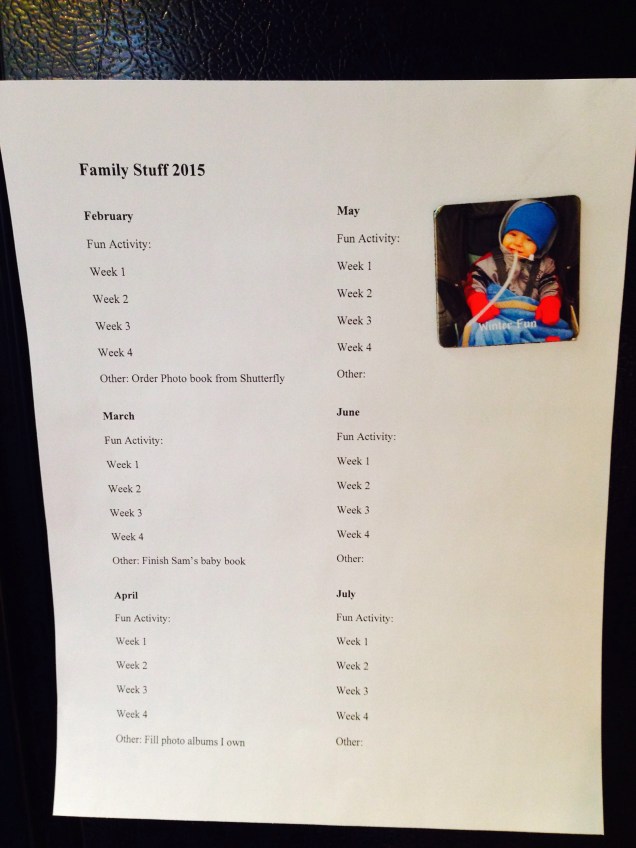
This list of "family stuff" hangs on my fridge. The list of weeks is where I will write in the weekly song I will sing with Sam.
This list of “family stuff” hangs on my fridge. The list of weeks is where I will write in the weekly song I will sing with Sam.
  • Have nightly family devotions, if even just a song and a prayer together (I’ve learned that a song and a prayer is a notable accomplishment with a one-year-old!)
  • Do one fun outing/activity a month as a family
  • Sing with Sam every day: Pick one song per week. (I included this one because the Bible commands me to “sing and make music in my heart to the Lord” [Eph. 5:19], but I don’t naturally do this; if I’m going to develop this habit and pass it along to Sam, I need a reminder!)
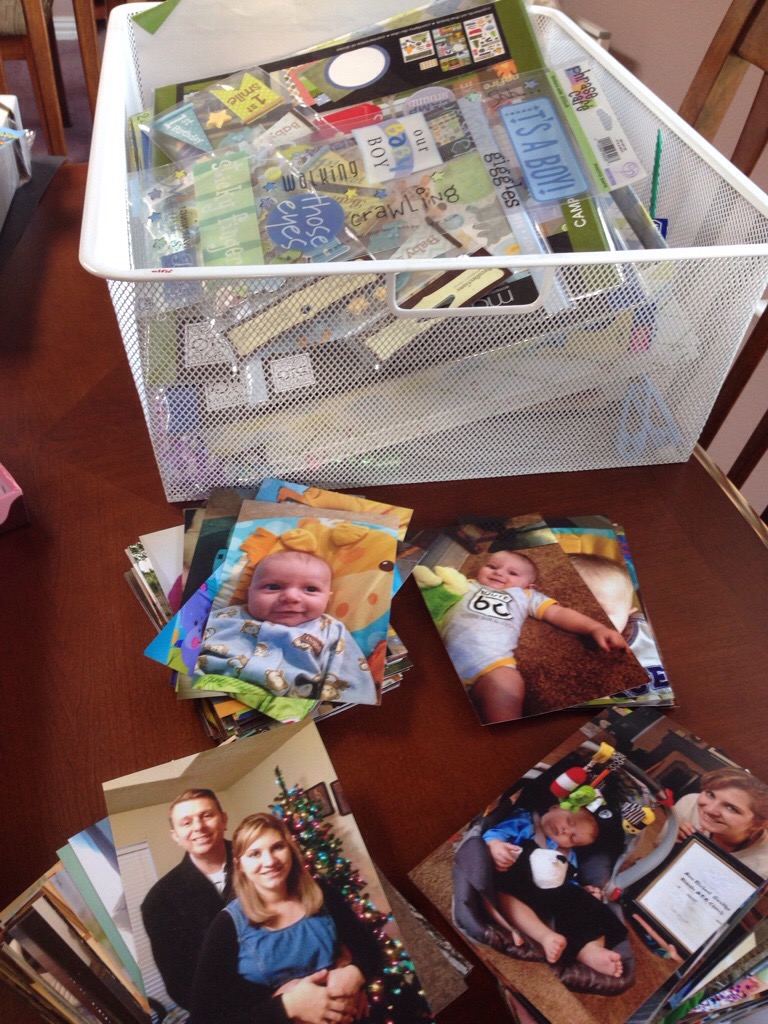
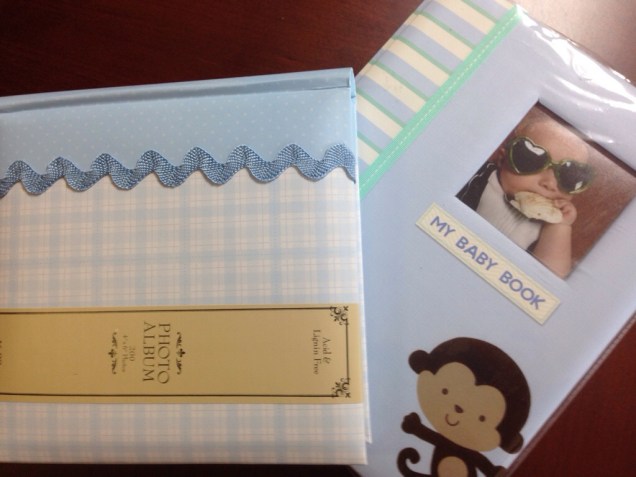
  • Finish Sam’s baby book
  • Fill photo albums with the pictures I already have, then start making electronic albums

Resolution 2: Make healthy choices for myself and make healthy food for my family.

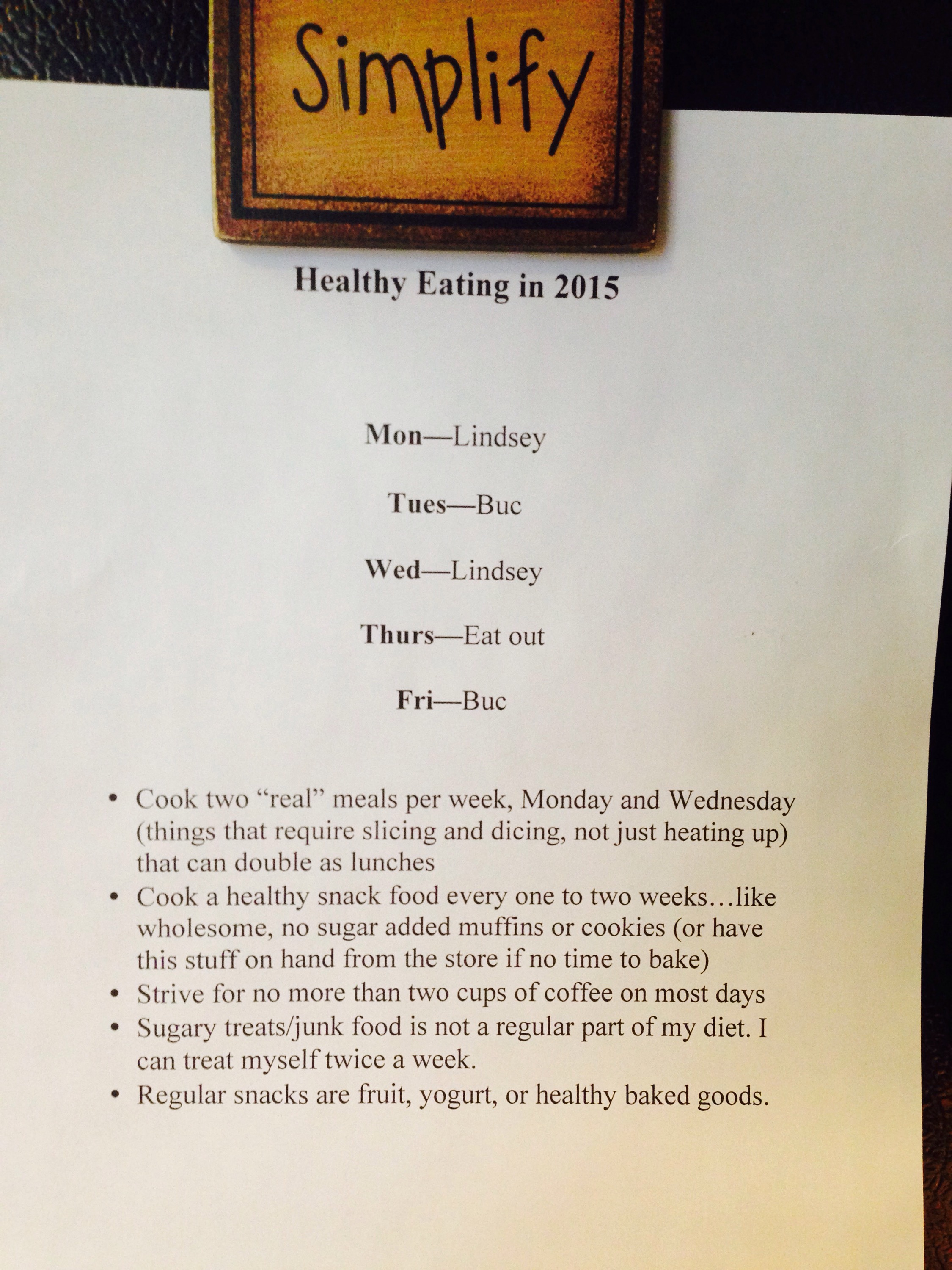
IMG_1776

I got Buc’s input on our family meal schedule, because he is not, shall we say, as experimental of an eater as I am! He generously agreed to take on the cooking for two nights a week–a relief for both him and me, because I can use those afternoons for other things, and he can count on two meals he is sure to like per week. He also agreed to take the family out to eat once a week to give us both a break in the cooking and evening cleanup departments. I sure have a good hubby!

Resolution 3: Get pregnant in 2015 with my second, and final, child.

I’m leaving this one to nature.

Resolution 4 (Recently Added): Write When I Can, and When It Doesn’t Interfere with Family Time

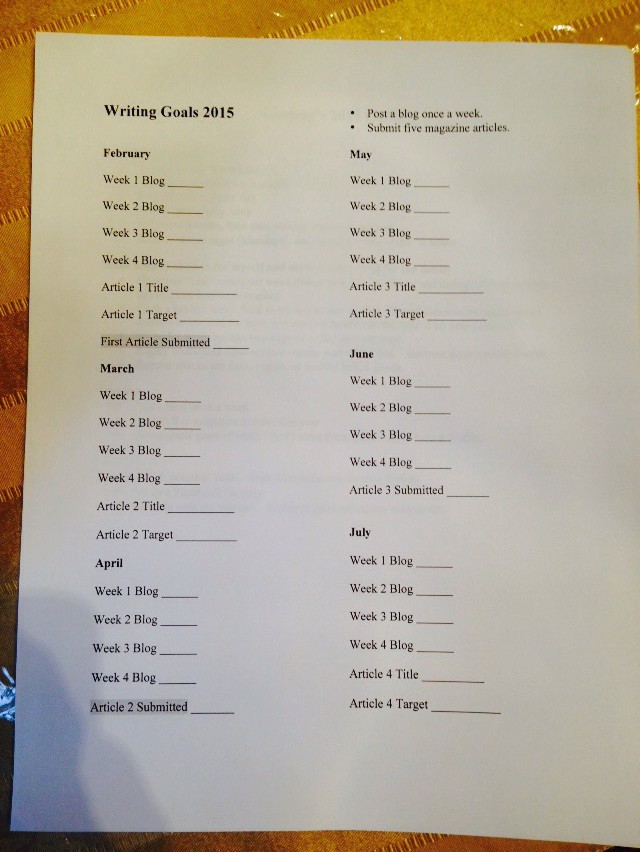
I’ve added “writing” as an area I want to focus on this year, even though I intend it to take a backseat to family life. Below are some goals that seem realistic for me this year; but because I can get obsessive in the area of writing, I’ve listed the third goal to give myself grace if I don’t meet my first two goals.

  • Post a blog once a week
  • Submit five magazine articles this year
  • Give myself grace if/when I don’t meet these guidelines. I have a toddler.

IMG_1752

Inspiration for Completing My Goals

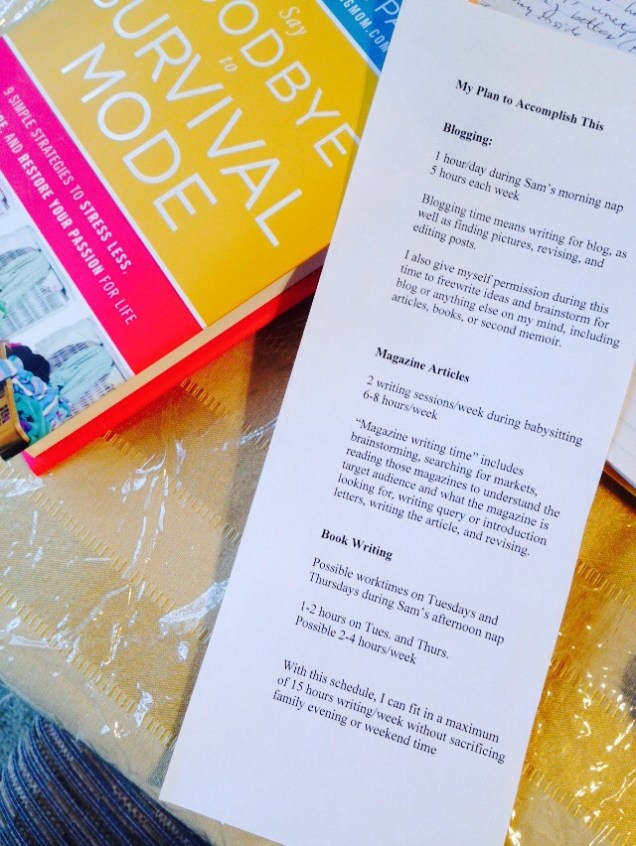
In case you’re curious, I’m getting a lot of my ideas and inspiration (such as the SMART acronym) from Crystal Paine’s Say Goodbye to Survival Mode. (And I got the book recommendation from hearing Crystal interviewed on Family Life Today–which radio program I also highly recommend). If you’re interested in getting help with setting and following through with goals, check out her book, or her very popular blog, moneysavingmom.com. In her book, she walks readers through setting up goals, a daily schedule, and more, all with the hope that the reader will Stress Less, Sleep More, and Restore [their] Passion for Life.

IMG_1753

Just be warned: Crystal is a highly driven woman with many, many goals, some Herculean (at least from where I sit in life right now), so I am trying to take her advice to not to compare myself with her, and to set my goals in the context of my individual circumstances. I realize my goals may change as I go along, should my circumstances change or should I discover a better fit for my life, but for now I am committed to implementing the suggestions she’s given, and doing what I’ve identified as most important to my values at this time. Stay tuned to see how it all goes! We can journey toward our goals together.

Embracing Imperfection

"Hands4" by TACLUDA
“Hands4” by TACLUDA

“I don’t watch TV and don’t feel like I waste my time. So why don’t I always have time for God? What can I cut out of my day to spend more time with Him?”

I asked my husband this question last weekend during a heart to heart about putting God back at the center of our lives. Buc admitted he needed to cut down on media use, but I couldn’t put my finger on any “time-wasters” in my day; everything I did seemed useful, even needful.

“I know what your problem is.” Buc answered. “You’re a perfectionist. You might do all good things, but it takes you three times as long as most people. So you do everything well, but you don’t get much done.”

Ugh. He’s told me this before. And I guess  I haven’t truly listened. But I’m finally starting to, because God has stepped in to send the message home. Over the last few weeks (during which I haven’t posted because I didn’t have time to write a “good enough” post) God has been teaching me that his idea of perfection is not the same as mine.

My idea of perfection looks something like this:

  • I should have morning worship every day
  • I should be a good and responsive mother to Sam (whatever that means while he is without language and can’t tell me what he wants/needs)
  • I should exercise vigorously every day
  • I should get to eat at least one meal with my husband (two would be better)
  • Those meals should be mostly healthy
  • I should get 8 hours of sleep every night
  • I should be writing every day
  • I should be blogging regularly
  • I should be involved at church
  • I should be preparing personalized Christmas gifts on Shutterfly (or similar sites) for my family
  • I should keep in touch with all my friends on a regular basis
  • I should keep my house clean–or, at the very least, should be able to get the dishes done at the end of every day
  • I should have clean hair every day

My daily reality is far from my daily “wish list.” And understandably; it’s an impossible list. Over and over in the past weeks God has been talking to me about my impossible standards, trying to redirect them to his standard. He says his “yoke is easy” and his “burden is light” (Matt. 11:28-30). That sounds better than the crushing yoke I’ve created for myself.

So what is God’s definition of perfection? I’m working on piecing together an imperfect definition, based on some verses he has directed me to lately:

“It is God who arms me with strength and makes my way perfect.” (Ps. 18:32, NIV)

“…count it all joy when you fall into various trials, knowing that the testing of your faith produces patience. But let patience have its perfect work, that you may be perfect and complete, lacking nothing.” (James 1:2-4, NKJV)

 “…from a child thou hast known the holy scriptures, which are able to make thee wise unto salvation through faith which is in Christ Jesus. All scripture is given by inspiration of God, and is profitable for doctrine, for reproof, for correction, for instruction in righteousness: That the (wo)man of God may be perfect, thoroughly furnished unto all good works.” (2 Tim. 3:15-17, KJV)

From these verses, I know there is nothing I can do to be “perfect”; it is only through God and his Word that I can aspire to “perfection.” And what is godly perfection? From James I am starting to understand that I can’t measure my “perfection” by my outward appearance; it has to do with my heart and my state of mind. Also, James tells me the road to becoming “perfect” is messy, paved with trials; and Timothy tells me that it may take some “reproof” and “correction” before I get there.

As I ponder and pray over these lessons from God and his Word, I am becoming more okay with days that don’t live up to my expectations. Good rest and good hygiene and healthy meals and quality time with my husband and robust writing production and everything else on my list would be really nice, but we live in an imperfect world–so these things won’t happen every day. So I have to become okay with that; I have to learn to embrace “imperfection” according to how I define imperfection (my shallow, outward definition), and embrace the “process of perfection” God has designed.

My house might be a mess, my hair might be a bit greasy, and it may be a month or more between blog posts…but that’s okay…as long as my connection with God is still intact.

In my imperfect world, maybe all I can do is a five-minute Bible study, or fifty distracted prayers throughout the day while chasing down a runway baby. Maybe I get blessed with an hour of “free” time in which to crack open my Bible commentaries. Maybe I only get to read a few scriptures on my index cards before motherhood calls.

The important thing is to not let the possibility of an “imperfect” Bible study or prayer session keep me from having that Bible study or prayer session. God has told me this recently. He told me, “Lindsey, ALL scripture is profitable for you…so even if you only get five minutes, take them.” And through a new favorite author, Lysa Terkeurst, he has also told me, “Your job is obedience; my job is results” (from Unglued: Making Wise Choices in the Midst of Raw Emotions).

Okay, God. I will embrace imperfection, as long as you keep helping me (and I know you will). As long you keep “perfecting” me according to your will, I will keep loosening my grip on my own imperfect ideas of perfection.

Messy house, greasy hair, and hasty blog post, here I come! This is my day, and that’s okay.

Better Reads for New Moms…Because “How-to” Books Don’t Always Cut It

In this post I review the precious few “New Mommy Memoirs” I have found, with some comments on the dearth of such books.

If you’re a new mom, love to read, and need some support, you’re in luck…sort of…depending on what you’re looking for. If it’s advice or quick snapshots of daily life you seek, “How-to” tomes and mommy blogs abound. If, on the other hand, you just want a girlfriend with whom to commiserate and cuddle up with (perhaps your baby has failed to respond to the wisdom of Ezzo, Ferber, Pantley, or Sears), the pickings are slim. Nonetheless, here’s what I’ve found–the good with the mediocre–because sometimes “how-to” books just don’t cut it.

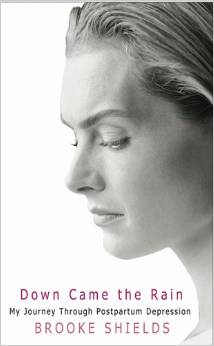
Down Came the Rain: My Journey Through Postpartum Depression, Brooke Shields

down came the rainThis high-profile account of post-partum depression probably got published more for its author’s celebrity than her writing prowess, still, it’s a fascinating read to a first-time mom, or a first-time pregnant lady. (I read it about halfway through my pregnancy and was hooked.) If you want to know some of the emotional risks that motherhood brings, or if you are struggling with post-partum depression, this is a good read for you. Most memorable for me was Shields’s description of visualizing her baby flying through the air, hitting the wall, and sliding to the floor–yikes! I had some hard days with Sam, but thankfully never anything as drastic as Shields describes. I appreciate her honest admission of how she fantasized not only about her baby’s death, but her own. I hope you never deal with this serious malady, but if you do, read this book. And after you finish this depressing read…

Sippy Cups Are Not for Chardonnay (and Other Things I Had to Learn as a New Mom), Stephanie Wilder-Taylor

sippy cupsSome humor for you! I stumbled upon this humorous collection of essays at a used book sale while three months pregnant, read it within the month, and recently reread certain chapters when my sleep deprivation was making me cry. If you, too, need to come up for a laugh from the never-ending demands of your baby, this book is a good choice. But Christian readers, beware. Like almost every secular comedian I know of, Taylor relies on some profanity and crassness to make her jokes. I wish I knew of a funny, clean, book on motherhood to recommend, but since I don’t, and you might really need comic relief, I offer this one. An interesting side note: Taylor makes numerous references to drinking in this 2006 book, and in the past year, I saw her featured on the Today Show for admitting she actually had a drinking problem. Sad, but good comedy always has an element of reality, doesn’t it? (Her second book on motherhood, which I will probably read at some point, is called Naptime Is the New Happy Hour.)

Signs of Life, Natalie Taylor

signs of lifeMaybe I shouldn’t include this book on a list of motherhood memoirs, because the top story here is a young widow grieving her dead husband…but the sub story is a young widow adjusting to new motherhood…so here you go. I actually picked this one up in 2011, before I planned on becoming a mother, to read about a young English teacher (which I was at the time) dealing with the freak accident death of her husband (which is one of my bigger fears in life). Then, I enjoyed Taylor’s strong writing voice and her many literary references (she derives comfort from literature like Christians derive comfort from the Bible)…but more recently, when I reread this book, I picked up on the common struggles of new motherhood. My favorite image from the book: she mentions a glob of jelly on her kitchen floor that she just can’t find time or energy to wipe up (no doubt due to both the exhaustion of grief and the exhaustion of new motherhood.) So true! If you are a mom who appreciates literature reflecting real life, you will appreciate Natalie Taylor’s take.

Double Time: How I Survived–and Mostly Thrived–the First Three Years of Mothering Twins, Jane Roper

double timeThis is the most forgettable memoir in the list, but if you are a new mother, and especially a mother of twins, you might still enjoy it. Unlike Shields’s life-threatening depression, Wilder-Taylor’s comic slant, or Taylor’s added challenge of being a single mother, Roper doesn’t bring anything new to the table, except for having to do double duty on feeding, diapering, and everything else mom-related. Roper is a writer a by trade, and no doubt thought she could get a book out of her twins, which is fine, because we all have a story to tell (and hey, I probably would’ve done the same). On a side note, Roper throws in her story of depression, which is purely clinical and responds well to medication, so not that interesting, but I appreciate this alternate, less serious description of the disease. My fun takeaway from the book: “twin-yang,” or the phenomenon of one twin acting great while the other one is a terror. My next-door neighbor with twin babies confirmed that this is a real condition:)

The Second Nine Months: One Woman Tells the Real Truth about Becoming a Mom. Finally. Vicki Glembocki

second nine months 2My favorite, by far! This is the book that new moms will relate to the most (I think). This is for the mom who is not suffering true post-partum depression, but who wonders, in those early months, if she made a mistake by having a baby. I wish I would’ve discovered this book back then, and not nine months into motherhood, but since Glembocki ends her story at her baby’s tenth month, I was right there with her on the back-end of her story, as her “devil baby,” Blair, becomes more human and lovable, and as Glembocki finally settles into her new role and finds rhythm in her new life.

I knew I had found the right book from one of her first scenes: she is strolling her new, three-week-young, screaming baby down the street, exploding at her husband over the phone that she needs help–please come home! She is trying to accomplish one thing that day–dry clean a comforter–just ONE THING, dang it, because nothing gets done anymore; but the baby is screaming and she is alone and has no help and no idea how to comfort her baby. I related to so many moments in this book, and I’m sure many other new moms will, too. I give this book my highest recommendation and urge you to buy it for yourself or a new mom in your life.

In Conclusion

Unfortunately, the “New Mommy Memoir” looks to be a largely untapped market, probably because new moms don’t have time, energy, or ambition to write more than a blog post here and there…and by the time they do, they’ve forgotten the “bad old days.” That’s why all of the books above, though they may not be “great” literary works, are important.

Though some are not very memorable, and a couple are not particularly well written, they might be invaluable to a new mom who doesn’t need more advice, but who just needs a girlfriend who’s gone before her. The best part about finding this girlfriend in a book? She’s available anytime, anywhere, no matter if you’re stuck in the house or your baby is stuck to your breast.

Yes, I’ve decided that anytime a writer-mom contributes to this genre, she gives a gift to other new moms. Now, if you’ll excuse me, I think I’ve found a new writing project to work on.

(Note: please don’t look for my “New Mommy Memoir” until Sam is in college. Just kidding. Maybe high school:)

My Near Brush with Scrapbooking

20140926-083917.jpgDo you ever fall into the trap, like I do, of feeling you must use something just because you have it? Last year I received some lovely scrapbooking supplies for my baby shower, and those supplies sat unused in a drawer for the first eight months of Sam’s life, taunting me, making me feel like a bad mother…until his ninth month, when I counted the cost of what scrapbooking would mean to my already busy life.

Already I was having trouble fitting into my day the things I loved (apart from Sam), and some things I didn’t really love, but really needed to do. I was not finding regular time to blog, read, or keep up with friends. I could not always find time to make healthy meals for my family. And I had committed to an exercise program that required just twenty-five minutes a day—but after completing the day’s demands, sometimes I literally could not find the time (or energy) to keep that commitment to my health. I realized again a lesson my people-pleasing personality needs over and over: I can’t do it all, at least not all at the same time; in life, I have to choose.

best yesHappily, just as I was trying to decide what to do with my scrapbooking supplies, I read Lysa Terkeurst’s book, The Best Yes: Making Wise Decisions in the Midst of Endless Demands—and I knew what to do. The thesis of the book is that God has “best yeses” for us, or things we are definitely meant to do in life; but we have to be intentional about our decisions, always checking them against God’s word and spiritual discernment, or we will trade our best yeses for things we are not meant to do. The two most important words we can wield, says Terkeurst, are “yes” and “no.” She helps readers determine when to say no. She helped me decide that scrapbooking, for me, was a “no.”

Along with Terkeurst’s wisdom, here are some questions I asked myself to determine whether something really deserves my time–along with how I applied it to my scrapbooking dilemma:

  • Will this thing matter in the end to others who matter to me? I decided it was important to preserve some pictures of Sam and some milestones and thoughts, but it didn’t really matter how. In other words, keeping a baby book and a regular photo album is just as good as keeping a scrapbook. Sam will feel loved from these simpler memory makers, so why not go easy on myself?20140926-083931.jpg
  • Will this thing matter in the end to me? In ten years, twenty years, or even tomorrow, I decided I don’t care if I have a scrapbook sitting on my shelf or not. In fact, I’m trying to de-clutter my home, so why would I add another baby book? It would be nice to have, but it’s just not for me.
  • What would I, or could I, do with my time instead? The things I am constantly craving more of right now are reading good books, writing, and time with God and family. These things refresh me, and when I am refreshed, I am a better, more pleasant person.
  • Is doing this thing helping fulfill God’s plan for me, detracting from it, or neutral? In the case of scrapbooking (big deal, right?), maybe the answer is neutral. But between the other two choices, I’d say it’s detracting from God’s plans. It would take time away from my real gift, which my hubby recently said (and I agree) is communicating–talking, listening, and writing to others. On a side note, the recent project I’ve been doing for my church is collecting, writing up, and disseminating info on all our ministries/activities–and I have thoroughly enjoyed doing this, and I feel good about it. The accompanying bulletin board my assistant and I have planned excites me far less (huh, bulletin-boarding kind of resembles scrapbooking), so I am thankful for a communications assistant who is enthusiastic about the board.

At the end of the day, the decision to scrap the scrapbooking was a great victory for me. “Redeem the time, for the days are evil,” the Bible says. Deciding not to scrapbook helped me crystallize what’s really important, and what’s really not–and it has helped me to redeem my time. Take the past twenty-five minutes, for instance. I could’ve been scrapbooking, but instead I got to record these thoughts. I feel better already.

20140926-083948.jpg

What things tempt you to trade your best yeses?

Is There Such Thing as Too Honest?

ID-10033219
freedigitalphotos.net

Most people agree that “Honesty is the best policy.” But as a writer and ministry leader who has made honesty her central message and MO, I wonder if it’s possible to sometimes be “too honest.” Not a few times as I’ve posted unflattering, embarrassing, content, I’ve wondered: am I hurting my influence by being so raw and real? After people read this, will they still look up to me?

I’ve found that honesty, at the level I go, can be hard to find in Christian writers, teachers, and leaders. Many I’ve observed in this group like to use honest illustrations and anecdotes…of other people’s struggles. Or, if the stories are first-person, they tend to remain on a safe, surface level. I once read an article by a Christian who used the analogy of scrubbing her floor to illustrate the filthiness in her heart. But she made no mention of what, exactly, was in her heart. “Scrubbing my dirty floor made me think of how God has to scrub my heart clean of sin. I thought, how much better if I kept it clean daily, instead of letting it all pile up?”

Illustrations of the gospel like this one don’t resonate with me. It’s not that they’re bad or untrue, it’s just that they’re so general, so vague so b-o-o-o-o-ring. Worst of all, illustrations like these are generally unhelpful when it comes to making real changes to behavior.

At the risk of assuming other humans think like I do, I would submit that humans long for authenticity. Especially when we’re talking about faith. If our sources of inspiration don’t hit close to home, addressing real issues we battle daily, they will be perceived as impotent, laughable, and even painful (because they minimize our struggles)—and they will be quickly abandoned.

That’s why I chose to be vulnerable in the memoir I wrote about discovering my new life in Christ.

It’s why I choose to be vulnerable almost every time I post on this blog.

I believe people are hungry for other people to relate to them—to say “I’ve been there, too. Look how screwed up I used to be, and how I still struggle sometimes. And yet, look what God was able to do with that mess!” I believe messages like this bring hope.

But what if I’m wrong? What if messages like this do the opposite? What if brutal honesty breeds distrust in God and disaffection for his “honest, messed-up followers?”

When leaders decide to be honest, this is a very real risk we take—the risk of our followers unsubscribing because we are not perfect.

I am willing to take this risk, not only for the reasons I listed above, but because a genuine Christian faith should not hinge on the words and deeds of any human being. (In other words, no one’s faith should hinge on me.) It should hinge on the person and words of Christ.

When Leaders Disappoint

A few years ago I was deeply disappointed when I learned that one of my spiritual heroes, Leo Schreven, committed suicide. Honestly, I felt betrayed and somewhat deceived by this man who previously appeared to “have it all together.” But I was able to weather this bad news by clinging to the truth that God is not, and never will be, totally represented by those claiming to be his followers. When we see good in Christians, that is from God. But when we see bad, that is from the enemy. We can’t lay every quality at Christ’s doorstep, because not every quality is from him.

IMG_0776
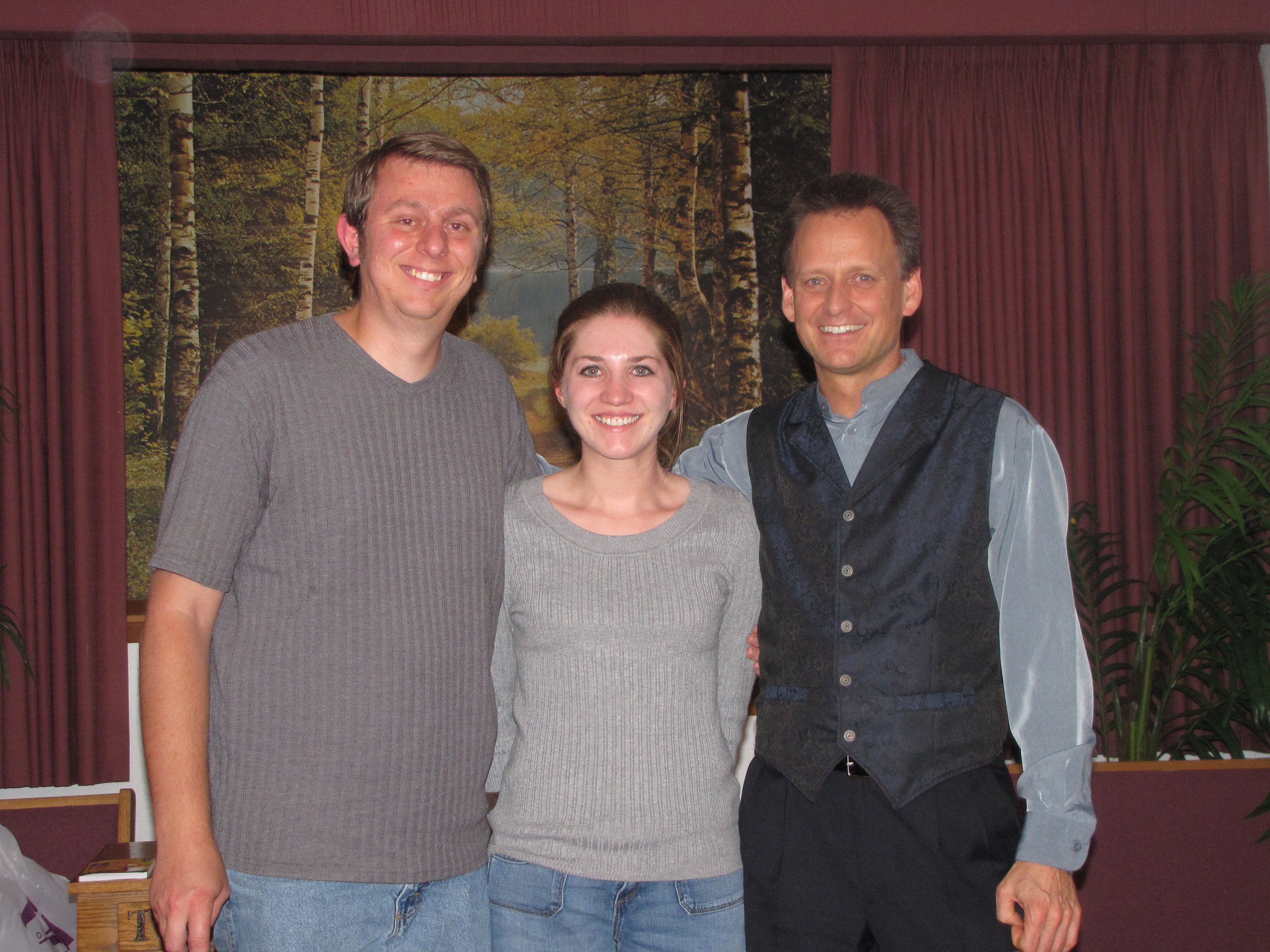
I had the privilege of meeting Leo Schreven in 2010 when he conducted a seminar at my church. My husband (left) had met him many years before and introduced me to Leo’s preaching through a set of seminar tapes that made me eager to meet him.

One quality I do believe is of God is the quality of honestly engaging our struggles as we seek His healing. I think I would have still respected my deceased spiritual hero if, in life, he had openly admitted his struggles. Perhaps I would have respected him even more for choosing bravery, rather than bravado—even though his brave sharing would have painted him as a fallible, sinful, wounded human being.

I have to add something here, to be fair. A family member of Leo Schreven’s contacted me after reading my blog post about Leo’s suicide, to tell me that my “hero” had struggled with psychological problems the public knew nothing about. This family member wanted me to have a fair, truthful view of Leo. The truth included mental illness, and as a former sufferer of mental illness, I empathized with that. I understood that I had put Leo on a pedestal. I also understood that his mental state may have precluded him from the type of honesty to which I am calling spiritual leaders.

Given the state of Leo’s mental health, it’s actually amazing that he enjoyed the long and successful career as evangelist and motivational speaker that he did. I have had similar thoughts, of course, about the late Robin Williams. Leo and Robin show us that there are exceptions to the standard of honesty I am putting forth. The exception applies to those who are not able to help themselves, or not able to let God help them, because of mental illness, or a genuine medical problem. Maybe they keep up the façade for the public for awhile, but in the end, we find out they are not the leaders we wished them to be. But then again, no one in whom we place our trust is immune to struggles, and to sin.

The Bible says that all have sinned and fallen short of the glory of God, so we know every person, Christian or non, ministry leader or not, has a mix of good and bad.

No matter what we know to be true about our leaders, hopefully we can sift the good from the bad, and remember and respect them for their good qualities. Hopefully we can go on learning from them, no matter what their lives reveal. Sometimes we may observe the right course, other times the non-example. As long as we are looking up to human beings, we should expect both. And if we are the ones being looked up to, we must trust Christ to be the one shining example our audiences need; we must be okay with being imperfect representations of him.

That said, I believe that we in positions of trust—ministry leaders, Christian writers, etc.—should do our best to represent Christ, and this includes being honest about how God is working in our lives and transforming our sinful patterns. We should also be honest about “wilderness” times,  times when we struggle with our faith…but we should do it wisely.

Guidelines for Christian Leaders

Here are two guidelines I’ve found helpful in my own writing and ministry that can help Christian leaders determine when, where, and how much to share.

freedigitalphotos.net

1) First, we should consider timing. You can read various sins and struggles of mine on this blog that occurred at various stages in my life. I blog about problems long past and problems of last week.

The safer type of post is the one about problems past. These problems are ones I have likely had victory over. They are problems that have yielded personal lessons I can use to teach others. These types of posts, and this type of sharing, should be an absolute “yes” for all ministry leaders. Why wouldn’t we use our stories of redemption as teaching tools? What better examples of the gospel could we present than the ones that have played out in our own lives?

The murky area is problems of the present. How much should Christian leaders share about present problems? Here, we have to be wise about audience.

2) Audience is the second consideration. Consider who will be reading or hearing your message. If you are a preacher and it is your job to inspire hope, then it may not be the best time to insert a struggle that you do not have victory over, or at least cannot yet talk about in a positive way.

Sure, there are times when you are on the upside of a struggle—you can see the end in sight, and you are pressing through for victory. That might be material for an inspiring message, and if you are comfortable exposing that yet-unresolved pain, go ahead.

But other times, pain and sin is too raw to project to a large, or public, audience. That’s when you need a small, confidential audience. I’m talking a few trusted friends or advisors who can help talk and pray you through your problems. When you have worked through those problems, then they may become appropriate large-group material. But don’t rush it. Getting outside voices mixed up in your current personal problems could hurt the healing process, and you need to get healthy first so you can go back to being your motivational self.

One caveat for leaders working through personal problems: if your challenge handicaps your ability to do ministry, whether because the emotions involved take too much energy, or because a sin you are fighting “disqualifies” you to be a role model at the time, then it’s probably the right time to step out of ministry, at least for awhile. In the case of Leo Schreven, I would have much preferred hearing the news that he had stepped out of leadership for awhile to tackle some personal problems to hearing that he had committed suicide. We are ultimately the most helpful to others when we get the help we need, first.

On This Blog, What You See Is What You Get

To apply my guidelines to myself, I routinely post about my current struggles, but many times I have chosen to remain silent until I have prayed over them and exposed them to Scripture and the wisdom and counsel of a few trusted others. By the time I post on an issue, I want it to be, if not totally resolved, at least on the path to resolution. I want others to look up to me, yes, but I am happy to admit that sometimes the best example I can give is: “Look, I’m broken here, but I’m looking to Christ. And if you feel the same way, you need to do the same.”

By posting my struggles, past or present, I risk losing my readers’ respect, but I also keep myself accountable to Christ for resolution. I put a problem out there (such as my sleep-deprived, desperate, witchy state), and I say, “Okay, this is the mess this sinful world, or sinful me, has created today. But now, how am I going to find Christ in the middle of it?” My mission is to find out how Christ will come through for me, and then to share my victory with my readers.

Indeed, if “Superwoman Christian” is the role model you want, look somewhere else. Because on this blog you’ll just encounter a broken girl trying to depend on Christ, and trying to work out her faith, in all things big and little. After all, as so many examples in the Bible show (Kind David and the 51st Psalm come right to mind), a Christian leader worth listening to is not someone who claims to be above sins and struggles, but someone who fully admits their weaknesses; has learned how to let Christ lead in the hard times; and can discern which, of all their life experiences, will be helpful for lifting others up.

Call Me a Desperate Housewife

I’m not gonna lie. Even though I’ve had what I call an “attitude change” about motherhood, I still have days when I feel like a desperate housewife. And not the sexy, Hollywood kind either. See below for the depressing details, but then keep reading…this post ends well!

sleep deprived 1Picture me bedraggled and frumpy as I haul myself out of bed at 1:50 a.m. to change a poopy diaper, administer medication, and give a bottle. At 3 a.m. he cries because he doesn’t want to go back to sleep. At 3:30, I cry because now I can’t go back to sleep. Sometime in the 4 or 5:00 hour I fall into an uneasy snooze, but by 6 a.m., the telltale wakeup cry pierces the monitor again.

I roll out of bed scowling and muttering. Buc, my husband, is in the shower and will be gone by 6:30, and it takes every ounce of self-control I have not to blame him for how I feel like a single mother during the workweek. When he emerges from the bathroom, I break my vow to speak peace and instead pounce, listing all that’s wrong with my world. These are the only words he will get from me for the next twelve hours until he returns again. This is his sweet sendoff. Man, I feel terrible. This is where I realize yet again: I am a desperate housewife. Desperate for sleep, yes, but also desperate for wisdom to handle these days when adequate sleep is but a dream.

About four months ago, or half of Sam’s life ago, I made the remark to a fellow parent, “At least the hardest part is over.” He only laughed at me. Now with Sam’s mobility, I know why. Yes, the sleep is better some nights. But not always. And days have gotten 100% harder. Now during waking hours, Sam needs constant supervision, because he will almost certainly hurt himself if I’m not there to catch him, redirect him, or take something away. When does this phase end?

About two months ago when I noticed my attitude consistently lurking in the pits, I recognized a desperate need to get back to the basics. Hence the attitude change I blogged about a few weeks ago. This change happened as I committed to using my “spare time” to uplift my soul, as I paid attention to everything I fed on, from food to books to music and television. I made sure I put good “fuel” in my brain, such as Christian radio programming, the Bible, and other inspirational books. And it helped. Tremendously.

sleep deprived 3aBut then Sam started having trouble sleeping again. And it didn’t matter what nuggets of wisdom I found time to gobble up (not many, by the way), not as long as my hunger for sleep went unsatisfied. Despite my prayers and good intentions and promises to myself that I would not be unpleasant, I often woke up a witch.

Things came to a head as this weekend hit. By Friday, not only had Sam strung together several bad nights, but my babysitter for that day got sick and canceled, and then I started to feel sick. I fought to get Sam to nap in the afternoon, but my best efforts only resulted in a half hour siesta for both of us. Late Friday afternoon found me, head buried in hands, moaning, “I’m a failure,” texting Buc at work and asking if he could sneak out of the office early to help me. I was tired, I was sick, and I felt like a failure as a mother.

I had read enough books to know that babies can be trained to sleep well, and I knew several moms whose babies slept well every night, but I had obviously failed in that department. “Lord, help me!” I cried. I was, indeed, a desperate housewife. And until I got Sam’s and my sleep sorted out, I knew the desperation would continue.

To make a long story short, Buc stepped in like a champ this weekend to give me a much-needed break, time to regroup, and time to tune in to the wisdom God has placed all around me. While he and Sam went to church Saturday morning and to my in-laws’ for Saturday lunch, I rested, read the wisdom of Proverbs, and refreshed myself on what the sleep experts in my parenting books said.

sleep deprived 2The verse that spoke to me in Proverbs was: “Plans go wrong for lack of advice; many counselors bring success” (15:22, NLT). Proverbs has a lot to say about fools, and I faced the fact that I’d been a fool on the sleep issue, too often going with my feelings instead by wise counsel. Ever since Sam’s separation anxiety (and his “mommy” attachment) manifested, I’d become lax on having him fall asleep by himself and instead often allowed him to fall asleep in the stroller, with a bottle, or in my arms. It was no wonder his sleep had gotten worse. I had been coddling him far too much. But being soft on the sleep issue was not kind to him or to me.

So on my sick Saturday morning off, I spent several hours poring over the wise counsel of the sleep experts (whom I’d silently shut away on my bookshelf), and then I wrote out an action plan for what to do at naptimes and bedtimes. I knew myself: if I didn’t have a plan, and if I didn’t rehearse it in my mind before testing time, I would resort to what “felt right” when Sam cried—and we would go on and on in our desperate, sleep-deprived cycle indefinitely. But I needed still more help. When Buc got home Saturday afternoon, I enlisted him as my assistant. I ran the plan by him, we tweaked it a bit, we prayed, and then we implemented it last night at bedtime and this morning at naptime. And guess what? It’s working!

I don’t believe in “crying-it-out” indefinitely, but Sam can go five minutes, then ten, by himself. (I am relying heavily on the method known as “Ferberizing,” for those interested). So far, we haven’t had to wait more than about fifteen minutes for him to go to sleep. Of course, this morning after he went back down at 5:15, I was wide awake. But that’s okay. I had gone to bed early as a preemptive strike, I felt strangely rested, and I got to write in blissful silence for a whole hour and fifteen minutes!

How I have missed this! Not just the writing, but the quiet morning time. The settling, centering time before the day wakes. This is how days were meant to begin. This is what I need to refresh my soul. Quiet time with God and quiet time with my pen and the blank page.

parenting-quoteI’m glad I can admit when I’m desperate, because that’s when God can help me the most. He helps me by telling me where to go: sometimes to bed early, sometimes to the writing desk. He helps me by telling me who to talk to: this weekend, my husband. He helps me by telling me what to read: down to specific scriptures, and sometimes specific parenting books.

And he also talks by just whispering to me in his still, small voice: “You’re not a failure, my child. You’re just learning the ropes. And as long as you lean on me, you’re never a desperate housewife.”

So maybe I shouldn’t call myself a desperate housewife. But maybe I should. It made for a good blog title; and honestly, I never want to stop being desperate for wisdom. Because when I ask, God answers (James 1:5).


When the Gospel Isn’t Enough

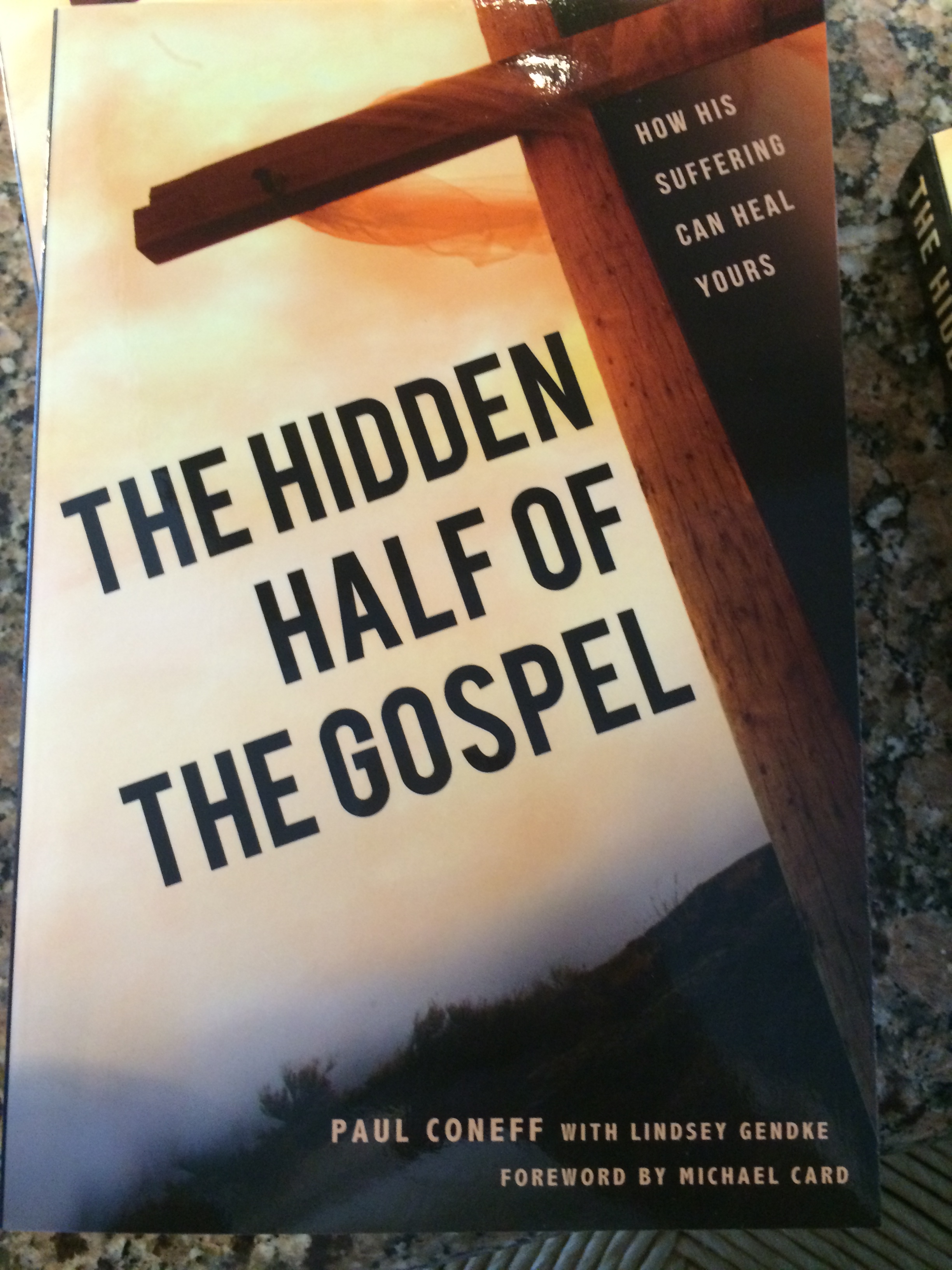
IMG_1702The Hidden Half of the Gospel is now in print, which means it’s time for me to sound promotion bells; but how about I just use a recent, personal example, to tell you why so many people (and maybe you) desperately need this message?

The other day I was listening to a radio show hosted by one of my favorite pastors. People call in with Bible questions, and this pastor answers them, usually with lots of scripture and high caller satisfaction. But one caller on the show did not receive a satisfactory answer.

Essentially, this caller wanted to know how he could get free from his past. He was fifty-two, had been abused as a child, and was still living “in bondage,” even though he went to church and prayed for the peace of the Holy Spirit. How, he wanted to know, could he experience the “new life” Christ promised, and the changes he read about when a person gets the Holy Spirit?

My heart broke for the man as the pastor proceeded to give pat answers that blatantly sidestepped the man’s apparent pain. “Let me ask you a question. Have you ever been to a funeral where the deceased sat up and complained about his past?”

“No.”

“Well, we can’t focus on the past. It’s done. As we drive through life, we can’t keep looking in the rearview mirror. We have to focus on what matters for eternity. We need to give the past to Jesus and then look to the future with him. Our pasts won’t matter in heaven. We need to believe that Jesus forgives us of our past sins and our guilt.”

Here I thought to myself, He totally didn’t address the man’s question: “How do you help someone who is trying, but is not experiencing, the Holy Spirit?” I wished I could contact this man and offer Paul’s and my book, The Hidden Half of the Gospel: How His Suffering Can Heal Yours. I wished I could talk to that pastor and give him our book, too, so next time he got a call like that, he could offer some real help: a complete picture of the gospel that not only addresses healing sin, but also healing suffering.

The Traditional Gospel Doesn’t Help Everyone

Sadly, this pastor was merely presenting the “status quo” gospel that so many Christian pastors, and Christians, promote. That is, “Christ died for our sins and rose again to forgive us and give us a new life.” Sounds nice. It is nice. This gospel has changed millions of lives. But what about those people who have already tried this gospel, who go to church and pray regularly, and who have even accepted Jesus’ forgiveness, and still live in bondage?

Today Christians and non-Christians alike live in bondage to things like divorce, abuse, addiction, depression, and cutting/self-harm (to name a few). More tragically, many Christians live in bondage to the negative thoughts and lies Satan slams us with in the aftermath and in the midst of these problems. Which means we end up living out false identities long after the initial pain of, say, childhood abuse.

I was one of those desperate people only a few years ago (see my seven-part series “My Ugly, Messy Rebirth Story“). But then God taught me what it really means to live a new life. Over a period of several years, I learned about Satan’s lies and how they take root in our minds and handicap our lives.

It’s insulting, and discouraging, when pastors or Christians tell us we should be “over it” just like that. It doesn’t work. And that’s why we need a better gospel, a complete gospel—the gospel that Paul Coneff unearthed as a young pastor in his search to minister to hurting individuals like that fifty-two-year-old Christian caller.

Jesus Preached a Better Gospel

When Jesus said He came to heal the brokenhearted and set the captives free, He didn’t just mean He would heal us when He came back again at His second coming, or set us free from our prisons of darkness when we get to heaven. His promise was for here and now. And that means it includes more than the gospel of forgiveness of sins. It has something for those of us who have been sinned against.

Our book, The Hidden Half of the Gospel, starts right where you are: in the midst of your misery. It doesn’t ask you to deny it or forget it, because that’s stupid; it’s impossible. Correction: by ourselves it’s impossible, but with God all things are possible. Specifically, for those of us who are suffering, healing begins with Jesus Christ’s life of suffering, and the promise that “He suffered in every way we did” so He could offer us his mercy and grace to help in time of need” (Heb. 2:17-18; 4:14-16). In our book, Paul and I flesh out the implications of these promises through stories of real individuals (like myself) who needed a Savior in the midst of suffering, and who found one who understands our pain exactly, because He has been through it.

Jesus was abandoned, betrayed, and abused; He was unfairly tried, convicted, and crucified; and in the midst of all this, he felt forsaken by his Father. As a “man of sorrows, well acquainted with grief,” He knows that we need time to heal, and He doesn’t expect us to do it overnight. He only asks that we look to Him and the victory He accomplished at the cross. As we look to Jesus and allow Him to tell us about the lies and wounds in our hearts, He can uproot them and replace them with a new identity. If this sounds like a message you could use, or one that you’d like to share with others, please visit hiddenhalf.org. There, you can read sample chapters, and if you like what you see, you can order the book. Happy reading!

Get a Discount on the book: When you click “buy the book,” the next page offers a discount box. Type in “HIS-story” to receive a 20% discount through October 31.

For My Thirtieth…an Attitude Adjustment

IMG_1580For my thirtieth birthday, I got a makeover…of my attitude. I haven’t blogged for two months because I took time off, intending, in fact, to come back a “new woman.” But when I said “Goodbye for July” (and August, as it turns out), I only intended to revamp my website and my writer persona—not my whole person. God had other ideas.

The makeover God wanted to give me was not primarily professional. It was more, shall we say, domestic? He wanted to make me into a loving, attentive mother. Self-sacrificing, patient, and wise, like Jesus was as he dealt with his children. This is not the woman I was focused on becoming as I signed off for July—at least, not the woman I wanted to be full-time.

I wanted to have this separate space in my life for the writer persona that has emerged through this blog and my other projects in the past two years.

On my new (but hardly dazzling) website, I have branded myself thus: “Lindsey Gendke: Writing True Stories for His Glory.” I wrote that tagline for potential memoir publishers, and maybe even clients one day (and because it describes my recently published works). I also wrote a lovely bio to characterize this blog and direct my future writings: “I am a happy writer, wife, teacher, and mom who doesn’t mind sharing that she used to be depressed,” et cetera, et cetera.

But after I signed off for my break in July (and after life got really busy, and Sam got really mobile), I couldn’t find time to write. I became unhappy, and I didn’t  want to share that with this audience. Ironic, huh?

It didn’t even matter that my first book, The Hidden Half of the Gospel, was published during those weeks (more in my next post). I still felt rotten.

Suddenly I became hard to live with because all I could do was complain about the lack of time I had to write. I found myself repeatedly apologizing to my husband for my nagging and hurtful words, and vowing to do better the next day. But the next day I only repeated my word crimes again.

Confession: sometimes when I’m stressed, I swear, and these negative months were no exception. Buc told me I better get my sporadic swearing outbursts under control before Sam was old enough to know what I was saying. But I knew I needed to get more than my words under control. I looked around at my life—beautiful baby, loving husband, nice house, good friends, PUBLISHED BOOK!—and I could not understand all the negative words flying out of my mouth.

I tried to write this post a few times…but found the words coming out so negative that I just couldn’t publish them, not in their totality. Here is one paragraph of clarity that slapped me in the face, though:

“I am disturbed sometimes by my lack of patience for Sam, my annoyance at how he disrupts my plans. I hate the wrong attitude I see in myself. Where is that love that conquers all? The love that doesn’t mind beginning the day at 4:20 because your sick baby is ready to get up? The love that is happy to put someone else’s needs before your wants? Sometimes I hate what motherhood shows me about myself. I hate how selfish it tells me I am.”

Yikes.

There it was, in plain black and white: I needed an attitude adjustment. That’s when I started doing everything I could think of to redirect, and correct, my thinking, flooding my mind with positive influences such as Christian radio programs, Scripture, books on mothering, and encouragement from my mommy friends.

I did not feel an instant change. Over a period of weeks, I had good moments and bad. But little by little, God spoke to me, until finally one day, He gave me a breakthrough.

As I tried to write this blog post one last time, and as I looked at the negative words I had previously penned, a switch tripped in my brain.

Wow, I thought to myself. Why am I complaining so much?

Suddenly, God brought to mind all the prayers he had recently answered.

  • I asked him for a book published by age thirty—he gave me one.
  • I asked for a baby—he gave me one.
  • I asked for a calling to touch hearts—and I believe he gave me one through the writing of my memoir.

With the realization of these answered prayers came instant repentance, a prayer of thanks, and my much-needed attitude change. Really, just like that.

I suddenly understood that it was time to rest from writing—at least in the professional sense. I understood now that writing more books might happen during later seasons of life, but right now is not one of those seasons.

I also suddenly remembered telling Buc, before we conceived, that I wanted my thirties to be a decade of relaxing from work and enjoying family. Now, I felt absolutely convicted that my first duty was to my family, and I regretted that I’d brought so much negativity and resentment to that sphere, treating my home duties as burdens rather than my calling. I understood that I had entered a new season of life—family, motherhood—and while I might find a moment here or there to write, writing could not be my primary focus right now. Not when my baby needed me, and not when my husband needed me.

It felt so freeing to hear God speak to me that way, and I’ve felt peaceful ever since. Over a week has gone by, in which time I didn’t do any writing, but I was okay with that, because I was taking care of my family—my primary job.

So, now that I have undergone my attitude adjustment, what happens with this blog?

I have decided to keep the “Writing True Stories for His Glory” tagline, because it describes the professional work I have completed, and one purpose of this site is to promote that work.

IMG_1647But as far as future posts? Right now I am a mother at home with my baby, trying to work out my faith through the trials of everyday life, and hoping to find a little writing time on the side. In a way, I guess my blogging counts as a story for His glory, because humans need to see faith worked out in the mundaneness of everyday life—otherwise, what good is faith?

God is doing something beautiful in my life, and it doesn’t exclude writing. It just means writing is not the end goal of my days right now—not for this season. That said, I hope this blog will be a witness to God’s continuing transformation in my heart and my mind. Specifically, I want to become more Christlike through my role as a mother, and I think that’s a story worth telling.