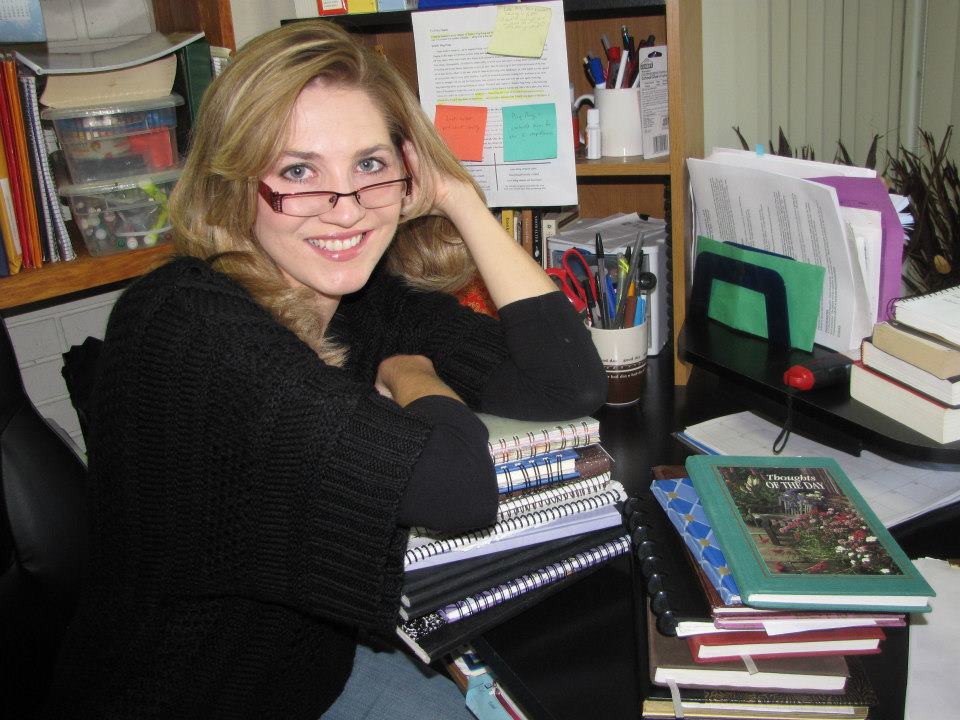
A Career Is Not Enough

Image


A few months ago I sat on a park bench amidst the buzz of a college campus, realizing for the first time in two years that maybe I was out of place. I was twenty-eight years old. I was about to finish a graduate degree. And I was thinking of starting another.

I had also been married for almost eight years to a husband I rarely saw.

As I watched college freshmen skipping past, carelessly slinging their backpacks as if all burdens were so light, I pulled out a notebook and began to write.

It’s a lonely life right now. I am too old to be running around with a pack of friends like these kids—and yet, I don’t really have a family life. Not one that buzzes like this, creating its own nucleus of self-contained activity, a destination and end in itself.

Both still striving for career goals, my husband and I have talked about how these disparate strands will one day converge—we will have enough money to take jobs side by side at a university, or we will have enough money saved to travel together around the country, or we will one day have so satisfied our roles in society that there’s nothing left to do but sit on a park bench like this. We have talked about this meeting of our lives…but we have not yet arrived.

What is it that gives meaning to our lives as a couple? As individuals, we find meaning in work. I find it in writing. But what is the meaning with another person? There has to be common ground. A place where we reap and sow together. Where we both put in time, and dwell together.

Right now we have a house. And technically we both put in time there. He works on the yard (and usually does our laundry), and I work within the walls, doing dishes, cleaning, painting, arranging. Most of our time together we are asleep.

Our house seems oddly empty.

How do two people, young and building separate careers, find common ground, apart from the passing patches at home? Aside from those moments of rushing out the door in the mornings, or flopping down exhausted in the evenings?

Where is that common ground on which we can meet to slowly, deliberately, live life together? Not merely rushing to the next thing or recovering from the last? Is this an ideal that no longer exists in the twenty-first century?

Or is this where kids come in?

How God Led Me Back to Writing

I think sometimes when a person has a conversion experience, all the old habits become suspect. And if not suspect, they remind you of old times when you lived in darkness. Is it okay to do this? A person wonders. I wondered this about my writing.

Writing—and I mean that personal writing I had done for over a decade with glorious abandon as ink, and often tears, flew across the page—used to bring such relief to me. But sometimes, now, it brought guilt. Maybe I hadn’t realized it before, but I was writing to wallow. Writing in the wrong.

That describes some of my writing history. But not all of it. My reasons were not always wrong, I have to believe. At first, they were just survival reasons, like at age fourteen, when I couldn’t talk to anyone. Or at age nineteen, when the ink substituted for blood. But after that I healed a little. And healed a little more each year, until, in my early twenties, writing was part wallowing, part revenge. By the time I had my conversion in 2010, around age twenty-six, I didn’t know exactly what my writing was. All I knew was that it felt uncomfortable now, didn’t seem to fit the new me, and the thought occurred to me: what if I’m sinning?

For a time I had tried to just forget about it, but early in 2012, I felt the old urge creeping up again. Despite the newly instituted seminar papers and thesis writing for a master’s degree, now it was starting to flow out into magazine articles and opinion pieces for the church newsletter and, of course, as always, my journal. I’m on journal number twenty-five since 1998.

But none of it was enough. None of these outlets was fully satisfying my urge. . . .

Nearing thirty, a realization was starting to sink in: I didn’t have forever to get a PhD, or to have kids, or to finally publish that book I’d always wanted to publish, much less do all three! What was I to make of these conflicting messages, and the confusion in my own heart?

*******************

I was definitely willing to consider that God had planted this recurring dream in me, like a seed that wanted to grow, but I still didn’t know what to do with it. So, God wanted me to write. But what?

As the summer wore on, I desperately wanted to apply to an MFA program [I am choosing not to reveal which one unless I get in!]. But I still felt I needed permission, somehow. I needed some validation that this was what I was supposed to do. I needed to know that writing could be different than it was before, because I was different.

And then, I met Paul Coneff.

To make a long story short, Paul came to my church to facilitate a week of prayer in March, around the time I was feeling desperate [about my career plans]. In five nights, he unfolded a message he calls The Hidden Half of the Gospel, or the message that Christ died not only for our sin—to give us a “happy ever after” in eternity—but that he also died for our suffering—to give us a happy life while on earth. An indispensible part of the message revolves around individuals finding their true, God-intended identities—restoring the identities that Satan strives to pervert, often through traumatic childhood experiences like mine.

Using a plethora of scriptures, Paul unfolded the story of the Suffering Messiah; Jesus had to suffer, die, and rise for our sins to free us. Because he was “tempted in all points like as we are, yet was without sin,” he is able to help us when we are being tempted. Because he has suffered like us—he was mentally, verbally, physically abused, plus he suffered depression and struggled to surrender his will—he can offer us healing for our pain (Heb. 2:17, 18; 4:15, 16). Because he was attacked at the very core of his identity, he is able to restore us to our true identities, replacing lies from Satan, the Father of Lies (John 8:44), with his truth.

When I heard this message, I was being attacked with lies. I was hearing messages like I’m trapped; I will never be able to write; I’m not good enough to write; I don’t deserve to get to follow my dreams. I have to be stuck in a graduate program that I hate for five years, and then it will be too late for me.

But when I heard Paul explain how Jesus had died not only for our sins, but our suffering, to restore us to our God-given identities, to enable us to follow and fulfill our God-given dreams, I began to feel hope.

At the end of the week, Paul announced that he would be holding discipleship and prayer training in our church for three men and three women. This three-month-long training would prepare participants to embrace their God-given identities, enabling them to become disciples who could, through personally testifying to God’s restoration, lead others to Christ.

This sounded hopeful to me. At least, I thought, How could it hurt?

After I began discipleship training with Paul, he mentioned he was writing a book. He said it with a grimace. The writing was coming hard; he was no writer. But he had to get this book done. As a prolific public speaker,[1] he needed a resource to offer listeners.

At hearing this, I felt another glimmer of hope. But I waited, taking this home with me, too. Now it was June, and I was struggling more than ever over my future, my graduate school plans, my teaching plans, my parenthood plans. I couldn’t find peace. Where was there room for the desires of my heart? More importantly, were those desires even valid?

Later in June when I received prayer for the first time—in this ministry, a prerequisite to discipling others is receiving prayer and healing in one’s own life, first—the prayer time revealed that I had not fully surrendered my will. Paul sent me home with a sample prayer and scriptures to pray day after day to further unfold this issue.

And so, in June, July, and August, I prayed. I cried. I read my Bible with fresh eyes. And like Jesus in the Garden of Gethsemane, I learned to pray “Lord, not my will, but yours.” I didn’t know exactly where all this praying, crying, and reading was leading, but I did know that, slowly, layers of remaining hurt were melting off. And within months, I had not only experienced peace to the point of deciding, conclusively, that I wanted kids, but also that I could trust God to make clear my career path in his good time.

By receiving Jesus’ victory over his carnal will, in July I was able lay my burdens at the cross, trusting God to work on my behalf, while I, meanwhile, composed my master’s thesis. Later that month, I had an article accepted by Insight Magazine—a piece I’d sent in over two years ago and had all but kissed goodbye. Because the article was embarrassingly autobiographical (it was actually a Guideposts reject from high school, chronicling my first suicide attempt), I kept it from most friends and family. But since I had five review copies, and since Paul deals with this type of thing all the time and was, moreover, still grimacing over the writing of his book, I figured, What the heck. I would give him one.

The day after he received the article, he called me, excited, saying, “This was really great; this really flowed. I want my book to flow like this.” Would I consider helping him write his book, which tells the stories of other wounded, yet healing, adolescents-turned-adults like myself?

The rest is history. As you read this, The Hidden Half of the Gospel: How His Suffering Can Heal Yours, should be going to press, to be published sometime in 2013. And it’s not about me.

Well, it is a little bit. Paul actually asked me to share part of my testimony in one of the chapters. I was a bit leery at first, wondering the same old question: Would I be writing this for the wrong reasons? But the more time I spent in prayer, both on my own and with our small group, the more peace I found about my career plans, my family plans, and my writing.

A few months ago I picked up one of those Bible verse cards with my name and my name’s meaning on it. This one says “Lindsey—Peaceful Isle,” and it has Psalm 37:4 printed below: “Delight thyself in the Lord, and He shall give you the desires of your heart.” This verse, among others I’ve studied recently, has led me to believe that the more I surrender my will to God, the more I actually can “listen to my heart.”

Image

Anyway, after finding the card, I set it on my desk at home, where I was writing my master’s thesis, and then Paul’s book, for most of the summer. As the weeks went by, as I continued to look at that card and ponder its message, I could only marvel at what God had done for me. Several years ago I had not been a “peaceful isle.” I had been a suicidal basket case with control and intimacy issues. But as I continued to delight myself in the Lord, he was slowly giving me the desires of my heart: chief most being the published book that would soon bear my name.



[1] You can find more information about Paul’s ministry at www.straight2theheart.com.

Chasing and Embracing Dreams

Dear Readers:

What gets in the way of you chasing your dreams? Crummy life circumstances? Fear of failure, perhaps? Or maybe failed past attempts? (Feel free to let me know in a comment!)

For me, it used to be all of the above, plus one:

I worried that following my dream was a sin.

You know how I wrote about treating tough subjects (both topics and people) appropriately in writing? Well, that’s because I used to not. See, I have this passive aggressive bone that metastasizes sometimes (see my previous post), and for a lot of years that’s mostly what happened in my writing.

Long story short, a few years ago, I was convicted that my motives for writing were all wrong. And I was confused. I didn’t know what to do. So I just quit.

But the writing dream wouldn’t go away.

My “writer’s bug,” as I called it in my MFA application essay, followed me everywhere—from college to career and back to college again, where I finally threw up my hands last spring and cried, “Lord, what am I supposed to do?” This was the same question I put to a campus counselor whom I sought out of sheer career desperation.

Then, after all my agonizing over the possible sinfulness of my writing, would you believe that counselor looked me straight in the eye and asked, “Why do you think you keep having this desire to write? Who do you think put it there?”

Whoa. Bull’s eye. Since that session in April, I’ve had to ask the same question about that providential counselor whose name I can’t even remember.

So God wanted me to write. But how? I still felt I needed permission somehow. For that matter, I needed some new material! If I was a “new creature,” a born-again Christian, but my writing record was stained with blood, ink, and tears (with a passive aggression that not a few times became active) what was I supposed to write about?

In my next post, using part of my MFA application essay, I’ll tell you about the answer/affirmation I got from God last summer.

Although the writing project He dropped in my lap is not the same one I am documenting on this blog, it is what has led me back to my writing roots—definitively, decisively, and defiantly.

It is also the same project I am struggling to finish up this week and, by extension, is keeping this blog painfully short and colloquial. And so, with that cliff-hanger (or choppy ending?), come back on Thursday for the rest of the story—or to read why I’m finally embracing my dreams.


Time, Space, and Empty Notebooks: My Book-Writing Recipe (for now)

So, I’ve made this goal to write and publish a book before I’m thirty. But how is that going to happen, you may or may not be wondering. (I’m thinking of those friends and family members who have heard me talking about publishing this so-called “book” for years, still with no results to show for all the pretty talk.)

  • First, I’m swallowing my embarrassment at all the talk and failed prior attempts.
  • Second, I’m really going to be serious about this. For the first time ever, it is going to become my “fulltime job.”
  • Third, I’m going to write. Well, that overlaps number two. Of course I’m going to write. How else can a book get written?

But although I’ve always self-identified as a writer, there is something scary about actually saying it is my job. Before, when I was a teacher, or a graduate student, I could blame my other commitments for my lack of production. Now? It’s just my keyboard and me, full days at my disposal in which to make literary things happen.

Now the rubber the meets the road; now is where I prove myself. Do I have what it takes?

Time will tell; however, can I just share one thing that makes me hopeful?

Last October (three months ago), after I had submitted my master’s thesis for review, and when I was on a break from my other book project (more on that later), I produced like crazy.

Prior to October, I had found this great sale on composition books at Target, had snapped up about twenty, and had promised myself I would fill them when I got a chance. So, for the month of October, and a bit of November, I did.

Having nothing more pressing to do each day, I headed off to one of several coffee shops (either to feel like a real writer, or just because it gets lonely at the house) and wrote. And wrote. And wrote. By the end of the month, I’d filled two books’ pages, front and back, and had produced the germ of this nebulous book I’m now blogging about.

Image

Soon, life interrupted again, as I had to finish my thesis, defend it, and graduate, among other things. So not much writing happened for the rest of the year. But now, a new year stretches before me, days of possibility call me.

Already I can see the challenges: I’m not good at saying no to people, and it could be easy to let my own projects take a backseat when other people or responsibilities come a-callin’. I’ll have train myself to keep to a schedule; I’ll have to learn uncomfortable things like using social media; and most importantly, I’ll need to stop feeling guilty if I have to say no sometimes in order to work.

But after I overcome those issues, I have faith that all will be well. If the past is any indication, I can do it. Given space and time to write, I do—I always have (even if not for an audience)—and I love it. At the end of the day, I have these things going for me: space, time, and love for my work. What more do I need? Only to dedicate all of the above to God (Prov. 16:3). Thanks, God. May you be uplifted in my space, my time, and my writing this year. 

A Book, a Blog, and a Dream: My ‘Before Thirty’ Project

Have you ever felt like there’s something you’re supposed to do, had a nagging feeling that’s followed you, kind of like your shadow, for most of your life—and yet, you’ve never done it? Have you found yourself wondering why you just can’t make yourself do that one thing you seem meant to do? Have you felt disgusted, even, because you’ve let other stuff get in the way? Or, another possibility, have you been so beaten down by circumstances that you’ve lost sight of your true purpose, and with that, your true identity?

Well, for me, that something is writing a book. And this blog is proof that I’m finally doing it. This blog started as a graduate class project for which I was researching and writing how to get published. But when my professor pushed us to write our last essay for a real-world audience, I felt it was time to take action.

I’d been waiting over ten years to publish a book; I was at the end of my master’s degree; and I was at a crossroads. As I wrote in my MFA application essay, I can’t fight this feeling anymore (some eighties band might have said that, too). Anyway, for months now, ideas have been spewing out of my pen, and although I don’t know what next year holds—I have applied for both PhD and MFA programs, and talks of kids are underway—for now I have a semester “off”; and I have decided to write.

But what am I writing about? Friends and family have asked. It’s not enough just to want to write—you also have to have an idea.

Look again at my first paragraph. That, in a nutshell, is what my book, and this blog, is about. It’s not just about my journey to publishing a book (although that’s part of it). It’s about pursuing dreams that were interrupted by depression and other disasters. In the words I have chosen to describe my project, it’s about writing to my roots: the roots of what I was meant to have, be, and do—and the roots of what kept me from having, being, and doing all of the above for most of my adult life.

Thank God, after praying through a lot of the bad roots in myself, I am ready to write to the good ones (though there’s always more healing to do). That said, in order to document the tangible feat of publishing a book by the time I’m thirty, I’ll also want to tell you about the many intangible feats it took for me to get here. I’ll tell you about how I’ve survived a broken family; how I’ve overcome a debilitating mental illness; and how I’m finally learning to redefine myself after, at age twenty, leaving everything I had and everything I knew—family, job, school, and friends—to move one-thousand miles and marry a man I’d known only four months. Spoiler alert: my story has a happy ending.Image