The Writing Life

It’s one thing to tell people you like to write. It’s another thing entirely to tell them you’re a “writer.” To illustrate, recently I’ve listed “freelance writer” on my resume. However, I still have trouble telling people that’s what I am. Apparently I’m somewhat embarrassed admitting to a lifestyle that has historically been the butt of jokes, scorn, and ridicule.

What the Stereotypes Say
snoopytyping

Writers themselves (ourselves?) make fun of the profession and perpetuate the stereotypes. You know, those tropes about sitting in a secluded place drinking coffee, frittering away time, professing to be “doing” something, but not getting much done at all. Sadly, even if we’re doing stuff, a lot of us hardly make enough money at it to pay the bills. (I’m certainly not there yet!)

Why We Do It

We live a life of poverty to continue a craft that may never yield monetary gain. Yes, it’s true: We could make more mowing lawns or babysitting. And yet, writers will tell you, we continue writing because we “love” it.

How We Do It—For “Fun”

A lot of writers have had to sneak writing into their lives by logging late night or early morning hours. Was it William Faulkner, or  Don Delillo (or maybe even Fitzgerald?), who wrote while manning his position as a night guard in a boiler room? I remember that from one of my lit. classes, but regardless of who it was, the point is that writing takes sacrifice. And I love the story of Samuel Johnson writing Rasselas in “one week of evenings” because he had to pay his mother’s health bills. Interesting that he knew he’d make money at his craft—but maybe times were kinder to writers in the eighteenth century.

Indeed, today some professionals advise that the only way to find enough time is to “steal it” from something else in your life (I remember reading this tidbit in Writer’s Market). But maybe this advice is mainly for those who have to support themselves and their families with other means.

How We Do It—For a Job

For my part, when I taught fulltime, I could never take that advice. Summer breaks were about the only time I could devote to writing—because the rest of the time I just didn’t have the energy (I guess starting a Master’s degree didn’t help).

But maybe the reason I couldn’t write while also holding a separate, fulltime job has more to do with my personality than anything else. Unlike other “side” writers, I found I just couldn’t multitask  without going a little crazy. I’m an all “all or nothing” kind of a gal, so writing sandwiched in between fulltime work responsibilities and family time didn’t work.

For me, then, the only solution was to make writing my fulltime job.

Lucky, blessed me! The Lord has made this possible. Sometimes I actually feel guilty that I can stay home and write. That I can sleep in until whenever (though I try to be up by 6:30 or 7). I feel guilty that I can have a leisurely breakfast and devotional—even exercise if I want—before starting “work” for the day. But, not one to make light of a divine gift, that is what I do most days…and I love it!

Some Differences Between Writing and Other Jobs

I don’t hurry through the mornings like I did when working a “real” job. First, I ground myself in Scripture and prayer and quiet time. Then, I’m ready to write. A pretty cushy life, some would say.

Yes, it is. But I think it has to be this way if I, Lindsey Gendke, hope to produce significantly and consistently. My writing, I like to think, is not top-of-the-head, hurried, or flippant. It is reflective. It grows out of being a slow-moving, reflective person, and also from cultivating slow-moving and reflective habits.

For me

Writing is cultivating quiet, and spending time alone.

Writing is thinking and reflecting, moving slowly and deliberately through life, and refusing busyness and activity just for activity’s sake.

Writing is seeing and saying what non-writers miss.

Writing is shaping reality and fueling imagination.

Writing is intimate—asking the reader to listen, without speaking.

Writing says what one could never otherwise say without interruption.

Writing is becoming bold in way that is impossible when speaking.

Writing is a lifestyle.

I know most don’t have the opportunity to live such a life, and that’s okay. My hope is just maybe, through reading my writing, others can begin to slow down and reflect, just a little more. In today’s hyper-fast-paced world, I don’t see how that could be a bad thing.

To the writers out there: Do you find that writing is more like a lifestyle, or a side activity? Can the two ever really be separated?

*Note: I got my title from Annie Dillard’s The Writing Life, in case you’re interested in a good book on this topic.


Escapist Writing and the Fear of Failure

Image
Photo Credit: Lusi at rgbfreestockphotos.

You can have the tools, the talent, and the time—but if you have the fear of failure, you might also have a nasty habit called Escapist Writing. And this very habit may be causing you to fail.

In my home office I have a desk, a laptop, and a comfy office chair. More importantly, I have writing skills honed by two English degrees and thousands of pages of practice. I have a rough draft of a book manuscript I’ve been typing up for the last two weeks—which is to say I also have time.

But this week during my prayer times, I’ve also discovered I have a crippling fear of failure—which manifests itself in the type of non-productive, self-obsessed writing I did yesterday. Here’s a summary, to spare you from the entire writing session:

  • Since I’ve begun writing to my roots, I’ve so committed myself to honesty that, when I feel bummed, I write about it. Thus, I vomit out my blues in my journal, and sometimes on this blog.
  • In doing this good thing—being honest, which I think really is a good thing after you’ve been hiding for a long time—I realize I’ve sometimes trusted to emotionalism rather than gospel truth.
  • Worse yet, sometimes a flow of unbridled honesty curbs my thoughts in wrong ways. I’m talking about when I begin to believe negative thoughts like this:
  1. Wow, is this what’s really inside me? I must suck.
  2. Look how pathetic I am.
  3. How can I be an inspirational writer if I mostly write about my barriers?
  4. With such barriers, how can I even get on with my day?
  5. I can’t do this (meaning write for a living). I’m gonna fail.
  • My negative pattern of escapist writing is confirmed by the fact that I get a sort of pleasure in writing about these twisted thoughts.
  • By convincing myself that my mind is too complicated (maybe neurotic), or that I’m too sensitive, or too pathetic, I release myself from any obligation to be a fully functioning adult.
  • By giving free reign to my feelings in my writing, I avoid having to face reality, and I resist taking risks.
  • By writing about why I can’t write, I justify my failure. And I also cause it.

No doubt about it: Lately, I’ve been so honest with myself that I’m starting to not like what I see. And I’m starting to see that letting out all your insecurities is a great way to become more insecure. But maybe this is like re-breaking a broken bone so it can finally heal correctly.

Now that I’ve identified this insidious pattern of escapist writing that masquerades as my friend, I can

  • Stop taking my feelings so seriously.
  • Start rebuking them with God’s word.
  • Tell myself I am not defined by my feelings (and neither is my writing process).
  • Remember that God has appointed for me a work to do (Eph. 2:10), and He wants me to succeed.
  • Pray a prayer like this:

Lord, help me to stop wasting time by escaping from reality in self-condemning writing. Let me write about YOU and YOUR power—your “glorious, unlimited resources” to help me (Eph. 3:16, NLT). Let me not be defined by my fear of failure. And let me get on with the work you have for me each day as the writer, and the woman, you want me to be. Amen.

Prozac Nation—Review by a Former Pill Popper

200px-ProzacNationBook
Photo Credit: Wikipedia

In her memoir on depression, Prozac Nation, Elizabeth Wurtzel paints an annoying picture of herself as a depressive, which includes being desperate and clingy, prone to panic attacks, dependent on boyfriends for her identity, ungrateful for all the good in her life, and selfish.

Reading this book, even I, a sympathetic co-sufferer, became frustrated. When is she going turn a corner? Why is she telling me this? I wondered. And, How can she presume to be the authority on this when her past was not as heartbreaking as mine?

In her afterword, Wurtzel responds to impatient readers like me, saying, basically, “If you got angry at me, good. I wanted you to feel that way.”

The Book’s Bummers

As Wurtzel explains, she wanted to convey what it was actually like to be around a depressive and, more ambitiously, wanted to give the reader the feeling of being trapped in a mental prison similar those in which depressives finds themselves.

Indeed, most of her book grovels in the quagmire of her own circumstances—her parents’ divorce, her father’s abandonment, her failed relationships, her struggle to get adequate medical attention—and this is what gets so  annoying . But at key points she surfaces from her self-obsessed soliloquy to take stock of what her situation reveals about her whole generation—and this is what resonates with me.

The Book’s Brilliance

What Wurtzel does particularly brilliantly is characterize the displacement that she and her whole generation faced as a result of the cultural revolution in the sixties. Her parents divorce is, of course, no very remarkable thing these days, but her brilliance is zooming in on this seemingly “small” detail.

She expresses outrage on behalf of a whole generation whose parents have led them to dismiss marriage like so many other traditions that used to give people roots—she expresses anger at the fact that nothing is held sacred anymore—and that individual whim reigns supreme. She characterizes how such a world–where individuality and mobility, not family ties or roots, are seen as virtues—leaves its children feeling hopeless and depressed. She doesn’t go as far as diagnosing the cause of the explosive use of Prozac in the 90s, and the booming popularity of depressed-obsessed punk rock bands like Kurt Cobain’s, but the suggestion is heavily weighted toward the disintegration of the American family.

Where We Agree—The Family’s Demise Spells Depression

Like Wurtzel, I firmly believe that by our disregard for the family unit we have self-imposed many of our problems. In our quest for self-gratification, we have damned and doomed the next generations. I think this is what the Bible refers to when it speaks of parents’ sins becoming a curse to the third and fourth generations. It’s not that God unfairly punishes children for what their parents did. It’s that children can’t help but be cursed when parents choose to be self- rather than God-centered.

How My Take on Depression Differs

I’m glad Wurtzel wrote this book, because now I  don’t have to. Years ago, a book about my life would have closely resembled hers, as far as the inspiration meter. Low.

Of course, inspiring readers wasn’t the purpose of the book. It wasn’t to make the reader feel warm and fuzzy, but to portray what depression feels like.

Although I used to envision writing such a book, once I had my conversion I no longer felt comfortable writing such a book. But now, having read Wurtzel’s contribution, I see that such literature has its place, even on a Christian’s bookshelf. Jesus didn’t look away from human suffering, and we shouldn’t either. My problem before was I felt I was wallowing. But now I see that the wallowing effect came from my audience and purpose for writing. My audience? Anyone who would listen, preferably those who had failed me earlier in life. My purpose? To get the sympathy now that I never felt I got when at my lowest points.

In all seriousness, maybe I could write a depressing book like Wurtzel’s these days without wallowing, but that’s only because I would no longer be focused on getting sympathy for my past wounds, but offering empathy to fellow sufferers. Yes, these kinds of books have their place. But since by God’s amazing grace I’ve emerged from that black hole, I’m glad that I don’t have to fill that market niche. And now, I can focus on the upward swing, not the downward slope.

Friends in High Places

I walked in the church, scanned the pews for a place to sit, and found tears in my eyes.

You know that story in the Bible where God opens the servant’s eyes to see the army of horses and flaming chariots surrounding him? His eyes were opened to see what had been all around him all the time—and suddenly he didn’t feel so alone anymore (2 Kings 6:14-17).

Well, God opened my eyes last weekend. For several months I’d been ruminating on how alone I felt. And it seems I never miss an opportunity to tell my readers that I’m 1,000 miles from home. Indeed, writing to my roots has revealed that I often feel displaced in my new home, and I feel even more that way when visiting my old home.

Being in a hiatus from work and school has also laid some things bare: I don’t know who I am without my work. Sometimes I don’t know how to relate to people outside of the most functional of activities: I can be a teacher, a sister-in-law, a communications secretary and music leader for church, a Bible study leader for friends.

But what about just a friend?

I can tell you right now, friendship—hanging out, relaxing, shooting the breeze—none of these have been my strengths.

Yet despite all the off-putting, prickly parts of me, God has drawn friends to me. And at the church that day, I saw them.

There was Tasha sitting in the back left pew of the church. Her friendship was a carryover from the small group Bible study my hubby and I had for a year and a half. We still get together often, for fun things like spa days, iced tea, and girl talk.

Image
Me and Tasha–on our cruise to Cozumel in December. The hubbies came, too.

Then, a few rows up, was Tammy, a new-ish fixture in our church, who responded to the call I made in October to start a choir. Now she has taken the reins, much relieving me, and also become a fun girlfriend.

Image
My friend Tammy directing a mean choir in December! They sounded great. I’m at the piano to the left (you can’t see me).

Across the aisle were Ashley and Christina, two young moms whom I’d only recently come to know from our Tuesday night prayer group. They’d been in the congregation for many months before their lovely personalities were uncovered for me. Both sincere and searching for the Lord, they responded to the opportunity to pray with Amanda and me, who had recently been trained in prayer ministry.

Image
Me and Ashley at my house for a late night Easter egg hunt. It was for the kids…really!
Image
Christina with her two strapping boys–also at my house for that late night Easter egg hunt.

And behind them was Amanda. I had known Amanda the longest of any of these ladies, yet until our prayer training, I’d hardly known her all–had not seen the beauty of her personality beneath her quiet exterior. Now we are prayer partners and buddies in ministry.

Image
That’s Amanda chuckling on the left–we had a great time at our 2012 New Year’s party. The life-sized Barbie was my husband’s surprise in our informal gift exchange.

How did it come to be that I was so blessed with all these friends?

Last summer when Amanda and I joined the prayer ministry Straight 2 the Heart to lay our hearts bare before God and our small group—I saw that we had a lot in common. A lot of hurt, a lot of self-protections, and a lot of desire to serve the Lord if we could only know how to channel our pain into something positive.

Looking back, I think it must have been the laying bare of my heart before God and a trusted small group that allowed me to be more authentic with these others that have decided they like my company. Sure, I’m still detail-oriented and serious when I talk church business. But over the past year, I’ve had more frank and open conversations with ladies in my church than I’ve had in eight years combined.

Sharing my heart in a prayerful, supportive environment has bound me together with Amanda, and now Ashley and Christina, in a way that mere biblical instruction can’t. And as a result, I have been able to relate more authentically to others like Tammy and Tasha, and even my music committee in meetings, where we have finally started talking openly and corporately about issues our church has had for a number of years.

Showing some vulnerability not only to my prayer partners but also to my acquaintances has opened the door for conversation that goes beyond surface level…and finally, friendship.

Since deciding to be more honest with others, it’s been a relief not to have to hide my feelings—to be able to speak up when something’s on my heart—to get it out in the open and deal with it sooner rather than later. And saying things that have gone unspoken before—such as on music committee—has actually gotten people thanking me for my honesty and openness.

Do people prefer pretenses, or plainness?

While being honest can open up some uncomfortable cans of worms, in my experience, that’s not any worse than tiptoeing through church—and through life—not knowing and not being known by anyone. Being honest is no worse than feeling alone—wondering if I’m the only one who ever suffers.

As I’ve learned, the sooner we share our stories with someone and listen to theirs in return, the sooner we are brought out of our self-centered misery. The sooner our eyes are opened to the fact that we are not alone.

I’m so thankful for my friends in high places, the old no less than the new (although this post just happened to be inspired by the new). Much love to all! Here’s to many more great memories!


Reclaiming My Voice

Image
Photo Credit: Nordic Photos/Super Stock

There’s an important thing in writing called “voice.” Different composition scholars define it in different ways, but basically “voice” refers to the unique qualities of the writer’s writing. What distinguishes his or her writing from everyone else’s?

More often than I wish were the case, college English classes discount voice, sacrificing it to academic conventions, or established norms and guidelines, to maintain the “language of scholarship.”

In my master’s thesis, I argued that I lost interest in my English classes, in part, because my voice was not allowed there. I still got A’s, though, because it was easy for me to imitate what teachers wanted—it was easy to “pose” as someone I was not on paper.

While this practice earned me a 4.0 in my major, sadly, it took me away from defining my own role as a writer, and developing my own voice.

As well, maybe I didn’t feel my voice was welcome, either in the classroom or anywhere else. Looking back, writing in non-academic settings should have been a given…but no…I resisted airing my voice in a professional, outward way—squelched it under the covers of my journals. Where else could it go?

My “voice” as I conceived of it at age twenty-one was that of a depressed, deflated victim—a mental basket case. I felt bad enough about myself already. So why should I let the truth out and ruin the cover I was trying to keep?

How to Hide Your Voice

When you want to hide your voice, and if you have some of your wits about you, it’s easy enough to blend in. Perhaps imitating others—whether in academic writing or behavior—isn’t the natural impulse, but when you want to lie low, it’s easy enough to blend. At least, it’s easy enough to “cap” your real voice.

Image
On our belated honeymoon trip to San Antonio in 2006.

Maybe I’ve never really “blended” as well as I’d like to think I have. But what I have done is to keep quiet. And by some miraculous twist, I’ve been able to project the image of calm and collected.

Many people have told me, and not just in recent years when I’ve actually achieved some inner peace, that they’re impressed by my outward calm. I’ve been called phlegmatic, composed, serene, and someone who never seems ruffled.

Image
Sailing in Saint Thomas, 2009.

Well. Ahem. Pat myself on the back. What a “good” job I’ve done at concealing my real self.

Apparently I used to think this was something to be proud of, suppressing my voice.

No more. I’ve grown tired of it.

Letting It Out

I used to stifle my voice because I thought it was warped and would get me labeled. What I didn’t realize was that it was okay to have that voice. It wasn’t okay to keep it forever, of course, because indeed it was warped—a warped outgrowth of my God-given identity.

Now I know my voice just needed redirecting. The form could remain, but the content had to change.

Image
My husband and me posing for a Christmas picture during the first year of our marriage, 2005.

Sometimes I tell my husband I’ve been trying to figure out who I really am since we married eight years ago. I tell him it’s like my personality was gutted after I went through my deep depression and initial college crash. He tells me I’ve always been the same person—I’ve always had my identity. I guess I have. But it just got buried for awhile in shame and self-doubt.

Image
My husband and me in a less posed setting in 2005. I think I look somewhat depressed here, or maybe I just need makeup.

No more. Starting with this blog, I’m reclaiming my true voice. And it’s not the voice of the popular majority. It’s not that of a detached literary critic. It’s not a silent observer. It’s not an insecure, defeated little girl.

My voice is thoughtful, emotional, yet hopeful. It is often unpopular. But I’m okay with that. It is mine, given by God, and I intend to use it.

Image
I’m not sure what to say about this picture. It was taken by my husband when no one else was looking.

I May Be Childless—At Least my House is Messy

Image
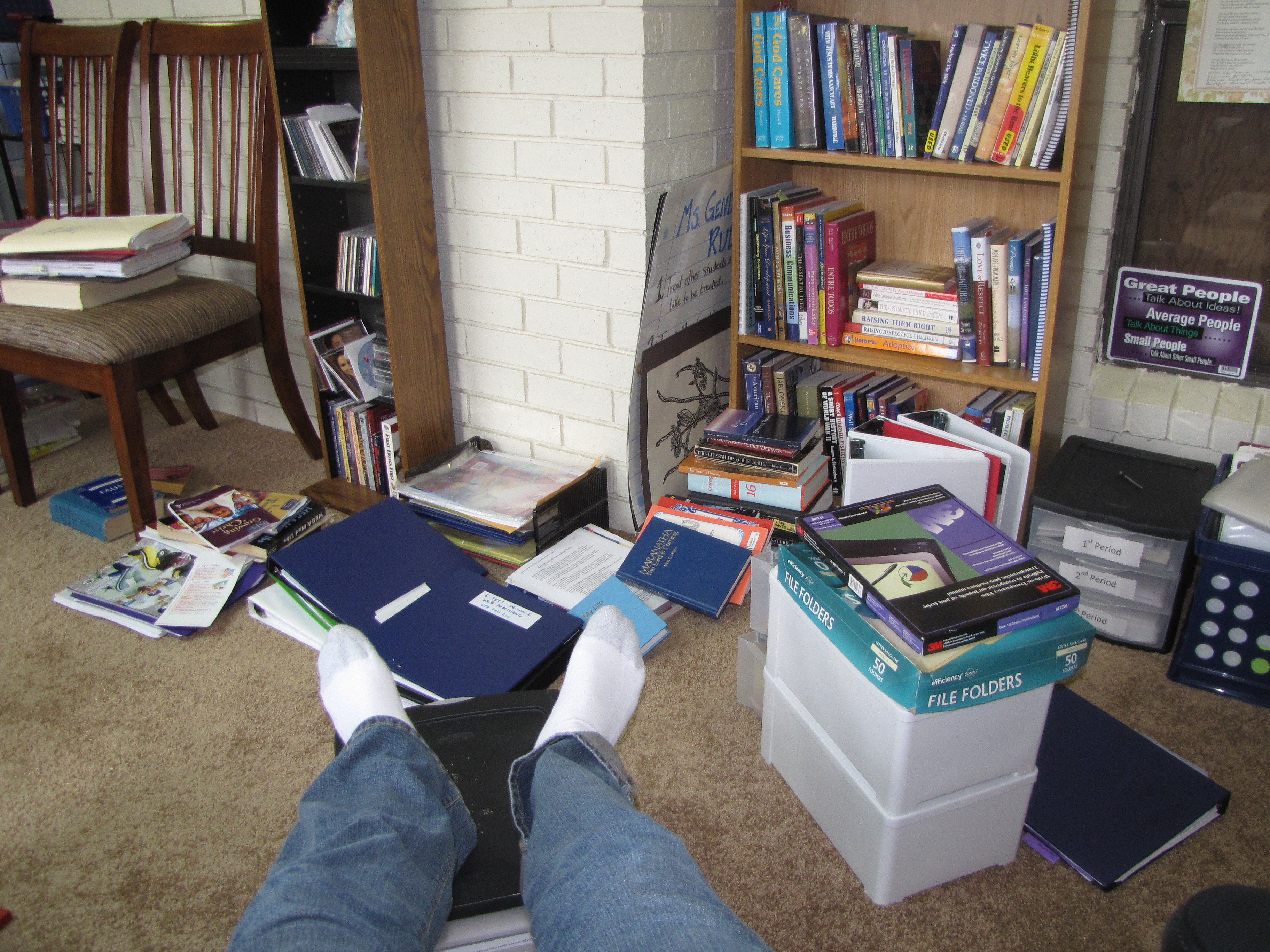
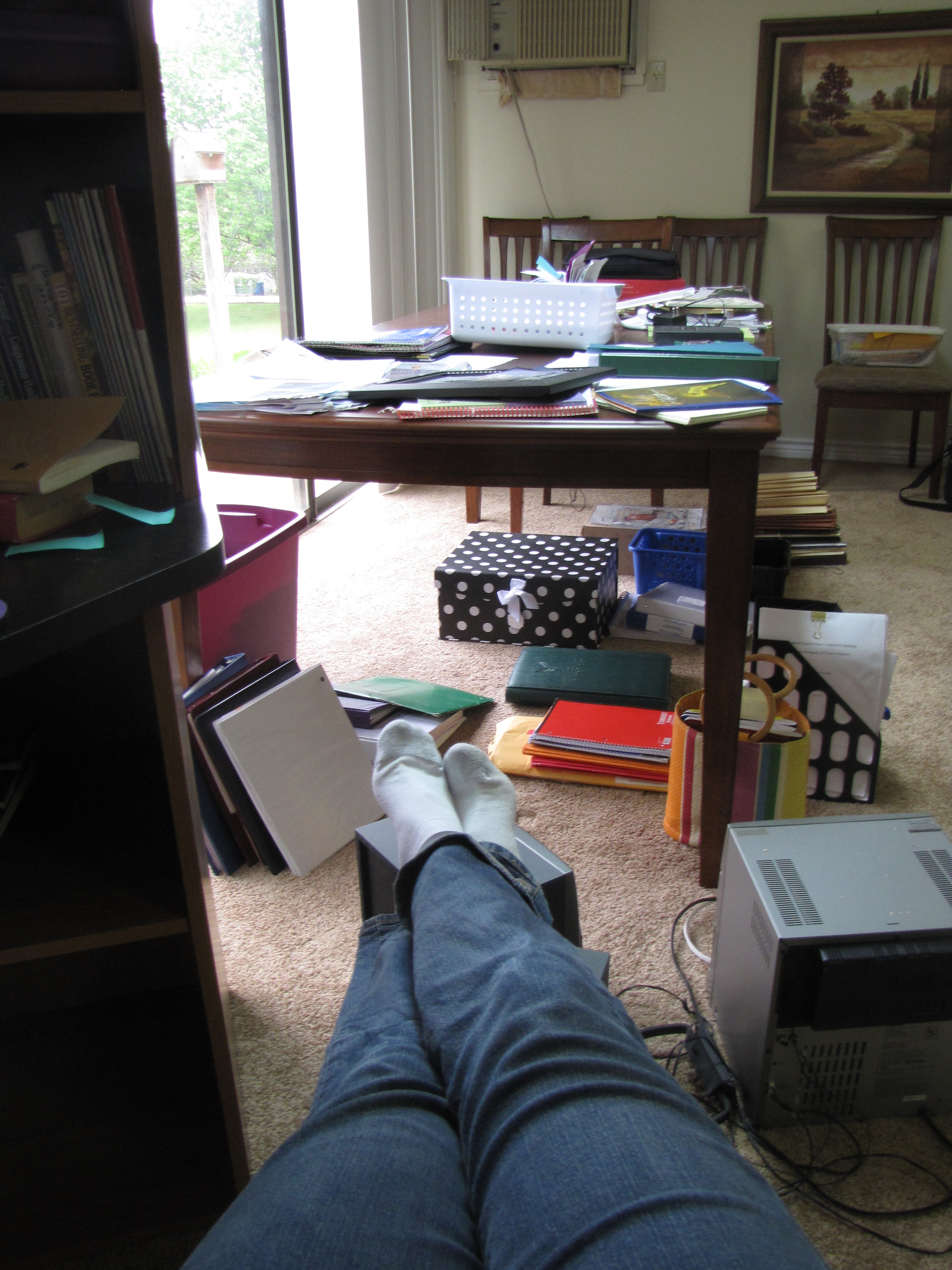
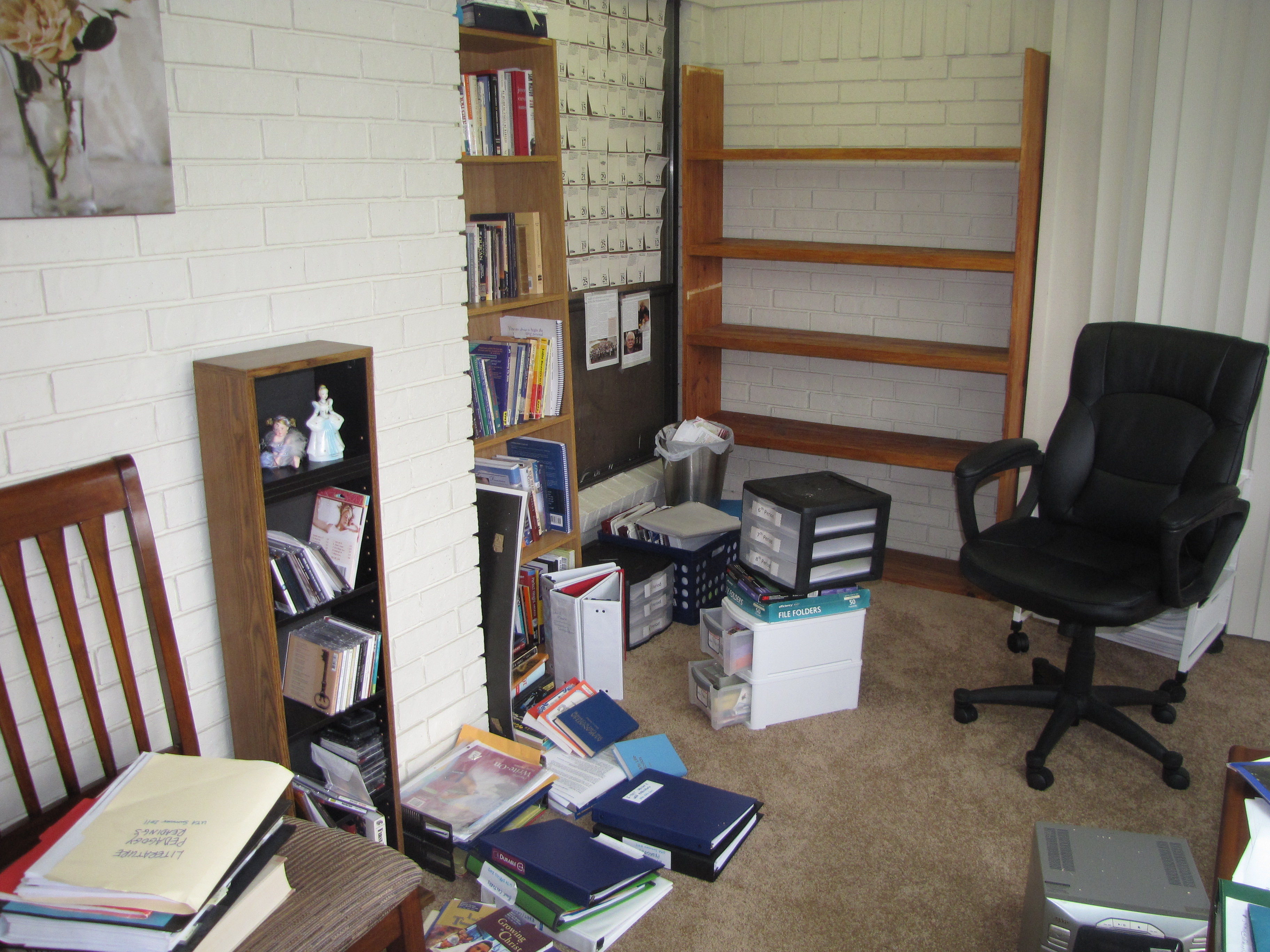
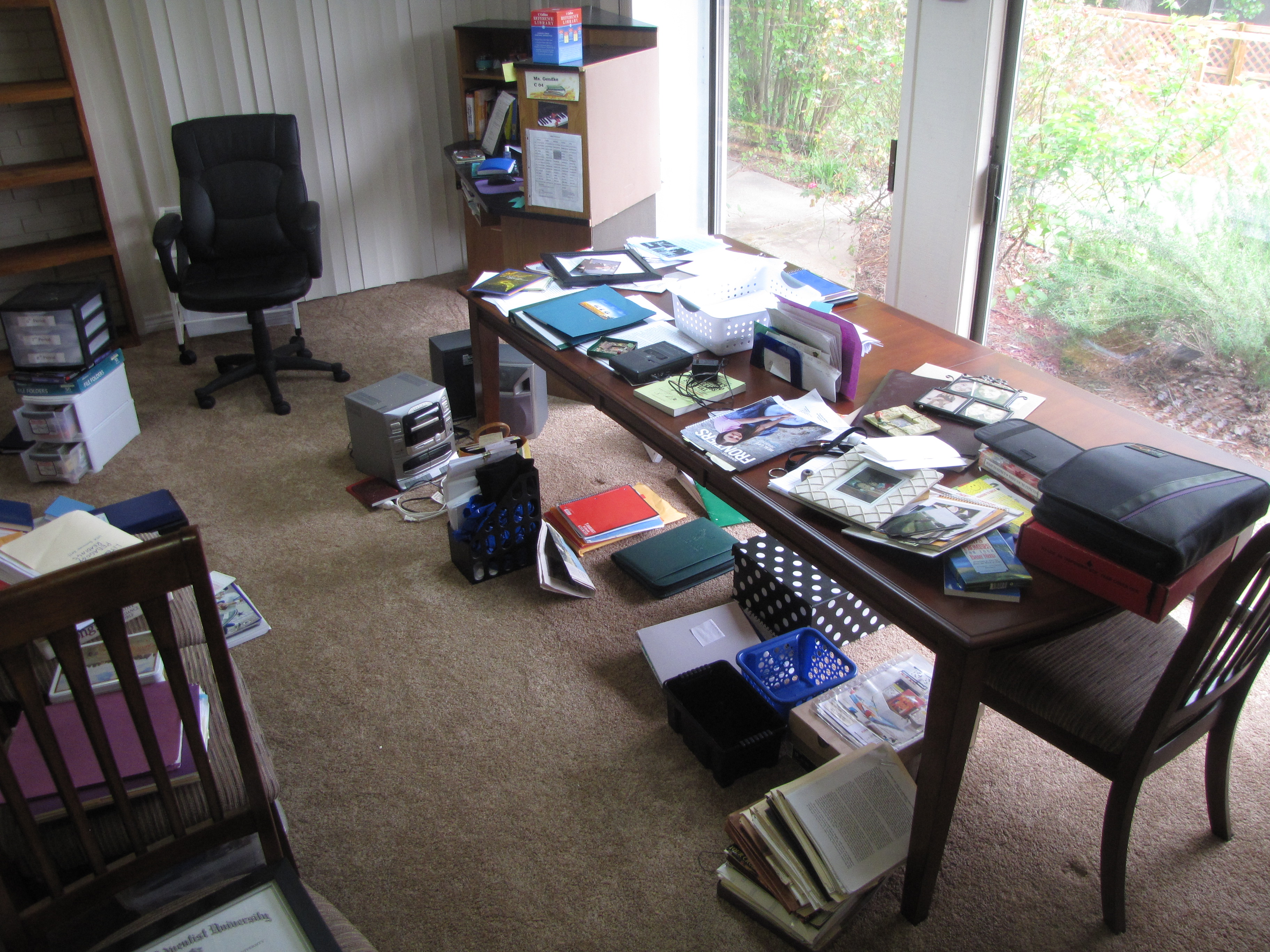
Please don’t think my house always looks this bad! This is just what it looks like when I reorganize my office.

Last weekend I again felt like a failure as a woman. How did this happen, you ask?

Scene: I’m standing in a pasture talking to two girlfriends. The first one is twenty-eight like me, and married, but unlike me, has a kid. Same with friend number two, only add a couple years and a couple kids.

Can you guess what we are talking about?

The pasture belongs to number-two. Number-one and I have come for a visit and are walking number-two’s property. Inevitably, the talk turns to houses and the jobs we work to afford them and the bodies we are housing with those jobs.

What are our livelihoods? How are we getting by day to day and affording these homes in which we live and raise our families?

Basic questions. They deal with basic necessities that we all have.

Yet when I find myself in these conversations, I see an un-level playing field.

Number-one has started cleaning houses to supplement income. Number-two has started selling Mary Kay. Number-one makes her own cleaning products from baking soda. Number-two plants and cans an impressive garden. Both plan to homeschool, and number-two is positively beaming just talking about what fun it will be to write lesson plans again (she was once a teacher).

Then there’s me. They don’t turn the conversation my way, but I take care of that in my head.

“So, what are you doing to supplement income? What financial struggles have you had? What sacrifices have you made for your family?”

“Uh, well, currently my life is pretty easy,” I’m embarrassed to say (in my head). “Financially easy, anyway. My hubby is making good money at the moment. And we don’t have kids. Yet.”

“Wow. That must be nice. So what do you do all day?”

Image

“Uh…” here I panic a little. My mind wants to go blank. What is it that I do again? It’s not gardening. It’s not concocting creative cleaning supplies, chasing rug rats, or drawing up lesson plans. When I did write lesson plans two years ago, I don’t remember relishing the act.

Truth is, I’m struggling just to keep my house clean at the moment. And I don’t even have kids, mind you.

Wow.

What a loser I must be.

Standing with these two very industrious ladies, I am suddenly struck with the weight of my failure as a woman.

Image
Yet another view of my office under construction. Note the headless bookshelf in the corner; my hubby made that for me, and I am waiting for him to finish it off before I put it back to use.

 Am I a Woman, or a Worm? (Perhaps a Writer…?)

A few days removed from my moments out to pasture, the Holy Spirit has helped me realize something I was missing while feeling so guilty for my perceived failings: There’s a good reason why I’m not out cleaning houses or selling Mary Kay or planning a garden or writing lesson plans, and it’s not because I’m a failure. It’s because that’s not who I am.

If you want to get financially pragmatic about it, sure—I’m also not doing those things because we don’t need the money (I might be if we did)—but there’s this point as well: We planned not to be put in that situation. All my waffling about motherhood aside, we also always wanted to be financially stable before we brought kids into the world.

As I prayed about my feelings of failure and my worthlessness as a woman, the Lord brought these words, like balm, to my soul: Don’t compare yourself to others. Just compare yourself to Jesus.

Sometimes when I pray I hear whole paragraphs and Bible verses rising out of the slime of my soul to comfort and guide me. Note that my slime wouldn’t do any good had I not already  planted God’s word in it (Psalm 119:10). Yet this message was annoyingly concise. So I thought about those words some more. How could I compare myself to Jesus in my struggle about womanly duties?

Then it came to me: Jesus had a mission and He followed it. He let others plant the gardens and tend the kids—let them do their missions. But as for Him, He wandered from place to place with “nowhere to lay his head.” He obviously had no house to clean.

Again, I was reminded, it’s not a gender issue.

Not to say I’m going to abandon cleaning altogether. Since I do have a place to lay my head, I will try to keep it reasonably clean. And if we have kids, I’m sure my mothering instincts will kick in. But the truth is, I’m just not by default a homemaker.

Image
Okay, I’ll admit it: I’d rather my table be full of literary rather than culinary masterpieces!

Like a blessed dew this memory came to me: As a girl, I hated gardening. When my mom tried to get us to help her, I tried anything I could to get out of it–unlike my girlfriends who have always enjoyed the activity.

I love and appreciate my girlfriends and their stellar skills at motherhood, gardening, cleaning, and other things I dislike doing. And I am thankful that they feel called to do them—for without women like these, I really think society would fall apart.

But as for me, well, I just didn’t come into the world wanting to work with my hands as much as dabbling in words and ideas.

So what is it that I do all day?

Well, until we really hit the jackpot and can afford a maid, regrettably, I clean when I have to. I cook a bit, too. But on the perfect days—on the days when Satan is not winning and I’m not worrying what the world thinks—I write.

Image
Just a few of my journals.

Hi there! If you liked this post, you might enjoy some of my other posts about women’s issues and family-related topics, such as:

Role Confusion and the Modern Woman

Celebrating 8 Years: Roots of a Love Story

A Career is Not Enough

The Question Every Young Couple Must Answer

The Dark and Light in a Writer’s Life

Why do literary writers so often languish in the dark? And why do I, a Christian writer, find myself tending there, too?
Image

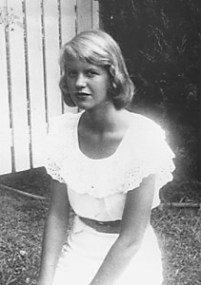
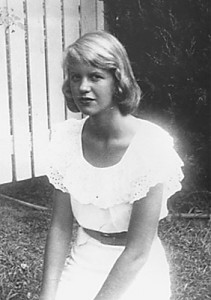
I think of Sylvia Plath who longed to succeed at writing so badly that it drove her entire life, and who eventually found success–only to kill herself. Her journal is full of amazing writing, by the way—lilting, lyrical writing that wowed me—but by the end, when I had to face the reality of a journal, and a life, prematurely cut short, I had to conclude: It wasn’t worth it.

That said, let me make a confession: I started out in the dark, too. (Oh, that word darkness is so fraught with metaphor, but let me hold off for a moment.)

I merely mean I wrote dark things—when I really started writing (age 14)—because my life had gone dark. There were certain things happening at home that I couldn’t talk about. Dark things. Embarrassing things.

I wrote in the dark, too (again, resisting the full metaphorical connotations). I mean, I wrote at night. Not only did my student schedule make nighttime the best time, but it just seemed fitting. Until after I got married, I remained a night writer, letting the day’s darkness inspire that in me to come out.

From my background in literature, it seems to me that a lot of great writers drew their inspiration from suffering. Some tragedy from childhood—or some shocking turn in adulthood. Why would a person, and how could they, write of darkness without living it? Why would they want to?

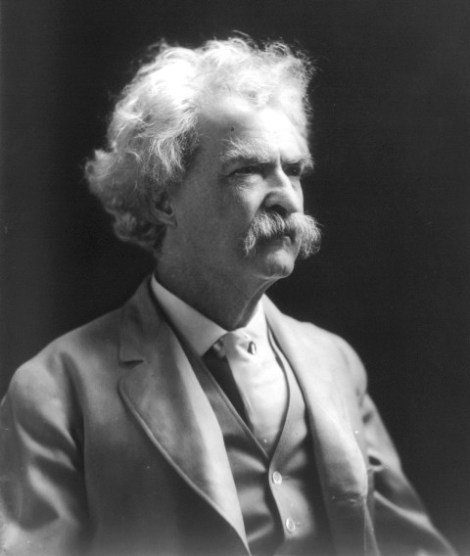
ImageMark Twain, commonly dubbed a humor writer, actually turned darkly pessimistic in his later years after losing his daughter.

You remember that highly anthologized story “The Yellow Wallpaper” with the unreliable (read: crazy) narrator? The author, Charlotte Perkins Gilman ended up killing herself, as did the popular Virginia Woolf.

Alcoholism ran in William Faulkner’s family, and Eugene O’Neil’s mother was addicted to morphine (this is depicted in his play Long Day’s Journey into Night).

T.S. Eliot had a nervous breakdown, and Ezra Pound died in an insane asylum.

From my American Literature class, I can remember a slew of writers whose fathers died in their youth or abandoned them, including Mark Twain, Stephen Crane, and Tennessee Williams.

And Sylvia. Poor Sylvia lost her father before the tender age of ten. She obviously never recovered, but for a period of years she was able to cover her pain with a slew of academic and literary achievements.

I see a lot of myself in Sylvia. Correction. A lot of my old self.

Poor Sylvia never found light. I did. I recovered a will to live as well as developed a prayer life. I decided my still forthcoming memoirs would not be all doom and gloom and “poor me, pity me,” but rather, “Look what God can bring forth from doom and gloom” and “Learn from me.”

And yet…

And yet…

I just had a conversation with a good friend in which I confessed: “I still find myself wanting to write mainly melancholy—I have to work to write positively. I worry that this blog gets too dark sometimes.”

She reassured me that, although, yes, I get a bit dark sometimes, there’s always hope inherent. “It’s a good mix,” she says. “And maybe it will help someone going through similar things.”

Can I make a spiritual/biblical application here?

My Characteristic Glimmer of Hope

In the past year, I’ve started marking metaphors I find in my Bible. I have a dream of teaching a college literature class that explores the figurative language in the Bible—it is so rich!

One of the recurring metaphors I find is that of light and dark.

This is so meaningful to me because of the darkness I’ve felt in my life—and more so just in me. The Bible tells me that Jesus came to shed light on my darkness. He is the Light of life. But the world did not recognize Him because they loved darkness (See Luke 1:78-79; John 1:3-5, 10; 8:12; 1 John 1:5).

I love the image of my Lord and Savior shining light on me—illuminating my narrow and closed mind, drawing me out of the night’s blackness into the morning light, warming my frigid insides.

Oh, He knows me so well! He knew what I would need—His light! Oh, Lord, more of your light!

But these remaining shadows! What of these mixed blog posts of light and dark? It’s like a struggle is going on in my soul.

The sobering reality is: There is a struggle going on in my soul. The enemy is clearly still fighting for me—he wants me back, that jerk. But I have no intention of going back.

And yet…those shadows.

Sometimes I wonder if going back on depression meds could help brighten my discouragingly-default-like pessimism. And then I remember that over six years, they never helped me as much as inviting Jesus into my heart. And I go back to my Bible to read that no pill could change the real problem (my fallen human nature), not unless it were God-sent manna-Prozac.

So—here’s my real gem of hope for today—maybe my mixed blog posts are churning out of my insides in the way they do to serve as a reminder, to me, to you, that there is a battle going on every day in our souls—and it won’t be over until God comes. 

“Therefore, we do not lose heart. Though outwardly we are wasting away, yet inwardly we are being renewed day by day. For our light and momentary troubles are achieving for us an eternal glory that far outweighs them all. So we fix our eyes not on what is seen, but on what is unseen, since what is seen is temporary, but what is unseen is eternal” (2 Cor. 4:16-18).

The Boston Marathon and the Pain You Can’t See

Again this week my writing was interrupted by tragedy. I mean to say not that the tragedy inconvenienced me, but that I was so wrapped up in my own writing that I almost missed it. I was sitting in my home office, a little “cubicle” in our dining room, when my husband texted, “Bombing in Boston. Turn on the TV.”

Since the bombing yesterday, I don’t know how many times I have seen the video replayed, how many interviews with eyewitnesses, how many commentaries on what it all means for our country.

This morning I again turned on the TV and saw a psychologist giving advice about how to talk to your children about such tragedies. I saw that support centers had been set up, hotlines put in place. And I knew we would be hearing about this for a long time.

However, rather than thinking about the losses the victims suffered yesterday, I found myself thinking mostly about the difference between dealing with physical versus emotional tragedies, or losses. And how one is more acceptable to acknowledge than the other.

And now I’m trying to work up to some poignant point about how it’s not fair—it’s not fair that people who have been wounded physically get to air their pain so much more freely than those who are wounded emotionally…but even as I think about writing that, the naysayers in my head start: “This is not the time to air your agenda.” “Show some compassion!” “How can you be so heartless!” “Did you really just say that?!”

Yes, I did.

In no way do I want to diminish the pain of yesterday’s victims (who will no doubt also suffer emotional scars), but when things like this happen, I must admit, I get certain thoughts…and certain questions that make me feel I must be a monster.

Readers, can you tell me, do you ever have these thoughts, too?

When these heinous crimes are committed, and it creates a media aftershock as sweeping as the Boston blasts, do you ever wonder how your life would have been different had it been a physical wound you’d suffered, rather than an emotional one?

Do you wonder: Had your wounds come from a public, graphic, physical injury, would you have healed sooner? Would you have had more support? Would it have been easier to survive, because you had so many at your side? Would it be easier to talk about just because there was no way to hide? Here I want to make a distinction between those who lost limbs and those who lost loved ones—I believe there is an important categorical difference between the two types of tragedies. (Or is there?)

What if I put it like this: Would you rather suffer from a physical malady than from an emotional or a mental one? Finally (and I may regret asking this), am I a monster for even raising such questions at a time like this? Please share your thoughts! (And yes, mine go out to the victims of yesterday, along with my prayers.)

Fable of a Freelance Writer

Image

Once upon a time (three months ago, to be exact), a freelance writer developed a blog, some book chapters, and a guilt complex.

You see, this writer started out herself to please—to fulfill a dream, put her heart at ease. No more would she hate herself for putting it off—no longer would her naysayers scoff. 

And so writing a schedule–for she must have a plan–finally, she began:

January

Wake up at 6, breakfast, goodbye.

Then meet with the Lord, at 7 or so.

Eight was for exercise, don’t get flabby!

 Then 9 was for work—let the writing begin!

The plan was to write until 4 or more—

Her memoirs, her art, her triumphant score.

But alas, as soon as she began,

She got the email from the man

Who wanted revisions on his manuscript…

So she said, “Okay, I’ll look at it.”

Then April came…

She’d made no progress

On her own goals…but I digress.


April

As the writer looked back on the past three months, she realized she had not stuck to her guns. Besides some blogs and some personal slime, she had nothing to show for her time. Something had happened, but she was not sure what—had she just wasted time, sitting on her duff?

As she searched the memories of her mind, she discovered it was not that she hadn’t tried—it’s just that some stuff had come up inside.

The joy of Jan was followed by blues…somewhere in Feb, kids came up, too. Then, in March, she thought back to home, a topic deserving a fully-fledged tome. So maybe her story isn’t written yet, but perhaps just now its reaching denouement.

What has she learned, this freelancer babe? In three months of blogging, and burbling, and talk? Maybe she just needs to lay off the clock.

  • Sleep in sometimes, and let the mind rest.
  • Talk to a friend, get things off of her chest.
  • Relax, and take the stick out the rear.
  • Go for a run, the fog will clear.
  • Relax, be a wife, and a friend, and a person.
  • Those bad writing days? Well, you win some, you lose some.

As she thought on these lessons she’d learned over time, she decided her life was really quite fine. The dream was not lost, merely delayed—and even if slow going, it still with her stayed. Maybe, she thought, I’ve been under delusion—thinking my story needs a conclusion. Maybe, in fact, I’ve been all wrong—and I’ve been living the dream all along.


On Teenage Suicide

Image

I was sitting in Mcdonald’s typing up one of my typically self-centered posts when the news hit: “Rehtaeh Parsons, a 17-year-old high school student…[and that victim of gang rape a year and a half ago], was taken off life support on Sunday, three days after she tried to hang herself.”

I tried to go through with my post, my selfish, solipsistic post about the insecurities of this past teenage girl (myself), but I just couldn’t. Not without acknowledging the tragedy.

Suddenly, my “Confessions of a 28-Year-Old Pimple-Face” couldn’t hold a candle to what I was imagining this poor girl had gone through: being gang-raped, then “blamed, shunned, and harassed by everyone,” to the point of death.

What were my puny pimples, compared to this?

And yet, once upon a teenage time, I, too, tried to commit suicide.

Though it seems almost vulgar to compare my story to hers, I’d like to…if only to throw into relief how little it takes for a girl to doubt her worth, to doubt her life, to consider ending it. And so, despite myself, I give you [a modified version of]…

Confessions of a 28-Year-Old Pimple-Face

No matter how much older and wiser I get, it seems I can’t quite move past certain childhood insecurities. These days especially, the fact that I’m a twenty-eight-year-old with recurring acne much disheartens me.

Thankfully, I don’t go through life with this “ugly complex” always on my mind—not like I used to. But as a teenager, I remember living with perpetual horror at the thought that I was un-pretty, and unworthy.

I remember it really starting at age fourteen. Somehow I got the idea that my stomach was just gross—incidentally, that was right around the time I had to start undressing in public. You know what I’m talking about. It’s that age-old trope about the locker room.

Kids historically have feigned all manner of sickness, inventing a bevy of excuses, to escape that locker room reckoning.

But I never wasted my excuses on a mere class period. I saved those for entire days when the insecurity, or the depression got too bad. Plus, I was in sports all school year, so I had to get used to it. I mean, I got used to dressing in the locker room with the other girls. But I never got used to how bad it made me feel about myself.

That year, as a fourteen-year-old eighth grader, I had my mom order a book for me, Karen Amen’s The Crunch. And every night I would close my bedroom door, don a sports bra sans shirt, and do those crunches—in hopes, I guess, of watching my stomach shrink before my very eyes. I even kept a log to track my progress. But I remember being very guarded about it.

No one but my mom knew that I had embarked on this program toward self-improvement. I didn’t let my dad or brother see me doing it, didn’t tell my friends. Only let my mom come into my room sometimes and see me in the sports bra, as I pointed in disgust at my stomach and lamented how freakish I was in comparison to other girls. I remember mom looking at me with sad eyes, just listening. Soon after, Mom left us. And I started taking antidepressants. (But I’m greatly compressing, of course.)

The thing is, adolescence is confusing enough without having to undress in front of others. Without having to contend with a parent’s abandonment. Or without having a boy shame you (much less four). All these things, which partly account for my first suicide attempt, are terrifying to a teen.

But having to go through what Rehtaeh did? Having my pain and my shame and my body and my insecurity swirled onto the World Wide Web for all to see? Unthinkable.

The Mirage of Hollywood

I can’t say for certain that the teenage years are worse for girls than for boys, but I feel I could make a strong case for the former. What do I know, though?

I do know there’s this extreme cultural pressure imposed on girls to be pretty, sexy, skinny. And while being all of this, girls are also supposed to be chaste—to be better sexually behaved than boys. And even though I’ve gained considerable perspective on all the media’s BS about what constitutes true beauty for a woman—and even though I don’t base my self-worth on my looks or my bra size like I used to—sometimes I still get taken in. Sometimes, when surrounded by bikini clad beauties whose clear skin and shapely bodies I will never rival, sometimes, for a little while, I feel like I hate my body, hate my face, hate  myself.

Even well past adolescence, I don’t need anyone else’s voice but my own to tell me I am unworthy, I am ugly, I am disgusting.

Rehtaeh, although a victim of gang rape, was called a whore by her classmates, by her friends, (by the media?).

Fortunately for me, because I have twelve years on Rehtaeh, and the benefit of no viral pictures or videos to condemn me, I can take a step back and re-see the whole picture. I can remember that this isn’t reality—this is a mirage of advertising and Hollywood and Satanic lies about what I have to do and how I have to look and how I have to be—to be worth anything. And as I make this reflective, redeeming remove, I can see clearly again.

But Rehtaeh never will.

A Devilish Game

Ladies, why are we continuously taken in?

Why do some girls get up at the crack of dawn to make themselves up? (One of my high school students proudly flaunted this fact.)

Why do others spend every spare moment in front of the mirror? (This describes many other students I had.)

Why do yet others become bulimic, depressed, and suicidal? (Yep, that was me.)

And why do innocent girls like Rehtaeh so easily become martyrs to rapists, to the media, to the devil?

We may not think we are playing the devil’s game, but all of us—whether we find ourselves fretting over pimples or starring in child porn—are.

It can’t be God’s will for women to worry and strive, to be attacked with lies, and to never feel pretty enough, never feel good enough.

It might be different if we felt it were a matter of choice not to go to all the trouble, not to spend an hour on the makeup, not to log our ridiculous repertoire of crunches, not to go along with any old man or boy, just because he’s offered—or if we just elected to do these things once in awhile. But I know ladies who won’t leave home without an hour’s prepping. I know women who can’t escape abusive relationships no matter what they say. And I know of a teen girl who will never, ever be able to get back her life—because the rumors, the bullying, the façade that life was over, was just too real.

Nearing the age of thirty, it’s funny to me that I’ve overcome, or am near overcoming, so many childhood demons—depression, fear of having children—but what still gets me on a regular basis is that little-girl insecurity about my looks, whether my adult acne; my below average bra size; my frizzy hair; or my thunder thighs.

After today’s news, these insecurities seemed almost too mundane to mention. But they’re not, of course, because they are outward fruits of the same hidden roots, lies, that so many women and teenage girls struggle with. And though it’s not the worst root some of us will contend with, I don’t want to leave it unchecked so that it continues to degrade us, to degrade me—and younger versions of me—forever. It has done destruction enough.

Rest in peace, Rehtaeh.