What Christians and Mental Patients Have in Common

I can never tell, I thought, sitting in a mental ward in Minnesota. I was nineteen.

When I get out I can’t tell friends that I dropped out of college. That I attempted suicide. I can’t tell them how messed up I am. I can’t let them see me like this.

When I got out after forty days, there was only one option (besides suicide, of course). I had to hide.

This year of my life, 2004 to be exact, is the darkest one I can remember. Almost a decade has passed, and there’s hardly anyone I’ve told.

After the mental ward, my social worker set me up in an efficiency apartment that was fully furnished, yet covered in grime. The walls were spotted with grease stains, the floors covered in dirt. Kind of like me.

Only, instead of dirt, I was filthy with lies—and they were rooted deep.

And unlike the dirt that disappeared after one afternoon’s scrubbing, it would take me many, many years to recover from the lies that had saturated my mind for so long.

I can never tell, I thought just today, before finally deciding that maybe someone besides me needed this post.

Image

It’s funny how those lies stay with us. You see, in 2013 my depression and suicidal tendencies are for the most part gone; but today I almost didn’t post this, for fear of looking “crazy” when friends or family read the opening lines.

The good news is, by this point in my twenty-eight years, I know I’m not alone. After repeatedly opening my heart to the Source that “lays bare our innermost thoughts” (Heb. 4:12-13) through prayer, and after training other women to do the same, I’m starting to feel less territorial about the pain I’ve guarded for so many years.

I can never tell. What about all the women and men who have been sexually abused? In The Hidden Half of the Gospel, the book I’m co-writing, we cite a “1 in 3” statistic about girls who have been sexually abused, which blows me away! (Since starting prayer ministry, I’ve also prayed with two women who have admitted to being sexually abused.)

I can never tell. What about the teenage boys and girls struggling with their sexuality—thinking they may be gay but afraid of rejection if they “come out”? I’m reading a memoir right now about a girl, stuck in a mental hospital for three years by her abusive, incompetent parents, who admitted to lying, stealing, cheating, and who lied about having a drug problem, plus an eating disorder, before she would ever admit she had gender confusion. (Still waiting to see how it ends, but the title, The Last Time I Wore a Dress, gives me a good idea.)

I can never tell. What about all the Christians struggling with pornography, drinking, or other “sins”? (In The Hidden Half, Paul and I share the stories of some such Christians.)

I can never tell. What’s the issue for you?

For me currently, this lie is complicating my various writing projects. Just as I did today, just as I did when I published my first magazine article about a suicide attempt . . .

I still sometimes battle that lie, I can never tell.
200px-ProzacNationBook

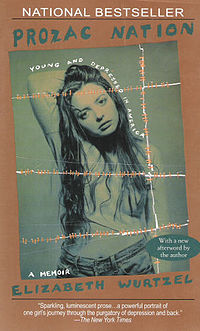
Maybe that’s why I like to read memoirs like Prozac Nation and other riveting romps through mental illness.

My husband thinks reading these kinds of things is unhealthy. Wonders if I am vicariously milking old, bad feelings through reading these books.

I used to wonder that, too. But these days, I don’t think so.

You see, more and more as I’ve dealt with my bad roots through prayer, I’m uncovering a holy rage about how humans (and Christians especially) cover up their bad roots. As if denying them is dealing with them. Who do we think we’re kidding? Certainly we’re not fooling God.

No, I like to read these memoirs not because they inspire my faith (I read the Bible and Stormie Omartian for that!), but because they inspire my honesty. I read them because they take me to a level of intimacy far below what I get with pretty much everyone else in my life.

Now for those Christians who may disagree with my “uninspiring” reading selections, that’s fine. But if you’re going to knock them, then at least tell me where else I can find such honesty. Sadly, I don’t find it in church, or from my family members, or even from most friends.

But as for me and my writing, we will be honest.

Not because I think we all need to be sharing and airing our garbage. If we did, just think what a stinky world it would be. But come to think of it, this world already stinks quite a bit…so maybe we don’t have much to lose. And if Christians would speak up more, maybe more people would join us, as they see that we’re not too out of touch to deal with the ugly realities that blot all human stories.

In any case, I’ve decided to be honest, in the name of not being fake…or distasteful to others because I can’t relate in any human way…or disgusting to myself because I’ve built my perceived flaws so big that I’ll never get over them. But the most important reason to be honest? Well, gosh darn, if so many people are writing the depressing stories, don’t we need someone to write the un-depressing ones? (This is the plan for the memoir I’m writing—to share how I got un-depressed.)

car

And so, to conclude my very abridged tale of woe (for today, anyway), at the end of that worst year of my life, I’m happy to tell you, God intervened, introducing me to my husband (in Texas of all places!) and moving me 1,000 miles from that dirty apartment and my broken past. He moved me away physically. Mentally, on the other hand, I had a long way to go! But that’s the subject of many more blogs.

So, though it’s sometimes hard for me to write, and might sometimes be hard for you to read (but I’m sure you can find lots of “fake” blogs to read, if this one makes you uncomfortable), I choose to tell. No matter how often Satan tries to tell me I can’t, with God’s help, I will ever tell.
 

What Would Jesus Write? On Writing the Truth with Compassion


Image

Speaking of entanglements, when writing memoir, there’s always that issue of how to talk about your parents. Your ex-boyfriends. Your husband. Or your in-laws. Now your words don’t just affect you and your impersonal readers: family and friends could be hurt or offended. And so, what is a writer, especially a Christian writer, to do?

Two Views on Writing about Real People

When it comes to writing about real people, immediately two options spring to mind.

First, my beloved Professor L used to like quoting an eighteenth-century writer (and I can’t remember whom) as saying something like: People better not tick off writers because they never know what he or she might write later. In other words, writers can and should write whatever they want about whomever they want.

While somewhat humorous to me, this view also seems selfish and inhumane, not to mention utterly unchristian. Even though I may have joked about wielding ammunition in my pen, seriously, this troubles me. “Revenge is mine [not Lindsey’s], says the Lord.” Needless to say, I don’t find much help here.

The second option comes from writer and teacher Peter Brickleback and, although not perfect, seems much more humane. In a nutshell, P.B. says that certain truths and experiences belong to us as writers, and so we should write about them. Those people we’re writing about? They “can write their own” version of the story.

I know this sounds somewhat callous, and even smacks of the other writer I paraphrased. However, here are some caveats P.B. tacks on that begin to win me over (see The Portable MFA, pp. 128-30). In writing “happily” about your “unhappy family [or whoever],” P.B. says the following:

  1. “Do not write as if you are Mr. or Mrs. Perfect.” He’s saying be honest about your flaws, too; don’t write as if you are the only victim in the world (your “oppressor” might be a victim, too).
  2. “Strive for compassion and empathy” in order to “[treat] the subject fairly.”
  3. Writing about difficult, universal experiences “contributes to our mutual benefit, to a wider social, human good.”
  4. Avoiding certain characters or topics can leave a “black hole of an absence” in the story, resulting in a “warped” version. In other words, sometimes we need to address these hard subjects to complete our stories.
  5. Writing using pain and anger as fuel helps us face pain more honestly.
  6. Writing in spite of pain can result in healing for both writer and writee—as in the case of a daughter who wrote a less-than-flattering memoir about her mother. In the end, P.B. reports, the mother and daughter came to have more understanding and compassion for each other: “[T]hey’ve straightened out some things that have gotten twisted through being buried. Also, being part of an attempt to put words to things, they’ve come to appreciate a lot more about the past and each other.”

Now, P.B.’s comments could easily be refuted, especially by Christians who are striving to “do unto others as you’d have them do to you.” Still, I’ve decided that Christians need to be open-minded to consider underlying assumptions and motives behind what might seem to be questionable opinions. In this case, P.B.’s very humane assumption is that writing should not (entirely) be selfish; rather, it should ultimately function for the greater good.

For Christians I think this means writing should, first and foremost, give glory to God—which is to say it must benefit others. But I am also coming to understand that that does not preclude writing about fallen humanity, including ours or others’. What is the Bible but the story of fallen humanity, anyway? That said, a Christian who is going to write on said topic might consider a few more caveats.

Some Christian Caveats for Writing about Other People and/or Pain

[Note: this section is really for me—but you can look, too!]

If I am a born-again Christian writing about a painful past that involves other people, I must be especially careful in how I shape the story. Does it end in redemption? Is there resolution available for all at the cross (even though some may not choose to accept it)? Because if I believe the Bible (and I do), Christ is the solution for all problems: by His stripes, we are healed (see Isaiah 53).

And so, after the happy (or at least hopeful) conclusion is settled, the remaining question for Christian writers might still be how to treat the bad roots, especially as they relate to or involve others. For myself, I’ve decided I want to include only the parts of their stories absolutely necessary to the telling of mine, but I also want to include enough so as to avoid leaving a “gaping hole.” Meanwhile, what I include should never needlessly hurt others.

While it may take awhile to figure out all of the above, I’m heartened by the same advice I’ve both given and gotten in English classrooms: Sometimes you have to write the body and conclusion before you figure out the beginning. Such is my story right now; but one day I’m confident I’ll get down to those roots I’m searching for.

You can view the photo from this post here.

One Big Tangle: Thoughts on Blogging versus Book-writing

As you may know, Writing to my Roots is chronicling the writing and publication of my first memoir—or the progress toward my lifelong goal. In other words, I’m writing about writing, both about how it’s going as a writer, and also about what’s happening in the writing—what roots I’m uncovering. In other words, where is the writing taking my story, book-wise, and me, person-wise?

Trying to untangle all of the above is not an easy task. And tangled is the right word. I feel so tangled up right now with conflicting tasks in storytelling. I’m telling you a story about a story I’m telling—and I find myself worrying about telling both stories right.

Something tells me I’m going about this all wrong. At least the blog. A book should be carefully organized, but a blog is a place to be more free, right? We’ll go with that for today, so I can get on with writing about writing.

Book Progress and Problems Since October, 2012

For starters, I have penned (literally, written with a pen) around 350 pages of my book. This morning I think I may have even written the last scene and decided on my title. So the writing is going well. Indeed, I feel like I have all the component parts of my book recorded in some form or fashion. I’ve got most of the big themes and thoughts I want to include collected into those once-empty notebooks I told you about last week.

But now comes the hard part. Revising and organizing. Shaping this amorphous blob of memories and musings into something pretty. The other night my dad asked me how many chapters I had written, and I had to just shake my head and say, “Dad, it doesn’t work like that.” (He’s a radio-advertising salesman who occasionally writes copy for commercials. How could he understand the complexities of drafting, revising, and organizing a book-length manuscript?)

I told my dad that my first draft was just emerging through the recording of scenes and ideas as they came to me. I’ve just been trying to get it all out of me, and then worry about organizing it. But that’s not so easy to do these days. The organizing, I mean.

Some Concerns Faced by “Real” Writers (especially Memoirists)

If you read contemporary memoir, you know that stories don’t always unfold chronologically. “Real” writers (and I think I have a little pride about being one, even though I probably shouldn’t, being that I have not yet published a book) make difficult literary maneuvers such as

  • flashback
  • flash forward
  • magnification
  • compression

Writers also

  • make use of extended metaphors and symbols, sometimes all throughout the book
  • pay attention to pacing and placement of scenes
  • carefully select and balance important versus unimportant detail.*

(see chapter two of The Portable MFA in Creative Writing for more)

*For memoirists, specifically, this selection and balance of detail is particularly hard, because all the details are personal. Which ones do you share, and which ones do you shelve? Here, we have tangled up literary concerns with personal, and sometimes moral, ones. There is so much to think about!

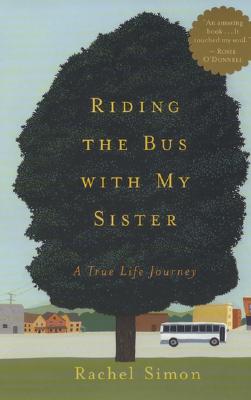
These are just a few of the challenges I’m encountering as I progress through the writing of my book. And I’m nowhere near close to figuring them all out. But yesterday I did find hope for making sense of my thoughts—and bringing order to my writing…through reading the memoir Riding the Bus with my Sister by Rachel Simon.

Riding the Bus with my Sister: Inspiration for the Aspiring Memoirist

In a nutshell, Simon tells the story of what she learned through one year of riding city buses with her mentally handicapped sister, Beth. At the beginning of the book, I expected the story to revolve around this year of bus-riding—I thought that was the core story. But the further I got into the book, I realized that, with carefully chosen, carefully placed flashbacks, Simon was telling the story of her family’s breakup, and her broken heart. Ultimately, it was through riding the buses with Beth, by slowing down to enjoy life again, and by remembering her roots, that Simon found a great deal of healing by book’s end (there’s more to it, of course, but I’m compressing).

Image

Wow, I thought, teary-eyed by the closing scenes. That was a job well done. Not only was her literary execution great, but her story was worth telling. And she didn’t go overboard with her tale of woe. Indeed, I was shocked halfway through to read of the horrific things that happened in her teenage years—so that was why she has all these problems in her adult life…not getting close to people, overworking, lacking hobbies. Suddenly the journey described in the book became much deeper than just a year of bus-riding with her sister. It was a journey of healing for herself.

In both Simon’s writing and her story, I see visions of myself. The personal story is similar to mine, although without the handicapped sister; and the sum total of her book’s organization leaves the effect I want my own book to have. What a great story—and what a great way to tell it, I want my readers to think of my book (just like I thought of Simon’s).

So, for today, I will disentangle myself just a bit with this: at least if my blog is not pretty, I want my book to be. For today, I’m feeling grateful to Rachel Simon for her story—and hoping you’ll ride with me as I untangle the telling of my own.

Time, Space, and Empty Notebooks: My Book-Writing Recipe (for now)

So, I’ve made this goal to write and publish a book before I’m thirty. But how is that going to happen, you may or may not be wondering. (I’m thinking of those friends and family members who have heard me talking about publishing this so-called “book” for years, still with no results to show for all the pretty talk.)

  • First, I’m swallowing my embarrassment at all the talk and failed prior attempts.
  • Second, I’m really going to be serious about this. For the first time ever, it is going to become my “fulltime job.”
  • Third, I’m going to write. Well, that overlaps number two. Of course I’m going to write. How else can a book get written?

But although I’ve always self-identified as a writer, there is something scary about actually saying it is my job. Before, when I was a teacher, or a graduate student, I could blame my other commitments for my lack of production. Now? It’s just my keyboard and me, full days at my disposal in which to make literary things happen.

Now the rubber the meets the road; now is where I prove myself. Do I have what it takes?

Time will tell; however, can I just share one thing that makes me hopeful?

Last October (three months ago), after I had submitted my master’s thesis for review, and when I was on a break from my other book project (more on that later), I produced like crazy.

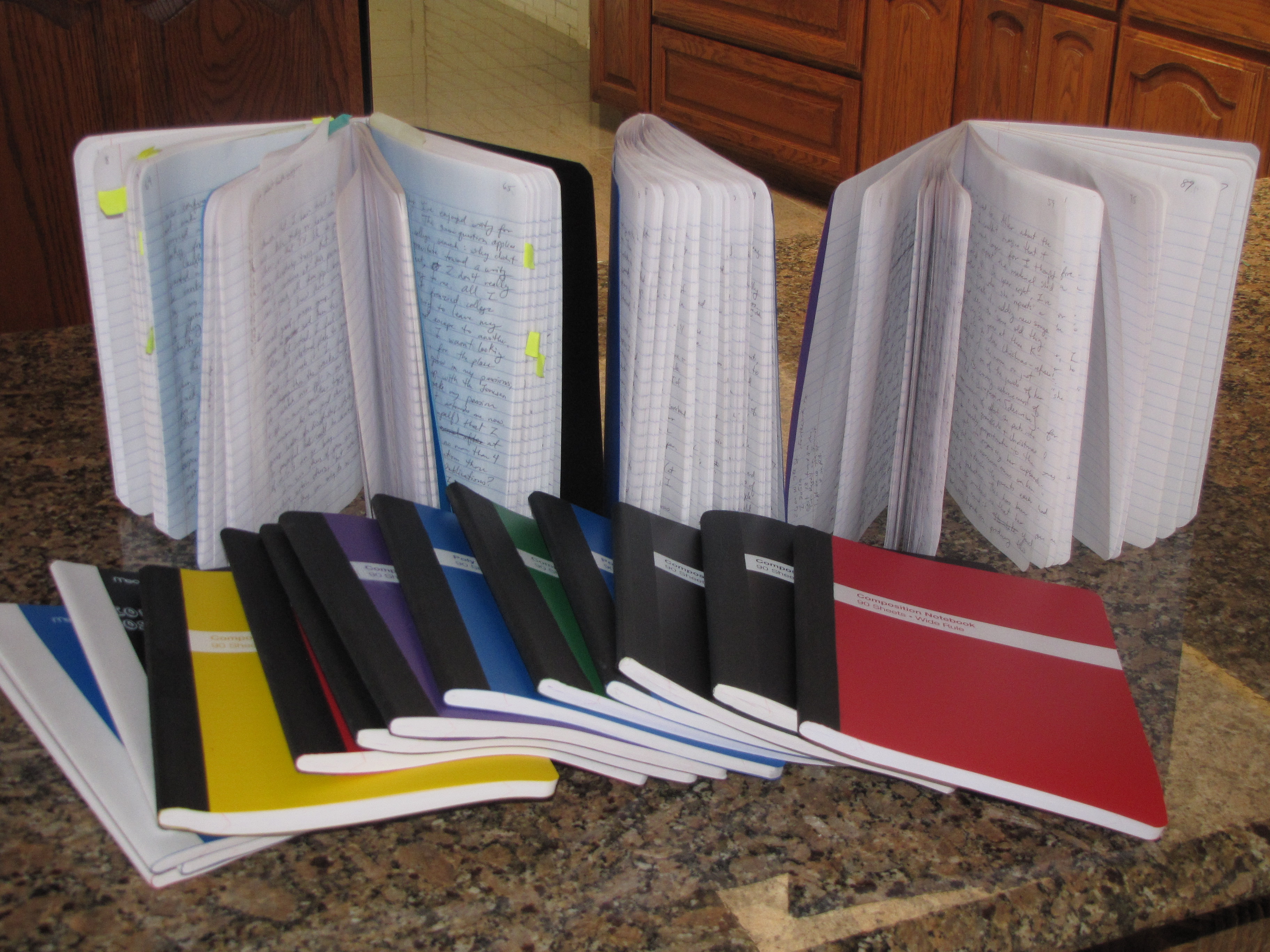
Prior to October, I had found this great sale on composition books at Target, had snapped up about twenty, and had promised myself I would fill them when I got a chance. So, for the month of October, and a bit of November, I did.

Having nothing more pressing to do each day, I headed off to one of several coffee shops (either to feel like a real writer, or just because it gets lonely at the house) and wrote. And wrote. And wrote. By the end of the month, I’d filled two books’ pages, front and back, and had produced the germ of this nebulous book I’m now blogging about.

Image

Soon, life interrupted again, as I had to finish my thesis, defend it, and graduate, among other things. So not much writing happened for the rest of the year. But now, a new year stretches before me, days of possibility call me.

Already I can see the challenges: I’m not good at saying no to people, and it could be easy to let my own projects take a backseat when other people or responsibilities come a-callin’. I’ll have train myself to keep to a schedule; I’ll have to learn uncomfortable things like using social media; and most importantly, I’ll need to stop feeling guilty if I have to say no sometimes in order to work.

But after I overcome those issues, I have faith that all will be well. If the past is any indication, I can do it. Given space and time to write, I do—I always have (even if not for an audience)—and I love it. At the end of the day, I have these things going for me: space, time, and love for my work. What more do I need? Only to dedicate all of the above to God (Prov. 16:3). Thanks, God. May you be uplifted in my space, my time, and my writing this year. 

A Book, a Blog, and a Dream: My ‘Before Thirty’ Project

Have you ever felt like there’s something you’re supposed to do, had a nagging feeling that’s followed you, kind of like your shadow, for most of your life—and yet, you’ve never done it? Have you found yourself wondering why you just can’t make yourself do that one thing you seem meant to do? Have you felt disgusted, even, because you’ve let other stuff get in the way? Or, another possibility, have you been so beaten down by circumstances that you’ve lost sight of your true purpose, and with that, your true identity?

Well, for me, that something is writing a book. And this blog is proof that I’m finally doing it. This blog started as a graduate class project for which I was researching and writing how to get published. But when my professor pushed us to write our last essay for a real-world audience, I felt it was time to take action.

I’d been waiting over ten years to publish a book; I was at the end of my master’s degree; and I was at a crossroads. As I wrote in my MFA application essay, I can’t fight this feeling anymore (some eighties band might have said that, too). Anyway, for months now, ideas have been spewing out of my pen, and although I don’t know what next year holds—I have applied for both PhD and MFA programs, and talks of kids are underway—for now I have a semester “off”; and I have decided to write.

But what am I writing about? Friends and family have asked. It’s not enough just to want to write—you also have to have an idea.

Look again at my first paragraph. That, in a nutshell, is what my book, and this blog, is about. It’s not just about my journey to publishing a book (although that’s part of it). It’s about pursuing dreams that were interrupted by depression and other disasters. In the words I have chosen to describe my project, it’s about writing to my roots: the roots of what I was meant to have, be, and do—and the roots of what kept me from having, being, and doing all of the above for most of my adult life.

Thank God, after praying through a lot of the bad roots in myself, I am ready to write to the good ones (though there’s always more healing to do). That said, in order to document the tangible feat of publishing a book by the time I’m thirty, I’ll also want to tell you about the many intangible feats it took for me to get here. I’ll tell you about how I’ve survived a broken family; how I’ve overcome a debilitating mental illness; and how I’m finally learning to redefine myself after, at age twenty, leaving everything I had and everything I knew—family, job, school, and friends—to move one-thousand miles and marry a man I’d known only four months. Spoiler alert: my story has a happy ending.Image