I’m sorry for this morbid photo. But it’s my proof that pregnancy gets a little rough sometimes.
The swollen feet, the achy back, the Braxton Hicks (who said they aren’t painful?!) are not funny anymore, but I’d like to laugh at myself today, just so I can forget how easy it is to cry right now.
Yesterday we showed ourselves to be those rookie expectant parents when we ended up unscheduled at the doctor’s office for a checkup—I was barely dilated past my point of last week—and later, in the Labor and Delivery Unit—once again, no change. The good news is we now know exactly where to go when the real deal comes.
I guess it was just one of those days. I woke up after a night of fitful sleep and some tears (those Braxton Hicks really can hurt like a mother) to chaos in my kitchen. The puppies, whom we’d trusted with an extra room open overnight (we thought they were coming along so well), had torn up my favorite kitchen rug, plus they had mangled the laptop charging cord. When I got done cleaning up, a message was waiting for me on my phone from a certain relative: “So you’re at the hospital now, right? Cuz you’re not answering your phone! Let us know! We can’t wait!”
Yes, it was my mother-in-law. Again. Every day she’s been calling to ask: “How are you feeling?” “Any change?” “Are you ready to go to the hospital yet?” This is just her personality. She is beyond punctual, calling us several times at least when we are on our way to any family event to ask, “Where are you at?” “Are you on the way?” Waiting for this baby to arrive has been no different. She loves him so much already, and just wants to meet him. It’s really sweet actually. I know she’s just showing her love. And I do appreciate the intent. But I’m at the point where my nerves are shot; I need to get my mind off the thing, lest I end up at the doctor’s office again, blubbering because I feel so pressured to deliver this baby.
I knew it probably wasn’t labor yesterday. But after my hubby urged me to “call the doctor!” (he’d seen and heard the pain from my practice contractions), I made the appointment out of passive aggression to say to everyone: “See? See? He’s not ready to come! Now leave me alone!” Actually, we missed my husband’s birthday dinner to be told what I already knew: “You’re not in labor yet.” At least I had a witness. Everyone wanted baby Sam to come on Buc’s birthday. We even asked to be induced (see, Mom, I tried!), but they are re-flooring the L and D unit and there was no room in the inn—at least, not for women who weren’t already in labor.
So, we headed home last night, me sore from being probed twice in one day, both of us dejected and hungry. I was embarrassed by the day’s events, but maybe they were for the best. I don’t know if I could have faced the whole family last night and their questions (however well-meaning they are), without crying. All day I had felt SO MUCH PRESSURE. Mentally and physically.
I’m glad I got a relatively good night’s sleep last night and both pressures have subsided. I was annoyed yesterday at Buc for “pressuring” me into the hospital visits, but now I think it was sweet. He held my hand the whole time, cracked jokes to make me laugh, and was so loving. I realized that he was just worried about me, and he was doing what he could to protect his wife. He said he didn’t like to see me in pain. I am even thankful for the persistent mother-in-law calls, which tell me that my baby and I are going to be so loved and well taken care of in the coming days and months.
Today, I have a much better outlook, and I feel ready to do something productive, like tackle writing my final post in my blog series and get my office cleaned up. I’ve discovered it’s not healthy to over-focus on this baby at this point, not until he comes, because I’ve done all I can do for now. And to my loving family and friends (and I really do love you all), if you want to call or text me, I love the calls and texts! Just…can we talk about something other than the baby today?
I am interrupting my rebirth series to record these moments: waiting to go into labor and, as WordPress has informed me, my blog’s one-year anniversary.
I haven’t blogged much about my pregnancy. I’ve kind of gone underground in the last month on the whole thing, here and on Facebook. I keep getting text messages asking, “Is he coming yet?” I have some very anxious family members who “can’t wait” until he’s here. In fact, judging by my lack of comment on the topic, they seem even more excited than I am. What gives?
Fear
One thing that has kept me from writing on the topic is fear. Baby Sam is not here yet, and labor and delivery is a risky thing. Not to mention that newborns are pretty fragile. When I used to talk about having kids, as I prefer to do with most things, I focused on cerebral concepts (parenting philosophies), not materialistic details (car seats, breast pumps, umbilical cord care, ec.). Now, with my due date less than a week away, all I can think of is the details—and I feel overwhelmed.
Yes, I’ve read a good deal on pregnancy and newborn care, and I’ve been working every day to ready my house—“nesting,” I think it’s called—but these activities have not really made me feel better. Every day lately I have been faced with the fact that I lack practice and know-how for the material details of life. I feel suddenly estranged from those things that have recently defined me—teaching, writing, leading (various church groups)—and it’s a scary feeling. Rather than burden the blogosphere with my worries, like the Virgin Mary, I decided to ponder these things in my heart. (I wonder if she worried about breaking her baby?)
Respect
Another reason I’ve avoided too much “baby talk” is out of respect for the women I know who are struggling with infertility. It seems unfair that I get to have this experience and they don’t. I feel like it’s even more unfair because I haven’t always wanted children. Some women know their entire lives that they want children, while I spent most of my twenties denying the desire. Shouldn’t the women who’ve always wanted kids be entitled to them, first? On the other hand, is it because my heart was so hard in this area that God decided I needed them (and the other ladies could go without)? (Or another thought: Was I formerly in denial?)
It’s probably not a comfort to the ladies struggling with this issue, but I make sense of their infertility like this: these ladies are already healthy in this area, this natural desire to nurture. I wasn’t. Maybe those hard-hearted of us (and overly cerebral, egg-head-ish types) need children more than the already well-adjusted, family types. I’ve thought about this a lot, and I’ve debated posting that hypothesis, scared I would offend or minimize someone’s pain. I’d be curious to get your thoughts in the comments. I don’t understand God’s ways, except I believe he allows bad things (like infertility) to happen, he doesn’t cause them.
Exhaustion
A final reason for not blogging about baby is that I’m exhausted right now. My body is exhausted from carrying the little dude, and my mind is exhausted trying to wrap itself around how my life is going to change when he comes. With limited energy, it seemed smart to use the little I had to get things ready as much as possible during these last days, materially speaking.
In Conclusion…
The Three of Us
I know it doesn’t sound like it, but I am very excited for baby Sam to arrive! I recently had my first “good” dream of his birth: he was cute, had a full head of hair, and he looked like my hubby—all things I expect, after seeing our 3D sonogram. I’ve imagined holding him in my arms and I want to cry for happiness. I smile at the thought of the three of us becoming a family. I long to inhale his baby scent and feel his smooth skin. I look forward to slowing down and becoming less mechanical and more of a person. I praise God for blessing me with a baby—and I will strive to be a good steward of what God has given me.
Perhaps the most comforting thought amidst these last-minute hormones and unknowns is the knowledge that Sam isn’t really mine—he is a gift on loan from God—and God is the only one who can sustain him. It’s not up to me to be a perfect mother; I’ll just do my best to follow God’s lead.
On that note, it should be an interesting second year on this blog, full of many firsts and, I’m sure, many mistakes—but always lots of learning and growth. Here’s to one good year behind me, and an exciting year ahead!
What does it mean to be a born-again Christian? To read the New Testament, you’d think it means getting a whole new perspective on life, a new heart, and new behaviors along with it. Galatians chapter 5 gives a nice, quick contrast between the life controlled by the flesh, and the life controlled by the Holy Spirit. The former produces bad fruit like sexual immorality, impure thoughts, idolatry, hostility, quarreling, outbursts of anger, selfish ambition, divisions, and much more. But the latter produces those famous “fruits of the Spirit”: love, joy, peace, patience, kindness, goodness, faithfulness, gentleness, and self-control (see vss. 16-26). To make it more personal, living a Spirit-filled, or “born-again,” life would mean new thoughts for the depressive (formerly me) who keeps repeating, “I just want to die” (Eph. 4:21-24; Col. 3: 1-3).
If an entire household were born-again, I suppose that would mean no more yelling at one another—no more anger and bitterness and malice. Parents would love each other and kids would respect their parents. Sabbath mornings would be joyful, not hate-filled. My parents would have stayed together—and our family would not have ended in an affair, an illegitimate child (or my beloved younger brother), a divorce, and possibly not the two older children (my brother and me) moving far, far away from a home that we came to know as a battleground. In a family that called itself Christian, how could we have gone so wrong?I believe it was because my family was not living a Spirit-filled life: we were not truly “born again.” (To read how Jesus explained rebirth and the Spirit-filled life, see John chapter 3).
Becoming “Adventist”
I know my parents were taught doctrine (a set of biblical beliefs) before joining the Seventh-day Adventist church, but were they taught about how to have a personal relationship with Jesus Christ? Were they taught how important it is to “be renewed in their minds”—and not just by learning information, but by internalizing God’s love for them and Jesus’ suffering and death and resurrection? When they were baptized, were they really taught what it meant to be buried with Christ—to put on love—and to die to self (Rom. 6:3-4)?
While I am tempted to blame the church for not teaching my parents these things—because the fruit in their marriage and in our family points to a “non-born-again” existence—I don’t know the answer to these questions.
Photo Credit: “Black Bible” by Tacluda
Before I go any further, I should note that my dad grew up Lutheran and my mom, Catholic, so if a church or denomination is to blame for missing the “born-again boat,” several are to blame. I don’t know much about my parents’ formative experiences with church, except that Dad’s didn’t leave any notable impression on him, and Mom’s left her wanting more and better answers. She finally started to read the Bible for herself in college, only to realize that the Catholic church strayed pretty far from its teachings sometimes. (One example would be their changing of the ten commandments—deleting the second one and splitting the tenth into two.)
I know my parents, when they were newly married, came into the Seventh-day Adventist church through a Revelation Seminar, or a series of meetings that teaches esoteric prophecies in Daniel and Revelation, along with other defining doctrines of the Seventh-day Adventist church (the seventh-day Sabbath, the state of the dead, the truth about hell, the health message, etc.). I know my parents latched on to the logical presentation they saw; they couldn’t argue with the Adventists, because these people proved everything they taught straight from the Bible. I know these convincing proofs were enough to get my parents baptized.
Photo Credit: gritintheoyster.wordpress.com
And then my parents started doing what the Adventists did. They took my brother and me to church on Saturday and restricted what we could do on the Sabbath: no TV, no sports, no shopping or eating out from Friday night sundown to Saturday night sundown. They stopped eating unclean meats, such as pork and seafood, per instructions in Leviticus. And as I grew up, these outward markers, to me, became what it was to be a Seventh-day Adventist Christian—only I didn’t think much about myself being a Christian, or a follower of Christ. I mostly thought of myself as an “Adventist,” because, it came to my attention, being “Adventist” separated me from my peers who were busy eating bacon, playing sports on Sabbath, and attending other fun events that I couldn’t.
My Fallout from Church
When I was sixteen, after Mom left with my baby brother and Dad and my older brother were angry and I was depressed, I started blatantly breaking the fourth commandment (“Thou shalt keep the Sabbath holy”) by working on Saturdays. Suddenly I didn’t care about breaking the Sabbath, because, well, why should I? I had been attending church all my life, but church hadn’t helped me any. It hadn’t saved my family.
I can’t remember if anyone tried to tell me about what it really meant to be born again: in this case, being renewed in my now-suicidal mind—or finding peace amidst the storm. Perhaps some caring adult tried to tell me, and their words fell on deaf and hurting ears. All I know is I didn’t see the Spirit-filled life, or love and joy and peace, demonstrated at home. And this brings up another crucial point.
Fruit of the Non-Born-Again Family—Plus, the Christian Pretending Game
Photo Credit: “Happy Family Leaving Church” by iamachild.wordpress.com –
I remember many kind church members who I think would have intervened had they known what was really going on in my home. But my parents were good at something many other Christians are: They hid our problems from the public eye. After they split up, my parents admitted that they’d always planned to divorce—but they were trying to wait until my brother and I graduated high school. When it hit the fan, not only our fellow church members, but also my brother and I, were flabbergasted that things were really that bad. Mom and Dad had played the game well.
Going back to the born-again discussion—because I think the true root of my family’s demise was that we were not born-again—my parents today admit that they entered marriage unprepared and unconverted in their hearts. I don’t ever remember Mom and Dad modeling for my brother and me daily prayer, except that we prayed before meals and sometimes before bedtime. Family devotions were non-existent. Our lifestyle, filled with sports and fiction and media and rock and country music, was very secular, except for one day a week when we put all that away to “keep the Sabbath.” So we were “Adventists.” But we were not really Christians (not really living like Christ). Which means we were really nothing but posers, because you can’t be a true Seventh-day Adventist without being a Christian, too.
Roots of a Blow-up
Learning doctrine is great, if it is biblical. I believe that Seventh-day Adventist doctrine is biblical. But if doctrine is all you have, in the end you really have nothing, as my family’s story shows. Along with doctrine, you need to have relationship—relationship with God and Jesus that transforms the way you think and live and relate to others every single day of the week. This is what I mean by being born-again.
Photo Credit: Peacefulparenting.com
Before shouting matches occurred in my home, we should have been dropping to our knees as a family. Before my depressive thoughts took root, I should have been planting scripture in my mind.
“We do not wage war with mere human plans or methods. But we use God’s mighty weapons, not merely worldly weapons…with these, we take captive every thought to Christ” (2 Cor. 10:3-5). What if my parents had learned, and I had learned, to take every thought captive to Christ?
Oh, what a much happier story I’d have to tell.
Instead, we went to church angry, put on plastic smiles, and then, when everything blew up, we kept those things out of sight, too. I learned to keep my depression out of sight. Then, when the façade became too farcical for me, I disappeared from church altogether.
The good news is that when your spiritual leaders fail you (possibly because they don’t know what you need, if they even know what they need), God can still get to your heart. He eventually got to mine. Sadly, it’s also true that the sins of the parents reach into the third and fourth generations—so sometimes even as we are coming back to God, it’s a murky, uphill battle. There are consequences to living opposed to God’s laws, and it can take a long time for life to smooth out again (hence my “ugly, messy” rebirth story).
Photo Credit: “From Roots to Fruits” on faithstudentministries.com
Before I can tell you about the good fruit God eventually produced in me, in part three, I will expand on the lingering effects of growing up in a (church) culture where I thought it was “not okay” to ask for help—as well as the idea that there wasn’t anything inherently life-changing about Jesus, his Word, or prayer.
When I was a little girl, going to church on Saturday (because we were Seventh-day Adventist Christians), was a disaster. I was apparently in my feminist phase, and I refused to wear dresses. I used to throw tantrums. Yes, the same woman who is quiet and reserved today—the one whom many dub phlegmatic and calm—was a stomping, screaming terror.
Why were the worst days on Sabbath? And not just for me, but for my whole family? We all yelled at each other, piled into the car with frowns on our faces, and crinkled brows. We drove to church seething at one another. My parents usually still made me wear a dress…after up to an hour of screaming at me and me screaming back.
Oh my.
Then we got to church and acted happy—I think. Truth is, my memory has left a lot of gaps, especially of the early years, which makes it hard to write a memoir sometimes. So here’s a digression…because this is a messy testimony…
Blanking Out the Past…Because It Hurts
I’ve been writing to my roots (writing this blog and writing my memoir) for about a year, and memories of my childhood are just starting to surface. It was only in the second draft of my memoir, after my editor pushed me to go there, that I delved into my formative years. Why is this?
I think it’s because I needed time to get back there. After my parents’ divorce and my depression, my suicide attempts and my hospitalizations, the present moment—the struggle to just maintain life and just be—became all consuming. I plumb forgot about my past, bad and good.
I used my parents’ divorce and the mess surrounding it to justify my depression and my eating disorder, among other self-sabotaging behaviors. I discounted the fact that—hello—I had depressive tendencies long before my home blew up. And now we go back to the story.
Bad Beginnings
Photo Credit: “Sad Tears” by Lusi
In writing to my roots, I’ve uncovered the ugly truth that I was always a melancholy child. Facing the fact that the problem has always been inside me—and it didn’t come from any externals (although it was certainly exacerbated by them)—has been hard. It means I can’t totally blame the dysfunction of my early adulthood on my parents or my church or anyone else—except the enemy of my soul.
It’s hit me hard lately that he was attacking me from very early on. I always had the tendencies to stress and despondency and impossible perfection that I still blog about. I remember freaking out about doing my fifth grade Science worksheets “just right.” I remember that my sixth grade Minnesota portfolio had to excel everyone else’s. Every year of elementary, I had to beat out the other kids in the reading program.
At home, I used to rant and rave about how stressed I was, making entire days a living hell for my parents. I learned there was some power in airing all my negative thoughts—“Life sucks,” “I wish I could die”—because they got me some attention. Even when I was shut away in my room, I wallowed for hours, yelling, weeping, complaining. Everyone knew when I was in a bad mood, because it clouded the whole house.
It’s amazing to me that these messages found their way into my brain so early, and that life was sometimes too heavy to handle, even at age ten. (Satan’s that good—I mean, that bad—isn’t he?)
Okay, let me pause again. These admissions are really embarrassing, but I make them in hopes of showing how our negative roots (negative thoughts) must lead to more and more negative fruits (negative behaviors) later in life. In my case, though my outward tantrums stopped around teenage-hood, I found other ways, inward ways, to sulk. The biggest way was keeping a very negative journal from age fourteen until age twenty-five—which, though less visible to the world, still reinforced my poisonous thoughts every bit as much as my childhood tantrums.
Tantrums Change…Temperaments Don’t…or Do They?
Photo Credit: “Melancholy” by Lusi
For most of my life, I’ve classed myself as a Christian. However, after I married and entered my adult phase (which events, I think, happened in that order), it always struck me as problematic that I still lived with my negative, “please let me die” thoughts. Was this the kind of fruit a truly “born-again” Christian should be producing?
Writing on the new life in Christ we are promised when we accept Jesus as our Savior, Paul said, “The mind of sinful man is death, but the mind controlled by the Spirit is life and peace” (Rom. 8:6). Romans 8:1-17 is all about living life through the Spirit, in fact, and it’s all about inward renewal, or thoughts. It tells me Jesus conquered “sin in sinful man” so that I could live not according to the sinful nature, but according to the Spirit (vss. 3 and 4).
The true, spirit-filled life doesn’t sound like it includes wanting to die. The “born-again” experience doesn’t seem like it has room for thoughts like, “Life sucks.” When I think back now to my life before rebirth, I see what Paul meant by his statement, “The mind of sinful man is death, but the mind controlled by the Spirit is life and peace.”
Before I accepted Jesus as my Savior on the inside, my mind was centered on death…which tells me that, although I was “in the church,” I wasn’t really “born-again.”
In part 2, I will explore why some Christians are depressed, and why my “Christian” family eventually imploded.
It’s a lesson I’ve been hearing and trying to apply for years: Don’t underestimate the power of good words. Today I’m not talking about skillful writing (per se), but uplifting words, written or spoken. I hear this advice as a wife, when my husband entreats me to stop nagging him for his shortcomings. “Positive reinforcement,” he says, “Is what will get me to change.”
I heard this advice at graduate school when learning best practices for teaching writing: “If you only criticize students, you will freeze their writing process. You must encourage what they are doing well so they can gain confidence to keep writing.” And, “Wait until later to correct their grammar and punctuation. If they only see red marks on the page, they will be so scared of screwing up, they won’t take any risks.”
The Bible says, “The soothing tongue is a tree of life, but a perverse tongue crushes the spirit” (Prov. 15:4), and, “Gracious words are a honeycomb, sweet to the soul and healing to the bones (Prov. 16:24).
Putting Wisdom into Practice
I’ve tried to put this advice in practice this semester as a college writing instructor. This doesn’t mean I never comment on what’s bad in an essay, but I give as many compliments, if not more, as criticisms. And I waited until about halfway through the semester to significantly address punctuation or grammar. I’m not sure if it was this approach, or my sequence of assignments, or the natural improvement that comes over time, but by essay four, all my students were writing their best papers yet. I think it has something to do with all of the above, plus the fact that the fourth assignment, modeled on a magazine article submission, was a true story of their choosing written for teens. They seemed to care more about this task, given the topic and the clear audience, and it showed in their writing.
I think older, more experienced writers, can handle criticism without letting it derail them. Same goes for older people in any context, if they are well adjusted adults who have learned to let adversity lead to growth. Still, “How beautiful on the mountains are the feet of those who bring good news, who proclaim peace, who bring good tidings…” (Isa. 52:7). As one who has just received some good news, I am reminded just how life giving good news can be.
My Own Good News
This weekend I received the edit letter on the second (partial) draft of my memoir. I sent Trish 130 new pages thinking, “These suck,” but I sent them anyway, because I had done what she suggested. As I awaited her letter, I expected to read, “You were right; I see why you didn’t put these things in the book originally; they don’t work, they aren’t well written.” I thought she would confirm my self-diagnosis, and I would be stuck at square one, trying to figure out a book structure that’s been problematic from the beginning.
Guess what? I was wrong. Her letter positively glowed. Here are some of the good words she gave me:
Fabulous
Good stuff
I am so, so proud of you for digging deep.
It was a vivid, powerful reading experience.
I didn’t do much line editing, mostly because I was really caught up in the story.
These are great scenes. There are lots of pages where I don’t note anything because the story was carrying me along. That means you’ve done it right.
Fantastic job!
Overall, you have raised your writing level so much with these new pages. I know this is taking longer than you thought it would. But you will be glad you took this time and wrestled out these scenes. The end result will be a book that you will be really proud of, and will entertain and bless your readers.
You’re a fun, talented writer to work with.
The Results of Good News
After the second time I read through the six-page letter, I felt light, like a weight had been lifted. A week ago when I sent in my pages, I felt heavy, lost in my writing process, and unsure what I was going to do after she told me to try again. I resisted working on my memoir for the entire week, figuring it would do no good until I knew what she would say.
Now I am re-energized. Last night around bedtime, I even felt compelled to sit down and outline some new scenes that will finish the book. The outline poured out and suddenly clarified the structure of my book. I saw how the new pages would circle back to and unify this new, as yet unwritten, ending. I realized I could not have conceived of this ending until now, because the events have just happened within the last month.
One lesson for me to learn was, again, God’s timing. Though I tried to set a date on this book project from my very first blog post, I couldn’t, because I didn’t know what all needed to be in the book.
The other lesson was good news. How lovely was this good news to me! Would I have seen the vision for completing my memoir without Trish’s good words? God used her words to revitalize my writing, and now I can’t wait to get back to work!
Making time for family photos is one of my weaknesses. In almost nine years of marriage, we have never had professional pictures made. Not even for our wedding.
This week has been a roller coaster. Imagine me moping because friends and family finally pushed me to choose a baby bedding set; yelling at my husband because he “can’t do anything right”; panicking because we have less than two months to paint the room; sobbing because I can’t get Target’s baby registry website to work; and generally freaking out because “I don’t know how I’m going to handle this all!”
Yeah. It’s finally sunk in. I’m gonna be a mom. And suddenly, all my shortcomings are hitting me, smack dab, in the face. The necessity of dealing with the baby room, especially, has slammed me with bad memories from my childhood, where I never knew how to decorate my bedroom and was always dissatisfied with my pathetic attempts. My mom tried her best to make our shabby houses nice, with inexpensive touch-ups like a coat of paint and tablecloths, but decorating wasn’t her strong point, either. To this day, she and I both freeze at the prospect of even hanging pictures.
I knew this would happen. I knew having a baby would call on me to face my weaknesses: decorating a room, learning to be a better homemaker, learning to depend on others, and setting aside my own goals in favor of the family. In short, Baby Sam is calling on me to be less selfish.
David and Tasha, some of our good friends, offered to take semi-professional pictures of my husband and me about two years ago for Christmas. This last weekend, we finally took them up on the offer. Baby Sam made the difference.
But everyone knows that. It’s obvious that parents have to be less selfish. It’s also common knowledge that parenting calls forth people’s weaknesses. I knew this all along, and that’s why I put off children for my first eight years of marriage. I knew kids would test me, and until now, I wasn’t ready for that test. Instead, I subjected myself to lots of other tests, earning bachelor’s and master’s degrees, where all the questions were safely embedded in a two-dimensional world. There wasn’t much to mess up—at least, it would be hard to mess up someone else’s life. Now, the game has changed. Now, my decisions can make or break someone’s life.
Ironically, I know I’ve done some messing with my husband’s life by keeping too busy and being self- and career-absorbed over the years. It wasn’t really possible for me to live a self-contained life: our decisions always impact others. I just wasn’t ready for the mega impact of a parent-to-child relationship.
Good news, though. God is stepping in, like he always does. The verse I keep hearing this week is 2 Cor. 12:9-10. “My grace is sufficient for you, for my power is made perfect in your weakness.” Thank God for that!
We were tempted to cancel our photo shoot, because it came after a long day of grocery shopping for me and outdoor work for hubby: my feet were swelling, and his whole body ached from putting up a greenhouse.
One practical demonstration of God’s sufficiency (“my God shall supply all your needs,” Paul writes) has been a new friend, who enthusiastically agreed to help me with the baby room. She came over on Tuesday and helped me order a bedding set. She talked me through using the breast pump my other friend gave me. She went shopping with me to choose paint and other baby supplies. And she’s coming again today to help make some decorations for the baby room. Maybe these things seem trite to you homemaker women out there, but to me, they have been a godsend.
I don’t think my new friend realizes why this stuff is so hard for me—it’s fun for her. But that’s because she’s a hands-on woman; I’m a hands-off type (read: I like to work with words, ideas—basically stuff I can’t break). Amidst my wallowing that “I suck” this week, God has turned my sorrow (and raging hormones) into joy.
The beginning of the week was hard, but the end is getting better. So I know that homemaking is not one of my strong points. So what? God’s power is made perfect through my weakness, and through friends and loved ones he sends to make up for what I lack. I feel so blessed this week to be surrounded by friends and family who can help me. Generally I don’t like to ask for help, but this lack of dependency is just another weakness God is helping me through. It’s a weakness I intend to ditch, because I know if I hope to get through parenthood, I’ll need some help. It sounds corny, but that old adage is really true: the first step to change is admitting we need help.
Thank you so much, Lord, for sending help just when I needed it.
But we went to take pictures anyway, tired and grumpy. In the end we had a lot of fun, and now we will always have the memory of this moment. Thanks to Deborah, Tasha’s mom, for the great pictures!
Photo Credit: “Exhausted,” posted on Thayer Memorial Library’s Website
I can talk a good game about living proactively, being productive, and striving for new heights; however, I’ve also found there’s a time to back off. The time is when you’ve made commitments that are not needful, helpful, or healthy for you to keep.
For a few weeks I’d been feeling stressed because I wasn’t finding enough time in my day to work on my memoir. I entered the fall planning to work on my book at least twenty-five hours per week. As I looked at my records for the past month, I saw that I was logging closer to ten. And because my baby’s due date was approaching, this was making me nervous. Could I still get my manuscript done by the time Baby Sam came?
My hubby has often said I tend to keep my plate full to the brim; he’s always known me to be stressed over what I’m not getting done. But since my unexpected breakdown, I had been trying to pare down the helpings on my plate. What had gone wrong?
As I’ve been learning to do when I get in a pickle, I prayed. But this time as I started to pray, my brain felt too scattered to even stay on track (this is a good sign you’ve got too much on your plate, or you’re pregnant, or both). So in my prayer journal, I began with a list of my current commitments, hoping to see a pattern or pick out something I was unnecessarily stressing over.
Let me fill in the background for you about the housecleaning item. In the past two months, thinking I needed to become a better homemaker for the baby, I picked up two books on housecleaning (three, if you count The Happiness Project), and started to try to drastically change my habits, per the books’ suggestions. I had started to feel positively weighted down by the thought of keeping my kitchen sink clean, de-cluttering a little bit every day, and deep-cleaning my kitchen.
When I made the list in my prayer journal and saw the housecleaning item mixed in with everything else, though, I realized something: Cleaning/organizaing my home doesn’t have to be a top priority right now. Especially since I’m not a dangerously messy person (i.e., my dust bunnies are not causing us physical health problems or my clutter creating safety hazards, like some people referenced in my cleaning books).
I asked the Lord to help me set some goals for what I actually needed to do for the time being. He told me, “You can stop reading the housecleaning books right now. If you want to focus on your own book [and I do], read stuff that inspires you to write [books on writing, or memoirs].
“Continue the habits of keeping your sink clean and purging your clutter when you can. But you don’t need to add anything else.”
This was making me feel lighter already. I was next able to list out some new, more manageable goals for my writing each week; although I had to admit it wouldn’t amount to twenty-five hours. This was because my unexpected teaching job had come up at the last minute, and it takes time to create curriculum when you’re teaching a brand new class. This was an item that was not negotiable.
The baby registry and choir cantata were pretty easy to resolve: I’d let them become overwhelming when I saw I couldn’t get the registry done in three sittings (but one more should do it), and the cantata piano music learned in two weeks (hopefully four more will do it—but if not, I have the out of purchasing the performance CD).
While my hubby had told me I shouldn’t feel bad about cutting back on my memoir work, I did feel bad, because this was the single most important thing I’d identified to get done before the baby came. I knew I wouldn’t cut back anymore than I had to, but God did help me see that I was worrying too much about getting the book done in my projected time frame. He helped me resolve this by reminding me that if I got the first section revised and a proposal written, I could start shopping the manuscript to agents/editors even if it was unfinished. This is how non-fiction publishing works, anyway.
Then, God gave me this list of do’s for my guilt:
Lighten up
Lessen your expectations
Give yourself a break. Unpredictable things (like the class and the puppies) have happened lately.
Finally, I realized that God would accomplish his work in his time. I didn’t need to worry about what wasn’t getting done, because he was seeing to it that everything that needed to get done was getting done.
When we are walking in God’s will, or doing our very best according to the light we have (based on reading his word and listening to his voice), we can “quit” certain good things with a clear conscience—and sometimes, to continue walking in his will, we must.
For “baby” names, we wanted something simple and symbolic–a dynamic duo. I think Bill and Ted was an excellent choice, don’t you?
When we decided to have a baby, I didn’t plan on getting two puppies with the deal. Alas, my house is filling up with testosterone faster than I can keep up!
Ever since our dachshund, Hope, died last December, my husband has been bringing up the subject of more dogs…and when my brother-in-law found these two darlings abandoned on the side of the road last week, well, all signs pointed to our house.
Bill is the white one, Ted, the black one. If you’ve seen the movie, though, you might have guessed that!
I was initially hesitant to get more dogs, because I knew I’d be the primary caregiver. I knew we’d get more dogs at some point, but I wanted to guard my last few months of freedom before baby. However, I’ve discovered my life is not my own anymore (never was, it turns out), and God is preparing me for motherhood by way of these puppies.
Some life changes I’ve had to make are:
Getting up in the middle of the night for potty breaks. Of course, I have already been doing this frequently for awhile, but the pups make it a little less easy to just flop back into bed.
Getting up earlier for “feedings.”
Putting up baby gates.
Cleaning up poop and pee.
Having to make arrangements every time I leave the house.
Worrying all the time what the “babies” are doing; trying to keep them in my sight.
I know there are some larger spiritual applications to all this motherhood training, but today I may be in too much of a hurry to see them. You see, it’s almost noon, and I haven’t even gotten down to the business of working on my memoir yet. As I thought about how my morning had gone so far, I realized I could either get frustrated that I hadn’t gotten any “work” done yet, or I could change my expectations for myself, because—hello—my life is changing pretty drastically.
I could choose to see my day so far as worthless because I haven’t yet worked on my profession, or I could choose to see what I’d done as worthwhile because I am a wife and mother taking care of her household.
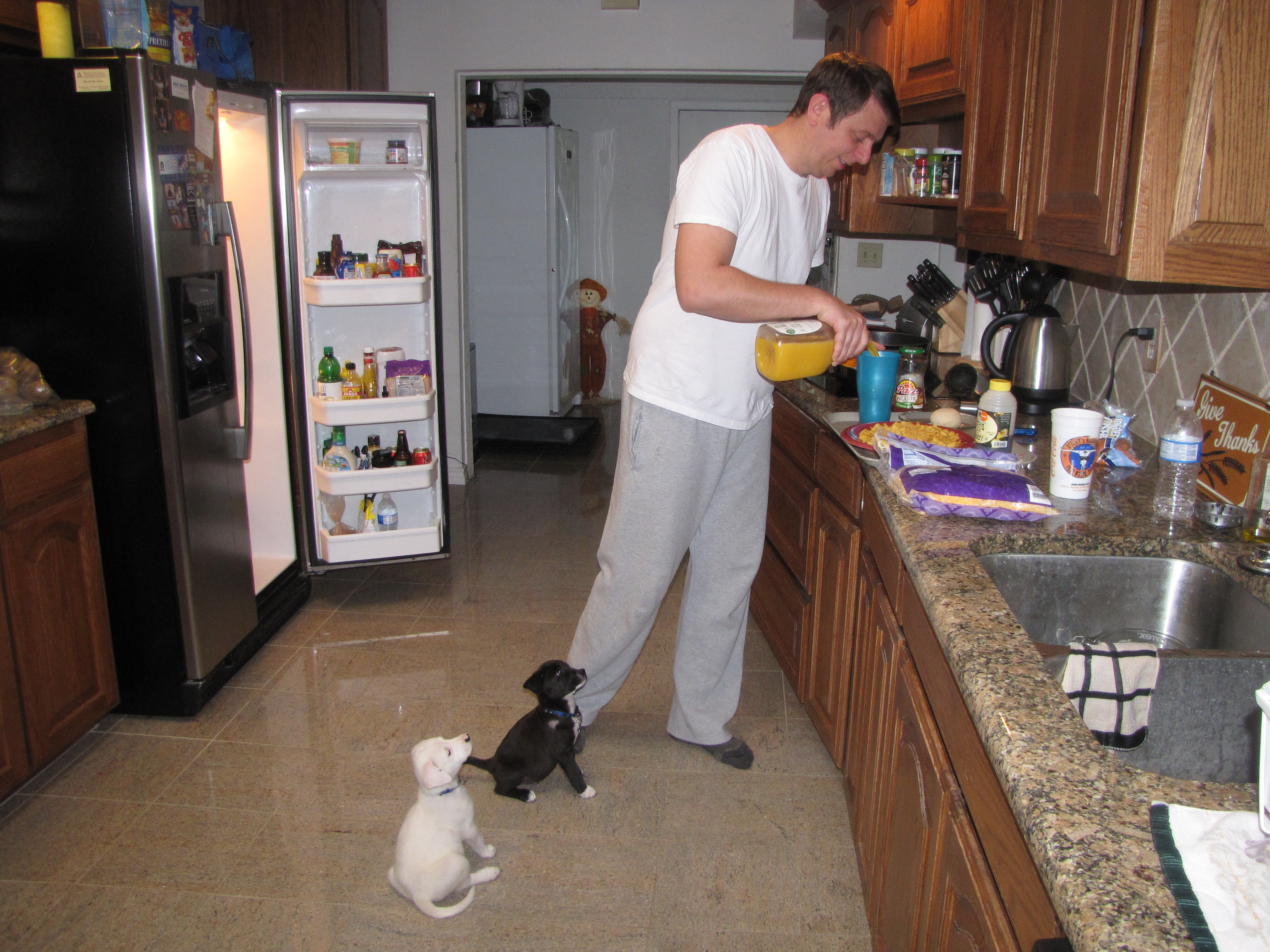
Bill and Ted are interested in whatever we are doing, especially if it involves food!
Since getting up, I have fed the puppies; spent much needed time with the Lord; knocked on the doors of two neighbors trying to get to the bottom of two large (and scary-looking) dogs that wandered into my backyard this morning (protecting both my puppies and the neighborhood); baked a loaf of banana bread for my college-age niece who stays over on Tuesday nights; and I have put ingredients in the bread maker for French bread for my husband, who told me he wanted a spaghetti dinner tonight.
Although they like to fight, Bill and Ted still aren’t too “grown up” to show one another affection. I love it when they sleep like this!
I have never really defined myself as a homemaker—I haven’t wanted to be the one who stays home and sees to it that everyone else is fed and clothed and clean and sane for their careers, because I wanted to have my own career. I still want to. I want to be a writer and a teacher, just like I’m doing (with more or less success, depending on the day). But the Lord is teaching me it’s okay if some of my days are spent doing homemaking things instead of career-building things. In fact, I know that the homemaking is probably ultimately more important. How quickly I forget that if there’s not happiness in the home, life is dismal. My home was unhappy, my life dismal, for too many years growing up, and because of my beautiful marriage today, I sometimes take for granted that a happy home is well worth the investment.
But each day I’m learning to take a little more joy in the simple things: puppies, babies, sunshine, lollipops, and rainbows…you get the picture! I continue to thank the Lord that he is straightening out my priorities, and my roles. Now, if I can just figure out how to balance them all!
So far Bill seems to be Buc’s dog and Ted, my dog. Bill is more laid back, while Ted has a hard time sitting still (and a temper that flares up sometimes at Bill)…hmmm, yes, the analogy works!
It’s finally starting to hit me: my baby is going to be here in just a few months. And I’m starting to feel a little panicky.
I thought I was doing well, keeping emotions in check. At least, it didn’t feel like I was any more emotional than usual. I’ve always been one to cry easily at a movie scene, or even a melody. So when I find tears welling up these days, I don’t necessarily blame pregnancy.
The exhaustion, though. That has to be pregnancy’s fault, right? Or maybe just an incidental collision of events piling up all at once?
Two Thursdays ago, life went haywire. It started with my doctor’s appointment, where I learned I was having a baby boy! It progressed to the ICU, where my father-in-law was having high-risk emergency surgery. Then it opened onto the waiting room, where I was furiously typing up last changes to my first memoir draft because, wouldn’t you know it, that day was also my deadline with my editor. Later that day found me trekking up to the airport to pick up my mom, who was spending the weekend with us.
During that visit, I was still trying to piece together my syllabus and assignments for the new class I was hired to teach just one week prior. And to top it off, that same weekend I hosted a women’s prayer retreat at my house to launch the last three-month Straight 2 the Heart prayer group before baby comes.
Mix in some family problems that arose after the weekend, which took my focus completely away from the class I had to teach and the writing I should have been doing, and you have the makings of a very edgy pregnant lady.
This week some friends kindly dropped off some baby things, and now I find the guest bedroom (where my college-age niece stays on Tuesday nights) being dismantled by my hubby, who suddenly got the crawl to work on the nursery. His “crawls” come in spurts, though, so he typically tears up something only to leave it in disarray for days, weeks, or months.
Today I came home from my writers’ group to find him laid up with a headache, the baby room/guest room in no better shape than before I left, and all of a sudden, I’m on the brink of tears because I don’t know where to sit down and just do some of the personal writing I haven’t had energy to do for several weeks. Suddenly there is no room in my house that can accommodate me because every room has a problem we’ve put off fixing for all the years we’ve lived here. The baby room has just put me over the top.
Suddenly I’m feeling like I’ll never have a room to myself again. I just want one room, darn it, that I can control. But the mess created by living human beings constantly intrudes on my desired place of sanctuary. My office, for instance, doubles as the dining room, and any time we have company, I have to interrupt my creative process to clear space.
Woe is me, right? What a problem. It’s hardly a problem. We have a very large house, and with some reorganization, we can figure this out. (As you know from previous posts like this one, and this one, I just happen to detest things like cleaning and organization.) What is the real problem, then?
Maybe I feel life surging too suddenly out of control, and I fear that, after baby, there will be no going back. He will be a wonderful, blessed addition to our lives. Just…how will I handle it all?
Like I’ve handled everything else, I will handle it with my Father’s help. I will handle it by letting Him handle it. I’m sure everything will be fine.
After such a crazy couple of weeks, maybe I just needed to get a little emotional. I needed to remember I don’t always have to hold it together as if these emotions are not ransacking my body and mind. I needed to pray, and write, and even cry a little.
Tonight I came to the library to find a clear desk space on which to clear my head, and now I feel better already.
I’ve said my dream was to be a writer. I developed this dream in childhood—I don’t know exactly when, but it was early. I read profusely from age eight on, and I’m guessing my writing dreams developed as my reading list grew.
At that age it was enough to have a foggy notion, a sort of affinity, a general inclination or tendency to writing. Writing was fun! I did it without overly thinking about it. I jotted silly stories and poems, and when I started playing the piano at age eight, also penning song lyrics. Back then I never thought about the practicalities of getting published, the imminent necessity of earning a living, the eventuality of needing a schedule to keep oneself on track to produce enough, often enough, to survive. No, back then my dream was a hobby, a thing I did at whimsy with no outside provocation. I did it because I enjoyed it. It brought me joy. It was fun.
How wonderful to be a child, to be innocent of worldly and societal expectations, or implications of adulthood. How I wish, as I write this, that I could go back.
Is that impossible?
It seemed impossible when life threw me its first really traumatic curveball at fourteen, when tragedy struck so quickly it seemed childhood was snatched away overnight. Then it was, I have to think, that Satan really went in for the kill on my identity. And with it, my dreams.
Suddenly I was no longer a capable, positive, promising child. I was an incapacitated, negative, doomed child. My world as far as I could see had collapsed around me. I couldn’t see beyond the walls of my home, now torn apart by dissension and hatred and despair.
Though a family breakup may not be our fault, it has everything to do with us. It has everything to do with how we see and understand our place in the world, everything to do with how we define ourselves. I’m not saying this is how it should be, or even that it’s logical, just that this is how it is.
This family event affected everything about me. It redefined me in negative, defeated ways. I became, in my eyes, a pitiable child, one who couldn’t speak up or have needs, either at home or at school.
Instead of being an empowered writer, I became a closet writer. That dream of writing got shoved in a closet, shoved under cover—literally, under the covers of journals—as I took to writing about my family plight and my own plight for no one’s eyes but my own. I guarded my writing, and with it, my pain, like I guarded the family secret. This was not healthy. And yet, by God’s grace, he even used that period of writing to myself for good. Even though the subject matter was bad, it kept me growing at least as far as a writer. The writing kept my joints oiled, kept me in practice. The practice was being perverted, but it was leading to something only God could see.
Photo Credit: “Happy Life” by Lusi
Today I feel I have regained the joy of writing–maybe I’m even embarking on my second childhood! Gone are the dark days and the need to hide who I am, because God has restored to me my value and my worth. I rejoice because my identity is not defined by what was done TO me, but by what God has done FOR me. He saved me. He restored me. And He has returned me to the joy of my youth. Thanks for sharing my journey!

























 Lindsey Gendke